Saudi Arabia.
المملكة العربية السعودية
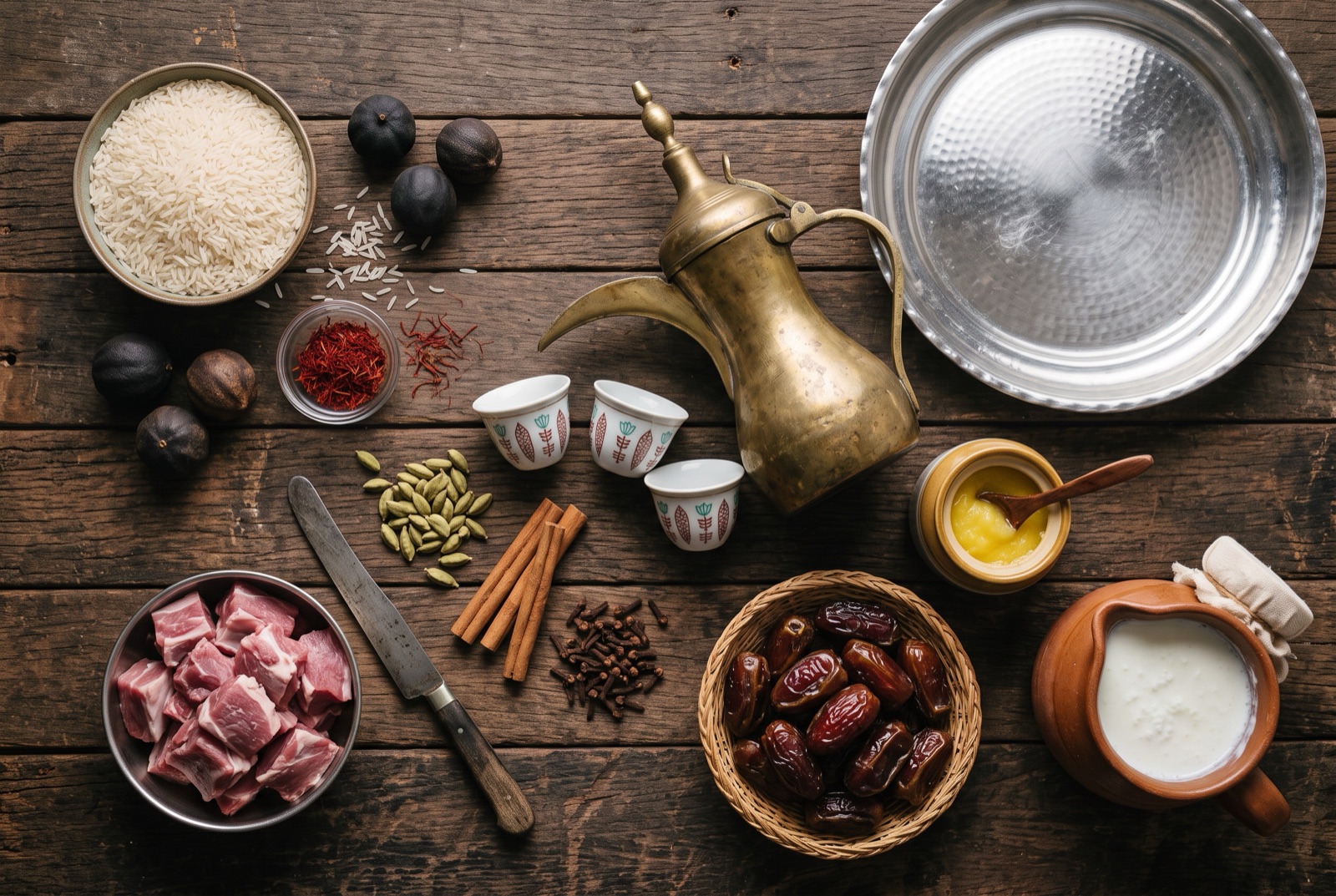
Saudi cooking is built on a single strong idea: one pot, one grain, one animal, shared from a communal platter. The centrepiece is almost always rice or wheat cooked in the broth of the meat it will be served with, so the starch carries the flavour rather than sitting beside it — that is the logic behind kabsa, mandi, saleeg and jareesh alike. The spicing is aromatic rather than hot: cardamom, cinnamon, cloves, black pepper and above all loomi, the sun-dried lime that gives Gulf food its distinctive musty citrus edge. Chilli heat, when it appears at all, arrives on the side as daqoos, a thin tomato sauce spooned over rice by whoever wants it. Around that spine sit the things that never leave a Saudi table: dates, unsweetened cardamom coffee, laban to drink, and bread torn straight from the oven. It is a cuisine shaped by desert scarcity and pilgrimage traffic in equal measure, generous in portion and restrained in seasoning.

- Continent
- AsiaMiddle East
- Recipes in atlas
- 10
- Must-try dishes
- 3
- Pantry staples
- 9
Start with the classics.
Must tryThe dishes that explain the Saudi Arabia kitchen fastest — if you cook only a few things from this page, cook these.
Inside the Saudi Arabia kitchen.
The defining technique is broth-cooked grain. A cook simmers lamb or chicken with onion, whole spices and pierced dried limes until the meat is tender and the water has become something worth cooking in, then lifts the meat out, measures the broth, and cooks long-grain rice directly in it. The meat goes back on top of the finished rice — browned under a grill, or in the case of mandi, hung above it in a sealed oven so its fat drips down through the grains. Nothing is wasted and nothing is seasoned twice. Get the broth right and the rice needs almost nothing else; get it wrong and no amount of spice at the end will rescue the plate.
The spice cabinet is narrow and used with confidence. Green cardamom is the signature aroma of the region, in coffee as much as in rice. Cinnamon sticks, cloves, bay and black lime handle the savoury pots; a ground blend variously called kabsa spice or baharat — cumin, coriander, black pepper, cinnamon, clove, nutmeg and dried lime powder — does the heavy lifting. Saffron and rose water tilt dishes sweet or ceremonial. Loomi deserves special mention: limes boiled in brine and dried in the sun until they are hollow and black inside, pierced and dropped whole into the pot, where they release a sour, slightly fermented perfume that fresh citrus cannot copy.
Dairy is drunk more than it is cooked. Laban — thin, salted, cultured buttermilk — is the standard mealtime drink and also the souring agent that turns cracked wheat into jareesh. Ghee is the finishing fat, poured hot over a bowl of porridge or a mound of milk rice. Fresh yoghurt, cucumber and mint appear as the cooling salad beside anything rich. Meat is overwhelmingly lamb and chicken, with camel eaten in the interior and on special occasions, and shellfish and reef fish along both coasts.
Bread has its own economy. Tamees, the wide soft disc slapped onto a tandoor wall, is baked around the clock by Afghan-run bakeries in every Saudi city and sold hot for breakfast with cream cheese and honey. Khubz arabi, the pocket flatbread, gets torn into scoops. Older desert breads survive in the countryside: qursan, dried wheat discs softened in broth, and marqooq, rolled paper-thin over a domed metal plate.
Regional difference is real and people are proud of it. The Hejaz on the Red Sea coast absorbed centuries of pilgrimage traffic and eats accordingly — Indonesian, Indian, Turkish, Egyptian and Yemeni influence is visible in mutabbaq, saleeg and the sweet-savoury breakfast bowls of Jeddah. The Najd plateau in the interior is the Bedouin heartland and its food is grain-heavy and plain in the best sense: jareesh, qursan, margoog. The Eastern Province looks across the Gulf toward Iran and India, with more fish, more rice, and machboos-style spicing. The southern Asir highlands, wetter and cooler, grow coffee and eat more sorghum, honey and chilli than anywhere else in the kingdom.
Signature pantry.
9 staplesThe ingredients this cuisine cannot function without.
- loomi (dried black lime)
- green cardamom
- long-grain basmati rice
- lamb
- dates
- ghee
- laban (cultured buttermilk)
- saffron
- cinnamon and cloves
How people eat in Saudi Arabia.
The default setting is a large shared platter placed on a cloth on the floor, with everyone seated around it eating from the section directly in front of them, right hand only. The host piles meat toward the guests rather than taking it, and refusing a second helping usually needs to be done three times before it is believed. Gahwa — pale, unsweetened cardamom coffee — brackets the meal: it is poured in small cupfuls from a long-spouted dallah, always with dates alongside, and you signal you have had enough by shaking the empty cup from side to side. Meals are quick and conversation moves to the coffee afterwards. Alcohol is absent, so laban, fresh juice and mint lemonade fill the glass.
Regional kitchens.
Saudi Arabia cooks 4 distinctly different ways depending on where you stand — here is what changes between them.
- R1Hejaz (Jeddah, Mecca, Medina)
- The Red Sea coast, shaped by centuries of pilgrims settling after Hajj. Its kitchen is the most cosmopolitan in the kingdom — saleeg, mutabbaq, masoub and a strong Yemeni and South Asian accent.
- R2Najd (Riyadh and the central plateau)
- Bedouin heartland and the source of the plainest, oldest dishes: jareesh, margoog and qursan, built on cracked wheat, laban and lamb rather than imported spice.
- R3Eastern Province (Al-Ahsa, Dammam, the Gulf coast)
- Date palm oases and a Gulf coastline, so more fish and shrimp, heavier dried-lime spicing, and dishes that overlap with Bahraini and Kuwaiti machboos.
- R4Asir and the South
- Cool highlands near the Yemeni border where coffee, sorghum and wild honey are grown. The food is greener and noticeably spicier, with chilli used as an ingredient rather than a condiment.
All Saudi Arabia recipes.
10 recipes and counting
Saudi Arabia2 hr 10 min
Jareesh
Crushed Wheat and Lamb Porridge
Saudi Arabia1 hr 50 min
Kabsa
Saudi Spiced Rice with Chicken
Saudi Arabia4 hr 5 min
Mandi
Pit-Smoked Lamb and Rice
Saudi Arabia1 hr 40 min
Saleeg
Hejazi Creamy Milk Rice with Chicken

Saudi Arabia25 min
Saudi Gahwa
Cardamom Coffee

Saudi Arabia2 hr 15 min
Saudi Luqaimat
Syrup-Soaked Dough Balls

Saudi Arabia15 min
Saudi Masoub
Banana and Bread Pudding
Saudi Arabia3 hr 10 min
Saudi Mutabbaq
Folded Meat-Stuffed Pancake

Saudi Arabia2 hr 25 min
Saudi Tamees
Tandoor Flatbread

Saudi Arabia1 hr 10 min
Shorbat Freekeh
Saudi Smoked Green Wheat Soup
Keep traveling.
Saudi Arabia sits in Middle East, and its kitchen shares borders as well as ingredients with Armenia and Bangladesh.
 Armenia
 Bangladesh