South Africa.
Suid-Afrika
South African food is not one cuisine with regional accents — it is several separate kitchens that have been cooking next to each other for three and a half centuries, sometimes borrowing, often kept apart by law. Xhosa, Zulu, Sotho and Tswana cooking built the base: maize and sorghum porridges, samp, beans, pumpkin leaves, soured milk, meat cooked simply and shared. Dutch settler farming added preserved meat, wheat baking and the cast-iron pot. Enslaved people brought to the Cape from the Indonesian archipelago, South Asia, Madagascar and East Africa created the sweet-sour, aromatic style now called Cape Malay. Indentured labourers shipped to Natal from 1860 made Durban a genuine Indian curry city with a masala of its own. Portuguese-Mozambican traders carried peri-peri chillies south. What holds it together is not a shared spice rack but a shared attitude: food is cooked in quantity, over fire when possible, and eaten in company. The result is a table where a curry, a maize porridge and a grilled sausage sit down together without anyone finding it strange.

- Continent
- AfricaSouthern Africa
- Recipes in atlas
- 10
- Must-try dishes
- 3
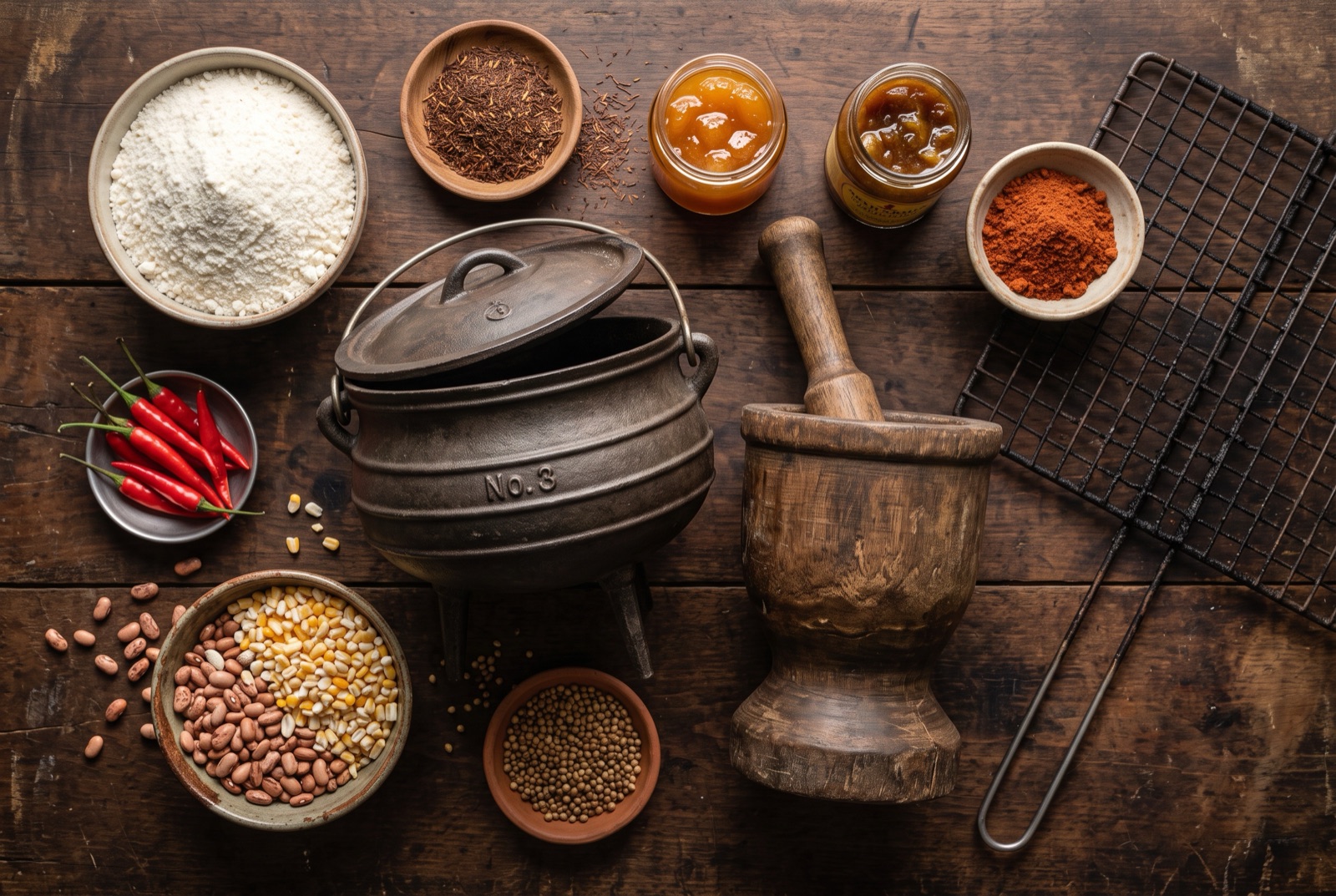
- Pantry staples
- 8
Start with the classics.
Must tryThe dishes that explain the South Africa kitchen fastest — if you cook only a few things from this page, cook these.
Inside the South Africa kitchen.
Maize is the floor the whole country stands on. It arrived from the Americas through Portuguese trade and displaced sorghum and millet over the nineteenth and twentieth centuries, and today white maize meal cooked with salted water is the daily starch for the majority of households — stiff as pap or phutu, crumbly as krummelpap, loose as a breakfast porridge, under a different name in nearly every language spoken here. Its dominance has a hard edge: decades of near-total reliance on refined maize produced serious nutrient deficiency, which is why the fortification of maize meal and bread flour is now a legal requirement rather than a marketing claim. Alongside it sits samp — dried maize kernels stamped and hulled until they crack — which cooks for hours with sugar beans into the Xhosa dish umngqusho.
Fire is the second constant. A braai is not a barbecue with a different accent; it is an event with its own etiquette, built on wood or charcoal rather than gas, where the fire is lit long before anyone is hungry and the cook stands over it holding a drink while the coals burn down. Boerewors goes on in a coil, lamb chops and marinated chicken follow, and in the townships shisanyama culture turned the same fire into commerce — you buy raw meat at the butchery counter, hand it over, and eat it at a table outside. The three-legged cast-iron potjie works the same coals for stews cooked over several hours and never stirred.
The Cape kitchen runs on sweet against sour. Dried apricots, raisins, apricot jam and fruit chutney are treated as savoury seasonings, balanced with vinegar or lemon and warmed with turmeric, cinnamon, cloves and mild curry powder. This is the cooking of the Cape Malay community, whose ancestors were enslaved or exiled to the Cape by the Dutch East India Company, and it produced bobotie, denningvleis, bredies and the syrup-soaked koesister. Wheat baking came from the same colonial households: vetkoek, roosterkoek grilled on the braai grid, and rusks dried overnight in a cooling oven.
Durban is a curry city on its own terms. Indentured labourers brought to the Natal sugar estates from 1860, and the traders who followed them, built a style that is hotter, redder and more chilli-forward than most Indian regional cooking, leaning on a coarse blended masala, curry leaves, whole cinnamon and star anise, and thickening with potato rather than cream. Bunny chow — curry served inside a hollowed loaf — came out of that city, and so did a large share of the country's everyday chilli tolerance.
Township cooking is where these lines blur most usefully. Chakalaka mixes grated vegetables, curry powder and tinned baked beans into a relish that belongs to no single tradition; kota, a quarter loaf packed with chips, polony and atchar, is Soweto's answer to the bunny; braai meat, pap and a sharp mango atchar make a plate that a Cape Town kitchen and a Durban one would both recognise in parts. Add peri-peri chicken from the Mozambican border and biltong dried in a cupboard, and the range of a single South African week becomes clear.
Signature pantry.
8 staplesThe ingredients this cuisine cannot function without.
- white maize meal
- samp and sugar beans
- apricot jam
- Durban masala
- coriander seed
- peri-peri chillies
- fruit chutney
- rooibos
How people eat in South Africa.
Meals are built for numbers. A braai runs for hours, everyone contributes meat or a salad, and the cook keeps control of the fire while conversation happens around it — Heritage Day on 24 September is widely spent this way. Pap is often eaten with the right hand, rolled into a small ball and pressed into gravy or relish, and no one hands anything over with the left. Sunday lunch is the big weekly meal in most communities, cooked in one large dish and eaten late. Chutney and atchar sit on the table as a right rather than a request. In Bo-Kaap, sweet things belong to Sunday morning, and plates of them are still walked between neighbours' houses.
Regional kitchens.
South Africa cooks 4 distinctly different ways depending on where you stand — here is what changes between them.
- R1Western Cape
- Cape Town and its wine valleys, where the Cape Malay kitchen turned dried fruit, vinegar and mild spice into bobotie, bredies and koesisters. Snoek off the boats, roosterkoek on the coals, and the country's oldest baking tradition.
- R2KwaZulu-Natal
- Durban's Indian kitchens produced a masala and a chilli level found nowhere else in the country, plus bunny chow. Inland, Zulu cooking centres on phutu, amasi (soured milk) and meat grilled over open fire.
- R3Gauteng and the townships
- Johannesburg and Soweto, where migrant labour mixed everything: chakalaka, kota loaves stuffed with chips and atchar, and shisanyama grills where you buy the meat raw and eat it at the fire.
- R4Eastern Cape and the Karoo
- Xhosa home cooking of umngqusho, umphokoqo and pumpkin, and beyond it the semi-desert Karoo, whose sheep graze on aromatic scrub and give the lamb South Africans argue is the best in the country.
All South Africa recipes.
10 recipes and counting
South Africa1 hr 35 min
Bobotie
Cape Malay Curried Mince Bake
South Africa10 hr 15 min
Boerewors
Coiled South African Farmer's Sausage
South Africa2 hr 35 min
Bunny Chow
Durban Curry in a Hollowed Loaf
South Africa40 min
Chakalaka
Spicy South African Vegetable Relish
South Africa9 hr 20 min
Koeksisters
Plaited Doughnuts in Ice-Cold Syrup
South Africa1 hr 15 min
Malva Pudding
South African Apricot Sponge in Cream Sauce
South Africa50 min
Pap
South African Stiff Maize Porridge
South Africa3 hr 45 min
Potjiekos
South African Three-Legged Pot Stew

South Africa11 hr
Umngqusho
Xhosa Samp and Beans
South Africa2 hr 25 min
Vetkoek
South African Fried Dough Buns
Keep traveling.
South Africa sits in Southern Africa, and its kitchen shares borders as well as ingredients with Algeria and Cameroon.
 Algeria
 Cameroon