Switzerland.
Schweiz / Suisse / Svizzera
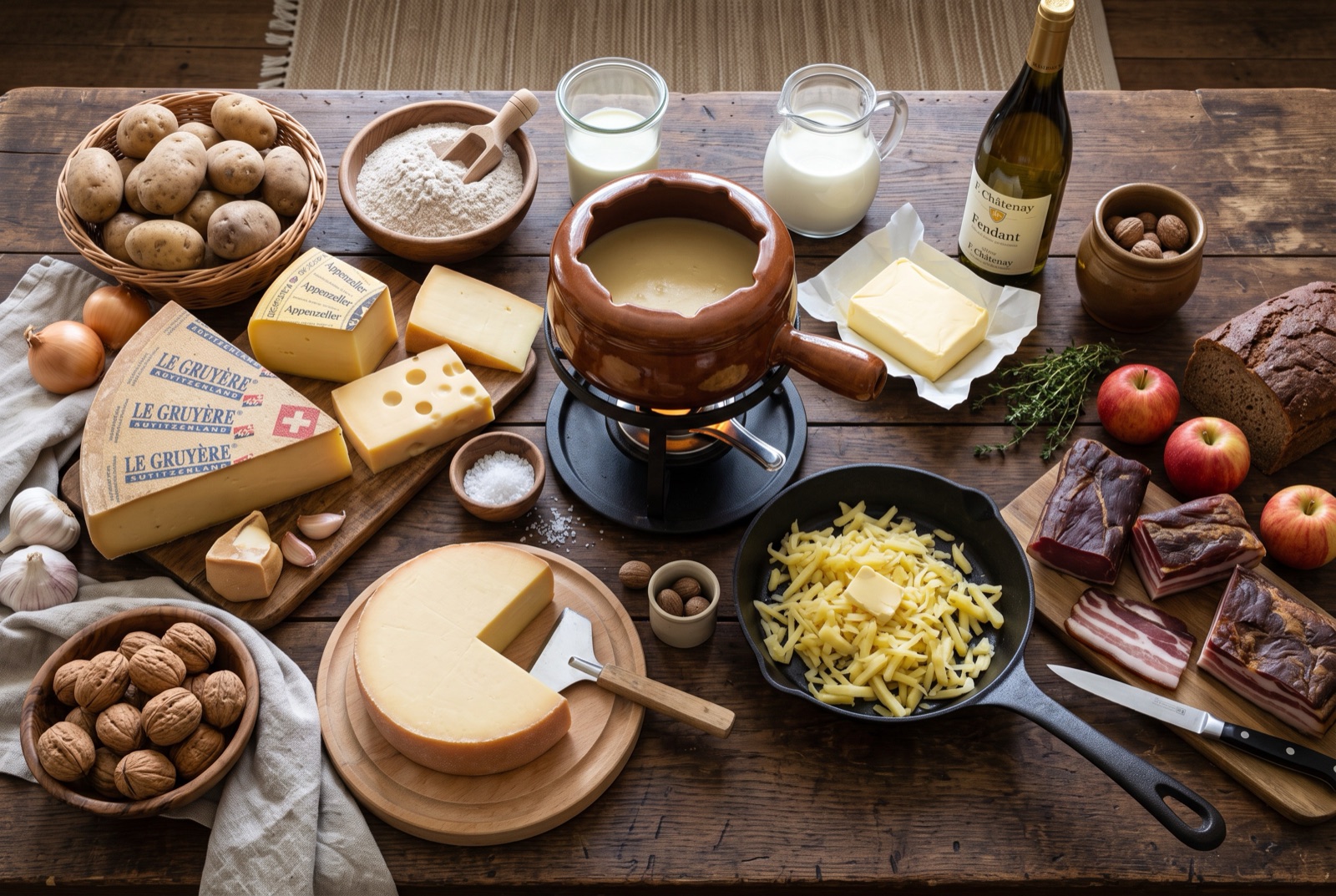
Switzerland does not have one kitchen, it has three borrowed ones and a mountain that reorganised them. German, French and Italian cooking all cross the border and then run into the same local constraints: a short growing season, steep pastures that produce far more milk than grain, and villages that spent centuries needing food to keep through winter. What comes out the other side is a cuisine built on dairy and starch — cheese aged in cellars for a year, butter used with a generosity that surprises visitors, potatoes fried until the crust crackles, bread enriched with milk. Seasoning is restrained on purpose. A Swiss cook trusts a good Gruyère, a properly browned onion and a splash of white wine to carry a dish, and treats heavy spicing as something that hides ingredients rather than improves them. Portions are hearty, plates are unfussy, and almost every regional classic began as farm or herdsmen's food.

- Continent
- EuropeCentral Europe
- Recipes in atlas
- 10
- Must-try dishes
- 3
- Pantry staples
- 10
Start with the classics.
Must tryThe dishes that explain the Switzerland kitchen fastest — if you cook only a few things from this page, cook these.
Inside the Switzerland kitchen.
Cheese is the organising principle. Alpine dairying — driving cattle up to high summer pastures and turning the milk into wheels large enough to survive the trip back down — produced Gruyère, Emmental, Appenzeller, Sbrinz, Vacherin Fribourgeois and the raclette cheeses of Valais, and those wheels shaped the cooking around them. Melted cheese dishes are not a novelty act for tourists; they are the logical use for a hard mountain cheese in a cold house. The technical detail that matters at home is that aged cheese melts badly on its own: fondue works because acid from white wine and a little starch keep the proteins from clumping, and raclette works because the cheese is a younger, higher-moisture type that melts smoothly at the cut face.
The second pillar is the potato, which arrived late and then took over. Rösti is the emblem — grated potato pressed into a pan and fried into a crust — but potato also thickens Papet vaudois into a purée, cooks in the same pot as macaroni in Älplermagronen, and carries melted cheese at every raclette table. The imaginary line separating German-speaking from French-speaking Switzerland is still called the Röstigraben, the "Rösti ditch", which tells you how seriously the country takes both potatoes and its own linguistic divide.
Meat is used sparingly and made to last. Bündnerfleisch is beef salted with mountain herbs and air-dried for months in the dry Grisons air; Valais has its own dried beef and rye bread to eat with it; smoked sausages such as the Vaud saucisse aux choux and the Bernese Zungenwurst were built to flavour a whole pot of vegetables rather than to be the main event. Fresh meat cookery is at its most refined in the cities, where Zürcher Geschnetzeltes — veal strips in a white wine and cream sauce — shows how much the German-speaking north absorbed from French technique.
Regional accents are real. Ticino, south of the Alps, cooks Italian: polenta stirred for an hour, braised beef, risotto with Merlot, chestnuts and cured meats served in a grotto. The Romandie leans French, with wine in the pot, leeks, and a serious pastry tradition. The German-speaking cantons run heavier on butter, onions, dumplings and pork. Graubünden, high and isolated, keeps the oldest habits: barley soup, dried meat, rye, and the walnut-and-caramel Nusstorte of the Engadine.
Baking sits apart from all of it. Zopf, the braided milk-and-butter loaf, appears on Sunday tables across the German-speaking cantons regardless of canton or dialect, and biscuits — Basler Läckerli, Zuger Kirschtorte, tirggel, Willisauer Ringli — are local identity in edible form. Chocolate is the export the world knows, but at home it is a bar in the cupboard rather than an ingredient in the kitchen.
Signature pantry.
10 staplesThe ingredients this cuisine cannot function without.
- Gruyère and other alpine cheeses
- butter
- potatoes
- cream
- dry white wine
- onions
- air-dried and smoked meats
- walnuts
- apples
- rye flour
How people eat in Switzerland.
Lunch is traditionally the substantial meal and is eaten early, with many restaurants pushing a fixed-price Tagesteller from about half past eleven. Dinner can be as light as bread, cheese and cold cuts. Communal pots matter: fondue and raclette are eaten slowly around one table over a whole evening, and there are house rules — you keep your fork moving in a figure of eight, you never double-dip your bread, and dropping it in the caquelon earns you a forfeit. Punctuality is not optional, guests wait for a shared toast before drinking, and glasses are raised with eye contact and the other person's name. Beer or white wine goes with melted cheese; ice water at the table is a modern habit rather than a Swiss one, and hot black tea is the traditional accompaniment.
Regional kitchens.
Switzerland cooks 4 distinctly different ways depending on where you stand — here is what changes between them.
- R1Deutschschweiz (German-speaking cantons)
- Bern, Zurich and Basel country: butter, onions, pork and potatoes, with Rösti as the regional flag. Zurich contributes the city's refined veal in cream sauce, Basel its browned flour soup and Bern the Sunday Zopf.
- R2Romandie (French-speaking west)
- Vaud, Fribourg, Neuchâtel, Geneva and Valais cook with a French accent — white wine in the pot, leeks, sausages simmered with vegetables — and hold the two great melted-cheese traditions, fondue moitié-moitié and Valais raclette.
- R3Ticino and the Italian south
- Below the Alps the food turns Italian: slow-stirred polenta, risotto, chestnuts, cured meats and braises served in a grotto with a carafe of Merlot. Butter gives way to olive oil and the pace of a meal lengthens.
- R4Graubünden and the Engadine
- Switzerland's highest, most isolated canton, and the only one where Romansh is still spoken. Its kitchen preserves the oldest alpine habits — barley soup, air-dried Bündnerfleisch, rye bread and the caramel-walnut Nusstorte.
All Switzerland recipes.
10 recipes and counting
Switzerland45 min
Älplermagronen
Swiss Alpine Macaroni with Potato
Switzerland55 min
Basler Mehlsuppe
Basel Browned Flour Soup
Switzerland720 hr 40 min
Bündnerfleisch
Swiss Air-Dried Alpine Beef
Switzerland26 hr 30 min
Engadiner Nusstorte
Engadine Caramel Walnut Tart
Switzerland35 min
Fondue Moitié-Moitié
Swiss Melted Cheese Pot
Switzerland1 hr 15 min
Papet Vaudois
Swiss Leek and Potato Stew with Sausage
Switzerland40 min
Raclette
Swiss Scraped Melted Cheese with Potatoes
Switzerland12 hr 50 min
Rösti
Crisp Swiss Grated Potato Cake
Switzerland3 hr 40 min
Zopf
Swiss Sunday Butter Braid
Switzerland40 min
Zürcher Geschnetzeltes
Zurich Veal in Cream Sauce
Keep traveling.
Switzerland sits in Central Europe, and its kitchen shares borders as well as ingredients with Albania and Austria.
 Albania
 Austria