Trinidad and Tobago.
Trinidad and Tobago
Trini food is Caribbean cooking with a South Asian spine. West African, Amerindian, Spanish, French, Portuguese, Chinese and Levantine cooks all left something on these two islands, but the arrival of Indian indentured labourers from 1845 onward changed the plate permanently: curry powder, geera, dhal, tawa-cooked roti and mango kuchela became ordinary Trinidadian food rather than immigrant food, and a roti shop today is as unremarkable as a bakery. Two flavour bases do most of the daily work. Green seasoning — chadon beni, thyme, scallion, garlic and pimento peppers blitzed into a rough green paste — goes onto nearly every piece of meat hours before it meets a pot. Browning, sugar melted in hot oil until it is almost black and just short of bitter, gives stews and pelau their mahogany colour. Heat comes from Scotch bonnet and the fruity, mild pimento pepper, but chile is usually served alongside as pepper sauce so each person sets their own level. Sweet, sour and hot are expected to share a plate: tamarind, mango chutney and pepper all land on the same doubles.

- Continent
- North AmericaCaribbean
- Recipes in atlas
- 10
- Must-try dishes
- 3
- Pantry staples
- 10
Start with the classics.
Must tryThe dishes that explain the Trinidad and Tobago kitchen fastest — if you cook only a few things from this page, cook these.
Inside the Trinidad and Tobago kitchen.
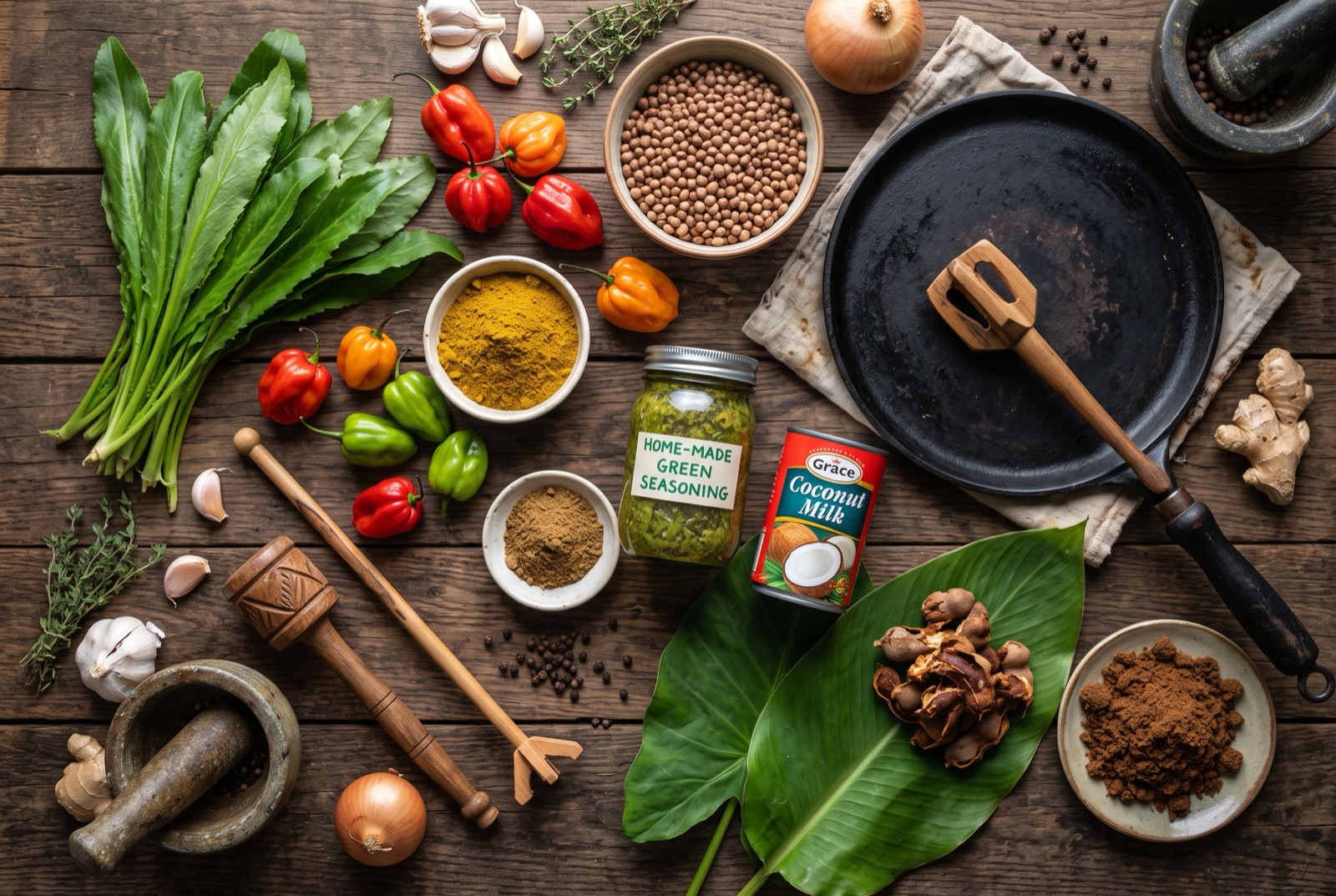
Start with green seasoning, because almost everything savoury does. Chadon beni (culantro, the long serrated leaf that tastes like cilantro turned up loud) is blended with thyme, scallion, garlic, celery leaf, onion and mild pimento peppers into a coarse green paste that lives in a jar in the fridge. Chicken, fish, goat and beef are rubbed with it and left overnight — Trinis call this "seasoning up," and skipping it is the single clearest marker of food cooked by someone who did not grow up eating this. The second base is browning: brown or white sugar melted alone in hot oil until it foams, darkens past amber and begins to smoke faintly. Meat dropped into that stage of caramel comes out deep mahogany with a bittersweet edge that no amount of soy sauce or gravy browning imitates.
The Indo-Trinidadian kitchen supplies the curry half of the national repertoire. Trinidadian curry powder is its own blend — heavy on turmeric and coriander, generous with roasted ground cumin, which locals call geera — and it is almost never sprinkled dry. It is slaked with water into a slurry, poured into hot oil with garlic and fried until the water cooks off and the paste darkens and smells toasted rather than dusty, a step called chunkaying. Only then do the chickpeas, potato, duck, goat or crab go in. Roti shops sell the results wrapped in dhalpuri, a flatbread layered with seasoned ground split peas, or scooped with buss up shut, paratha beaten on the tawa until it shreds. Amchar masala, a sour, fenugreek-forward finishing blend, goes in at the end.
The Creole side of the kitchen runs on coconut milk, salt meat, ground provisions and the pot. Callaloo — dasheen leaves and okra swizzled smooth with coconut milk and crab or salted pigtail — anchors Sunday lunch beside stew chicken, macaroni pie and a plate of provisions: dasheen, cassava, yam, sweet potato and green fig boiled and eaten as starch. Oil down, cook-up rice, fish broth and pelau all belong to this half, where one pot does everything and the seasoning goes in raw at the start rather than as a finishing flourish.
Street and roadside food is a genuine national institution, not a tourist add-on. Doubles are breakfast, sold from carts before seven in the morning. Bake and shark belongs to Maracas Bay, corn soup and pholourie to the roadside at night, aloo pie and saheena to the roti shop counter, souse and black pudding to Saturday. Everything is finished at a condiment bar the customer controls: chadon beni sauce, tamarind, mango chutney, kuchela, pepper.
Tobago cooks differently enough to notice. The smaller island is more African-Creole and less Indian, its signature dish is curry crab and dumpling eaten with the hands, and coconut, breadfruit and reef fish dominate where Trinidad reaches for curry and roti. Both islands share the festival calendar, which drives some of the best cooking of the year: pastelles, black cake, ponche de crème and sorrel at Christmas; sweets and vegetarian food for Divali; sawine for Eid; and corn soup at four in the morning during Carnival.
Signature pantry.
10 staplesThe ingredients this cuisine cannot function without.
- chadon beni (culantro)
- Scotch bonnet and pimento peppers
- Trinidadian curry powder
- geera (roasted ground cumin)
- coconut milk
- pigeon peas
- dasheen leaves
- tamarind
- brown sugar for browning
- green seasoning
How people eat in Trinidad and Tobago.
Breakfast is often bought, not cooked: doubles or a sada roti from a cart, eaten standing, wrapped in waxed paper. Sunday lunch is the fixed point of the week — stew chicken or curry, callaloo, macaroni pie, rice, provisions and a slice of something sweet, all on one plate at once rather than in courses, and cooked in quantities that assume relatives will appear. Pepper is never cooked into a dish so hard that a child cannot eat it; the bottle of pepper sauce on the table does that job. Hands are normal utensils for roti, bake and crab. Anyone who arrives at the house is offered food immediately, and refusing twice is the polite limit.
Regional kitchens.
Trinidad and Tobago cooks 4 distinctly different ways depending on where you stand — here is what changes between them.
- R1Port of Spain and the East-West Corridor
- The urban north, where the street-food economy lives: doubles carts before dawn, corn soup and pholourie at night, and the Creole Sunday table of stew chicken, callaloo and macaroni pie.
- R2Central Trinidad and the Caroni Plain
- Former sugar-cane country and the heart of Indo-Trinidadian cooking. Roti shops, dhalpuri, curry duck by the river, and the geera-heavy curries that define the island's vegetarian food.
- R3The North Coast and Maracas Bay
- A single mountain road leads to the beach that made bake and shark famous, with a row of huts and a condiment bar of chadon beni sauce, tamarind, pineapple and pepper.
- R4Tobago
- More African-Creole and less curry-driven than its larger neighbour. Curry crab and dumpling is the signature, alongside reef fish, breadfruit, coconut and slow-cooked one-pot food.
All Trinidad and Tobago recipes.
10 recipes and counting
Trinidad and Tobago2 hr 45 min
Bake and Shark
Trinidadian Fried Shark in Fried Bread

Trinidad and Tobago2 hr 5 min
Buss Up Shut
Trinidadian Shredded Paratha Roti
Trinidad and Tobago1 hr 5 min
Curry Channa and Aloo
Trinidadian Chickpea and Potato Curry
Trinidad and Tobago1 hr 30 min
Curry Crab and Dumpling
Tobago Coconut Crab Curry

Trinidad and Tobago3 hr 10 min
Doubles
Trinidadian Curried Chickpeas in Fried Flatbread
Trinidad and Tobago1 hr 30 min
Pelau
Trinidadian Caramelised Chicken and Rice
Trinidad and Tobago27 hr 30 min
Trinidadian Black Cake
Rum-Soaked Christmas Fruit Cake
Trinidad and Tobago1 hr 15 min
Trinidadian Callaloo
Dasheen Leaf and Okra Soup
Trinidad and Tobago1 hr 20 min
Trinidadian Macaroni Pie
Sliceable Baked Cheddar Macaroni
Trinidad and Tobago1 hr 35 min
Trinidadian Stew Chicken
Browning Sugar Braised Chicken
Keep traveling.
Trinidad and Tobago sits in Caribbean, and its kitchen shares borders as well as ingredients with Canada and Costa Rica.
 Canada
 Costa Rica