Ukraine.
Україна
Ukrainian cooking is what happens when some of the most fertile soil on the planet meets a climate with a real winter. The black-earth belt grows wheat, rye, buckwheat, beetroot, cabbage, potatoes and sunflowers in quantities that made the country a grain exporter for centuries, and the kitchen was built to turn that harvest into food that keeps: soured cabbage, salted pork fat, pickled tomatoes, dried mushrooms, fruit dried for winter compote. The flavour signature is sour and rich at the same time — fermented or vinegared brightness cutting through pork fat, sour cream stirred into almost everything, raw garlic and fresh dill added at the last second so they still smell green. It is not a spice-driven cuisine; there is little heat and few blends. What it has instead is depth built from long simmering, generous fat, and the sharp counterweight of something soured. Orthodox fasting calendars did the rest, giving nearly every rich dish a genuinely old meatless twin.

- Continent
- EuropeEastern Europe
- Recipes in atlas
- 10
- Must-try dishes
- 3
- Pantry staples
- 10
Start with the classics.
Must tryThe dishes that explain the Ukraine kitchen fastest — if you cook only a few things from this page, cook these.
Inside the Ukraine kitchen.
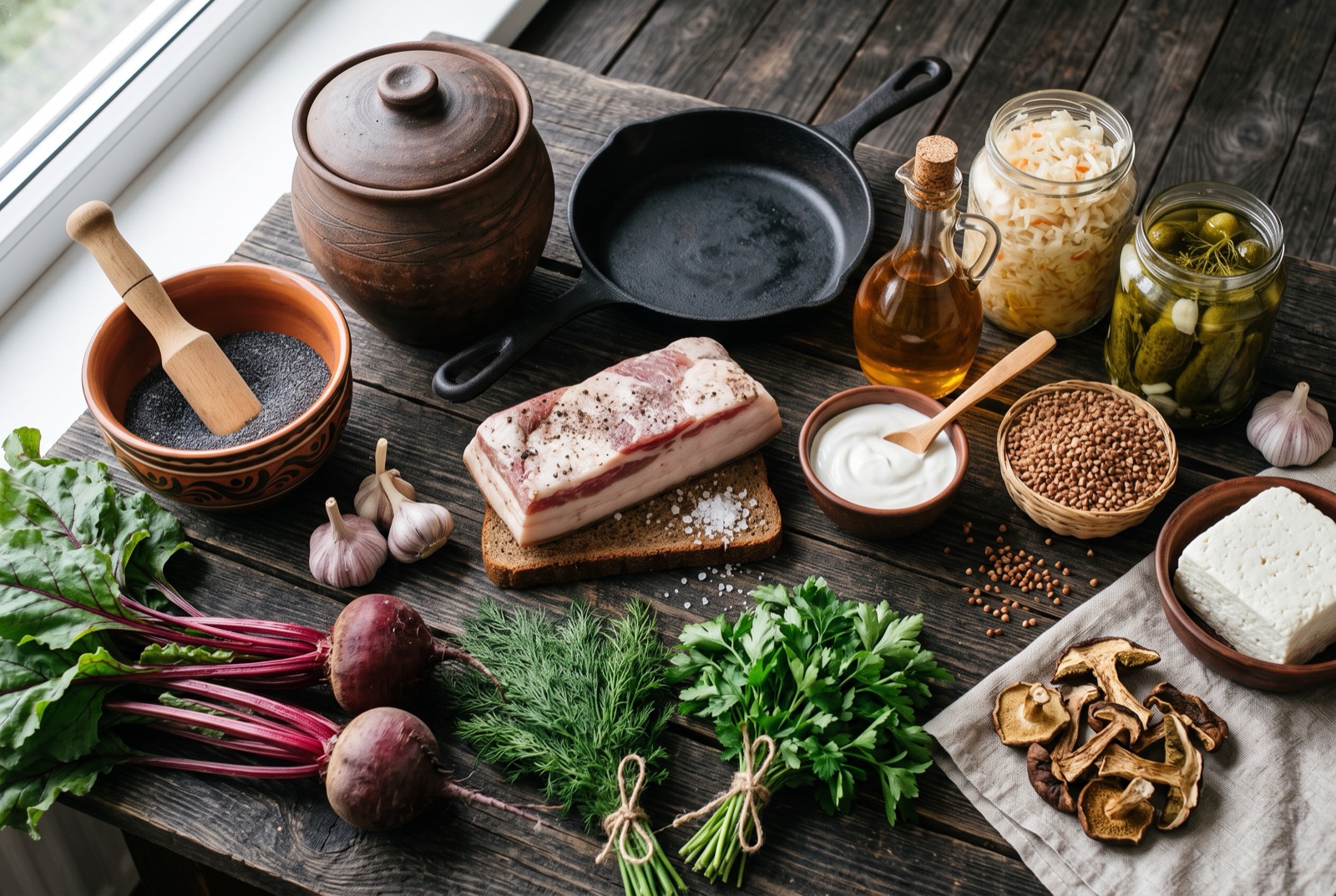
Start with the fat, because it explains the rest. Salo — salt-cured pork back fat — is the historical cooking medium, the winter calorie bank and a national in-joke all at once, rendered into cracklings (shkvarky) that finish potatoes, dumplings and porridge, or pounded in a mortar with garlic and stirred into a pot of borscht at the end as an enrichment called zaprazhka. Alongside it stands sunflower oil, unrefined and dark gold, with a toasted seed aroma that is unmistakable in a salad of tomatoes and onion. Ukraine grows more sunflowers than anywhere else on earth, and cold-pressed sunflower oil is used here the way olive oil is used around the Mediterranean.
The second pillar is sourness. Sauerkraut, brine-pickled cucumbers and tomatoes, sour apples, kvas made from rye bread, and above all smetana — thick cultured sour cream — appear at almost every meal. Sour cream is not a garnish in Ukraine; it is an ingredient. It goes into dumpling dough, into cake batter, into the cornmeal porridge of the Carpathians, and it lands on the table in a bowl with a spoon so that everyone adjusts their own plate. In borscht, acidity is also technical: without an acid the beetroot turns brown and the soup loses its ruby colour, so cooks add vinegar, beet kvas, tomato or sour apple deliberately.
The technique that shapes so many dishes is the zasmazhka (also called zazharka): onion, carrot and often beetroot or tomato paste cooked slowly in fat until sweet and jammy, then stirred into a soup or stew near the end rather than at the beginning. It is a flavour bomb added late, and it is why a Ukrainian soup can taste long-cooked without having simmered all day. The other constant is the dough tradition — varenyky, halushky dumplings, pyrizhky buns, pampushky rolls, and the enormous seasonal breads that mark weddings and holidays. Wheat here is cultural, not just agricultural.
Regional differences are real. The Carpathian west cooks with corn, sheep cheese and forest mushrooms, and shares a border-blurred repertoire with Hungary, Slovakia, Romania and Poland. The centre and Poltava region are dumpling and salo country. Odesa and the Black Sea south are the loudest, most mixed kitchen in the country, with Greek, Jewish, Bulgarian and Moldovan layers and a taste for small fried fish. Crimean Tatar cooking brings lamb, layered pastries and chebureky to the same national table.
Finally, the fasting calendar. Orthodox and Greek Catholic practice historically excluded meat, dairy and eggs for long stretches of the year, so Ukrainian cooks developed serious "postni" versions of their own classics: borscht built on mushroom or bean stock, varenyky filled with cabbage or cherries, holubtsi rolled around buckwheat. These are not modern vegan adaptations — they are the older, poorer, equally traditional half of the cuisine, and several of them are better than the rich versions.
Signature pantry.
10 staplesThe ingredients this cuisine cannot function without.
- beetroot
- salo (cured pork fat)
- smetana (sour cream)
- unrefined sunflower oil
- garlic
- dill
- buckwheat
- sauerkraut and brined pickles
- dry curd cheese (syr)
- forest mushrooms
How people eat in Ukraine.
A Ukrainian table fills up before anyone sits down. Zakusky — pickles, salo on rye, herring, sliced tomatoes with onion and sunflower oil — cover the surface, and the hot dish arrives into whatever space is left. Soup is a full meal rather than a first course, eaten with bread and a bowl of sour cream on the side. Bread is treated with genuine respect: it is not thrown away, and the ceremonial loaf with salt is still how guests are welcomed at weddings. Hospitality is insistent, and refusing a second helping is usually taken as an opening offer rather than a final answer. Toasts are made with intent, not decoration, and no one drinks a shot of horilka without something to eat immediately after it.
Regional kitchens.
Ukraine cooks 4 distinctly different ways depending on where you stand — here is what changes between them.
- R1The Carpathians and Hutsul highlands
- Sheep country in the far west, where corn replaces wheat and brynza replaces butter. Banosh, mushrooms fried in cream, smoked cheese and mountain bread belong here, shaped by centuries of contact with Hungary, Slovakia and Romania.
- R2Central Ukraine and Poltava
- The heartland of dumplings, salo and borscht — deep black soil, orchards, and the region most often cited when Ukrainians argue about the correct way to make varenyky and halushky.
- R3Odesa and the Black Sea south
- A port kitchen assembled from Greek, Jewish, Bulgarian, Moldovan and Turkish neighbours. Small fried fish, aubergine, tomatoes and forshmak, cooked with more oil, more garlic and more argument than anywhere else.
- R4Crimea and the Tatar table
- Lamb, layered pastry and yoghurt-adjacent sauces from the Crimean Tatar tradition — chebureky, yantyk and plov — a distinct cuisine with its own history that sits inside the Ukrainian food map.
All Ukraine recipes.
10 recipes and counting
Ukraine40 min
Banosh
Hutsul Cornmeal Porridge with Brynza
Ukraine45 min
Deruny
Ukrainian Lacy Grated Potato Fritters
Ukraine2 hr 35 min
Holubtsi
Ukrainian Cabbage Rolls in Tomato and Sour Cream
Ukraine2 hr 30 min
Kotleta po-Kyivsky
Chicken Kyiv with Herb Garlic Butter
Ukraine27 hr 10 min
Kyivskyi Tort
Kyiv Hazelnut Meringue Cake
Ukraine2 hr 35 min
Pampushky
Ukrainian Pull-Apart Garlic Rolls
Ukraine96 hr 25 min
Salo
Ukrainian Cured Pork Fat with Garlic
Ukraine1 hr 5 min
Syrnyky
Ukrainian Curd Cheese Breakfast Patties
Ukraine3 hr 5 min
Ukrainian Borshch
Beetroot, Cabbage and Bean Soup
Ukraine2 hr 5 min
Varenyky
Ukrainian Potato and Curd Cheese Dumplings
Keep traveling.
Ukraine sits in Eastern Europe, and its kitchen shares borders as well as ingredients with Albania and Austria.
 Albania
 Austria