United States.
United States of America
American cooking is regional before it is national. There is no single mother sauce and no governing tradition — what exists instead is a set of strong local kitchens that grew where immigrant technique met local ingredients and stayed put. Louisiana built a French roux on West African okra and Spanish rice. The Carolina Lowcountry turned field corn and creek shrimp into breakfast. New England learned chowder from ships and coastal clam beds. The South made buttermilk, pork fat and cornmeal into an entire grammar of bread and gravy. Philadelphia and Buffalo invented sandwiches and bar snacks that outgrew their cities within a generation. The through-lines are corn, pork, dairy and a habit of generosity with portion and richness — and, more than most cuisines admit, a deep debt to Black, Indigenous and immigrant cooks whose names rarely made it onto the menus. Learn the regions and the country stops looking like a blank.

- Continent
- North AmericaNorth America
- Recipes in atlas
- 10
- Must-try dishes
- 3
- Pantry staples
- 9
Start with the classics.
Must tryThe dishes that explain the United States kitchen fastest — if you cook only a few things from this page, cook these.
Inside the United States kitchen.
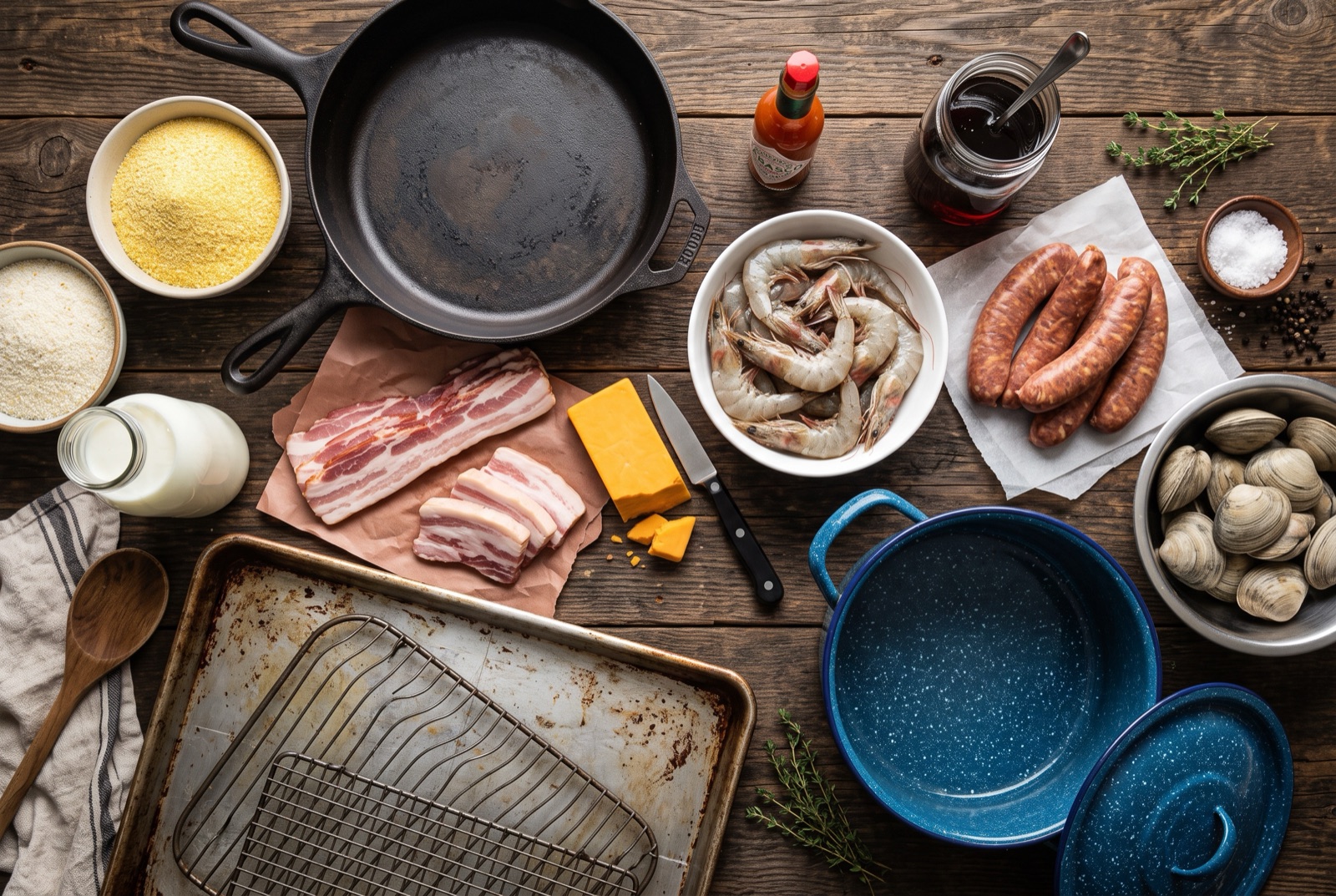
Corn is the foundation the whole country stands on. Indigenous farmers domesticated it and taught colonists to grow it, and it survives today in three main forms: whole kernels, cornmeal ground fine or coarse for cornbread and hushpuppies, and hominy — corn treated with alkali — which is dried and cracked into grits. Southern cornbread is unsweetened, poured into a screaming-hot skillet of fat, and treated as a savory bread; Northern cornbread is sweeter, cakier, and a genuinely different food. Grits are the Lowcountry breakfast starch, and the difference between instant grits and slow-cooked stone-ground grits is the difference between wallpaper paste and a bowl of creamy corn porridge worth waking up for.
Pork fat is the second foundation. Bacon, salt pork and country ham are seasoning as much as protein: chowder starts by rendering diced salt pork, greens simmer on a ham hock, cornbread bakes in bacon drippings, and breakfast sausage becomes the base of white gravy. Beside it sits dairy — buttermilk for biscuits and cornbread, heavy cream for chowder, and cheddar melted into everything from macaroni to burgers. Butter is a finishing fat in a way that would look profligate in most of Europe.
Louisiana runs on its own system entirely. Roux — flour cooked in fat until it darkens from blond to peanut butter to milk chocolate — is the base for gumbo and etouffee, and the darker it goes the nuttier and less thickening it becomes. Onto it goes the holy trinity of onion, celery and green bell pepper, the local answer to mirepoix. Creole cooking (city, French-Spanish, tomato-friendly) and Cajun cooking (country Acadian, darker roux, no tomato) are related but distinct, and Louisianans will correct you on the difference.
Regional seafood defines the coasts. New England reads clams, lobster and cod; the Chesapeake reads blue crab and Old Bay; the Gulf reads shrimp, oysters and crawfish; the Pacific Northwest reads salmon and Dungeness crab. Inland, barbecue splits along equally hard lines — Texas beef brisket with salt and pepper, Carolina whole hog with vinegar, Memphis ribs, Kansas City sweet sauce — each with partisans who consider the others a misunderstanding.
The meal structure is loose. Breakfast is the most distinctly American meal — eggs, sausage, biscuits, pancakes, and a whole savory-and-sweet plate at once. Dinner tends toward a protein with two sides rather than courses, and the potluck, the cookout and the holiday table are where the real regional cooking still lives. Restaurant food skews toward the sandwich, the burger and the diner plate; home food skews toward casseroles, skillets and slow-cooked pots that make a lot at once.
Signature pantry.
9 staplesThe ingredients this cuisine cannot function without.
- cornmeal and stone-ground grits
- buttermilk
- bacon and salt pork
- sharp cheddar
- gulf shrimp
- cayenne hot sauce
- maple syrup
- andouille sausage
- clams
How people eat in United States.
Portions are large and refills of coffee, water and soda are usually free and automatic. Everything arrives at once rather than in courses, and it is normal to take leftovers home in a box without embarrassment. Tipping is not optional: 18 to 20 percent on top of the bill is how restaurant staff are actually paid, and leaving less reads as a complaint. Hot sauce, ketchup and ranch dressing live on the table as personal adjustments rather than chef corrections. Big food is social food — the backyard cookout, the church potluck, the Super Bowl spread and the Thanksgiving table are where people cook hardest, and guests are expected to bring a dish. Eating with your hands is fine for a whole category of food: wings, ribs, corn, sandwiches and pizza.
Regional kitchens.
United States cooks 4 distinctly different ways depending on where you stand — here is what changes between them.
- R1Louisiana and the Gulf Coast
- Creole and Cajun country, where dark roux, the holy trinity and Gulf shellfish produce gumbo, jambalaya and etouffee. The most distinctive regional cuisine in the country, and the least like anywhere else.
- R2The South and Appalachia
- Cornmeal, buttermilk, pork fat and slow-cooked greens. Home of biscuits and gravy, skillet cornbread, barbecue and the soul-food canon carried north during the Great Migration.
- R3New England
- Cold-water seafood and thrifty colonial cooking: clam chowder, lobster rolls, baked beans and cod. Cream, potatoes and salt pork do the heavy lifting, and the chowder wars with Manhattan are eternal.
- R4The Northeast Cities
- Philadelphia, New York and Buffalo, where immigrant kitchens turned into street food with a fixed address — cheesesteaks, bagels, pizza by the slice and the bar-snack chicken wing that conquered the world.
All United States recipes.
10 recipes and counting
United States1 hr 20 min
Baked Macaroni and Cheese
Southern Cheddar Custard Bake
United States45 min
Biscuits and Gravy
Buttermilk Scones in Sausage Cream Gravy
United States40 min
Buffalo Wings
Cayenne and Butter Chicken Wings
United States1 hr 20 min
Jambalaya
Louisiana One-Pot Rice with Sausage and Shrimp
United States4 hr 50 min
Key Lime Pie
Florida Keys Lime Custard Tart
United States2 hr 30 min
Louisiana Gumbo
Creole Roux and Seafood Stew
United States55 min
New England Clam Chowder
Creamy Clam and Potato Soup
United States1 hr 20 min
Philly Cheesesteak
Griddled Beef and Melted Cheese Roll
United States1 hr
Shrimp and Grits
Lowcountry Shrimp over Corn Porridge
United States35 min
Skillet Cornbread
Unsweetened Southern Cast-Iron Bread
Keep traveling.
United States sits in North America, and its kitchen shares borders as well as ingredients with Canada and Costa Rica.
 Canada
 Costa Rica