Uzbekistan.
Oʻzbekiston
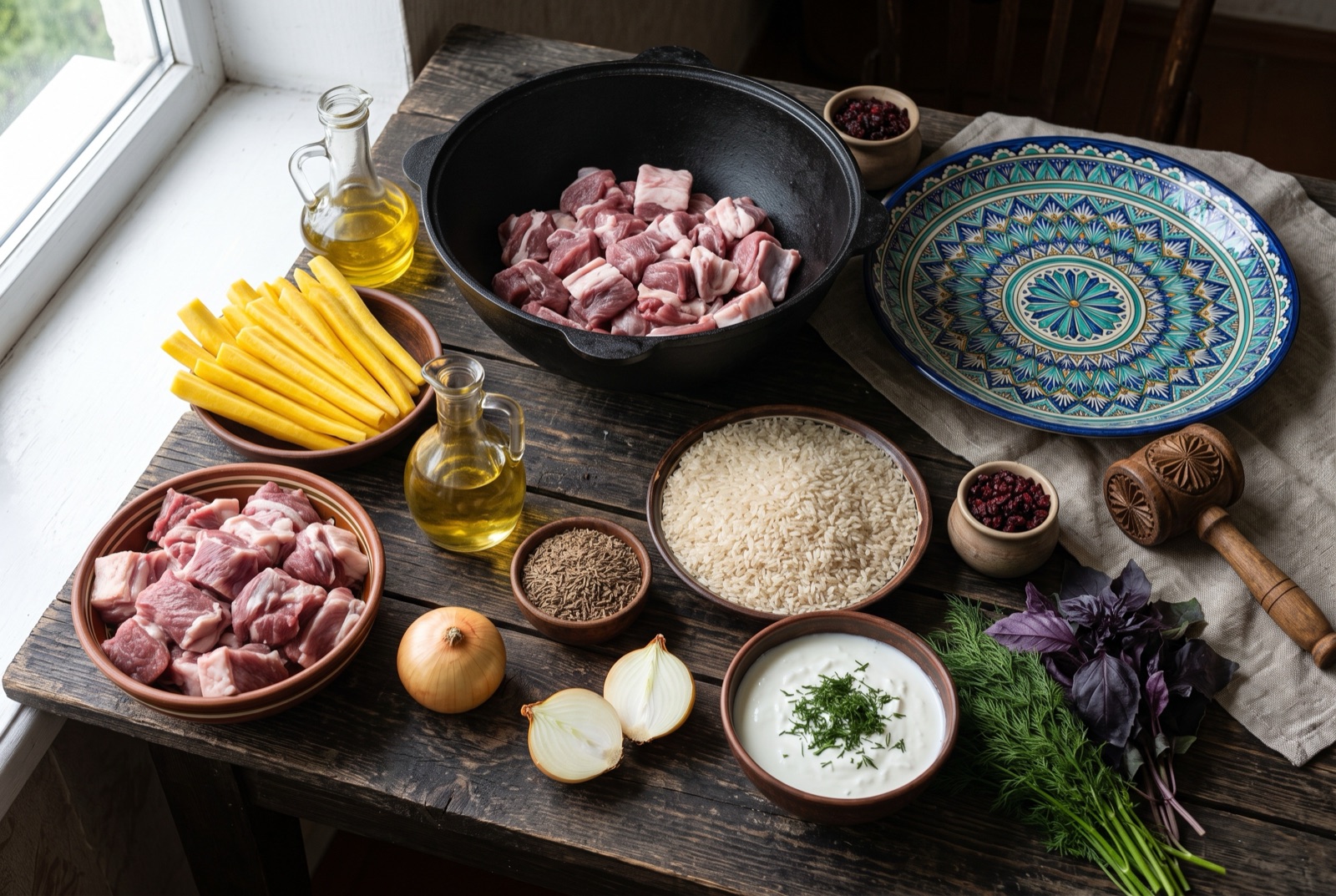
Uzbek cooking is what happens when a settled oasis kitchen and a nomadic steppe kitchen live in the same house for a thousand years. From the oases come wheat, rice, cotton-seed oil, apricots, melons and the tandir bread that anchors every table; from the steppe come sheep, sheep-tail fat, dried curd and the habit of cooking one large thing in one large pot over live fire. The result is food that tastes of lamb fat, cumin, sweet carrot and slowly browned onion rather than of chilli or heavy spicing — deep and savoury but rarely hot. Almost everything is built in a kazan, the thick cast-iron wok-shaped cauldron that sits over a fire hole, and almost everything is meant to feed more people than are currently in the room. Uzbeks cook in quantities, not portions, and hospitality is measured in how much is left on the table when guests stand up.

- Continent
- AsiaCentral Asia
- Recipes in atlas
- 10
- Must-try dishes
- 3
- Pantry staples
- 9
Start with the classics.
Must tryThe dishes that explain the Uzbekistan kitchen fastest — if you cook only a few things from this page, cook these.
Inside the Uzbekistan kitchen.
The kazan is the first thing to understand. It is a heavy, round-bottomed cauldron set into a brick or metal stand over wood or gas, and its shape does real work: fat pools at the bottom for frying, heat climbs the curved walls, and a domed lid traps steam so that a single vessel can sear, braise and steam in sequence without transferring anything. Plov, dimlama, lagman sauce and shurpa all start the same way — fat rendered hard and hot, meat browned in it, onion fried until it is genuinely brown rather than merely soft — and the decision that follows, whether to add water or to withhold it, is what separates one dish from another.
Fat is a flavour, not a cooking medium to be minimised. Traditional cooks render dumba, the fat from the tail of the local fat-tailed sheep, until the cubes shrink into crisp golden nuggets called jizza, and the perfumed fat left behind is the base for the day's cooking. Cottonseed oil, which Uzbekistan produces in enormous quantity, is the everyday alternative and carries a distinctive nutty smell that Uzbeks associate with proper plov. Home cooks abroad usually substitute sunflower oil and a little extra lamb fat; the dish still works, but this is the flavour that goes missing first.
The spice cabinet is small and used with intent. Zira — Central Asian cumin, smaller and more bitter than Indian jeera — is the signature, rubbed between the palms to wake it up before it hits the pot. Coriander seed, black pepper, dried barberries for sourness and sometimes a whisper of turmeric fill out the rest. Chilli exists mostly as a sharp side sauce or a single dried pod in the plov, never as a dominant note, and fresh herbs — dill, coriander, reyhan basil, scallion — arrive at the end, raw.
Bread and dairy are non-negotiable. Obi non, the round tandir loaf with a dense stamped centre and a puffed rim, appears at every meal and is treated with real reverence: torn by hand, never cut with a knife, never laid face-down. Alongside it sits suzma, thick strained yogurt used as a spread, a soup finisher and a dumpling sauce, plus qatiq for drinking and dried salty qurt balls for the road. Green tea, poured back into the pot three times before the first cup is offered, runs through the entire meal rather than following it.
Regional differences are real and locals will argue them at length. Fergana plov is dark, glossy and cooked in devzira rice; Bukhara and Samarkand keep their plov paler and layer it rather than mixing it at the table. Khorezm in the northwest leans on fish from the Amu Darya and on shivit oshi, noodles turned green with dill. Karakalpakstan, on the ruined shore of the Aral Sea, has a sparser, more nomadic table. And in the Fergana Valley the Dungan and Uyghur communities gave the country its hand-pulled lagman noodles — a dish Uzbeks now cook as their own without pretending it was theirs first.
Signature pantry.
9 staplesThe ingredients this cuisine cannot function without.
- lamb and fat-tailed sheep fat
- yellow carrots
- devzira rice
- zira (Central Asian cumin)
- onion
- cottonseed oil
- suzma (strained yogurt)
- dried barberries
- dill and reyhan basil
How people eat in Uzbekistan.
Meals happen around a low table or on a raised platform bed called a supa, with guests seated on cushions and the most honoured place furthest from the door. Bread is torn by hand at the start and stays on the cloth throughout — cutting it with a knife or leaving it upside down is a genuine offence. The host pours tea in small amounts so cups are refilled often, which is a sign of attention rather than stinginess; a cup filled to the brim politely signals it is time to leave. Plov arrives on one wide communal platter, eaten from the section in front of you and traditionally with the right hand. Salads, sauces and yogurt are shared, and nobody starts before the eldest person at the table does.
Regional kitchens.
Uzbekistan cooks 4 distinctly different ways depending on where you stand — here is what changes between them.
- R1Fergana Valley
- The country's densest, most fertile pocket and the birthplace of the dark, glossy plov most Uzbeks consider the benchmark. Its Dungan and Uyghur communities also gave Uzbekistan hand-pulled lagman.
- R2Samarkand and Bukhara
- Old Silk Road cities with a Tajik-Persian accent: paler layered plov served without mixing, famous stamped non, and a sweet-savoury streak of apricots, raisins and quince in savoury pots.
- R3Khorezm and Karakalpakstan
- The northwest, along the Amu Darya and the shrunken Aral Sea. River fish, dill-green shivit oshi noodles and a plainer, more nomadic table built on dried curd, mutton and flatbread.
- R4Tashkent
- The capital eats everything: chaikhana plov by the cauldron-load at lunch, Korean-Uzbek carrot salads from the deported Koryo-saram community, and Russian-era pastries alongside somsa stalls.
All Uzbekistan recipes.
10 recipes and counting
Uzbekistan25 min
Achichuk
Uzbek Tomato and Onion Salad
Uzbekistan1 hr 55 min
Chuchvara
Tiny Uzbek Dumplings in Broth
Uzbekistan2 hr 10 min
Dimlama
Uzbek Layered Meat and Vegetable Braise
Uzbekistan2 hr 20 min
Lagman
Uzbek Hand-Pulled Noodles with Meat Sauce
Uzbekistan2 hr 50 min
Obi Non
Uzbek Round Tandoor Bread
Uzbekistan2 hr 25 min
Osh Palov
Uzbek Lamb and Carrot Rice Pilaf
Uzbekistan2 hr 20 min
Somsa
Uzbek Tandoor-Baked Meat Pastry
Uzbekistan83 hr 30 min
Sumalak
Uzbek Sprouted Wheat Navruz Pudding
Uzbekistan2 hr 15 min
Uzbek Manti
Steamed Lamb and Pumpkin Dumplings
Uzbekistan2 hr 45 min
Uzbek Shurpa
Clear Lamb and Vegetable Soup
Keep traveling.
Uzbekistan sits in Central Asia, and its kitchen shares borders as well as ingredients with Armenia and Bangladesh.
 Armenia
 Bangladesh