Vietnam.
Việt Nam
Vietnamese cooking is built on balance rather than richness: nearly every dish negotiates salty fish sauce, sour lime, a little sugar, fresh chile and an enormous quantity of raw herbs. Rice anchors everything — as grain, as noodles in a dozen widths, as translucent paper for wrapping — and the food stays remarkably light, with clear broths and dipping sauces doing the work that fat does in other cuisines. A thousand years of Chinese rule left noodles, chopsticks and stir-frying; a century of French colonization left the baguette, pâté and coffee, all absorbed and made thoroughly Vietnamese. But the real signature is the table itself: platters of mint, cilantro and lettuce arrive alongside the meal so each diner wraps, dips and seasons every bite to taste. The kitchen deliberately sends food out unfinished, and the eater completes it.

- Continent
- AsiaSoutheast Asia
- Recipes in atlas
- 10
- Must-try dishes
- 3
- Pantry staples
- 8
Start with the classics.
Must tryThe dishes that explain the Vietnam kitchen fastest — if you cook only a few things from this page, cook these.
Inside the Vietnam kitchen.
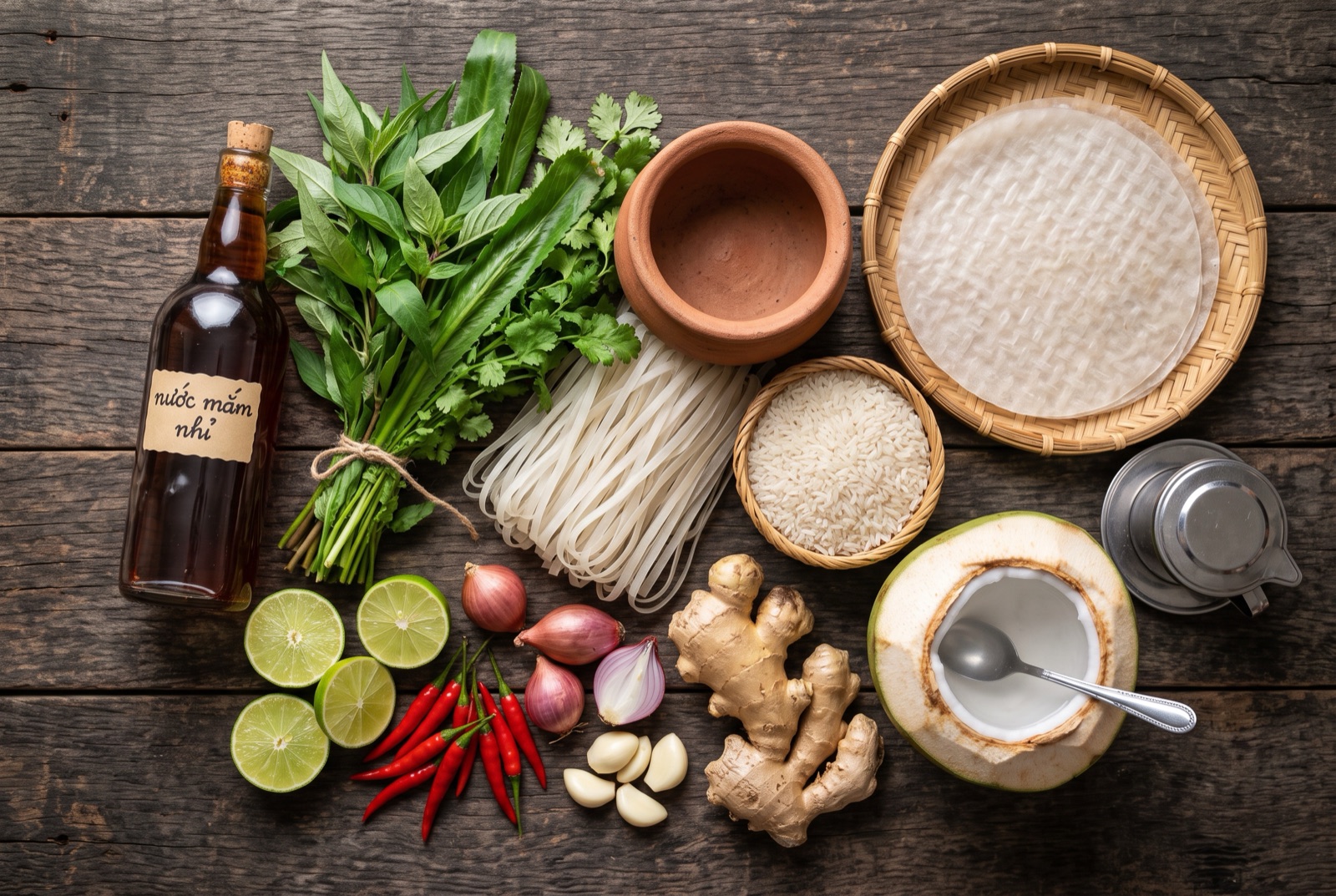
The foundation of the whole cuisine is nước mắm — fish sauce, fermented from anchovies and salt, some of the best of it aged in wooden barrels on the island of Phú Quốc. It seasons marinades and braises the way salt does elsewhere, and diluted with lime, sugar, water, garlic and chile it becomes nước chấm, the dipping sauce that sits on virtually every table. A Vietnamese cook is judged on the balance of that little bowl.
Rice is the second pillar, and it appears in more forms than almost anywhere else: steamed grain at every family meal, flat phở noodles, round bún vermicelli, translucent rice paper for summer rolls, fermented into vinegar, ground into the batter for sizzling bánh xèo crêpes. Wheat plays a supporting role inherited from France — the bánh mì baguette, crisp-shelled and light, may be the most successful colonial leftover in the world, split and stuffed with pâté, pickled carrot and cilantro.
Technique leans on water and fire rather than fat. Long-simmered broths, skimmed obsessively until clear, underpin the noodle soups. Charcoal grilling flavors bún chả and countless street skewers. And the most distinctive move in the repertoire is nước màu — plain sugar cooked to a bitter-edged dark caramel that gives braised dishes like thịt kho their mahogany color and depth. Fresh herbs are treated as vegetables, not garnish: mint, Thai basil, perilla, sawtooth coriander and fish herb are piled onto plates and eaten by the handful.
Geography splits the kitchen three ways, and the differences are real. The North, cradle of phở, cooks with restraint — subtle broths, black pepper over chile, little sugar. The Center, around the old imperial capital of Huế, is the spiciest region and favors refined, labor-intensive small dishes descended from royal court cooking. The South cooks sweeter and more abundantly, with coconut, tropical fruit and a wider herb basket from the Mekong Delta.
Meals are communal: a pot of rice, several shared dishes, a canh (light soup), and chopsticks reaching across the table. Street food is not a lesser category but the proving ground — the phở stall that does one dish for forty years is the national ideal of mastery.
Signature pantry.
8 staplesThe ingredients this cuisine cannot function without.
- fish sauce (nước mắm)
- rice and rice noodles
- fresh herbs (mint, Thai basil, cilantro)
- lime
- shallots and garlic
- ginger
- chiles
- coconut water
How people eat in Vietnam.
Everyday meals are shared: steamed rice for everyone, communal dishes in the middle, and a light soup drunk from the rice bowl rather than a separate course. Noodle soups like phở are traditionally breakfast food, eaten at street stalls on low stools, and slurping is normal — chopsticks in one hand, spoon in the other. Herbs, lime, chile and sauces arrive on the side because seasoning is the eater's job; taste the broth before you touch the condiments, then adjust. Handing or receiving anything at the table is politest with both hands, and the eldest person usually lifts their chopsticks first.
Regional kitchens.
Vietnam cooks 3 distinctly different ways depending on where you stand — here is what changes between them.
- R1The North (Hanoi & the Red River Delta)
- The historic heartland and the birthplace of phở. Northern cooking is the most restrained in the country — clear, subtle broths, black pepper favored over chile, minimal sugar — with Hanoi classics like bún chả and chả cá built on precision rather than abundance.
- R2The Center (Huế & the coast)
- Home of the former imperial court at Huế, whose kitchens bred a tradition of refined, intricate small dishes — and, in contrast, the boldest chile heat in Vietnam. Bún bò Huế, the region's lemongrass-beef noodle soup, is phở's fiery rival.
- R3The South (Saigon & the Mekong Delta)
- The tropical, abundant kitchen: noticeably sweeter seasoning, coconut water in braises like thịt kho, towering herb platters, and a port-city openness in Saigon that piles more garnishes onto everything — including its own generously accessorized style of phở.
All Vietnam recipes.
10 recipes and counting
Vietnam2 hr 10 min
Bánh Cuốn
Steamed Rice Rolls with Pork and Wood Ear
Vietnam1 hr 25 min
Bánh Mì
Vietnamese Baguette Sandwich with Pâté and Pickles
Vietnam1 hr 25 min
Bánh Xèo
Crispy Vietnamese Turmeric Rice Crepe
Vietnam1 hr 55 min
Bún Chả
Hanoi Grilled Pork with Rice Noodles
Vietnam10 min
Cà Phê Sữa Đá
Vietnamese Iced Coffee with Condensed Milk
Vietnam40 min
Canh Chua Cá
Mekong Sour Tamarind Fish Soup
Vietnam3 hr 20 min
Chè Ba Màu
Vietnamese Three-Color Bean Dessert
Vietnam2 hr 5 min
Chicken Pho
Hanoi-Style Phở Gà
Vietnam2 hr 5 min
Thịt Kho Trứng
Vietnamese Caramel Braised Pork with Eggs
Vietnam50 min
Vietnamese Summer Rolls with Peanut Sauce
Keep traveling.
Vietnam sits in Southeast Asia, and its kitchen shares borders as well as ingredients with Armenia and Bangladesh.
 Armenia
 Bangladesh