Kärntner Kasnudeln.
Carinthian Curd Cheese Dumplings
Kärntner Kasnudeln · say it: KERNT-ner KAHS-noo-deln
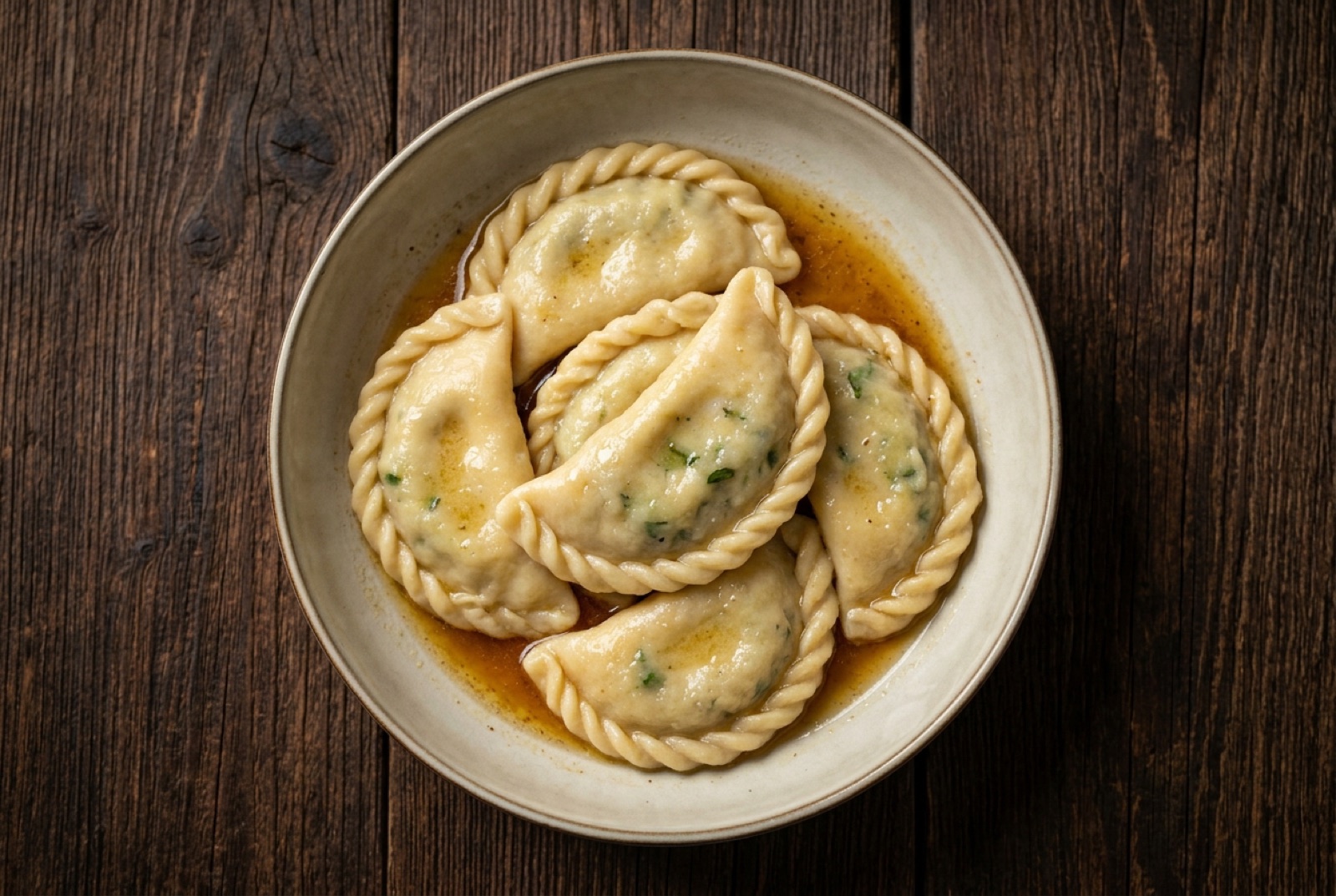
Kasnudeln are large half-moon dumplings from Carinthia, filled with a mixture of curd cheese and floury potato scented with mint and chervil, and finished with browned butter poured over the top. The dough is thin and slightly chewy, the filling is soft, tangy and faintly herbal, and the whole thing tastes gentler than it sounds — closer to a cheese-filled pasta than to a heavy Alpine dumpling. What makes a Kasnudel Carinthian rather than generic is the edge: instead of pressing the seam with a fork, cooks twist it into a raised rope called the Krendl, one small fold at a time. It takes practice, it is entirely decorative, and locals judge you on it.

- Gate
- AustriaCarinthia
- Prep
- 1 hr
- Cook
- 20 min
- Total time
- 1 hr 50 min incl. 30 min rest
- Serves
- 4
- Status
- Takes skill
- Nutrition / serving · estimated
- Calories 580 kcal
- Protein 22 g
- Carbs 62 g
- Fat 27 g
- Fiber 4 g
- Sodium 620 mg
Why this recipe works.
- Uses a warm-water egg dough that stays soft and elastic enough to stretch thin without tearing.
- Balances curd cheese with floury potato so the filling holds together instead of leaking into the water.
- Explains the Krendl seal step by step, with a fork fallback that will not embarrass your dumplings.
- Calibrated for ordinary garden mint, since Carinthian Nudelminze is not available outside the region.
Ingredients.
15 itemsFor the dough
For the filling
To serve
Equipment
- Rolling pin or pasta machine
- Potato ricer or masher
- Round cutter, about 10 cm
- Wide pot
- Slotted spoon
Instructions.
Make the dough
Mix 300 g of flour with the salt, then work in the egg, oil and warm water to a firm, smooth dough. Knead for 8 minutes until it springs back when pressed, wrap it and let it rest for 30 minutes at room temperature.
Cook and cool the potatoes
Boil the potatoes in their skins until a knife slides through, then peel while hot and push them through a ricer onto a plate. Spread them out and let them cool completely so the steam escapes.
Soften the onion
Cook the diced onion in the butter over low heat for 6–8 minutes until translucent and sweet but not coloured. Let it cool before it goes anywhere near the cheese.
Mix the filling
Combine the cooled potato, drained curd cheese, onion, mint, chervil and sour cream and season assertively with salt and pepper. Taste it now — it should be clearly herbal and just tangy, since the dough adds nothing.
Tip If the mixture feels wet or slumps on the spoon, add a spoonful more riced potato rather than flour.
Roll the dough thin
Divide the dough in four and roll each piece out to about 1.5 mm, thin enough to read large print through. Cut out 10 cm rounds and keep them covered with a cloth as you work.
Fill and seal
Place a walnut-sized ball of filling slightly off centre on each round, fold into a half-moon and press the edges firmly together with dry fingers, pushing out any trapped air.
Tip Do not flour the sealing edge — flour is exactly what stops dough sticking to dough.
Krendl the edge
Starting at one corner, fold a small piece of the sealed rim over onto itself, press it down with your thumb, move 5 mm along and repeat, working around the curve until a twisted rope runs the whole edge.
Tip A fork crimp works perfectly well if the rope defeats you — it holds just as securely.
Poach gently
Slide the dumplings into a wide pot of well-salted water held at a bare simmer and cook for 8–10 minutes, until they float and the dough at the seam looks translucent rather than chalky.
Brown the butter and serve
Melt the butter in a small pan and cook until it foams, quietens, and the milk solids turn nut brown and smell toasted. Lift the drained Kasnudeln onto warm plates, pour the butter over and scatter with chives.
Tips from our kitchen.
- Drain the curd cheese in a sieve for an hour if it looks at all wet. Excess whey is the main reason Kasnudeln burst in the pot.
- Rice or mash the potatoes while hot and let them cool completely before mixing with the cheese, or the residual heat makes the filling sticky and loose.
- Roll the dough thinner than feels sensible — about 1.5 mm. It puffs slightly in the water, and a thick Kasnudel is stodgy.
- Work with a quarter of the dough at a time and keep the rest under a cloth. Dried edges will not seal no matter how hard you press.
- Poach at a bare simmer, never a rolling boil. Vigorous water tears the seams open and empties the dumplings.
- Taste the raw filling before you fill anything. Mint strength varies enormously and the seasoning cannot be corrected afterwards.
Substitutions.
- Bröseltopfen (dry Carinthian curd cheese) → Quark, dry curd cheese, or full-fat ricotta drained overnight
- You want something crumbly and sour, not creamy. If using ricotta, add a squeeze of lemon to get closer to the Carinthian tang.
- Carinthian Nudelminze → Garden mint, used at about two thirds the quantity
- Common spearmint is more assertive. Chopping it fine and mixing it in warm melted butter first softens the edge a little.
- Chervil → A mix of parsley and a pinch of fennel fronds or tarragon
- Chervil is faintly aniseed and hard to find fresh. The substitution gets the aroma into the right neighbourhood without dominating.
Variations.
- Kletzennudeln
- The sweet Carinthian relative, filled with dried pears cooked down with spices — same dough, same Krendl edge, eaten as a main course.
- Fleischnudeln
- Filled with minced cooked meat and onion instead of cheese, common on Carinthian holidays when meat was worth cooking.
- Kasnudeln in brown butter and breadcrumbs
- Toasted breadcrumbs added to the browned butter for a crunchy finish — an everyday Austrian trick for filled pasta and dumplings alike.
Storage & reheating.
Uncooked Kasnudeln are best frozen rather than refrigerated: lay them on a floured tray, freeze until solid, then bag them for up to 2 months and poach straight from frozen with 3 minutes extra. Refrigerated raw dumplings go soggy where the filling touches the dough and will tear after a few hours. Cooked leftovers keep 2 days and are traditionally sliced and pan-fried in butter until the cut faces are crisp, which is arguably better than the original. Do not reheat them by boiling again — the seams give way.
Serve with
Browned butter, a green leaf salad with pumpkin seed oil, and a glass of Carinthian white wine or cold beer.
The story behind Kärntner Kasnudeln.
Carinthia sits in Austria's far south, sharing borders and kitchen habits with Slovenia and Friuli, and its cooking looks less like Vienna's than like a mountain version of northern Italy's. Filled pasta belongs to that shared world, and Kasnudeln are its Carinthian expression: a farmhouse dish built from what the alpine dairy produced — sour curd cheese — stretched with potato once potatoes had settled into the local diet, and perfumed with a herb the Viennese kitchen barely uses.
That herb is the point of contention and the point of pride. Carinthians call it Nudelminze or Kärntner Minze, a wild mint that grows in gardens and along field edges in the region and tastes softer and less menthol-forward than commercial spearmint. Every family claims a different balance of mint to chervil, and the argument about how much is correct is a genuine local sport. Outside Carinthia you will be using ordinary garden mint, which is stronger, so the sensible move is to start with less than you think and taste the raw filling.
The Krendl edge is the other identity marker. Rather than crimping with a fork or a press, the cook seals the dumpling by folding and twisting a thin rope of dough along the curved edge with thumb and forefinger, producing a ridge of small even loops. Carinthian village festivals hold Kasnudel-making contests judged partly on this, and it is common to hear that a woman who could not krendl properly was considered unready to run a household — a piece of folklore repeated affectionately rather than seriously. A fork-sealed Kasnudel tastes exactly the same and no one will refuse it, but it will be identified instantly as the work of an outsider.
They are served plainly: drained, brushed with a lot of browned butter, and eaten with a green salad. Sweet versions filled with pears, apples or curd and sugar exist in the same region and the same shape, which is a reminder that the border between savoury and sweet in Austrian cooking is unusually porous.
Questions, answered.
Why did my Kasnudeln burst in the water?
Either the filling was too wet or the water was boiling too hard. Drain the curd cheese thoroughly and make sure the potato is cooled and dry before mixing, then seal with clean, unfloured edges — flour on the seam stops the dough sticking to itself. Poach at a bare simmer where bubbles barely break the surface, and never stir the pot with anything but a slotted spoon.
What is the Krendl and do I have to do it?
The Krendl is the twisted rope edge that seals a Carinthian Kasnudel: you fold a small piece of the dough edge over, press, move along and repeat, producing a ridge of even loops. It is the regional signature and locals judge dumplings on it. It is purely decorative, though — a fork-crimped or firmly pinched edge holds just as well and the dumplings taste identical.
What cheese should I use if I cannot find Topfen?
Quark is the closest widely available match. Failing that, use dry curd cheese, farmer's cheese, or full-fat ricotta drained overnight in a sieve. The essential qualities are crumbly texture and a sour edge, so avoid cream cheese, which is too smooth and too rich, and add a little lemon juice to milder cheeses.
Can I make Kasnudeln ahead?
Yes, but freeze them rather than refrigerate. Arrange the raw dumplings on a floured tray so they do not touch, freeze until firm, then transfer to a bag for up to two months and cook them from frozen, adding about three minutes. Raw dumplings left in the fridge slowly absorb moisture from the filling and tear when you lift them.
Is the mint really traditional?
Yes — mint is the defining herb of savoury Kasnudeln, not an optional garnish. Carinthians use a local wild variety called Nudelminze that is milder than commercial spearmint, usually alongside chervil. Recipes without mint exist in neighbouring regions, but in Carinthia a cheese Kasnudel without it would be considered incomplete.
You might also like.
All recipes →

Keep exploring Austria.
Austria has 9 more dishes in the atlas — Backhendl and Erdäpfelsalat, and 7 more.
Recipe by The DishRoute Kitchen · published August 19, 2026 · updated August 19, 2026