Lao Larb.
Minced Meat Salad with Toasted Rice Powder
ລາບ · Laap · say it: lahp
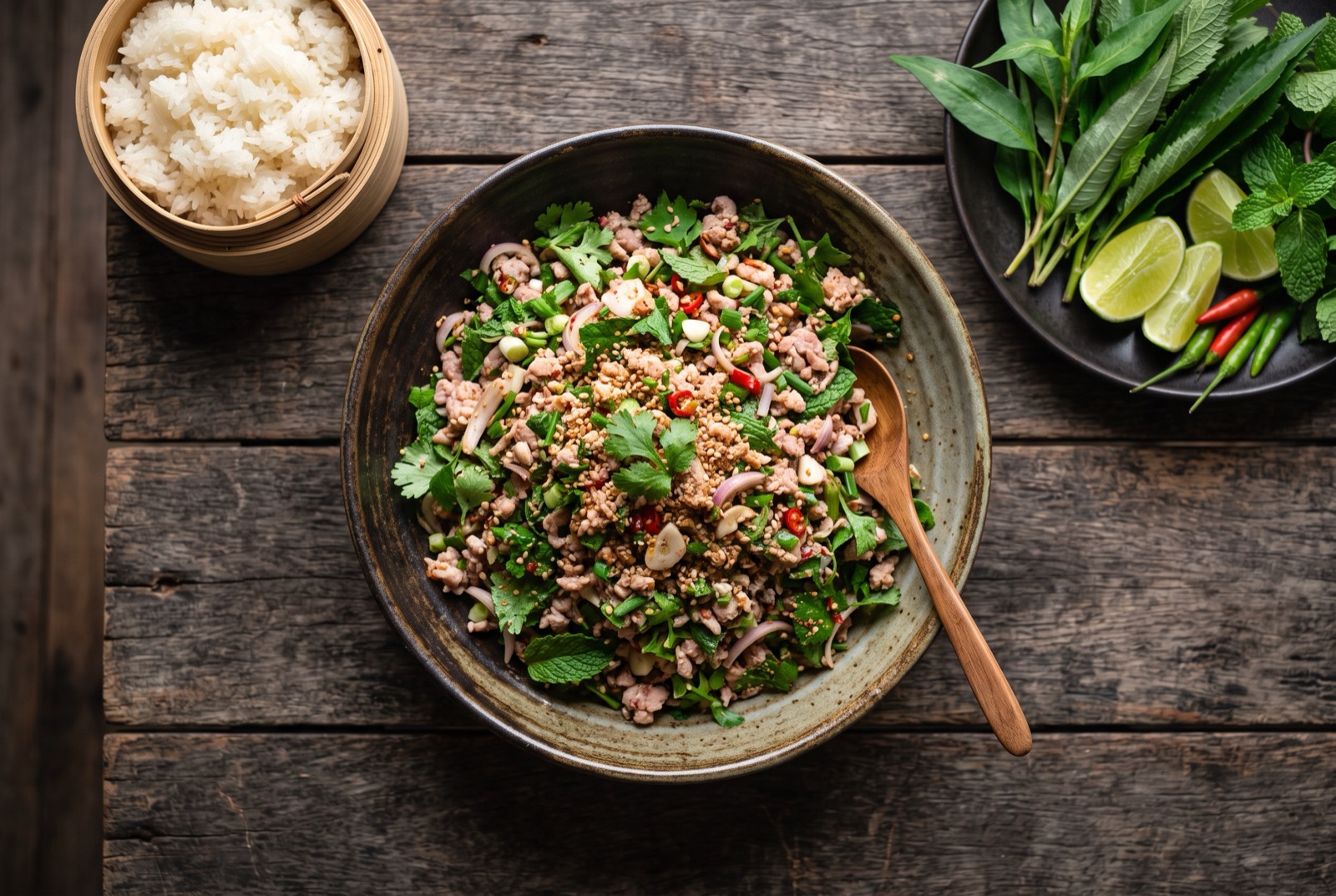
Larb is minced meat dressed like a salad. The pork is cooked in a splash of water rather than fried, so it stays loose and pale instead of browning, and everything else happens off the heat: lime juice, fish sauce, dried chile, sliced shallots, spring onion, and a big handful of mint and coriander tossed through at the last second. The one ingredient that makes it larb and not a generic mince is khao khua, sticky rice toasted in a dry pan until deep gold and ground to a coarse sand — it thickens the juices, stops the salad going watery, and adds a toasty, popcorn-like flavour that runs under the sourness. It is eaten warm or at room temperature, always with sticky rice and raw leaves.

- Gate
- LaosNationwide
- Prep
- 20 min
- Cook
- 12 min
- Total time
- 32 min
- Serves
- 4
- Status
- Easy
- Nutrition / serving · estimated
- Calories 340 kcal
- Protein 27 g
- Carbs 12 g
- Fat 20 g
- Fiber 2 g
- Sodium 1100 mg
Why this recipe works.
- Toasts and grinds the rice powder from scratch — the jarred kind is stale and tastes of nothing.
- Simmers the pork in a little water instead of frying it, which is what keeps the texture loose and Lao rather than browned and Western.
- Dresses off the heat so the mint stays green and the lime stays sharp.
- Honest about the Lao–Isan overlap instead of filing the dish under Thai food.
Ingredients.
13 itemsFor the rice powder
For the larb
To finish
Equipment
- Dry frying pan for toasting rice
- Mortar and pestle or spice grinder
- Wide mixing bowl
- Sharp cleaver if chopping the meat by hand
Instructions.
Toast and grind the rice
Put 3 tbsp of raw sticky rice in a dry pan over medium-low heat and stir constantly for 8–10 minutes, until the grains are the colour of strong tea and the kitchen smells like popcorn. Add the dried chiles for the final minute, then tip everything out to cool.
Tip The rice keeps darkening off the heat, so pull it a shade lighter than you want.
Grind to coarse sand
Pound the cooled rice and chiles in a mortar or pulse in a spice grinder until they resemble coarse sand with a few larger flecks. Set aside; it stays fresh in a jar for about two weeks.
Cook the pork gently
Bring the water to a simmer in a wide pan, add 500 g of pork and break it up hard with a spoon or spatula. Cook for 4–5 minutes, stirring, until no pink remains but the meat is still pale and loose — do not let it brown or the texture turns tough and crumbly.
Tip Breaking the meat up in the first thirty seconds is what prevents pellets later.
Reduce and cool
Raise the heat briefly and let the pan liquid boil down until only a couple of tablespoons of glossy juice remain around the meat. Take the pan off the heat and let it sit for 3–4 minutes, until it stops steaming heavily.
Dress off the heat
Tip the pork and its juices into a wide bowl. Add the fish sauce, padaek if using, lime juice, sliced shallots and two-thirds of the rice powder, and toss thoroughly so every strand is coated.
Taste before the herbs
Taste now and correct: it should read sour first, then salty, then chile. Add lime if it is flat, fish sauce if it is thin, more rice powder if any liquid is pooling at the bottom of the bowl.
Fold in herbs and serve
Add the spring onion, mint, coriander and culantro and toss just two or three times so the leaves stay whole and bright. Scatter the remaining rice powder over the top and serve warm with a basket of sticky rice and a platter of raw vegetables.
Tips from our kitchen.
- Toast the sticky rice over medium-low heat and keep it moving for a full 8–10 minutes: you want a deep tea-gold colour and a smell like popcorn, not pale grains.
- Grind the rice coarse, like wet sand. Powder-fine khao khua turns the salad pasty instead of giving it grip.
- Buy coarse-ground pork or, better, chop shoulder by hand — fine supermarket mince clumps into pellets when it cooks.
- Taste and correct before the herbs go in. Larb should hit sour first, salty second, chile third; if it tastes flat, it needs lime, not salt.
- If you can find padaek, add a spoonful with the fish sauce. It is what separates a Lao larb from a Thai one, and a little goes a long way.
- Serve it warm or cool, never straight from the pan — heat wilts the herbs and mutes the whole thing within minutes.
Substitutions.
- Padaek (fermented fish sauce) → An extra tablespoon of regular fish sauce plus a mashed anchovy fillet
- You lose the funk and the slight murk, but the salinity and depth land close enough. Lao and Vietnamese grocers stock padaek in jars.
- Ground pork → Ground chicken, duck, beef, or finely chopped mushrooms
- Chicken larb (larb gai) needs a little extra fish sauce; mushroom larb wants a splash of soy alongside to make up the savoury depth.
- Culantro → Extra coriander plus a few torn Thai basil leaves
- Culantro is stronger and more bitter than coriander, so use roughly half the volume when swapping the other way.
Variations.
- Larb gai
- Made with minced chicken thigh. Lighter and the most common version outside Laos, usually a touch more lime to compensate for the leaner meat.
- Larb pa
- Fish larb, made with steamed or poached freshwater fish flaked apart, extra dill, and no chewing of the meat required.
- Larb het
- A meat-free version built on finely chopped mushrooms, seared hard first so they lose water and take on some browning before dressing.
Storage & reheating.
Larb keeps 2 days refrigerated, though the herbs darken after a few hours. If you plan to make it ahead, cook and dress the meat but hold back the mint, coriander and half the rice powder, then fold them through just before serving. Do not freeze — the texture turns grainy and the dressing separates on thawing. Leftovers are good cold, straight from the fridge, or warmed briefly in a pan with a squeeze of fresh lime to wake it up.
Serve with
Sticky rice in a basket, plus a platter of raw cabbage wedges, long beans, cucumber and lettuce leaves for scooping A bowl of thin sour soup to sip between mouthfuls
The story behind Lao Larb.
Larb is the dish Lao people name first when asked what their food is, and the name itself carries luck — laap sounds close to the Lao word for good fortune, which is why it turns up at weddings, house blessings, New Year and any table where someone is being wished well. The meat is traditionally chopped by hand with a cleaver rather than ground, which gives a rougher, springier texture that machine mince cannot quite match, and in villages the chopping itself is part of the occasion: two blades working on a board while everyone else assembles herbs.
Almost every version you will meet abroad is labelled Thai, and that needs saying plainly. Larb comes from the Lao-speaking world, which straddles the Mekong: ethnic Lao people are the majority in Isan, northeastern Thailand, and they carried larb with them into Thai restaurants worldwide. The Thai version drifted toward sugar and a softer chile profile; the Lao original is more sour, more bitter and much heavier on padaek, the thick fermented fish sauce. Neither is a copy of the other. They are the same dish on two sides of a border drawn by other people.
There are versions of larb for nearly everything — pork, chicken, duck, beef, buffalo, fish, mushrooms — and in the north a genuinely raw style, larb dip, is made with fresh blood and bile, giving a bitter edge that Lao eaters prize and visitors rarely expect. The recipe below is the everyday cooked pork version: fast enough for a weeknight, and forgiving as long as you keep two rules. Do not brown the meat, and do not dress it while the pan is still hot, or the herbs collapse and the lime turns dull.
Questions, answered.
Is larb Lao or Thai?
Larb originates in the Lao-speaking world, which includes both Laos and Isan in northeastern Thailand, where ethnic Lao people form the majority. It reached global restaurant menus labelled as Thai food, but Lao cooks have made it for far longer than the modern border has existed. The Thai version is sweeter and milder; the Lao version is more sour and uses fermented padaek.
What is toasted rice powder and can I skip it?
Khao khua is uncooked sticky rice dry-toasted in a pan until golden, then ground coarse. It thickens the dressing, absorbs excess juice and adds a nutty, popcorn-like flavour. Skipping it leaves you with a watery mince salad rather than larb, so it is the one component worth the extra ten minutes.
Why is my larb watery at the bottom of the bowl?
Either too much liquid was used to cook the meat, or not enough toasted rice powder went in. Simmer the pork in only a few tablespoons of water, let the pan juices reduce to a glaze before dressing, and add another spoonful of rice powder to bind whatever liquid remains.
How spicy should larb be?
Traditionally quite hot, but heat is adjustable and the dish still works dialled down. Lao cooks use dried chile flakes toasted in the same pan as the rice, which gives smokiness rather than raw burn. Start with one teaspoon for four people and add more at the table.
Can I make larb with raw meat?
There is a traditional raw version, larb dip, made in Laos with fresh meat and blood. It is not advisable outside that context: the food safety risk with commercially ground meat is real, including parasites and bacterial contamination. The cooked version below is what most Lao households eat day to day.
You might also like.
All recipes →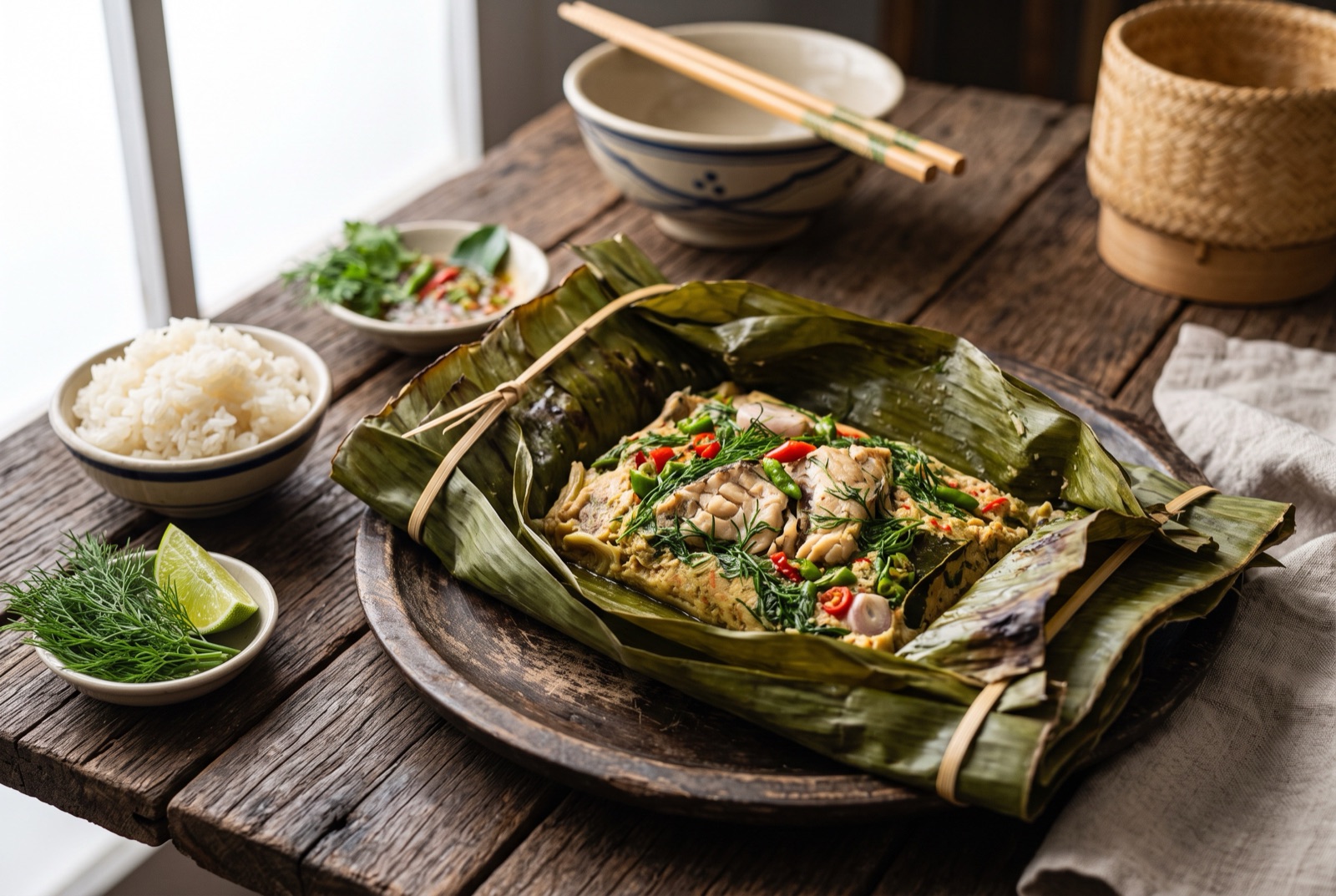
Keep exploring Laos.
Laos has 9 more dishes in the atlas — Jeow Mak Len and Khao Piak Sen, and 7 more.
Recipe by The DishRoute Kitchen · published August 20, 2026 · updated August 20, 2026