Masala Dosa.
Fermented Rice Crepe with Potato Masala
ಮಸಾಲೆ ದೋಸೆ · Masale dose / masala dosai · say it: muh-SAH-lah DOH-sah
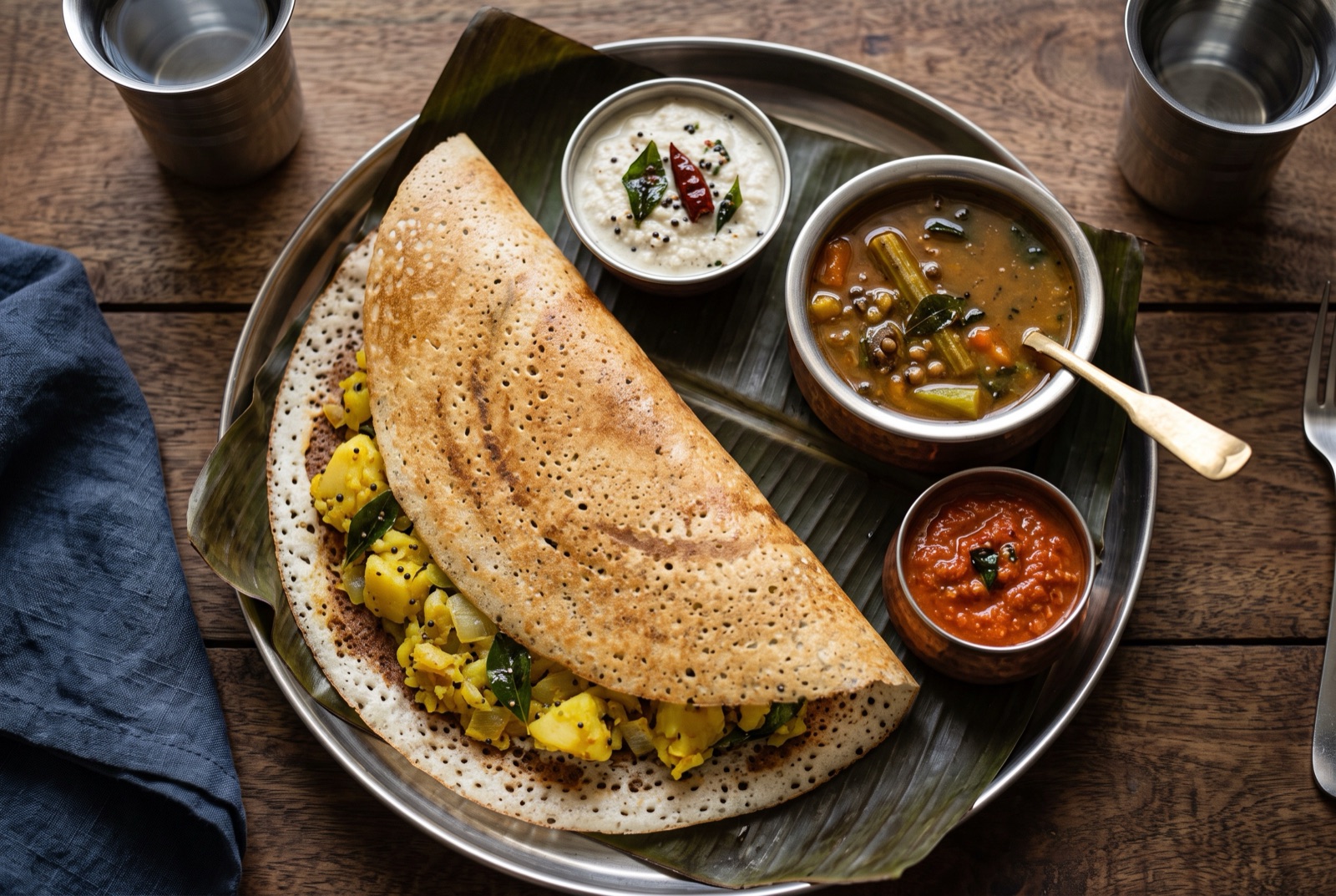
Masala dosa is a thin, crisp crepe made from a batter of rice and skinned urad dal that has been soaked, ground and left to ferment overnight, then spread into a wide disc on a hot griddle and wrapped around a soft, turmeric-yellow potato filling. The crepe itself tastes faintly sour and nutty from the fermentation, with a shattering crisp rim and a chewier centre; the filling is mild and buttery, sweetened by slow-cooked onion and cut with mustard seed, curry leaf and green chile. It is breakfast across most of South India, served with sambar and a coconut chutney to dip torn pieces into. The technique takes practice, but nothing about the ingredient list is exotic.

- Gate
- IndiaKarnataka and Tamil Nadu
- Prep
- 30 min
- Cook
- 40 min
- Total time
- 17 hr 10 min incl. 16 hr rest
- Serves
- 4
- Status
- Takes skill
- Nutrition / serving · estimated
- Calories 470 kcal
- Protein 11 g
- Carbs 76 g
- Fat 13 g
- Fiber 6 g
- Sodium 780 mg
Why this recipe works.
- Batter ratio and soak times that actually ferment in a normal home kitchen, plus what to do when yours is cold.
- Poha (flattened rice) in the batter for reliable crispness without a wet-grinder or a stone grinder.
- The potato filling is built as a proper tadka, not boiled potatoes with curry powder stirred through.
- Honest about the learning curve: the first dosa off the pan is a sacrifice, and the recipe tells you why.
Ingredients.
21 itemsFor the batter
For the potato masala
To cook
Equipment
- Powerful blender or wet grinder
- Large bowl with a lid for fermenting
- Flat cast-iron tava or a wide non-stick pan (28 cm or more)
- Flat metal spatula and a small ladle
Instructions.
Soak the rice and dal separately
Rinse 300 g of rice in several changes of water until it runs almost clear, then cover it with fresh water in one bowl. In a second bowl, rinse the urad dal and fenugreek seeds together and cover with water. Soak both for 6 hours.
Tip Separate bowls matter — the dal needs to be ground alone first, and mixing them now makes that impossible.
Grind the dal until fluffy
Drain the dal, keeping the soaking water. Grind it with 100–150 ml of ice-cold water into a smooth paste that is visibly light and airy — rub a little between your fingers and it should feel like whipped cream, not grit. Scrape it into a large bowl with room to double.
Tip Add the water in small splashes. Flooding the blender gives you a thin paste that never aerates.
Grind the rice and poha
Rinse the poha and add it to the drained rice, then grind with about 200 ml of cold water to a paste that is smooth but still faintly gritty, like fine semolina between your fingers. Add it to the dal.
Mix and ferment overnight
Add the salt and mix the two pastes together with your clean hand for a full minute — the warmth and bacteria of your hand genuinely help. The batter should be thick, like pancake batter that just drops off a spoon. Cover loosely and leave in a warm spot for 8–12 hours.
Tip It is ready when it has risen by roughly half, the surface is domed and full of small bubbles, and it smells clean and sour like yogurt. If it smells of alcohol, it has gone too far — still usable, just sourer.
Make the potato masala
Boil 700 g of potatoes until a knife slides in with no resistance, drain well, and crush them coarsely by hand — you want lumps, not purée. Heat the oil in a wide pan, add the mustard seeds and wait until they pop and jump, then add the urad dal and chana dal and fry until they turn pale gold and smell nutty.
Build the filling
Throw in the curry leaves, green chiles, ginger and asafoetida — they will crackle hard for a few seconds — then add the sliced onion and cook over medium heat until soft, translucent and just starting to catch gold at the edges, about 8 minutes. Stir in the turmeric, then the crushed potato, a splash of water and salt. Cook 3 minutes until it holds together as a soft, spoonable mass, then finish with lime juice and cilantro.
Heat and season the pan
Set a flat cast-iron tava or wide non-stick pan over medium-high heat until a few drops of water flicked on the surface hiss and disappear in about two seconds. Dip the cut onion half in oil and wipe the surface with it.
Tip The first dosa almost always sticks or tears. Cook it, eat it standing up, and treat it as a heat test — the second one will be better.
Spread the dosa
Stir the batter gently and thin it with water until it pours in a smooth ribbon. Ladle about 80 ml into the centre of the pan and, with the back of the ladle, spread it outward in a continuous widening spiral without lifting — you have about five seconds before it sets. Drizzle a teaspoon of ghee around the rim.
Cook, fill and fold
Cook without touching it for 2–3 minutes, until the edges lift away from the pan on their own, the underside is a mottled reddish-brown, and the top has dried from wet to matte with visible lacy holes. Spoon a line of potato masala down the middle, fold the dosa over it in half or in thirds, and slide it onto a plate. Wipe the pan with the oiled onion and repeat.
Tip Do not flip a masala dosa. It is cooked on one side only — the steam from the batter finishes the top.
Tips from our kitchen.
- Grind the urad dal first, separately, until it is genuinely fluffy and white — it should feel light and increase in volume. That aeration is what lifts the batter overnight.
- Use as little water as you can while grinding. A thick batter ferments better and dilutes easily the next morning; a thin one ferments into a sad, flat liquid.
- If your kitchen is below about 22 °C the batter will stall. Park the bowl in a switched-off oven with the light on, or in a cold oven with a mug of just-boiled water beside it.
- The pan must be at exactly the right heat: sprinkle water on it, and it should hiss and vanish in about two seconds. Too hot and the batter seizes before you can spread it, too cool and it sticks.
- Wipe the hot pan with half an onion dipped in oil before every dosa. It seasons and cleans the surface in one move and is what dosa cooks in Udupi hotels actually do.
- Stir the batter gently before each dosa, never beat it — you want to keep the bubbles that the fermentation built.
Substitutions.
- Idli rice / parboiled rice → Regular short-grain white rice, or 3 parts regular rice to 1 part basmati
- Parboiled rice gives the best crispness and the classic texture. Plain white rice works but produces a slightly softer, more pancake-like dosa.
- Poha (flattened rice) → 2 tbsp cooked rice, or 1 tbsp fenugreek seeds extra
- Poha helps with browning and crispness. Cooked rice does a similar job; extra fenugreek boosts fermentation and adds a faint bitterness that belongs in dosa.
- Ghee for griddling → Sesame oil or any neutral oil
- Makes the dish fully vegan. Ghee browns more and tastes richer; oil gives a slightly crisper, less fragrant dosa.
- Fresh curry leaves → Omit them
- Dried curry leaves contribute almost nothing. The filling will be less aromatic but still good — do not substitute bay leaf, which tastes nothing like it.
Variations.
- Mysore masala dosa
- Before adding the potato, spread a thin layer of red chutney — soaked dried red chiles ground with garlic, roasted chana dal and a little tamarind — across the inside of the dosa. Hotter, and arguably the better version.
- Paper roast
- Same batter, spread thinner and cooked longer until fully brittle, then rolled into a tall cone and served with the potato filling in a separate bowl.
- Plain dosa and uttapam
- Skip the filling for a plain dosa with chutney and sambar. Or pour the batter thick, scatter onion, tomato and chile over the wet surface, and cook covered — that is uttapam, and it is what day-three batter is for.
Storage & reheating.
Fermented batter keeps 4–5 days in the fridge and gets sourer each day; bring it to room temperature for 30 minutes before using, and thin it as needed. Freeze it in portions for up to a month. The potato filling keeps 3 days refrigerated and reheats well with a splash of water. Cooked dosas do not keep at all — they go leathery within minutes, which is why they are made to order, one at a time, and eaten immediately.
Serve with
Coconut chutney and hot sambar are non-negotiable at a South Indian table — the dosa is torn by hand and dipped into both. A steel tumbler of filter coffee, if you want the full Udupi hotel breakfast.
The story behind Masala Dosa.
Some form of dosai has been eaten in the Tamil country for a very long time — the word appears in Tamil literature centuries before anything resembling a modern restaurant existed — but the thin, crisp, griddle-spread dosa with a potato filling is a more recent creation, and Karnataka has the strongest claim to it. Masala dosa is closely tied to Udupi, the temple town on the Karnataka coast whose Brahmin cooks built one of the most successful restaurant traditions in the country. Through the twentieth century, Udupi hotels opened in Bangalore, Madras and Bombay serving fast, cheap, strictly vegetarian food, and masala dosa travelled on that network until it became a dish every Indian city knows.
The batter is the recipe. Rice supplies structure and crispness, skinned urad dal supplies protein, viscosity and — crucially — the wild yeasts and lactic bacteria that live on the dal and drive the fermentation. Nothing is added: no commercial yeast, no starter. Left in a warm kitchen overnight, the batter rises, fills with bubbles and turns pleasantly sour, and that sourness is what separates a real dosa from a rice pancake. South Indian households run the batter on a cycle, grinding a fresh batch every few days and using the older, sharper batter for uttapam once it has passed its dosa prime.
Regional variations are endless and taken seriously. Mysore masala dosa is smeared inside with a fiery red garlic-chile chutney before the potato goes in. Paper roast is spread even thinner and served rolled into a cone as long as your forearm, with the potato on the side. In Andhra the equivalent breakfast is pesarattu, a green moong dal crepe that is not fermented at all. And in Tamil homes, dosa is as likely to be eaten for dinner as for breakfast — the batter is there, and it takes four minutes.
Questions, answered.
Why is my dosa batter not fermenting?
Almost always temperature. The wild bacteria and yeasts on urad dal need roughly 25–32 °C to work; below about 22 °C they stall and the batter just sits there. Put the covered bowl in a switched-off oven with the light on, or in a warm cupboard, and give it up to 16 hours. Other causes: salt added before fermentation in a very cold kitchen, batter ground too thin, or old urad dal with little live culture left on it.
Why does my dosa stick to the pan?
Either the pan is not hot enough, or it is not seasoned. A cast-iron tava needs several uses to build a non-stick surface, and it should be wiped with an oiled onion half before each dosa. Also check the heat: water flicked onto the surface should sizzle away in about two seconds. Non-stick pans work but cannot be too hot — spread on medium heat instead of high. The first dosa of any batch usually sticks regardless; treat it as calibration.
Can I make masala dosa without a wet grinder?
Yes. A powerful blender handles it if you grind in batches with ice-cold water and pause to let the motor cool, so the batter does not heat up and kill the culture. Grind the urad dal alone first until light and fluffy, then the rice to a slightly grainy paste like fine semolina. A stone wet grinder gives a fluffier batter and marginally better dosas, but it is not the difference between success and failure.
What is the difference between dosa, uttapam and idli?
They come from closely related fermented rice-and-urad-dal batters. Dosa batter is thin and spread into a crisp crepe. Uttapam uses the same batter poured thick, like a small pancake, with vegetables pressed into the top. Idli batter is coarser and made with more urad dal and parboiled rice, then steamed into soft, spongy cakes. Many South Indian households keep separate idli and dosa batters going at once.
Is masala dosa gluten-free and vegan?
The batter and filling are naturally gluten-free — rice and lentils only, with no wheat anywhere. It is vegan too if you griddle with oil instead of ghee, which is how most street and hotel dosas are cooked anyway. The one thing to check is asafoetida if you add it: compounded hing is usually cut with wheat flour, so buy a gluten-free brand.
You might also like.
All recipes →
Keep exploring India.
India has 9 more dishes in the atlas — Aloo Paratha and Butter Chicken, and 7 more.
Recipe by The DishRoute Kitchen · published August 19, 2026 · updated August 19, 2026