Egusi Soup.
Nigerian Melon Seed and Greens Stew
Ọbẹ̀ efo elegusi · say it: eh-GOO-see
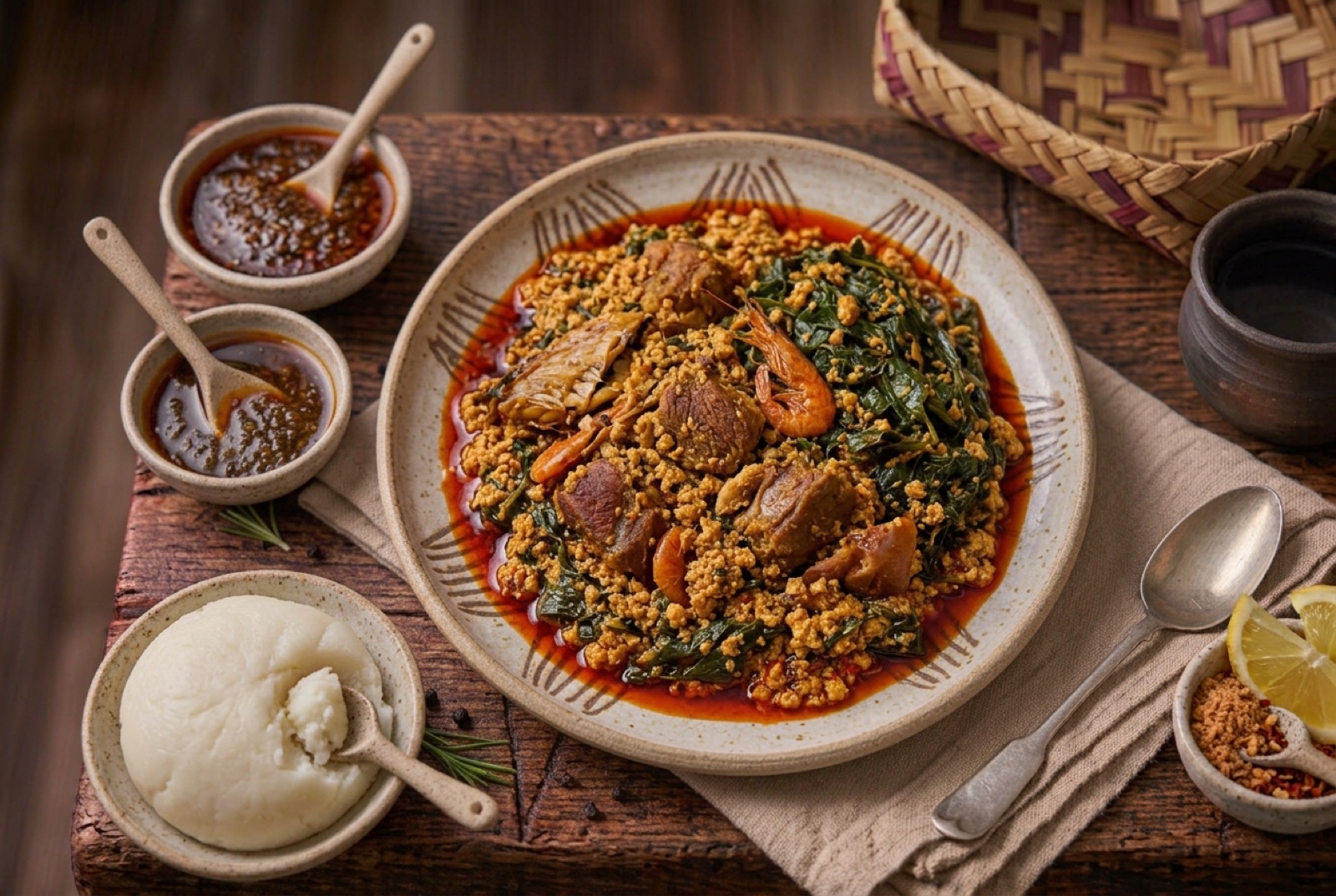
Egusi soup takes its body from ground melon seeds, which behave like nothing else in the pantry: stirred into hot palm oil and left alone, they seize into soft, nutty lumps that suspend themselves through the pot. Around those curds go goat meat or beef, smoked fish, ground crayfish, fermented locust beans and a heap of greens wilted in at the end. The result is thick enough to hold a spoon upright, rich rather than sharp, and clearly savoury from the dried seafood. It is one of the most widely eaten dishes in Nigeria, cooked in slightly different ways by nearly every ethnic group, and it is always served with swallow rather than eaten on its own.

- Gate
- Nigeria
- Prep
- 25 min
- Cook
- 1 hr 30 min
- Total time
- 1 hr 55 min
- Serves
- 6
- Status
- Medium
- Nutrition / serving · estimated
- Calories 690 kcal
- Protein 45 g
- Carbs 14 g
- Fat 51 g
- Fiber 6 g
- Sodium 980 mg
Why this recipe works.
- Uses the caking method and explains what setting seeds actually look like, so you get lumps rather than grit.
- Cooks the meat first and builds the soup on its stock, which is where the savouriness comes from.
- Tells you when to add each green so ugu, bitterleaf or spinach all end up right rather than grey.
- Realistic about the stockfish and crayfish: what they do, and what you lose by leaving them out.
Ingredients.
14 itemsFor the meat and stock
For the soup
Equipment
- Large heavy pot
- Blender
- Bowl for soaking stockfish
- Wooden spoon
Instructions.
Cook the meat
Put the goat meat in a pot with the chopped onion, the stock cubes, a good pinch of salt and just enough water to cover. Simmer covered for 40 to 50 minutes, until a knife slides into a chunk with only light resistance. Lift out the meat and keep every drop of the stock.
Tip Goat needs longer than beef. Taste a piece rather than trusting the clock — undercooked goat stays springy.
Prepare the dried fish
Cover the stockfish with boiling water and leave it for 30 minutes until pliable, then shred it and pick out any bones. Flake the smoked fish separately, discarding skin and bones, and set both aside.
Loosen the egusi
Mix the ground egusi with about 150 ml of the warm meat stock to make a thick, spoonable paste, roughly the consistency of a stiff porridge. It should hold its shape briefly when you scoop it.
Bloom the palm oil and aromatics
Heat the palm oil in a large pot over medium heat until it thins and turns bright orange, about 2 minutes — do not let it smoke. Add the chopped onion and cook for 3 minutes, then stir in the blended bell and scotch bonnet peppers and fry for 10 minutes, until the mixture darkens and oil rises to the surface.
Cake the egusi
Drop the egusi paste into the pot in tablespoon-sized mounds, spacing them out, and leave them completely undisturbed over medium-low heat for 8 to 10 minutes. They are set when the surfaces look dry and firm and the mounds hold together as you nudge one with a spoon.
Tip This is the step people rush. Every early stir costs you texture.
Build the soup
Break the set egusi into rough lumps, then pour in the remaining meat stock along with the crayfish and iru. Return the meat, stockfish and smoked fish, and simmer uncovered for 20 minutes until the soup thickens enough to coat a spoon and a film of orange oil floats on top.
Wilt the greens and finish
Stir in the shredded greens and cook for 3 minutes only, just until they collapse and turn deep green. Taste for salt and heat, then take the pot off the heat while the leaves still have some bite and serve alongside pounded yam or eba.
Tips from our kitchen.
- Buy egusi already ground if you can, and check that it smells sweet and nutty. Old seeds go rancid and there is no rescuing a soup made with them.
- Once the egusi paste is in the oil, leave it completely alone for several minutes. Stirring too early stops it setting and you end up with a sandy sauce.
- Soak stockfish in hot water for at least half an hour before it goes near the pot, then pull it into shreds and check for hidden bones.
- Add greens last and cook them for two or three minutes only. Bitterleaf is the exception — pre-washed bitterleaf can take five.
- Keep the soup thick. If it looks loose after the greens go in, simmer uncovered for a few minutes rather than adding more egusi.
Substitutions.
- Ground egusi (melon seeds) → Raw shelled pumpkin seeds, ground fine
- The closest widely available match — similar fat content and a comparable nutty flavour, though the colour is greener and the curds are softer. African grocers and online sellers carry real egusi cheaply.
- Bitterleaf or ugu (fluted pumpkin leaves) → Mature spinach, chard or collard greens
- Spinach releases more water, so wilt it briefly and let the pot reduce afterwards. Collards hold up better but need a few extra minutes.
- Stockfish → Extra smoked fish, or dried cod soaked overnight
- Stockfish is air-dried cod and needs long soaking. It adds a specific chewy texture and slow savouriness; smoked fish alone gives depth without the chew.
- Iru (fermented locust beans) → A teaspoon of white miso, or omit
- Miso covers some of the fermented funk but is sweeter and saltier. Leaving it out gives a cleaner, more Igbo-leaning soup rather than a broken one.
Variations.
- Egusi ijebu
- A Yoruba version where the seed paste is boiled into the stock until it dissolves completely, producing a smooth, thick, almost custardy soup with no lumps at all.
- Ofe egusi with bitterleaf
- The Igbo direction: bitterleaf washed until only a pleasant bitterness remains, added generously, with uziza leaves and no locust beans.
- Vegetarian egusi
- Built on mushroom stock with smoked paprika replacing the smoked fish, plenty of greens and no meat. The texture works; the savoury depth is different rather than equal.
Storage & reheating.
Egusi keeps 4 days in the fridge and reheats better than most stews, since the seed curds firm up rather than fall apart. Warm it gently with a splash of water because it thickens considerably when cold. It freezes for 3 months, though the greens soften noticeably; if you plan to freeze a batch, cook the base without greens, freeze that, and wilt fresh leaves into it after thawing. In many Nigerian households a large pot is cooked once and portioned into daily containers for the week.
Serve with
Pounded yam, eba or fufu, plus cold water — the soup is rich and the heat catches up with you.
The story behind Egusi Soup.
Egusi is not one seed but a category — the shelled seeds of several gourds and melons grown across West Africa, ground to a coarse meal. The plants are cultivated for the seeds rather than the flesh, and the milled powder has been a thickener and protein source in this region for a very long time, well beyond Nigeria's borders into Ghana, Benin, Cameroon and Togo. What Nigeria has done is build an enormous number of local variations on it, so that egusi in Enugu, Ibadan and Calabar are recognisably relatives rather than copies.
The main technical split is between the caking method and the dissolved method. In the caking, or frying, method the seed paste is dropped into hot oil in spoonfuls and left undisturbed until it sets, then broken up so the finished soup is textured with distinct lumps. In the dissolved method the paste is stirred into the stock and cooked out smooth, giving a uniform, gravy-like body. Both are traditional and both have committed defenders; this recipe uses the caking method because the lumps are what most people picture when they hear egusi. The greens change by region too — bitterleaf in much of Igboland, where the soup shades toward ofe onugbu, ugu or fluted pumpkin leaves elsewhere, and spinach standing in when neither is available.
What does not change is the supporting cast. Assorted meat means exactly that: goat, beef, tripe, cow skin and whatever else the household eats, cooked first so its stock becomes the soup base. Stockfish and smoked fish add a depth that fresh fish cannot, ground crayfish supplies the savoury backbone, and iru brings a fermented sharpness in Yoruba versions. Palm oil is not interchangeable with anything else here — its colour and its slightly grassy weight are half the identity of the dish. Egusi arrives at the table opposite a mound of pounded yam or eba, and the two are eaten as one thing.
Questions, answered.
What exactly is egusi?
Egusi is the shelled, ground seed of certain West African gourds and melons grown specifically for their seeds rather than their flesh. Milled to a coarse meal, it is high in fat and protein and acts as both thickener and body in soups across Nigeria, Ghana, Cameroon and Benin. It has a mild, nutty taste similar to pumpkin seed.
Why did my egusi turn out grainy instead of lumpy?
The paste was disturbed before it set. Egusi needs to sit undisturbed in hot oil or simmering stock for several minutes so the fat renders and the seeds bind into curds. If you stir it in the first few minutes, the meal disperses and stays gritty. Drop it in as spoonfuls, wait until the surface looks dry and firm, then break it up.
Can I make egusi soup without palm oil?
You can cook it in any oil and it will still be a good pot of soup, but it will not look or taste like egusi. Red palm oil supplies the orange colour, a mild grassy weight and part of the flavour that Nigerians identify the dish by. It is widely sold at African and Caribbean grocers; look for sustainably sourced brands.
What is swallow, and which one goes with egusi?
Swallow is the starchy dough eaten alongside Nigerian soups — pounded yam, eba from cassava garri, amala from yam flour, fufu or semolina. You pinch off a piece, use it to scoop the soup and swallow it without much chewing. Egusi pairs with all of them; pounded yam and eba are the most common choices.
Is egusi soup very spicy?
It is usually hot, but the heat comes from scotch bonnets you control rather than being built into the seeds. Two blended scotch bonnets in a six-portion pot gives a strong but manageable burn; one deseeded pepper leaves a gentle warmth. The richness of the palm oil and seeds softens chilli heat more than you might expect.
You might also like.
All recipes →
Keep exploring Nigeria.
Nigeria has 9 more dishes in the atlas — Akara and Ayamase, and 7 more.
All Nigeria recipes Goat recipes Spinach recipes Scotch bonnet recipes soupmaingluten freedairy freeRecipe by The DishRoute Kitchen · published August 20, 2026 · updated August 20, 2026