Tzatziki.
Greek Yogurt, Cucumber and Garlic Dip
Τζατζίκι · Tzatziki · say it: tsah-TSEE-kee
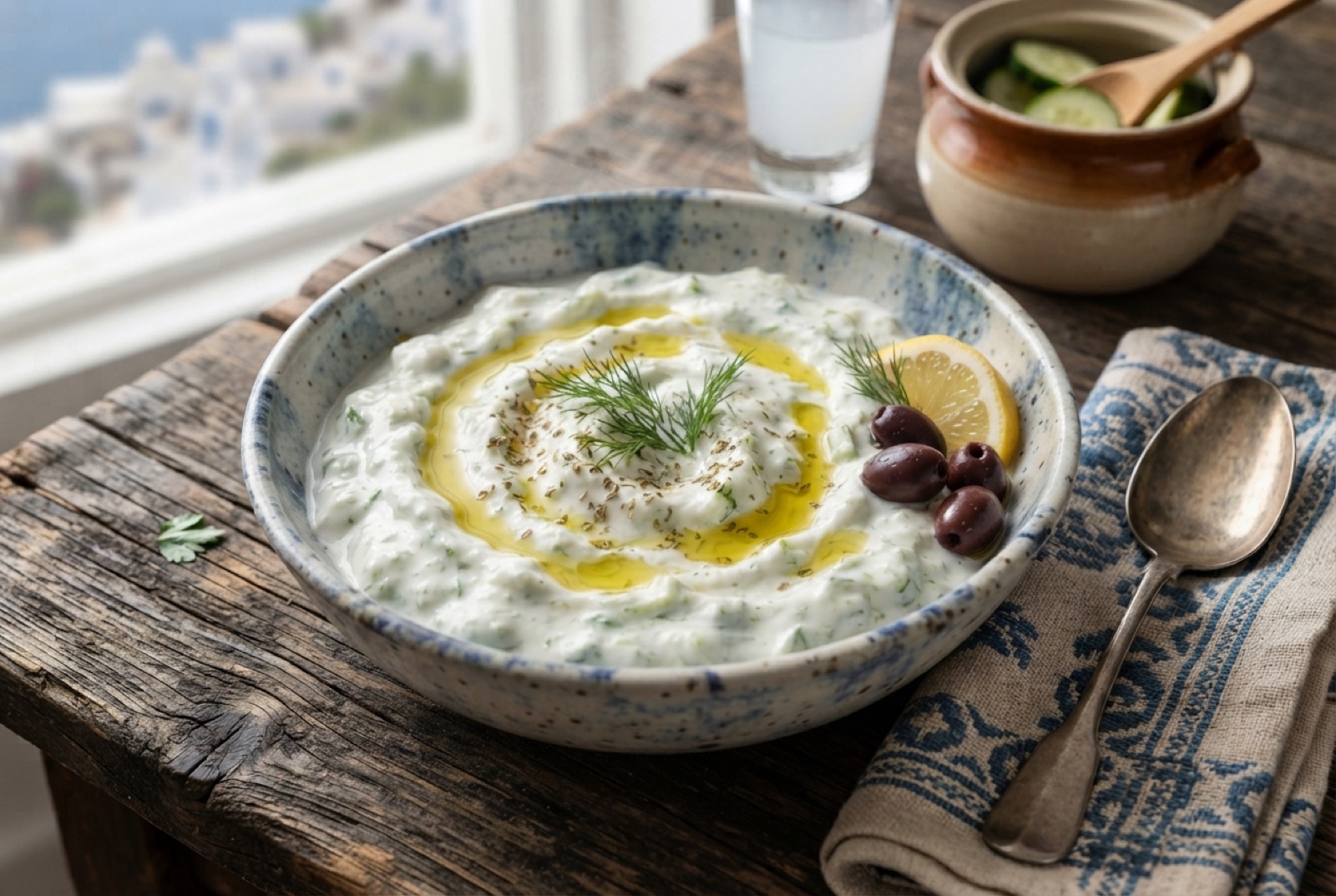
Tzatziki is the cold white sauce of the Greek table: thick strained sheep's or cow's yogurt loaded with grated cucumber, raw garlic, olive oil and usually a little dill or mint. Done right it is dense enough to hold a spoon upright, cool and tangy with a garlic bite that announces itself and lingers. Done wrong it is a watery puddle, and the difference is one technique: salting the grated cucumber and squeezing it nearly dry before it ever meets the yogurt. It takes ten minutes, keeps for days, and improves after a night in the fridge — the single hardest-working item in the Greek refrigerator.

- Gate
- Greece
- Prep
- 15 min
- Cook
- 0 min
- Total time
- 1 hr 15 min incl. 1 hr rest
- Serves
- 6
- Status
- Easy
- Nutrition / serving · estimated
- Calories 110 kcal
- Protein 6 g
- Carbs 5 g
- Fat 8 g
Why this recipe works.
- The cucumber is salted, drained and wrung out hard — the one step that separates thick tzatziki from cucumber soup.
- Full-fat strained yogurt only, so the dip stands on a spoon the way it does in a Greek taverna.
- Garlic is grated to a paste and given a rest in the yogurt, so it flavors every bite instead of ambushing some of them.
- Honest quantities: enough garlic to be Greek, with guidance for scaling it down without losing the point.
Ingredients.
7 itemsEquipment
- Box grater or coarse microplane
- Clean kitchen towel or sieve for squeezing
- Mixing bowl
Instructions.
Grate and salt the cucumber
Coarsely grate the cucumber (scrape out the seed core first if it is large and watery), toss it with a generous half teaspoon of salt in a sieve set over a bowl, and leave it 15 minutes, until liquid is visibly dripping through and the shreds look glassy.
Squeeze it dry
Take handfuls of the cucumber and squeeze hard over the sink — or twist it in a clean kitchen towel — until it stops releasing liquid and feels almost dry, like wrung-out cloth. You should extract several tablespoons of water.
Tip This is the make-or-break step. When you think you have squeezed enough, squeeze once more.
Make the garlic paste
Grate the 3 cloves of garlic to a fine paste on a microplane, or mince it and crush it against the board with the flat of a knife and a pinch of salt until no pieces remain and it smears like butter.
Combine
Stir the 500 g of yogurt with the garlic paste, olive oil, vinegar, dill and salt until smooth, then fold in the squeezed cucumber. The mixture should be thick enough that a spoon stood in it leans only slowly.
Rest and finish
Cover and refrigerate at least 1 hour, until the garlic has mellowed from sharp to warm and the flavors taste like one thing rather than a list. Taste, correct the salt and acid, and serve cold with a thread of olive oil over the top.
Tip Overnight is even better — day-two tzatziki is the version tavernas serve.
Tips from our kitchen.
- Buy full-fat strained ("Greek") yogurt, 5% or 10% fat. Low-fat or unstrained yogurt makes thin, sour tzatziki no amount of draining will fix.
- Squeeze the salted cucumber in your fists or a clean towel until it stops dripping and looks almost dry — you should get several tablespoons of liquid out. This is the whole recipe.
- Grate the garlic to a paste on a microplane or crush it with salt under a knife blade; visible chunks of raw garlic are landmines.
- Make it at least an hour ahead. The garlic mellows and spreads, the flavors knit, and day-two tzatziki is better than day-one.
- Taste after the rest, not before — the garlic and salt both grow overnight, so season shy and correct later.
- Serve it cold, with a pool of olive oil and a few olives on top, taverna-style.
Substitutions.
- Strained Greek yogurt → Plain full-fat yogurt, strained at home
- Set it in a cloth-lined sieve over a bowl in the fridge for a few hours until thick. Cheaper, and closer to how villages did it anyway.
- Fresh dill → Fresh mint, or a mix of both
- Both are traditional in different households; mint reads slightly more northern-Greek. Dried dill works at half quantity.
- Red wine vinegar → Fresh lemon juice
- Vinegar is the more traditional souring agent, but lemon is common and slightly gentler. Either way, add a little and taste.
Variations.
- Light on garlic
- For a gentler version, use one clove and let the tzatziki rest overnight — you keep the aroma and lose the burn. Greeks will forgive you, barely.
- Almost-tarator
- Thin the finished tzatziki with cold water and a few crushed walnuts for something close to the Balkan cold soup — a genuine hot-day lunch.
- Beet tzatziki
- A shocking-pink taverna favorite: fold in coarsely grated roasted beets. Sweeter, earthier, and striking on a meze table.
Storage & reheating.
Tzatziki keeps 3–4 days covered in the fridge, and the flavor actually peaks on day two. A little liquid may separate on the surface — stir it back in rather than pouring it off. Do not freeze it; the yogurt splits and the cucumber turns to mush on thawing. It is meant to be served cold, so there is no reheating question — just give it a stir and a fresh thread of olive oil.
Serve with
Warm pita or crusty bread, grilled meats and souvlaki, fried zucchini or eggplant — anything charred, fried or salty.
The story behind Tzatziki.
Tzatziki belongs to a family of yogurt-cucumber-garlic preparations that stretches across the old Ottoman world and beyond — Turkish cacık (the word tzatziki itself comes from the Turkish name, which likely has Persian roots), Balkan tarator, and more distant cousins like Indian raita. Where exactly the family began is not something anyone can prove; yogurt, cucumber and garlic have been kept cool together for a very long time across that whole region. What Greece did was fix its own version: thicker than the often soupy or drinkable Turkish cacık, built on strained yogurt, heavier on garlic, finished with olive oil and typically dill — a dip and a sauce rather than a cold soup.
The strained yogurt is the structural difference and a Greek point of pride. Straining off the whey concentrates the yogurt into something closer to fresh cheese — the product the world now buys labeled "Greek yogurt" — and that density is what lets tzatziki stand up on a plate and cling to grilled meat instead of running off it. Village tradition strained sheep's milk yogurt through cloth bags; the tang of sheep's milk is still the flavor older Greeks miss in supermarket versions.
In Greece tzatziki is everywhere and always cold: first out with the mezedes alongside bread, olives and taramosalata; folded into the anatomy of the gyro and the souvlaki wrap, where it is the glue holding pork, tomato, onion and (contentiously) fries together; and beside anything grilled or fried, because its cool acidity is the natural answer to char and oil. It is also famously antisocial — real tzatziki carries enough raw garlic that the polite move is for the whole table to eat it together. Greeks consider that a feature. A tzatziki timid with garlic is understood, correctly, to be tourist tzatziki.
Questions, answered.
How do I keep tzatziki from getting watery?
Deal with the cucumber. Grate it, salt it, let it sit about 15 minutes, then squeeze it in your fists or a clean towel until it is nearly dry — cucumber is over 95% water and most of it must come out before it touches the yogurt. Use thick full-fat strained yogurt, and stir back (do not pour off) any whey that separates in the fridge.
Should I peel and seed the cucumber for tzatziki?
Seeding helps more than peeling. The watery seed core adds liquid and little flavor, so scraping it out with a spoon before grating is worthwhile with large cucumbers. Peel is a style choice — skin-on gives green flecks and slightly more texture; many Greek cooks half-peel in stripes. Thin-skinned cucumbers need no peeling at all.
What is the difference between tzatziki and Turkish cacık?
They are close relatives from the same Ottoman family — the Greek word even derives from the Turkish. The practical differences: tzatziki is thicker (strained yogurt), usually more garlicky, finished with olive oil, and served as a dip or sauce, while cacık is often looser — sometimes thinned with water or ice to a drinkable or spoonable consistency — and commonly leans on dried mint.
Can I make tzatziki ahead, and how long does it keep?
Yes — you should. An hour in the fridge is the minimum for the garlic to mellow and the flavors to merge, and overnight is better still. Covered and refrigerated it keeps 3–4 days; stir before serving and refresh with a drizzle of olive oil. Freezing is the one thing it will not survive.
How much garlic is authentic in tzatziki?
More than most non-Greek recipes admit — two to four cloves for about 500 g of yogurt is normal in Greece, and the raw bite is considered part of the dish, softened but not erased by a rest in the fridge. If you are garlic-shy, start with one clove and rest it overnight; the aroma stays while the sharpness fades.
You might also like.
All recipes →


Keep exploring Greece.
Greece has 9 more dishes in the atlas — Fasolada and Galaktoboureko, and 7 more.
All Greece recipes Yogurt recipes Cucumber recipes Garlic recipes sauceappetizervegetariangluten freeRecipe by The DishRoute Kitchen · published August 18, 2026 · updated August 18, 2026