Byrek me Spinaq.
Albanian Spinach and Curd Pie
Byrek me spinaq · say it: byuh-REK meh spee-NAHK
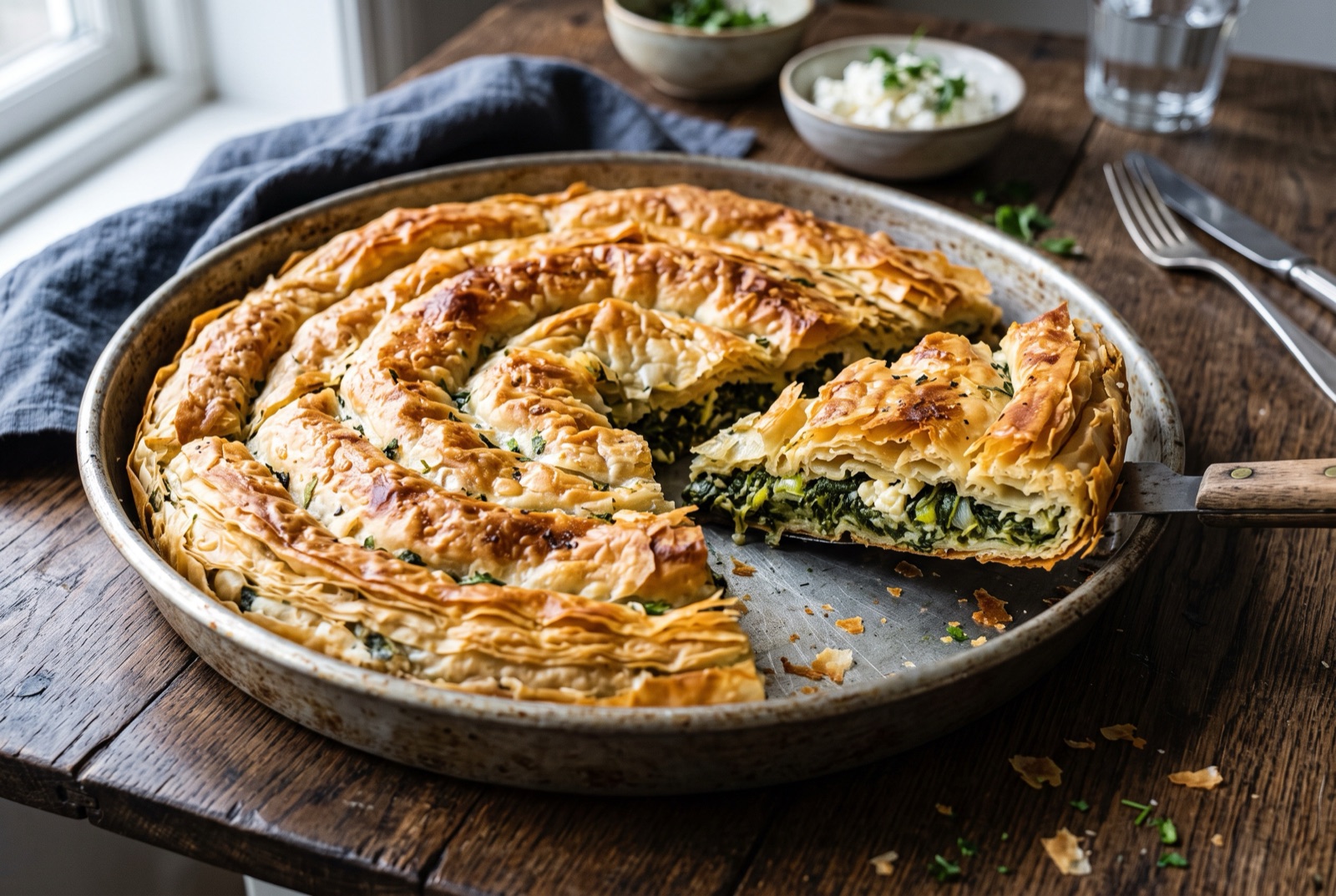
Byrek me spinaq is the Albanian answer to breakfast, lunch and everything eaten standing up. Paper-thin sheets of unleavened dough called petë are stacked with a filling of wilted spinach, sliced spring onions and crumbly fresh curd, each layer painted with oil so the pastry bakes into brittle, separate leaves rather than a solid slab. The flavour is plain in the best way: green, salty and a little tangy from the curd, with the toasted pastry doing most of the work. Cut into wedges from a round tray, it is eaten hot from the byrektore counter, warm at home with a glass of ayran, or cold from the fridge at midnight, which is arguably its finest hour.

- Gate
- AlbaniaTirana and the south
- Prep
- 1 hr 15 min
- Cook
- 45 min
- Total time
- 2 hr 45 min incl. 45 min rest
- Serves
- 8
- Status
- Takes skill
- Nutrition / serving · estimated
- Calories 480 kcal
- Protein 16 g
- Carbs 48 g
- Fat 25 g
- Fiber 4 g
- Sodium 720 mg
Why this recipe works.
- Full hand-rolled petë method, with the resting and oiling steps that actually make the layers separate.
- A drained-spinach filling, so the middle bakes crisp instead of steaming the pastry from the inside.
- Honest about shop-bought filo: the recipe tells you exactly how to adapt if you skip the rolling.
- Uses a mix of fresh curd and salty white cheese, which is how the tang and the seasoning are balanced in Albania.
Ingredients.
12 itemsFor the petë dough
For the filling
To assemble
Equipment
- Long thin rolling pin or a standard one
- Large clear table for rolling
- Round baking tray, 30–32 cm
- Pastry brush
Instructions.
Make the dough
Mix the flour and salt, then work in the warm water, olive oil and vinegar until a soft, slightly tacky dough comes together. Knead on the counter for 8 minutes until it turns smooth and springs back slowly when pressed.
Tip The dough should be softer than bread dough. If it feels tight, add water a tablespoon at a time.
Rest the dough
Divide the dough into 6 balls, rub each with oil, cover with a cloth and leave to rest for at least 45 minutes at room temperature. This is not optional — rested dough stretches, unrested dough fights back.
Cook and drain the spinach
Wilt 900 g of spinach in a dry pan over high heat until it collapses and turns dark, about 3 minutes. Tip into a colander, cool briefly, then squeeze in handfuls until no more water runs out and the mass feels almost dry.
Tip You should be left with about a quarter of the original volume. If it still drips, squeeze again.
Mix the filling
Chop the squeezed spinach and combine with the spring onions, crumbled curd, white cheese, beaten eggs and black pepper. Taste and add salt only if needed — the cheese is already salty. The mixture should hold together loosely, not slump.
Roll the petë
On a well-floured table, roll each ball into a round as thin as you can manage, aiming for a sheet you can almost read through. Turn it a quarter turn between passes and re-flour underneath so it never sticks.
Tip Tears are normal and invisible once stacked. Keep going rather than restarting.
Layer the tray
Oil a 30 cm round tray and lay in three sheets one at a time, brushing each generously with oil and letting the edges overhang. Spread the filling evenly, then cover with the remaining three sheets, oiling between each and tucking the overhang in around the sides.
Score and bake
Brush the top thickly with oil and score through the upper sheets only, cutting the pie into eight wedges. Bake at 200°C for 40–45 minutes, until the top is deep gold, visibly blistered and crackles when tapped with a knife.
Tip If the top browns before 30 minutes, drop the oven to 180°C so the middle has time to dry out.
Cool slightly and cut
Let the byrek sit for 10 minutes before cutting through the scored lines with a serrated knife. Serve warm, with the crisp top layers deliberately shattering as you lift each wedge out.
Tips from our kitchen.
- Squeeze the cooked spinach far harder than feels reasonable — a wet filling is the single most common cause of a soggy byrek.
- Rest the dough at least 45 minutes. Unrested dough springs back the moment you roll it and will never stretch thin enough.
- Oil generously between sheets. Skimping here gives you one thick pastry brick instead of a stack of crisp leaves.
- Roll on a large table with plenty of flour and work from the centre outward, turning the sheet a quarter turn between passes.
- Small tears do not matter once the sheets are stacked, so keep rolling rather than starting over.
- Score the top layers into portions before baking; cutting a finished byrek shatters the crust and scatters it everywhere.
Substitutions.
- Hand-rolled petë → 450 g shop-bought filo pastry
- Use two commercial filo sheets where the recipe calls for one petë, and oil between each pair. The result is crisper and lighter, with less chew.
- Gjizë (fresh curd) → Dry ricotta, or cottage cheese pressed through a sieve and drained
- Albanian gjizë is drier and more granular than ricotta. Drain whatever you use in a sieve for 30 minutes so the filling is not loose.
- Spinach → Chard, young nettles, or a mix of spinach and finely sliced leek
- All are traditional Albanian byrek fillings. Chard stems should be sliced thin and wilted a minute before the leaves go in.
Variations.
- Byrek me gjizë
- The plainest and possibly most popular version: just curd beaten with egg and a little salt, no greens at all. Rich, mild and best eaten hot.
- Byrek me presh
- Sliced leeks sweated slowly in oil until sweet, sometimes with a little rice to bind. A winter favourite in the north.
- Lakror
- The southern Albanian cousin from Korçë and Përmet, baked in a shallow pan between hot metal lids covered with embers, giving a smokier crust.
Storage & reheating.
Byrek keeps 2 days at room temperature under a cloth and 4 days refrigerated, and Albanians eat it cold without apology. To bring back the crunch, reheat slices in a 180°C oven for 8–10 minutes rather than a microwave, which turns the pastry limp. Unbaked assembled byrek freezes well: freeze it solid in the tray, then bake straight from frozen with 15 extra minutes.
Serve with
Cold ayran or a glass of thin yoghurt, and a bowl of pickled peppers or turshi to cut the richness.
The story behind Byrek me Spinaq.
Byrek is Ottoman in name and Balkan everywhere in practice — the same pie is börek in Turkey, burek in Bosnia, banitsa in Bulgaria and lakror in the Albanian south, and arguing about who invented it is a reliable way to lose an afternoon. What is specific to Albania is the shape and the fillings. Albanian byrek is usually a flat round or rectangular tray pie built in layers rather than the coiled rope of Bosnian burek, and the filling is more often vegetable and dairy than meat: spinach, leek, nettles, pumpkin, or simply gjizë with egg. Meat byrek exists but is the minority choice, which surprises people who arrive expecting the Bosnian model.
The pastry is the part that separates a home cook from a professional. Petë are rolled with an okllai, a broomstick-thin rolling pin nearly a metre long, on a floured table until each sheet is wide enough to see the wood grain through it. Village women still make them in batches and dry them for later use, and every Albanian family has an opinion about whose petë are best. Nobody will judge you for buying filo — shops in Albania sell packets of ready-made petë precisely because the skill takes years — but it is worth knowing that the handmade sheets are slightly thicker and stretchier than commercial filo, which is why homemade byrek has more chew and less dust.
In southern Albania the same idea becomes lakror, baked between two metal lids buried in embers, and around Korçë the tradition is strong enough that specific villages are known for specific fillings. In the cities byrek is street food: the byrektore opens early, sells by the slice from a hot tray, and closes when the tray is empty. It is what students eat between classes, what workers eat at ten in the morning, and what gets bought by the kilo when relatives are coming over.
Questions, answered.
Why is my byrek soggy in the middle?
Wet filling, almost every time. Cooked spinach holds an enormous amount of water and must be squeezed out in handfuls until it stops dripping, and soft curd should be drained in a sieve first. The other cause is baking too low: byrek needs a properly hot oven, around 200°C, so the pastry sets and dries before the filling can steam it.
Can I use shop-bought filo instead of making the dough?
Yes, and plenty of people in Albania do. Use around 450 g of filo, stack two commercial sheets for each handmade one, and brush oil between every pair. Commercial filo is thinner and more brittle, so the finished pie is lighter and crisper but has less of the chewy layered texture that handmade petë give.
What is gjizë and what can I use instead?
Gjizë is the fresh curd left over from Albanian cheesemaking, similar to a dry, granular ricotta with a mild sour edge. Dry ricotta is the closest supermarket match; drained cottage cheese or a mix of ricotta and crumbled feta also works. Whatever you use should be dry enough to crumble rather than spread, otherwise the filling loosens in the oven.
Is Albanian byrek the same as Bosnian burek?
They share a name and an Ottoman ancestry but differ in build and filling. Bosnian burek is specifically the meat version, rolled into a rope and coiled into a spiral, with cheese and spinach versions carrying different names. Albanian byrek is usually built flat in layers in a round or rectangular tray, and vegetable and curd fillings are at least as common as meat.
Can I make byrek ahead for a party?
Assemble it completely, cover and refrigerate for up to a day, then bake just before serving — this gives the best crust. It also holds well baked: bake it in the morning, leave it uncovered at room temperature, and give it 8 minutes in a hot oven before guests arrive. Do not cover a hot byrek with foil or plastic, as trapped steam softens the top layers immediately.
You might also like.
All recipes →
Keep exploring Albania.
Albania has 9 more dishes in the atlas — Fërgesë Tirane and Jani me Fasule, and 7 more.
Recipe by The DishRoute Kitchen · published August 20, 2026 · updated August 20, 2026