Amok Trey.
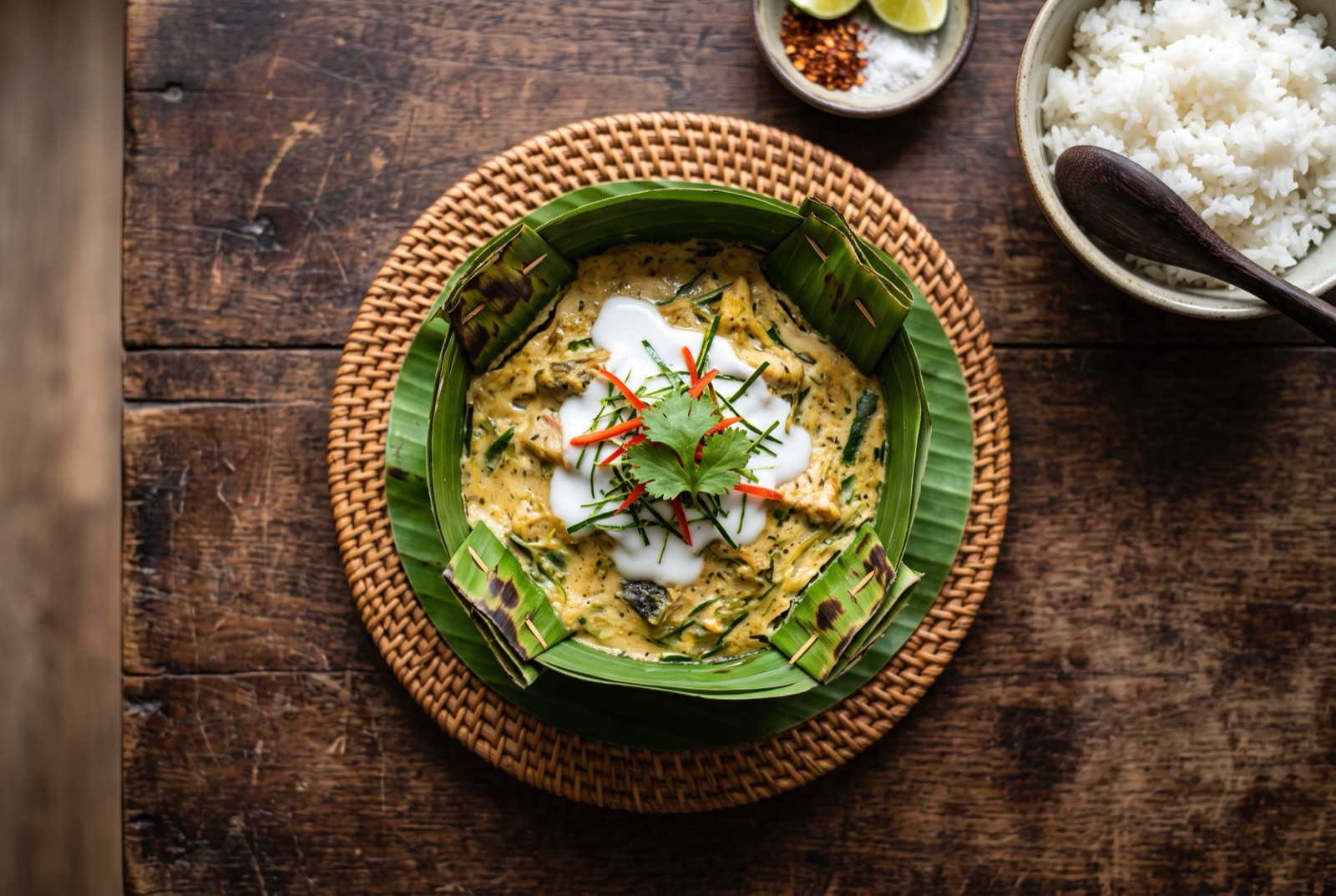
Khmer Steamed Fish Curry Custard
អាម៉ុកត្រី · say it: ah-MOK trey
Amok trey is steamed fish curry that behaves like a custard. Chunks of freshwater fish are coated in kroeung — the pounded lemongrass, turmeric and galangal paste at the heart of Khmer cooking — bound with coconut cream and beaten egg, spooned into a folded banana leaf cup and steamed until the mixture puffs, sets and stops sloshing. The texture is the whole point: soft, mousse-like, spoonable, nothing like a saucy curry. It tastes fragrant rather than hot, with citrus from lemongrass and lime leaf, an earthy hum from turmeric, deep savour from fish sauce or prahok, and a sweetness that sneaks in from palm sugar. Bitter slok ngor leaves line the base and cut the richness. Eat it straight from the leaf with plain jasmine rice.

- Gate
- CambodiaTonlé Sap Basin
- Prep
- 30 min
- Cook
- 25 min
- Total time
- 55 min
- Serves
- 4
- Status
- Medium
- Nutrition / serving · estimated
- Calories 420 kcal
- Protein 34 g
- Carbs 12 g
- Fat 26 g
- Fiber 2 g
- Sugar 7 g
Why this recipe works.
- Steams to a genuine set custard — egg and coconut cream in the right ratio, not thickened soup in a leaf.
- Kroeung built from scratch, with a blender method that is honest about what the mortar does better.
- Workable substitutions for snakehead fish and slok ngor leaves, with an explanation of what each one contributes.
- Portioned in cups so every serving has its own crust of coconut cream and lime leaf on top.
Ingredients.
15 itemsFor the kroeung
For the custard
To finish
Equipment
- Steamer or wide pan with a rack and lid
- Mortar and pestle or small blender
- 4 ramekins or banana leaf cups
Instructions.
Pound the kroeung
Pound the lemongrass, turmeric, galangal, 2 whole lime leaves, garlic and shallots in a mortar, hardest ingredients first, until you have a damp yellow paste with no visible fibres. In a blender, add 2 tablespoons of the thin coconut milk and scrape down repeatedly.
Tip Stop when the paste smells sweetly citrus rather than sharp and grassy — that is the moment the lemongrass has actually broken down.
Season the fish
Whisk the kroeung with the thin coconut milk, fish sauce, prahok if using and the palm sugar until the sugar dissolves. Add 600 g of fish chunks and turn gently to coat every piece, then leave for 10 minutes.
Bind with egg
Beat the eggs and fold them through the fish mixture with a spatula, lifting rather than stirring so the chunks stay whole. The mixture should look like a loose, mustard-yellow batter that just coats the fish — thick enough to mound slightly on the spoon.
Fill the cups
Line four ramekins or banana leaf cups with the spinach leaves, pressing them flat against the base and sides. Divide the fish mixture between them, filling to about 2 cm below the rim so there is room for the custard to rise.
Steam gently
Set the cups in a steamer over simmering water, cover and steam for 20–25 minutes, until the tops are domed and matte and a knife slipped into the centre comes out clean. The custard should wobble as one piece, not slosh.
Tip Lay a cloth under the steamer lid to catch condensation — drips pit the surface of the custard.
Finish and rest
Spoon the reserved thick coconut cream over each cup and scatter with the shredded lime leaf and chile. Return to the steamer uncovered for 1 minute so the cream warms and glosses, then rest 5 minutes off the heat before serving with rice and lime wedges.
Tips from our kitchen.
- Slice lemongrass paper-thin across the stalk before pounding or blending — long fibres never break down and will show up as splinters in the finished custard.
- Use full-fat coconut milk and skim the thick cream from the top of the can for the topping; light coconut milk will not set and weeps water in the steamer.
- Cut the fish in 3 cm pieces rather than mincing it. You want distinct flakes suspended in custard, not fish paste.
- Keep the steam gentle. A hard rolling boil overcooks the egg and the custard turns grainy and pulls away from the sides.
- Fresh turmeric root gives a cleaner, brighter colour than powder; if you use powder, halve the quantity or it tastes dusty.
- Let the cups sit five minutes off the heat before serving — they firm up noticeably as they cool.
Substitutions.
- Snakehead or featherback fish → Firm white sea fish — monkfish, cod loin, halibut or catfish
- Catfish is the closest in texture and is widely available frozen. Avoid thin, flaky fillets, which disintegrate into the custard.
- Slok ngor (noni leaves) → Young spinach, chard or Chinese broccoli leaves
- You lose the characteristic bitterness that offsets the coconut. Adding an extra squeeze of lime at the table partly compensates.
- Prahok (fermented fish paste) → An extra tablespoon of fish sauce, or 1 tsp anchovy paste
- Prahok gives a deeper, funkier savour. Anchovy paste is the nearest widely available stand-in for that fermented depth.
- Banana leaf cups → Small ramekins, teacups or heatproof bowls
- The leaf perfumes the custard slightly, but the dish works without it. Frozen banana leaves from Asian grocers thaw in minutes if you want the real presentation.
Variations.
- Amok sach moan
- Made with chicken instead of fish. It needs a few extra minutes of steaming and produces a firmer, meatier set.
- Amok gnoam (snail amok)
- A rural Tonlé Sap version using freshwater snails, chewier and much more strongly flavoured than the fish version.
- Vegetarian amok
- Firm tofu and mushrooms in place of fish, seasoned with soy and a little miso instead of fish sauce and prahok.
Storage & reheating.
Amok keeps 2 days refrigerated, covered. Reheat by steaming again for 5–6 minutes rather than microwaving, which overheats the egg and makes the custard weep. It does not freeze — the coconut and egg separate on thawing and the texture turns watery and curdled. The kroeung paste, on the other hand, freezes beautifully: make a double batch and freeze half in tablespoon portions for the next time.
Serve with
Plain steamed jasmine rice and a plate of raw cucumber and long beans to eat between spoonfuls.
The story behind Amok Trey.
Amok is not one dish but a technique found across mainland Southeast Asia — the Lao mok, the Thai hor mok, the Malay otak-otak all steam seasoned fish inside a leaf — and Cambodians, Thais and Lao each claim their version as the original. The honest answer is that the method almost certainly predates the modern borders entirely. What is specific to Cambodia is the seasoning and the set: Khmer amok is built on yellow kroeung with almost no chile, uses freshwater fish from the Tonlé Sap rather than sea fish, and is enriched with egg so it firms into a custard rather than staying a loose paste.
The fish matters more than any restaurant will tell you. Traditionally amok is made with snakehead fish or featherback from the great lake, whose flesh is firm and slightly gelatinous and holds together through steaming. Cambodians also line the banana leaf cup with slok ngor — the leaves of Morinda citrifolia, faintly bitter and slightly medicinal — which balances all that coconut fat. Neither is easy to find abroad, and this is the point where honesty beats pretence: with a firm white sea fish and a few spinach or young chard leaves, you get a genuinely good amok that a Khmer cook would still recognise, minus one layer of bitterness.
In Cambodia amok belongs to celebrations and to the Water Festival, and it is the dish put in front of every visitor to Siem Reap. That popularity has flattened it — tourist versions are often coconut soup poured into a leaf, thickened with cornflour, barely steamed. The real thing is denser than you expect, sets enough to hold a spoon mark, and is made in small portions because it is rich. Building it at home in ramekins or small heatproof bowls, with a banana leaf lining if you can get one, gets you far closer than most restaurants outside the country manage.
Questions, answered.
Why did my amok stay liquid instead of setting?
Almost always too much thin liquid or not enough egg. Use full-fat coconut milk rather than light, and do not add extra water or stock to loosen the mixture — it should look like a thick batter going into the cups. Under-steaming does the same thing: the centre needs to reach roughly 75°C, which takes a full 20–25 minutes in gentle steam for a standard ramekin.
What is kroeung and can I buy it ready-made?
Kroeung is the Khmer aromatic paste of lemongrass, fresh turmeric, galangal, kaffir lime peel, garlic and shallot, pounded until fibrous and damp. Jarred versions sold in Asian grocers are usable and will save fifteen minutes, but they are saltier and much less fragrant than fresh. If you buy it, use slightly less and add extra fresh lemongrass and lime leaf to wake it up.
Is amok spicy?
No. Khmer yellow kroeung contains little or no chile, and amok is one of the mildest dishes in the cuisine — aromatic and gently sweet rather than hot. Cambodians who want heat add sliced fresh chile or a pepper-lime dip at the table rather than cooking it into the custard.
Can I make amok without a steamer?
Yes. Set a metal rack or an upturned heatproof saucer in a wide pan, add 3 cm of water, sit the cups on top, cover the pan and keep the water at a gentle simmer. You can also bake the cups in a water bath at 160°C for about 30 minutes, which gives a slightly firmer, more baked-custard texture.
What fish should I avoid using?
Skip thin, delicate fillets such as sole, plaice, tilapia or basa, which break down into shreds and make the custard mushy. Oily fish like mackerel and salmon also fight the coconut and turn the dish heavy. Firm, mild white fish cut into thick chunks is what you want.
You might also like.
All recipes →
Keep exploring Cambodia.
Cambodia has 9 more dishes in the atlas — Bai Sach Chrouk and Kdam Chaa Mrech Kchei, and 7 more.
All Cambodia recipes White fish recipes Coconut milk recipes Lemongrass recipes maingluten freedairy freepescatarianRecipe by The DishRoute Kitchen · published August 20, 2026 · updated August 20, 2026