Tolma.
Armenian Stuffed Grape Leaves with Lamb and Rice
Տոլմա · say it: tohl-MAH
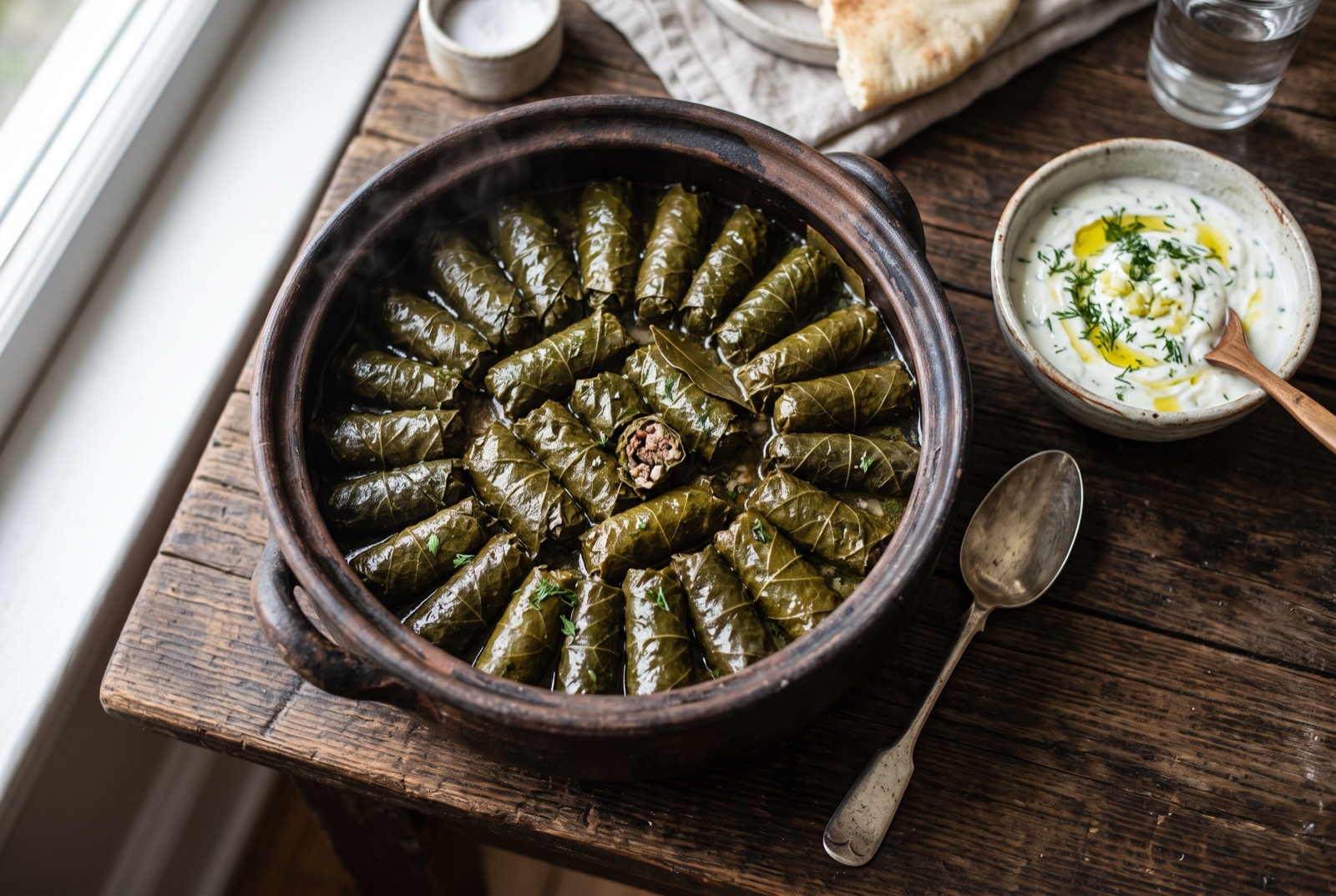
Tolma is minced lamb, rice and chopped herbs wrapped in brined grape leaves and simmered slowly in a shallow pot until the leaves go silky and the filling swells into one soft, savoury mass. The taste is sour before anything else — the leaves give a clean vine-leaf tang that cuts the fat of the lamb — then herbal, then faintly sweet from long-cooked onion. Nothing in it is spicy. Armenians eat tolma hot with a bowl of garlic-spiked matsun for dipping, and the contrast of warm, sour parcel against cold, sharp yogurt is the whole point of the dish. Rolling takes patience; the cooking is close to unattended.

- Gate
- ArmeniaArarat Valley
- Prep
- 45 min
- Cook
- 1 hr
- Total time
- 1 hr 55 min incl. 10 min rest
- Serves
- 4
- Status
- Medium
- Nutrition / serving · estimated
- Calories 520 kcal
- Protein 27 g
- Carbs 34 g
- Fat 31 g
- Fiber 4 g
- Sodium 940 mg
Why this recipe works.
- The filling goes in raw, so the meat juices cook into the rice instead of being lost in a pan first.
- A weighted plate on top keeps the rolls from unwinding — the single fix that separates tidy tolma from a pot of shredded leaves.
- Honest ratios: enough rice to swell without turning the filling into a rice ball, enough onion to keep it moist.
- Includes the summer vegetable version, which uses the identical filling and no rolling at all.
Ingredients.
16 itemsFor the parcels
For the filling
For the pot
To serve
Equipment
- Wide, heavy-based pot or deep sauté pan with a lid
- A heatproof plate that fits inside the pot
- Large mixing bowl
Instructions.
Prepare the leaves
Lift the grape leaves from their brine, unroll them gently and rinse in two changes of cold water. Taste a corner: if it is still sharply salty, soak them for ten minutes more. Drain and stack them shiny side down, trimming off any thick stems.
Mix the filling
Combine the lamb, rinsed rice, chopped onion, parsley, dill, coriander, dried mint, tomato paste, salt and pepper in a bowl. Work it with your hand for a full minute until the mixture is uniformly flecked green and tacky enough to hold its shape when squeezed.
Tip Fry a teaspoon of the mixture in a small pan and taste it — this is your only chance to correct the seasoning.
Roll the tolma
Lay a leaf vein side up, put a heaped teaspoon of filling near the stem end, fold the base over it, fold both sides in, and roll into a cigar about the width of your thumb. Keep it snug but leave a little slack — the rice nearly doubles as it cooks.
Pack the pot
Line the base of a wide pot with torn leaves and a few lemon slices. Pack the rolls seam side down in tight concentric circles, layering as you go, so they brace each other and cannot shift.
Weight and add liquid
Pour over the melted butter and lemon juice, then add enough stock to just cover the top layer. Press a heatproof plate face-down onto the rolls so they stay submerged and cannot unroll.
Simmer gently
Bring to a bare simmer, cover, and cook on the lowest heat for about 55 minutes, until a test roll cuts cleanly, the rice is fully swollen with no chalky centre, and the leaf has gone from bright green to a soft olive drab.
Tip If the liquid drops below the rolls at any point, top up with hot water rather than cold.
Rest, then serve
Take the pot off the heat and leave it covered with the plate still in place for 10 minutes so the rolls firm up. Stir the crushed garlic into the matsun and serve the tolma hot, spooning a little pot liquid over each portion.
Tips from our kitchen.
- Rinse brined leaves in two changes of cold water and taste one. If it is still fiercely salty, soak for ten minutes — you cannot salt-correct the dish later.
- Roll snugly but not tightly. The rice expands to nearly double, and a drum-tight roll will split along the seam.
- Line the pot with torn, damaged or oversized leaves before you stack. They act as a sacrificial layer so the bottom rolls do not scorch.
- A heatproof plate pressed face-down on the rolls is not optional. Without weight the rolls float, tumble and unroll.
- Fatty lamb makes better tolma than lean. If your mince is very lean, work in a spoonful of butter or a little grated lamb fat.
- Fresh vine leaves from an unsprayed vine are excellent, but blanch them for 30 seconds first or they stay tough and taste grassy.
Substitutions.
- Brined grape leaves → Blanched cabbage leaves, ribs shaved flat
- Cabbage tolma is fully traditional in winter and in the north. Roll larger parcels and add 15 minutes to the cooking time.
- Ground lamb → Half beef, half pork — or all beef
- Mixed mince is common in Armenian homes. All-beef tolma is leaner and needs a little extra butter in the filling.
- Matsun → Thick plain yogurt, ideally full fat and unsweetened
- Matsun is sharper than supermarket yogurt. Thin the substitute with a spoon of water and add extra garlic to get closer.
Variations.
- Ambarshapatik tolma (summer vegetable tolma)
- The same filling packed into hollowed peppers, tomatoes and small aubergines, stood upright in a pot with their cut-off caps replaced, and braised until the skins slump.
- Pasuts tolma
- The Lenten version: no meat at all, with red beans, lentils, chickpeas and cracked wheat bound with fried onion. Made in big batches for Christmas and eaten cold.
- Sour-plum tolma
- A handful of dried sour plums or a spoon of sour-plum paste tucked between the layers, which deepens the sourness beyond what the leaves alone give.
Storage & reheating.
Tolma keeps 3 days refrigerated in its cooking liquid and genuinely improves on day two once the sourness settles into the filling. Reheat covered with a splash of water over low heat, or steam them — a microwave dries the leaves and makes them chewy. They freeze well cooked: freeze in a single layer, then bag, and reheat from frozen in a covered pan with a little water for about 20 minutes.
Serve with
Garlic matsun for dipping, warm lavash, and a plate of raw herbs and spring onions to eat between bites.
The story behind Tolma.
Stuffed leaves belong to everyone between the Balkans and the Caucasus, and Armenia is one of the loudest voices in that argument. The word tolma is usually traced to a Turkic root meaning "to stuff," but Armenians point out that the practice of wrapping food in vine leaves is far older than any of the modern names for it, and that grape cultivation in the Armenian highlands runs back thousands of years. The honest position is that nobody owns it: Greeks, Turks, Azerbaijanis, Georgians, Armenians, Lebanese and Iranians all make a version, the versions differ meaningfully, and each community learned it from the same shared geography rather than from each other.
What makes the Armenian version its own thing is the summer counterpart. Alongside the rolled leaves sits ambarshapatik tolma — a whole summer's vegetables hollowed out and filled with the same mixture: peppers, tomatoes, aubergines, sometimes quince or okra, packed upright in a pot so they steam in their own juices. There is also pasuts tolma, the Lenten version, where the leaves hold beans, lentils and cracked wheat instead of meat, made in quantity around Christmas and Easter and eaten cold. A family that makes tolma usually makes all three across the year.
The ritual around it matters as much as the recipe. Tolma is what gets made when there are enough hands in the kitchen to justify it — a table of women rolling while the pot fills, a stack of leaves shrinking through an afternoon. It is holiday food, mourning food and reconciliation food, and in 2017 the Tolma Festival held outside Yerevan turned the whole business into an annual public argument about whose is best, which is exactly the right spirit for it.
Questions, answered.
Why did my rolls fall apart during cooking?
Almost always one of three things: the leaves were rolled too loosely, the pot was too roomy so the rolls shifted around, or there was no weight on top. Pack the rolls shoulder to shoulder in a pot they just fit, and press a heatproof plate face-down over them before adding liquid.
Should the rice be cooked before it goes into the filling?
No. Raw rice is correct — it absorbs the lamb juices and the cooking liquid as it swells, which is where most of the flavour comes from. Pre-cooked rice turns pasty and makes the filling heavy. Just rinse it until the water runs clear so it does not clump.
What is the difference between tolma and dolma?
They are the same family of dish under different spellings; Armenians generally say tolma, while dolma is the more common spelling elsewhere in the region. Stuffed leaves and stuffed vegetables are made from the Balkans to Iran, and no single country invented them, so the naming difference is cultural rather than culinary.
Can I make tolma ahead for a party?
Yes, and you should. Roll and cook them a day in advance, cool them in the pot, and refrigerate. Reheat gently with a little water added, covered, over low heat. The flavour is better after a night, and it removes the rolling from the day itself.
Are grape leaves and vine leaves the same thing?
Yes — the leaves of the grapevine, sold jarred in brine or vacuum-packed in Middle Eastern, Greek and Balkan shops. Pick the ones with a uniform olive-green colour and no black patches. Fresh leaves work too, picked young in late spring and blanched briefly before use.
You might also like.
All recipes →
Keep exploring Armenia.
Armenia has 9 more dishes in the atlas — Armenian Harissa and Eetch, and 7 more.
Recipe by The DishRoute Kitchen · published August 20, 2026 · updated August 20, 2026