Ghapama.
Armenian Pumpkin Baked with Rice and Dried Fruit
Ղափամա · say it: gha-pa-MAH
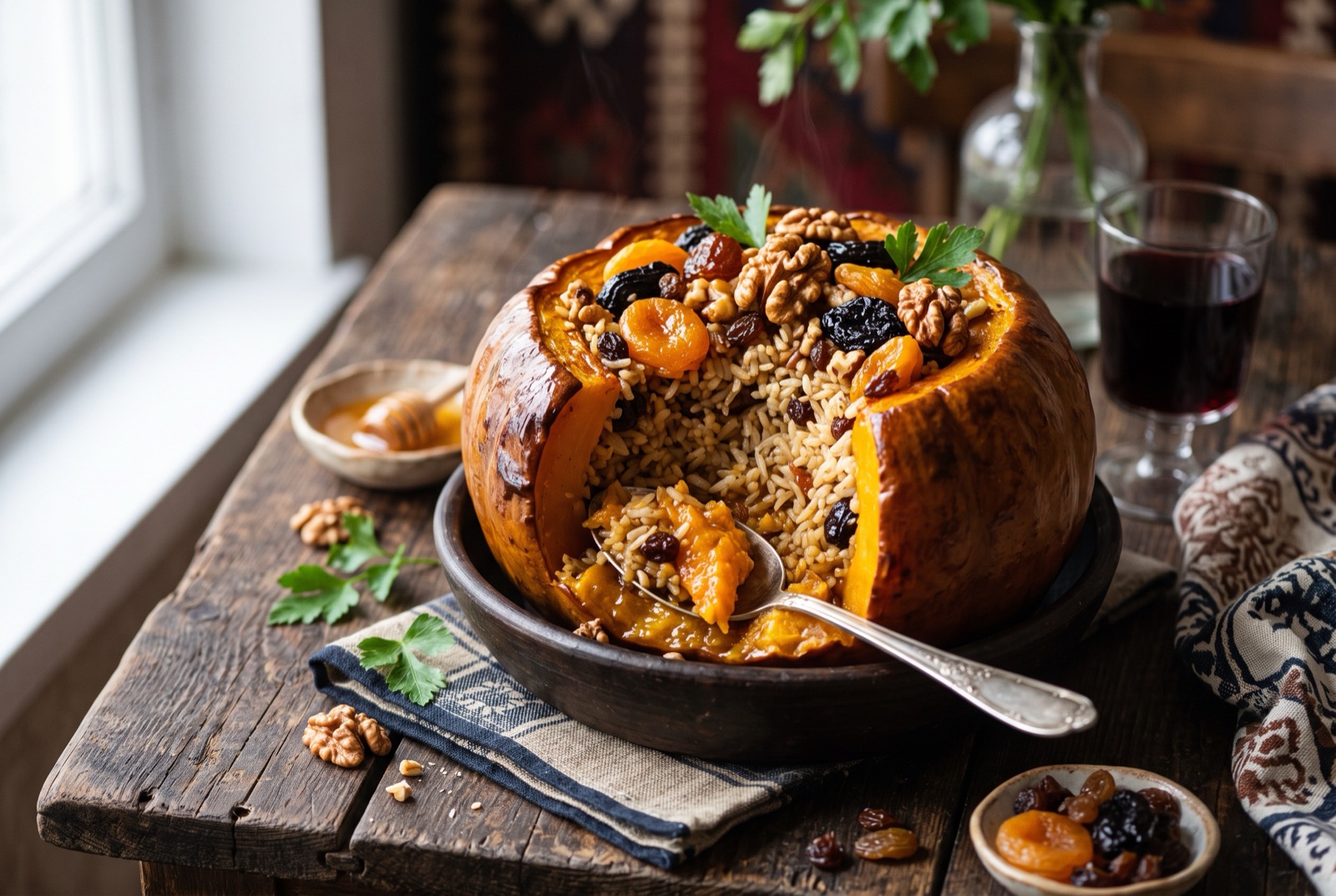
Ghapama is a whole pumpkin used as its own cooking pot: the top is cut off as a lid, the seeds scraped out, and the cavity packed with part-cooked rice, dried apricots, prunes, raisins, walnuts, butter, honey and cinnamon. Baked for a couple of hours, the flesh softens to the point where a spoon takes pumpkin and filling together in the same scoop. It is sweet but not dessert-sweet — the fruit does most of the work and the pumpkin stays vegetal underneath — and it arrives at the table whole, still steaming, to be cut open in front of everyone. In Armenia it is winter, wedding and New Year food.

- Gate
- ArmeniaHighland Armenia
- Prep
- 35 min
- Cook
- 1 hr 50 min
- Total time
- 2 hr 40 min incl. 15 min rest
- Serves
- 6
- Status
- Medium
- Nutrition / serving · estimated
- Calories 480 kcal
- Protein 8 g
- Carbs 76 g
- Fat 18 g
- Fiber 7 g
- Sugar 32 g
Why this recipe works.
- The rice is part-cooked before it goes in, so the filling finishes at exactly the same moment as the pumpkin flesh.
- A pumpkin size and weight given explicitly, since the whole timing depends on it.
- Sweetness kept in check with lemon zest and salt, so it works as a main course rather than a pudding.
- Explains the two failure modes — watery collapse and undercooked walls — and how to avoid both.
Ingredients.
13 itemsFor the pumpkin
For the filling
Equipment
- Sturdy roasting tray
- Sharp knife and a strong metal spoon for hollowing
- Foil
Instructions.
Open and hollow the pumpkin
Cut a lid off the top at a slight inward angle so it will sit back in place, then scrape out the seeds and every stringy fibre with a metal spoon until the inside walls feel smooth. Rub the cavity with salt and stand it upside down for 15 minutes to drain.
Part-cook the rice
Boil the rinsed rice in well-salted water for 5 minutes only, then drain thoroughly. Bite a grain — it should be soft outside with a distinct hard core, because it will finish cooking inside the pumpkin.
Soak the dried fruit
Cover the apricots, prunes and raisins with hot water for 10 minutes until they plump and soften, then drain, keeping the soaking liquid. Dry fruit going in straight from the packet stays leathery in the finished dish.
Mix the filling
Fold the drained rice with the softened fruit, walnuts, butter, honey, cinnamon, lemon zest and salt until everything is evenly coated and glossy. Taste it — it should be sweet and clearly salted, not one or the other.
Fill and seal
Blot the pumpkin cavity dry and spoon the filling in, pressing it down only lightly and stopping about 2 cm below the rim so the rice has room to swell. Pour in the hot water and the reserved fruit liquid, then set the lid back on.
Bake covered
Sit the pumpkin on a crumpled foil ring in a roasting tray, tent it loosely with foil, and bake at 180°C for 90 minutes. The skin will darken and the whole thing will start to smell of cinnamon and caramelised fruit.
Uncover and finish
Remove the foil and bake for a further 20 minutes to colour the shoulders. It is done when a skewer pushed through the side wall near the base meets no resistance and the flesh feels like soft butter.
Tip If the top is browning too fast but the base is still firm, drop the oven to 165°C and re-tent it.
Rest and cut at the table
Let the pumpkin stand for 15 minutes so the flesh firms up enough to slice. Carry it out whole, lift off the lid in front of everyone, and cut down from the top into wedges through skin, flesh and filling together.
Tips from our kitchen.
- Pick a squat, round pumpkin of about 2.5 kg with thick walls. Flat decorative pumpkins collapse and the enormous ones stay raw at the base long after the top is done.
- Scrape the cavity properly with a metal spoon until the walls are smooth. Leftover stringy fibres never soften and end up threaded through the rice.
- Salt the inside of the cavity and let it stand for 15 minutes, then blot it. This draws off surface water that would otherwise thin the filling.
- Part-cook the rice only to the point where it still has a firm core. Fully cooked rice going in means mush coming out.
- Sit the pumpkin on a ring of crumpled foil in the tray so it cannot roll, and cover it loosely — direct oven heat scorches the shoulders before the base is tender.
- Test doneness by pushing a skewer through the side wall near the base, not the top. That is the last place to cook through.
Substitutions.
- Whole pumpkin → A large butternut or kabocha squash, halved and hollowed
- Halves take about 40 minutes less and are far easier to serve, though you lose the theatre of opening it at the table.
- Butter and honey → Olive oil and a little grape molasses or maple syrup
- This makes the dish fully vegan and is closer to the older fasting-day version. Grape molasses is the more Armenian of the two sweeteners.
- Walnuts → Almonds, or omit entirely
- Walnuts are traditional and give a faint bitterness that balances the fruit, but the dish works without them for anyone avoiding nuts.
Variations.
- Meat ghapama
- Browned lamb or chicken pieces layered through the rice with less fruit and no honey, turning the dish into a full savoury main course.
- Individual ghapama
- Small round squashes filled and baked one per person, ready in about 50 minutes and much easier to serve at a dinner table.
- Bulgur ghapama
- Coarse bulgur in place of rice, which absorbs less liquid and gives a nuttier, chewier filling — common in western Armenian households.
Storage & reheating.
Ghapama keeps 3 days refrigerated, though the pumpkin softens further and the wedges no longer hold their shape. Scoop the flesh and filling into a container rather than storing the shell. Reheat covered in a 160°C oven for 20 minutes or in a covered pan on the stove with a spoonful of water. It does not freeze well — the pumpkin releases water on thawing and the rice turns grainy. If you need to work ahead, prepare the filling a day early and stuff the pumpkin on the day.
Serve with
Cut into wedges from the top and served with a bowl of matsun or thick yogurt to offset the sweetness.
The story behind Ghapama.
Ghapama is the rare dish that most Armenians know through a song before they know it through a plate. "Hey Jan Ghapama" is a folk wedding song about a pumpkin being carried to the table, each verse listing what went inside it, and it is sung so widely that the dish and the tune are effectively inseparable. Ask an Armenian about ghapama and there is a decent chance they will start humming.
The cooking logic behind it is old highland practicality. Pumpkins keep for months in a cold storeroom without any processing at all, and so do dried apricots, prunes, raisins and walnuts — the four things Armenian households dry and store in quantity every autumn. Ghapama is what those winter stores look like when they are put together and given heat. The original bakes happened in a tonir, the clay pit oven, where a sealed pumpkin buried in the residual heat cooked slowly for hours without anybody watching it. That is also why the dish is traditional at Christmas and New Year, when the tonir was already hot and the storeroom was full.
The balance of the filling shifts by household and region. Some versions lean savoury and go alongside meat; some add a spoon of honey and read almost as a dessert; some include lamb or chicken worked through the rice and stop being sweet at all. There is no settled canonical version, and Armenians argue about it in the friendly way families argue about their own grandmother's proportions. What everyone agrees on is the presentation: the pumpkin comes out whole, the lid comes off at the table, and it gets cut into wedges from the top down so each person gets skin, flesh and filling in the same piece.
Questions, answered.
Which pumpkin variety should I use?
A dense, thick-walled cooking pumpkin — kabocha, red kuri, sugar pie or a squat Hokkaido-type squash all work. Avoid large carving pumpkins, which are watery and stringy and were bred for size rather than eating. Aim for around 2.5 kg, which serves six comfortably.
Why is my filling wet and the pumpkin collapsing?
Either the pumpkin was a watery carving variety, or the rice was fully cooked before it went in and had no capacity left to absorb the juices the pumpkin releases. Use a dense squash, part-cook the rice to a firm core, and salt and blot the cavity before filling it.
Can I make ghapama without the whole pumpkin?
Yes. Halve a butternut or kabocha, hollow it out, fill both halves, and bake them cut side up covered with foil for about 70 minutes. You get the same flavours with easier serving and shorter cooking, but the dish loses the moment where the lid comes off at the table.
Is ghapama a dessert or a main dish?
It sits in between, and Armenians serve it both ways. With honey and heavy dried fruit it leans sweet and can close a meal; with less sweetener, more salt, or meat worked through the rice it functions as a main course. The version here is deliberately balanced so it can go either way.
How do I serve it without the whole thing falling apart?
Let it rest 15 minutes out of the oven so the flesh firms slightly, then cut down from the top in wedges like a cake, straight through skin, flesh and filling. Slide a wide spatula underneath each wedge to lift it. Do not try to scoop the filling out first — the shell will slump the moment it is empty.
You might also like.
All recipes →
Keep exploring Armenia.
Armenia has 9 more dishes in the atlas — Armenian Harissa and Eetch, and 7 more.
Recipe by The DishRoute Kitchen · published August 20, 2026 · updated August 20, 2026