Manti.
Armenian Boat-Shaped Baked Dumplings
Մանթի · say it: mahn-TEE
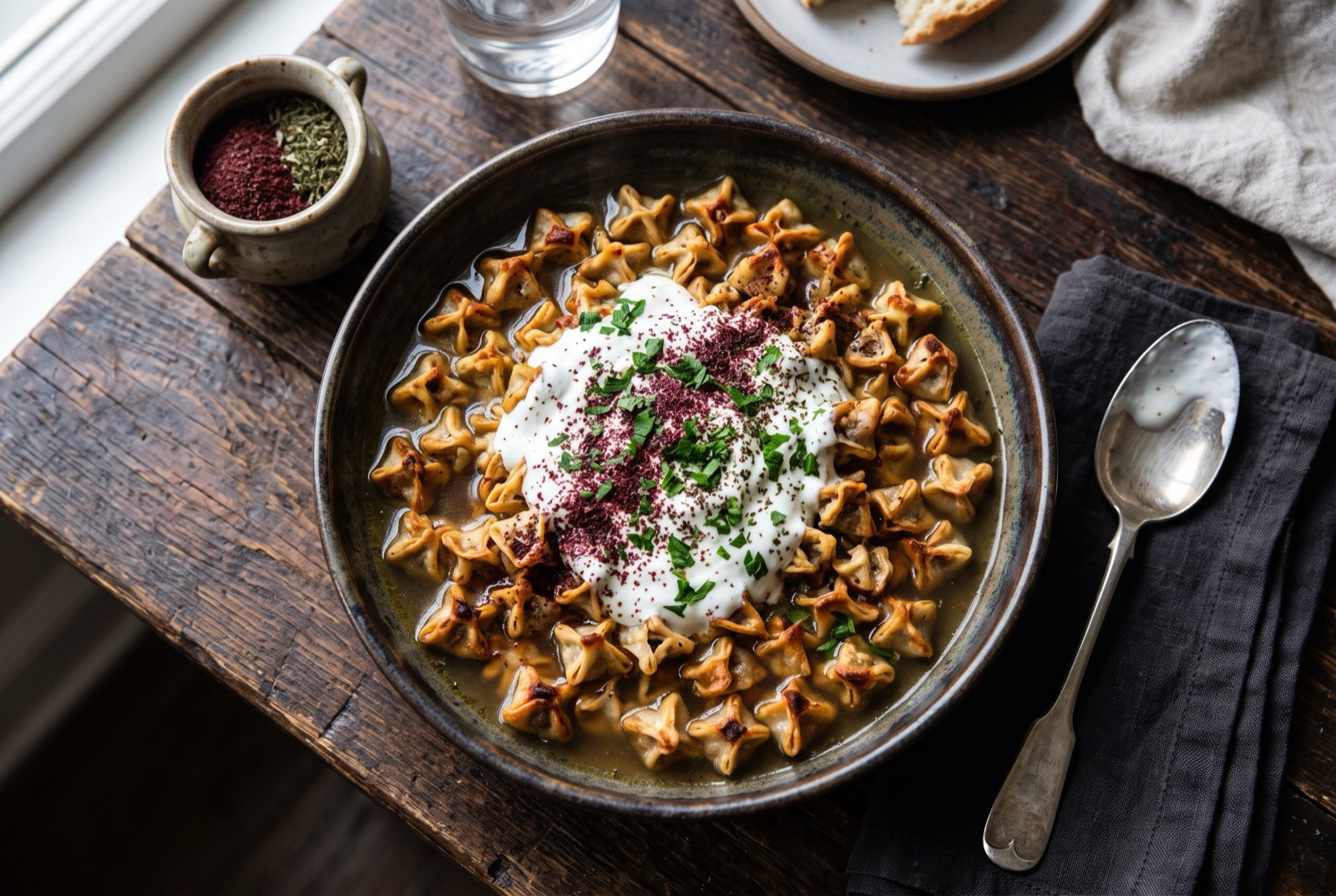
Armenian manti are thumb-sized open dumplings — squares of thin dough pinched into little boats around a pinch of spiced minced meat — packed side by side in a tray and baked until the exposed dough goes deep gold and brittle. They are not boiled. Instead, hot broth is ladled over them just before eating, so the crisp edges soften unevenly and every spoonful gets both crunch and give. Over the top go cold garlic yogurt and a heavy dusting of sumac, which brings a sharp, fruity sourness against the toasted dough. Making them takes an afternoon and a certain tolerance for repetition; eating them takes about four minutes.

- Gate
- ArmeniaWestern Armenian tradition
- Prep
- 1 hr 15 min
- Cook
- 30 min
- Total time
- 2 hr 15 min incl. 30 min rest
- Serves
- 4
- Status
- Medium
- Nutrition / serving · estimated
- Calories 590 kcal
- Protein 32 g
- Carbs 62 g
- Fat 24 g
- Fiber 3 g
- Sodium 1250 mg
Why this recipe works.
- Bakes the dumplings dry before any liquid touches them, which is what gives Armenian manti their toasted flavour.
- A dough hydration that rolls thin without tearing, plus the thickness to aim for in millimetres.
- Broth poured at the table rather than in the kitchen, so the texture contrast actually survives to the plate.
- A folding rhythm that makes 100-plus dumplings manageable rather than punishing.
Ingredients.
16 itemsFor the dough
For the filling
For baking
To finish
Equipment
- Rolling pin
- Large shallow baking tray
- Pizza wheel or sharp knife
- Ladle
Instructions.
Make and rest the dough
Work the flour, egg, salt and warm water into a firm, slightly stiff dough and knead for 8 minutes until it turns smooth and springs back slowly when pressed. Wrap it and leave it at room temperature for 30 minutes.
Mix the filling
Squeeze the grated onion hard in your fist to get rid of its water, then mix it with the meat, parsley, paprika, salt and pepper until evenly combined. Keep it cold until you are ready to fill.
Tip Wet onion is the main reason manti leak in the oven — squeeze harder than you think you need to.
Roll and cut
Roll a quarter of the dough at a time on a floured surface until it is about 1.5 mm thick and you can see your hand through it. Cut it into 4 cm squares with a pizza wheel, keeping the rest of the dough covered.
Shape the boats
Put a scant half teaspoon of filling in the middle of each square, lift two opposite edges and pinch them together at each end, leaving the centre open like a little canoe. Set them upright in a buttered tray, packed tightly against each other.
Bake dry
Brush the tops lightly with melted butter and bake at 200°C for about 20 minutes, until the exposed dough is a deep biscuit gold and crisp to the tap and the meat has shrunk slightly into each boat.
Tip Rotate the tray halfway through — the corners always run ahead of the middle.
Heat the broth and mix the yogurt
Bring the stock to a hard boil, whisking in the tomato paste if using, and taste it — it should be noticeably well seasoned, since it is the only sauce. Separately stir the crushed garlic into the loosened yogurt and leave it 20 minutes.
Assemble at the table
Divide the hot manti into bowls, carry them out, and ladle boiling broth over each portion so it comes about halfway up the dumplings. Spoon cold garlic yogurt on top, dust heavily with sumac, and eat straight away.
Tips from our kitchen.
- Roll the dough thinner than feels sensible — about 1.5 mm, thin enough to read large print through. Thick dough bakes into cardboard.
- Work with one quarter of the dough at a time and keep the rest under a cloth, or the edges dry out and refuse to pinch shut.
- Use a scant half teaspoon of filling per dumpling. Overfilled manti burst open in the oven and leak fat over the tray.
- Pack them shoulder to shoulder in the tray. Gaps mean the outer dumplings scorch while the inner ones stay pale.
- Take them out when the exposed dough is the colour of a good biscuit, not when the meat looks cooked — the meat is done long before the dough is.
- Make the garlic yogurt at least 20 minutes ahead so the raw garlic mellows from harsh to fragrant.
Substitutions.
- Ground beef → Ground lamb, or a half-and-half mix
- Lamb is closer to the older version and gives a stronger flavour. Beef is what most diaspora households use because it is milder.
- Homemade dough → Square wonton wrappers, trimmed if needed
- A real shortcut that many Armenian-American cooks use. They bake a little more brittle and less nutty, but the dish still works.
- Matsun for the yogurt sauce → Greek yogurt thinned with a spoon of water
- You want the consistency of pouring cream and a definite sourness. Greek yogurt straight from the tub is too stiff and too mild.
Variations.
- Tomato-broth manti
- The broth spiked with tomato paste and a knob of butter before pouring, giving a red-tinted, richer liquid — common in Aleppo Armenian kitchens.
- Crown manti
- The same dough and filling pinched at four corners into open squares instead of boats, which hold slightly more filling and toast more evenly.
- Dry manti
- Served without broth at all, straight from the oven with yogurt and sumac only, eaten with fingers as a snack alongside tea.
Storage & reheating.
Unbaked manti freeze extremely well: arrange them on a tray until solid, then bag them, and bake from frozen with 5 minutes added. Baked, unbrothed manti keep 3 days refrigerated in an airtight box and can be crisped back up in a hot oven for 6 minutes. Do not store manti that have already had broth poured over them — they turn to paste within an hour and cannot be brought back. Broth and yogurt sauce both keep 3 days separately.
Serve with
Cold garlic yogurt, plenty of sumac, and a simple herb and tomato salad to cut the richness.
The story behind Manti.
Manti is a name that travels. Versions exist from Central Asia to Anatolia to the Caucasus, and they are not variations on one dish so much as separate dishes that share a word: Uzbek manti are large steamed parcels the size of a fist, Turkish Kayseri mantı are boiled and minuscule, Korean mandu are something else again. The Armenian version is defined by the oven. The dumplings are open at the top, arranged in a tray like a fleet at anchor, and dry-baked first so the dough toasts before any liquid comes near it — a technique that gives them a nutty, almost pastry-like flavour the boiled versions simply do not have.
This is western Armenian food, carried out of Anatolia and now most strongly rooted in the diaspora communities of Aleppo, Beirut, Los Angeles and the eastern United States, where sini manti — manti in a tray — is the standard form. Some households toast the empty dumplings twice, once bare and once after a brush of butter or a spoon of tomato-tinted stock, to build colour in layers. The shape varies too: boats, or open-topped squares pinched at four corners into little crowns, depending on whose grandmother is in charge.
What is constant is the assembly at the table. The broth must be near-boiling, the yogurt must be cold and sharp with raw garlic, and the sumac goes on last and generously. Nobody pours the broth in the kitchen, because manti that sit in liquid for five minutes turn to porridge. The dish is served the moment the two temperatures meet, which is also why it is a dish for people who are already sitting down.
Questions, answered.
Why bake the dumplings instead of boiling them?
Because toasting the dough is the point of the Armenian version. Dry heat browns the exposed dough and gives it a nutty, biscuit-like flavour that boiling cannot produce. The broth added at the table then softens part of each dumpling while the rest stays crisp, which is the texture the dish is built around.
How thin does the dough need to be?
About 1.5 millimetres — thin enough that you can see the shape of your hand through it when lifted to the light. Anything thicker bakes hard and stays hard even after the broth goes on. If your dough springs back while rolling, let it rest another ten minutes and try again.
Can I make manti ahead of time?
Yes, and freezing is the best route. Shape them, freeze them uncovered on a tray until firm, then transfer to a bag for up to three months. Bake straight from frozen, adding about 5 minutes. You can also bake them fully a day ahead and re-crisp in a hot oven just before serving.
Why did my manti go soggy?
The broth was poured too early or there was too much of it. Manti should meet the broth at the table, not in the kitchen, and the liquid should come about halfway up the dumplings rather than submerging them. Serve immediately after pouring — the window between crisp and soft is only a couple of minutes.
What does the sumac actually do here?
It supplies a sharp, tannic, fruit-like sourness that the yogurt alone does not reach. Without it the dish tastes flat and heavy — meat, dough and dairy with nothing to lift it. Use it generously, dusted over each bowl at the end rather than stirred into anything.
You might also like.
All recipes →
Keep exploring Armenia.
Armenia has 9 more dishes in the atlas — Armenian Harissa and Eetch, and 7 more.
Recipe by The DishRoute Kitchen · published August 20, 2026 · updated August 20, 2026