Gata.
Armenian Sweet Layered Pastry
Գաթա · say it: gah-TAH
Gata is a sweet pastry built on a filling most people have never met: khoriz, which is flour rubbed into soft butter with sugar until it looks like damp sand, then packed inside a rich yeasted dough. As it bakes the khoriz melts, re-sets and turns sandy-crumbly, so cutting into a gata gives you a firm golden shell with a soft, sweet, faintly toasted rubble inside. It is not a wet or creamy pastry — it is dry in the way good shortbread is dry, and it exists to be eaten with tea or coffee. The top is scored in patterns before baking, which is both decoration and the reason it does not dome.
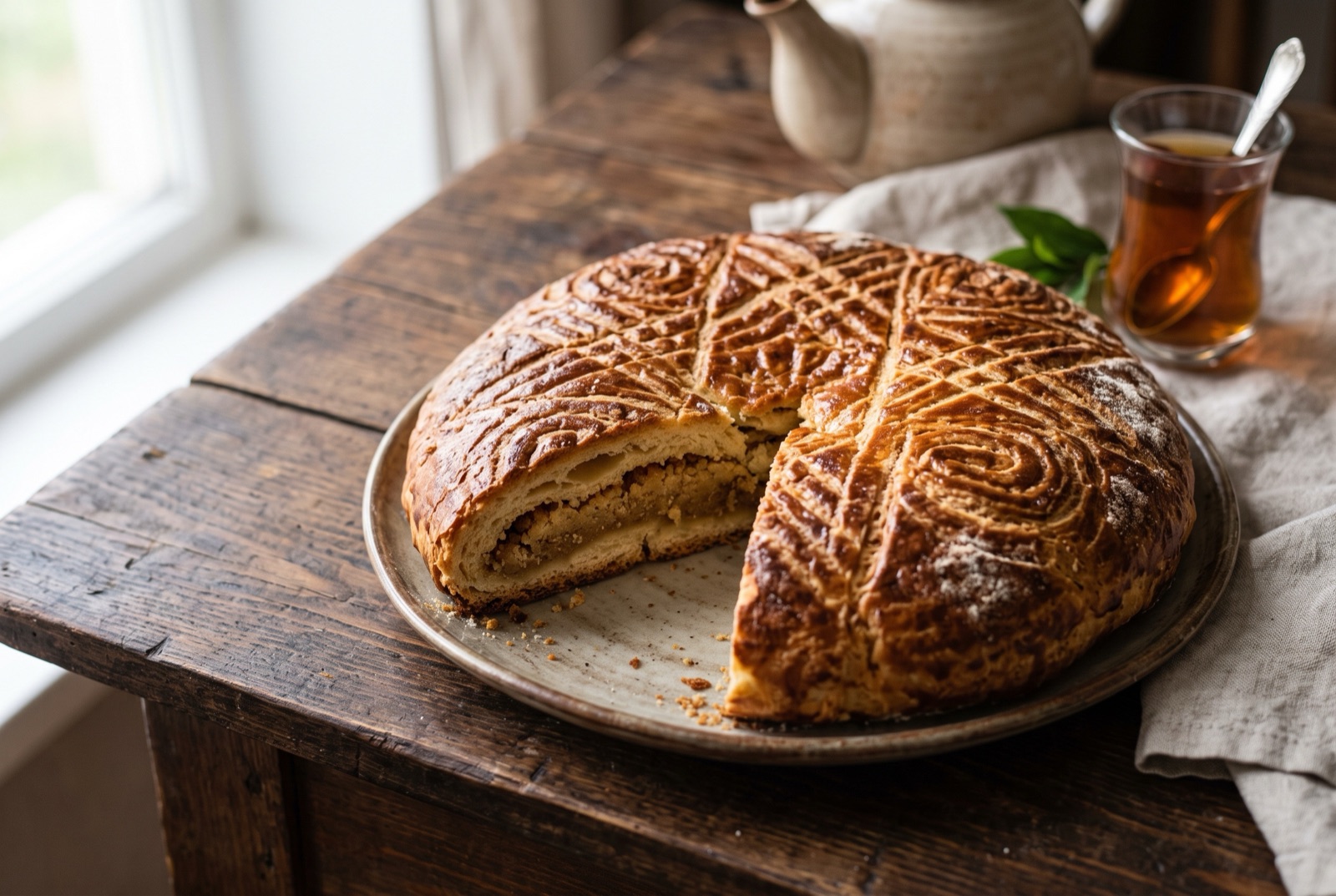

- Gate
- ArmeniaNationwide
- Prep
- 40 min
- Cook
- 35 min
- Total time
- 2 hr 30 min incl. 1 hr 15 min rest
- Serves
- 8
- Status
- Medium
- Nutrition / serving · estimated
- Calories 520 kcal
- Protein 8 g
- Carbs 62 g
- Fat 27 g
- Fiber 2 g
- Sugar 22 g
Why this recipe works.
- Khoriz mixed to the exact texture that stays crumbly instead of melting into a puddle.
- A yeasted dough enriched enough to taste like pastry but sturdy enough to hold the filling in.
- Scoring explained as function, not decoration — it is what keeps the top from ballooning.
- Bakes to a colour and sound you can check, rather than trusting a timer alone.
Ingredients.
14 itemsFor the dough
For the khoriz filling
To finish
Equipment
- Baking tray and baking paper
- Rolling pin
- Fork or knife tip for scoring
- Pastry brush
Instructions.
Start the dough
Stir the yeast and sugar into the warm milk and leave it 10 minutes until it foams. Rub the softened butter into the flour and salt, then work in the sour cream, egg and the yeast mixture until a soft, smooth dough forms.
Rest the dough
Knead briefly until the dough is even, then cover and leave it in a warm place for an hour. It will not double like bread dough — expect it to swell by about half and feel noticeably softer to the touch.
Make the khoriz
Rub the cool butter into the flour, sugar and salt with your fingertips until the mixture looks like damp sand and holds its shape briefly when squeezed in a fist. Stop there — do not work it into a dough. Fold in the walnuts if using.
Tip If your kitchen is warm and the mixture starts to look greasy, put the bowl in the fridge for five minutes and carry on.
Chill the filling
Refrigerate the khoriz for 20 minutes so it firms up. Cold filling stays where you put it while you roll and seal; warm filling smears and finds its way out through the seam.
Roll and fill
Roll the dough into a rectangle about 30 by 40 cm and 5 mm thick. Spread the khoriz evenly over it, leaving a 2 cm clear border, then roll it up from the long side into a firm log and pinch the seam shut along its whole length.
Shape and score
Coil the log into a spiral on a lined tray, seam side down, and press it gently into a flat round about 3 cm thick. Brush with the egg glaze and score a lattice or sunburst across the top, cutting 3 to 4 mm deep.
Tip The scoring is not just decoration — it lets steam out so the top does not balloon away from the filling.
Bake until deep gold
Bake at 180°C for 35 to 40 minutes, until the top is a deep, even gold and the base sounds hollow when tapped. Pale gata tastes raw and floury, so give it the full colour.
Cool before cutting
Let the gata cool on the tray for at least 15 minutes so the filling sets from molten to crumbly. Cut into wedges with a serrated knife and serve with strong tea.
Tips from our kitchen.
- The butter for the khoriz must be soft but not melted. Melted butter makes a paste that liquefies in the oven and leaks out of the seams.
- Rub the khoriz between your fingertips only until it looks like damp sand and just holds when squeezed. Overworking it into a dough is the classic mistake.
- Chill the khoriz for 20 minutes before filling. Cold filling stays put while you roll and seal.
- Seal the seam thoroughly and place it seam side down. Any gap and the melting filling will find it.
- Score the top 3 to 4 mm deep, right through the surface layer. Shallow decorative marks close up and the pastry domes.
- Bake until it is properly deep gold, not pale blond — the flavour of gata is largely in the colour of its crust.
Substitutions.
- Yeasted dough → All-butter shortcrust or rough puff pastry
- Both are used in real Armenian households. Puff gives the flakier style closer to nazook; shortcrust is quicker and slightly sandier.
- Sour cream in the dough → Matsun, thick yogurt, or buttermilk
- All work. The point is the acidity and fat, which tenderise the dough and stop it baking bready.
- Egg wash → Milk brushed on and a light dusting of sugar
- Slightly less shiny and less deeply coloured, but fine if you would rather not open an egg for a tablespoon.
Variations.
- Nazook
- The same khoriz rolled inside a laminated dough into a long log, sliced into diamonds before baking, and finished with walnuts and vanilla.
- Geghard-style flat gata
- A single large flat disc, lightly sweetened and heavily scored, baked in a tonir and sold warm outside the monastery. Less rich, more bread-like.
- New Year coin gata
- A clean coin wrapped in foil and hidden in the filling before baking; whoever finds it in their slice is said to have luck for the year.
Storage & reheating.
Gata keeps 5 days in an airtight tin at room temperature and is deliberately built for it — the dryness that makes it a poor dessert makes it an excellent keeper. Do not refrigerate, which turns the crumb hard and stale-tasting. Refresh a day-old piece in a 150°C oven for 6 minutes to bring back the crispness of the crust. It freezes well baked, wrapped tightly, for up to two months; thaw at room temperature and warm briefly before serving.
Serve with
Strong black tea or Armenian coffee, and nothing else — gata does not want cream or sauce.
The story behind Gata.
Every region of Armenia has its own gata and considers the others slightly wrong. Some are made as one big round loaf, cut in wedges like a cake; others as flat discs; others as small rolled logs sliced into pieces. Some doughs are yeasted and bread-rich, others are laminated with butter into flaky layers. What holds the category together is khoriz, the butter-flour-sugar filling, and the marked top: patterns pressed with a fork, a knife tip or a carved wooden stamp, in lattices, sunbursts and spirals that vary by household.
The most famous gata is sold outside the monastery of Geghard, where women bake it in outdoor tonirs and sell it warm at tables by the road. Buying a piece there, in the gorge under the cliffs, is one of the standard rituals of a day trip from Yerevan, and the version sold is a large flat disc with a lightly sweetened dough. Similar stalls sit outside other monasteries, and the bread is tied loosely to feast days, to hospitality, and to travel — it keeps well for days, which is exactly what you want from something bought on a road.
There is also a superstition worth knowing. At New Year and on Candlemas, a coin is baked inside a gata, and whoever gets the slice with the coin is meant to have a good year. This is a widespread Christian custom rather than an exclusively Armenian one, and Armenians do it with the same mixture of belief and amusement as everyone else. The close relative nazook — a flakier, rolled version made with the same filling — is often confused with gata and is essentially the same idea in a different shape.
Questions, answered.
What exactly is khoriz?
Khoriz is the filling that defines gata: soft butter rubbed together with flour and sugar until the mixture resembles damp sand. It is not a cream or a paste. In the oven it melts and re-sets into a sweet, sandy, faintly toasted crumb inside the pastry, which is the texture the whole dish is built around.
Why did my filling leak out during baking?
Either the butter was melted rather than softened, the khoriz was overworked into a paste, or the seam was not sealed properly. Use butter at cool room temperature, stop rubbing the moment it looks sandy, chill it before filling, and pinch the seam firmly with the pastry placed seam side down on the tray.
Why do you score the top?
Partly tradition — the patterns vary by household and region and some families use carved wooden stamps — but mostly function. The cuts let steam escape so the top does not balloon away from the filling, and they give the crust more surface to brown. Score 3 to 4 mm deep, not just a surface scratch.
What is the difference between gata and nazook?
They use the same khoriz filling and differ in dough and shape. Gata is typically a round or flat pastry made with a yeasted or shortcrust dough and scored on top. Nazook is rolled into a long log with a flakier laminated dough, sliced into diamonds before baking, and often contains walnuts and vanilla.
Can I make gata ahead?
Yes, easily. Both the dough and the khoriz can be made a day early and refrigerated separately, and the assembled unbaked pastry can sit covered in the fridge for a few hours before it goes in the oven. Baked gata keeps for five days in a tin, which is one of the reasons it has always been travel food.
You might also like.
All recipes →
Keep exploring Armenia.
Armenia has 9 more dishes in the atlas — Armenian Harissa and Eetch, and 7 more.
Recipe by The DishRoute Kitchen · published August 20, 2026 · updated August 20, 2026