Lavash.
Armenian Thin Tonir Flatbread
Լավաշ · say it: lah-VAHSH
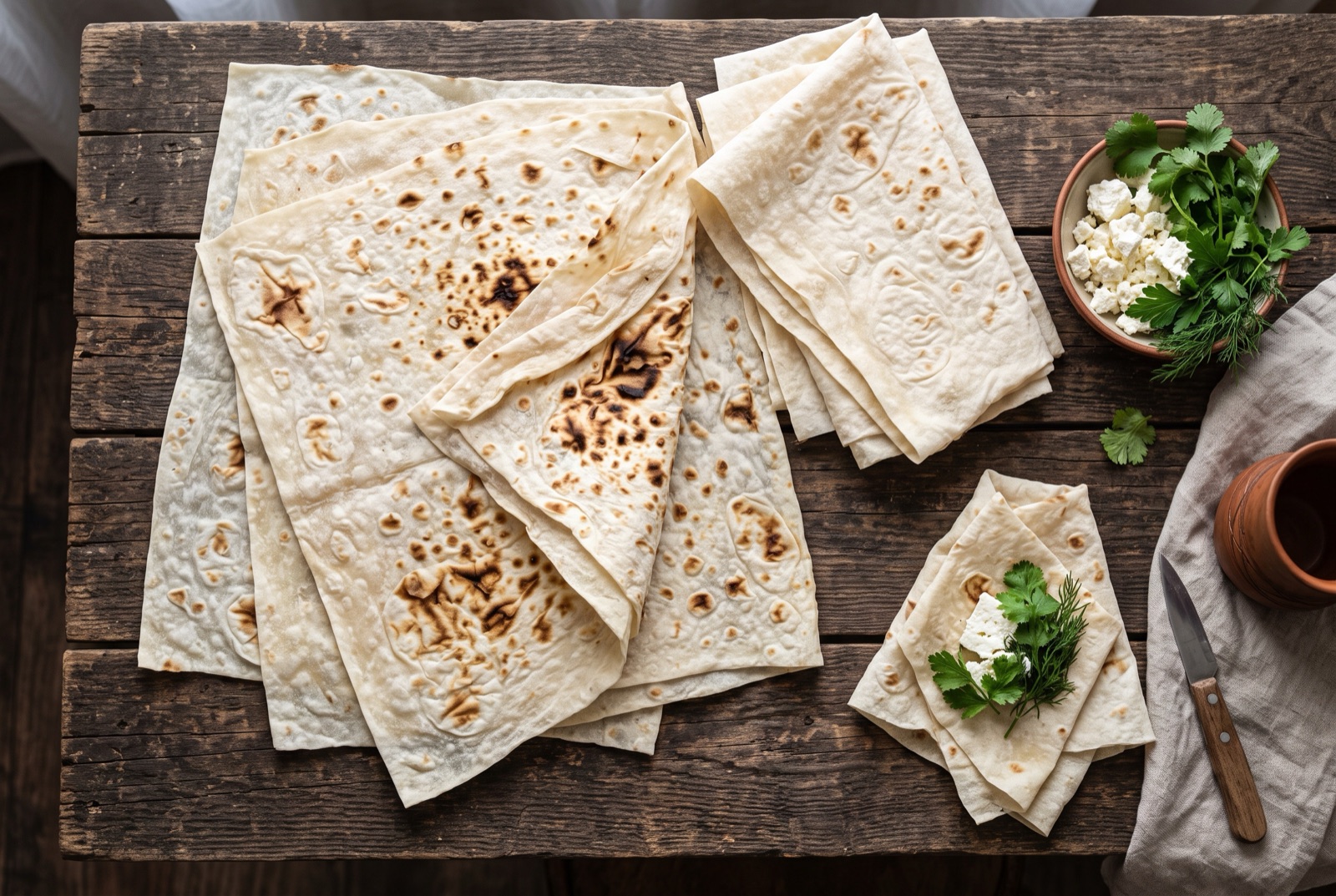
Lavash is a soft, unleavened-tasting flatbread rolled so thin you can see through it, cooked in seconds against the searing wall of a clay tonir until it blisters and puffs in patches. Fresh from the oven it is pliable, faintly chewy and just salty, with a scorched flavour along the bubbles that no pan-baked bread quite matches. Left out, it dries to a brittle sheet that stores for months and comes back to life with a sprinkle of water. In Armenia it functions as bread, plate, wrapper, napkin and spoon, and it earns that by being strong enough to hold grilled meat without tearing.

- Gate
- ArmeniaNationwide
- Prep
- 40 min
- Cook
- 20 min
- Total time
- 2 hr incl. 1 hr rest
- Serves
- 8
- Status
- Medium
- Nutrition / serving · estimated
- Calories 220 kcal
- Protein 7 g
- Carbs 46 g
- Fat 1 g
- Fiber 2 g
- Sodium 440 mg
Why this recipe works.
- A dough hydration that stretches translucent without tearing, which is the whole difficulty of lavash.
- Honest about the tonir: tells you exactly what the pan version loses and what it keeps.
- The stacking-under-a-cloth step that makes the difference between pliable bread and cracker.
- Covers drying and reviving the sheets, which is how lavash is actually stored in Armenia.
Ingredients.
5 itemsFor the dough
Optional topping
Equipment
- Long thin rolling pin
- Cast-iron pan or overturned wok
- Clean cloths for stacking
Instructions.
Mix the dough
Stir the flour, salt and yeast together, pour in the warm water, and bring it together into a shaggy mass. It should feel firm and slightly tacky, not sticky — add flour a spoonful at a time only if it clings to your hands.
Knead until smooth
Knead on an unfloured surface for about 8 minutes until the dough is smooth, elastic and no longer tears when you stretch a corner. Push, fold and turn in a steady rhythm rather than tearing at it.
Rest the dough
Cover the dough and leave it at room temperature for at least an hour. It will relax noticeably — a poked dent should fill back in slowly rather than springing straight out. This is what makes it stretchable.
Divide and shape
Cut the dough into 8 pieces, roll each into a tight ball, and cover them with a cloth. Let them sit another 15 minutes so the gluten settles again after handling.
Roll paper-thin
Working one ball at a time on a lightly floured surface, roll from the centre outward, turning the sheet a quarter turn between passes, until it is about 1 mm thick and you can read large print through it. Press in sesame seeds now if using.
Tip If the dough keeps springing back, set it aside under the cloth and roll the next ball — it will be cooperative when you return.
Heat the pan hard
Put a dry cast-iron pan or an overturned wok over the highest heat for a good 5 minutes. Flick a drop of water on: it should skitter and disappear within about two seconds before you bake anything.
Bake in seconds
Drape a sheet onto the hot surface and watch it: within 30 to 45 seconds it will bubble up in patches and the underside will show scattered brown blisters. Flip it, give it another 20 to 30 seconds, and take it off.
Tip Pale and even all over means the pan was too cool. You want irregular dark spots, not uniform colour.
Stack under a cloth
Move each finished sheet straight onto a stack under a damp tea towel and cover it again. The trapped steam softens the bread as the pile grows, turning brittle sheets into pliable ones by the time you finish the last.
Tips from our kitchen.
- Rest the dough for at least an hour. Underrested gluten fights back and the sheet will spring into an oval no matter how you roll.
- Roll from the centre outward and rotate the sheet a quarter turn after each pass, so it thins evenly instead of going lopsided.
- Get it thin enough to read newsprint through. If the dough is too elastic to reach that, cover it and wait ten minutes rather than forcing it.
- The pan must be genuinely hot — a drop of water should skitter and vanish in about two seconds. A moderate pan dries the bread out instead of baking it.
- Flip when the surface bubbles and the underside shows scattered brown spots, usually 30 to 45 seconds. Any longer and it goes crisp.
- Stack the finished sheets under a damp cloth immediately. The trapped steam is what keeps them foldable.
Substitutions.
- A tonir → A dry cast-iron pan, or an overturned wok over a gas flame
- The wok upside-down over a burner is the closest home approximation to a curved, radiantly hot surface, and it gives better blistering than a flat pan.
- Yeast → Omit it entirely
- Traditional lavash is often made without leavening at all. The dough is less soft to handle but the finished bread is nearly identical.
- Plain white flour → Up to a quarter wholemeal flour
- Village lavash was rarely made with fully white flour. More than a quarter wholemeal makes the sheet tear when stretched thin.
Variations.
- Dried storage lavash
- Sheets left flat until brittle and stacked in a dry place for months. Sprinkled with water and covered for ten minutes, they come back completely soft.
- Lavash crackers
- Sheets baked longer in a low oven until they snap, then broken into shards — the base for the Armenian-American cracker bread sold as a snack.
- Seeded lavash
- Sesame seeds or nigella pressed into the surface with the rolling pin before baking, common on the wider, thinner sheets served at restaurants.
Storage & reheating.
Fresh lavash stays soft for two days wrapped tightly in a cloth inside a bag. Beyond that, let it dry completely flat — brittle sheets keep for months stacked in a dry cupboard, which is how Armenian households have always stored it. To revive dried lavash, flick water across both sides with your fingers, stack the sheets under a damp towel for 10 minutes, and they return to full pliability. It also freezes well, interleaved with baking paper, for up to three months.
Serve with
Everything: wrapped around khorovats, torn into spas, or folded over salty cheese and a handful of raw herbs for breakfast.
The story behind Lavash.
Bread carries more weight in Armenia than in most places, and lavash is the reason. Sheets of it are laid on the shoulders of a bride and groom at weddings as a wish for prosperity, and dropping bread on the floor is treated as something close to a small disgrace. In 2014 UNESCO inscribed the preparation, meaning and appearance of lavash in Armenia on its Intangible Cultural Heritage list — recognition not of a recipe but of a practice, since making it properly requires several women working in rhythm around a hot pit in the ground.
The tonir is central to the whole thing. It is a clay-lined cylindrical oven sunk into the floor of the house or courtyard, fired with brushwood or dung cakes until the walls glow. The rolled dough is stretched over a cushion called a batat, then slapped against the inside wall, where it sticks, bakes in 30 to 60 seconds, and is hooked off with an iron rod. Bakers work in a line — one rolling, one stretching, one at the oven — and the tonir is hot enough that the last of these is a genuinely uncomfortable job.
The naming is worth being straight about. Lavash and closely related thin breads are made across the whole region — Iran, Turkey, Azerbaijan, Georgia and Central Asia all have their versions and their words for it — and in 2016 UNESCO added a separate joint inscription covering flatbread making and sharing culture in several of those countries. The two listings caused a certain amount of public argument. The sensible reading is that the bread is regional and old, while the specific Armenian practice, with its wedding rituals and its household tonir, is what was recognised in 2014.
At home nobody has a tonir, and the honest version is a dry cast-iron pan or an overturned wok run as hot as the stove will go. It is not the same bread — you lose the scorched underside and the huge irregular blisters — but the dough, the thinness and the technique of stacking under a cloth to steam soft are all identical.
Questions, answered.
Can I make lavash without a tonir?
Yes, though it will not be identical. A dry cast-iron pan or an upside-down wok over the hottest burner you have gives good blistering and the right texture; what you lose is the deep scorching and the huge irregular bubbles the clay wall produces. The dough, the rolling and the steaming under a cloth are exactly the same either way.
Why is my lavash cracking instead of folding?
Either it stayed on the heat too long or it was not stacked under a cloth straight away. Lavash is done at 30 to 45 seconds a side, when the surface bubbles and the underside is spotted brown but not evenly coloured. Move each sheet onto the stack under a damp towel the moment it comes off, and the steam will soften it.
Is lavash leavened or unleavened?
Traditionally it is unleavened, or made with a small amount of old dough as a starter rather than commercial yeast. This version uses a little yeast because it makes the dough easier to stretch thin at home, but you can leave it out entirely and the finished bread will taste almost the same.
How thin does the dough actually need to be?
Thin enough to see the shape of your hand or read large print through it — roughly 1 millimetre or less. This is the single hardest part of the recipe, and the trick is patience rather than force: if the dough springs back, cover it and let it relax for ten minutes before continuing.
Is lavash Armenian, Iranian or Turkish?
Thin flatbreads of this type are made across Armenia, Iran, Turkey, Azerbaijan, Georgia and Central Asia, and no single country invented them. UNESCO recognised the specific Armenian practice — including its wedding rituals and household tonir baking — in 2014, and separately recognised flatbread making and sharing culture in several neighbouring countries in 2016.
You might also like.
All recipes →
Keep exploring Armenia.
Armenia has 9 more dishes in the atlas — Armenian Harissa and Eetch, and 7 more.
Recipe by The DishRoute Kitchen · published August 20, 2026 · updated August 20, 2026