Zhingyalov Hats.
Armenian Herb-Stuffed Flatbread
Ժենգյալով հաց · say it: zhen-gya-LOV hats
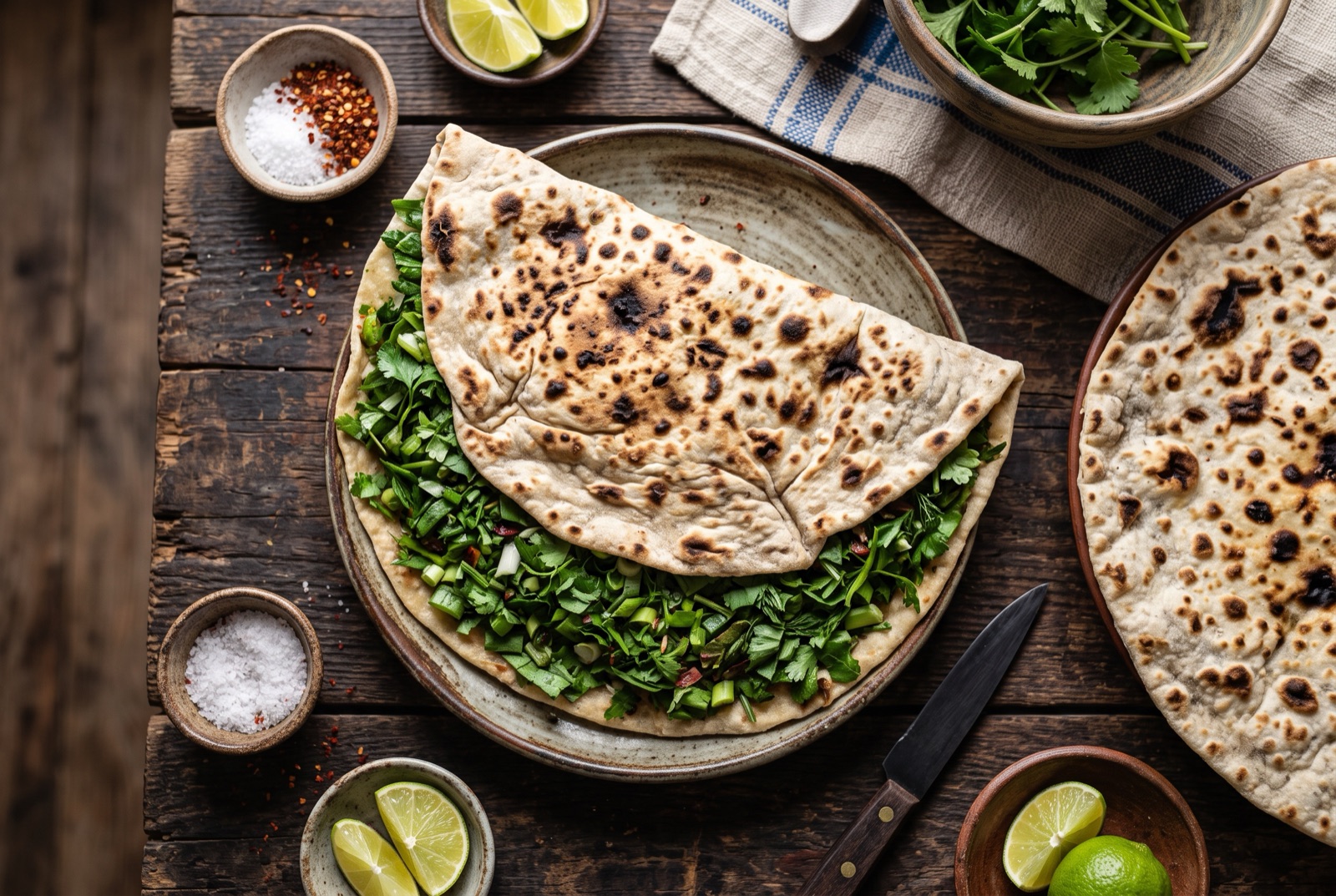
Zhingyalov hats is a thin flatbread packed with so many chopped herbs that the filling outweighs the dough. A soft unleavened round is rolled out, heaped with a dozen or more greens — spinach, chard, sorrel, coriander, dill, spring onion, whatever is in season — gathered shut at the top, flattened again, and cooked dry on a hot pan with no oil at all. The greens wilt inside their own steam and the dough goes spotted and brittle-edged around them. It tastes green and slightly sour, salted rather than spiced, and it is one of the very few traditional Armenian dishes that is vegan without anybody having planned it that way.

- Gate
- ArmeniaArtsakh
- Prep
- 45 min
- Cook
- 25 min
- Total time
- 1 hr 40 min incl. 30 min rest
- Serves
- 6
- Status
- Medium
- Nutrition / serving · estimated
- Calories 310 kcal
- Protein 10 g
- Carbs 52 g
- Fat 7 g
- Fiber 6 g
- Sodium 780 mg
Why this recipe works.
- A workable herb mix built from what a normal shop actually sells, with the sour and pungent roles explained so you can substitute intelligently.
- Salts and squeezes the greens first, so the bread does not steam itself into a wet mess.
- A sealing method that survives being rolled flat, which is where most first attempts fail.
- Cooked completely dry — no oil in the pan, exactly as it is done in Artsakh.
Ingredients.
15 itemsFor the dough
For the greens
Equipment
- Large dry cast-iron or heavy non-stick pan
- Rolling pin
- Very sharp knife for chopping greens
Instructions.
Make the dough
Mix the flour, salt and warm water into a soft dough and knead for 6 minutes until it is smooth and slightly slack — softer than a bread dough, since it has to stretch around a huge filling. Cover and rest for 30 minutes.
Chop the greens
Stack the leaves in handfuls, roll them into tight cigars and slice them finely with a sharp knife, working through every herb and green in turn. You should end up with a large bowl of fine, distinct shreds rather than a pulp.
Tip Do not use a food processor — it bruises the leaves and turns them watery.
Salt and squeeze
Toss the chopped greens with the salt and leave them for 10 minutes, then take them up in handfuls and squeeze hard over the sink until no more liquid runs out. Dress the squeezed greens with the olive oil, lemon juice and black pepper.
Roll the bases
Divide the dough into 6 balls and roll each into a thin round about 22 cm across, thin enough to see the board faintly through it. Keep the rest covered while you work.
Fill and seal
Pile a very generous mound of greens onto the centre of a round, leaving a 3 cm border, then bring the edges up all around and pinch them together at the top into a purse. Twist off the knot of excess dough and press the seam flat.
Tip The mound should look like too much. It shrinks to a third of its volume as it cooks.
Flatten gently
Turn the sealed parcel seam side down and press it out with your palms, then roll lightly, into a flat disc about 20 cm across. Work slowly and patch any tear with a scrap of dough before it opens further.
Cook dry
Cook in a dry pan over medium-high heat, with no oil, for about 3 minutes a side. It is done when the surface is covered in dark spots, the edges are crisp and dry, and the bread has visibly deflated as the greens wilt inside.
Tip Press the bread down with a spatula while it cooks so the whole surface makes contact.
Serve hot
Slide each bread onto a board and cut it into wedges, or hand it over whole to be torn. Eat while the edges still snap and the filling is steaming — this is not a bread that waits.
Tips from our kitchen.
- Aim for at least eight different greens. Fewer than that and it tastes like a spinach pasty rather than zhingyalov hats.
- Include something sour — sorrel, purslane or a squeeze of lemon — and something pungent, like spring onion tops or garlic chives. Those two roles carry the flavour.
- Chop the greens fine and by hand. A food processor bruises them into a wet pulp that leaks through the dough.
- Salt the chopped greens, wait ten minutes, then squeeze them hard in handfuls. The water you pour off is water that would otherwise burst your bread.
- Overfill it. The filling should look absurd before you seal it, because it collapses to a third of its volume as it cooks.
- Cook in a dry pan with no oil whatsoever. Oil fries the surface and stops the dough drying into its characteristic spotted crust.
Substitutions.
- Wild Artsakh greens → Spinach, chard, coriander, dill, parsley, spring onion, rocket, watercress and lettuce
- A shop-bought mix that hits the right balance. Add sorrel or a squeeze of lemon for the sourness the wild greens would supply.
- Sorrel → Baby spinach plus a good squeeze of lemon juice
- Sorrel is the hardest ingredient to find outside the region. Lemon reproduces the acidity, though not the grassy note.
- Homemade dough → Shop-bought thin flatbread or tortilla, filled and folded over
- A real compromise rather than an equivalent, but it gets herb bread on the table in fifteen minutes. Cook it the same way, dry and hot.
Variations.
- Zhingyalov hats with walnut
- A handful of crushed walnuts worked through the greens, which adds richness and is common in some Artsakh villages though not universal.
- Pomegranate-dressed filling
- A spoon of pomegranate molasses stirred into the greens before filling, sharpening the sourness when good sorrel is unavailable.
- Oven-baked
- Baked on a preheated stone or steel at 250°C for about 8 minutes instead of pan-cooked — easier for making several at once, with a drier crust.
Storage & reheating.
Best within an hour of cooking, while the edges still snap and the filling is warm. They keep 2 days refrigerated wrapped in cloth and are traditionally eaten cold at that point rather than reheated. If you do reheat, use a dry pan over medium heat for 2 minutes a side — an oven dries them out and a microwave makes the dough leathery. Cooked breads freeze for a month; reheat from frozen in a dry covered pan over low heat.
Serve with
Eaten hot from the pan on its own, or with a glass of tan — salted yogurt thinned with water — and a bowl of olives.
The story behind Zhingyalov Hats.
This is the signature dish of Artsakh, the mountainous region also known as Nagorno-Karabakh, and it is inseparable from that landscape. The classic filling calls for a large number of different greens — locals will name twenty or more, many of them wild and gathered in spring — and the point is variety rather than any single herb: sorrel for sourness, nettle and mallow for body, coriander and dill for aroma, spring onion tops for bite. Knowing which hillside plants go in, and in what proportion, was practical knowledge passed between generations of women rather than written down.
Because it needs no oven, no oil, no dairy and no meat, zhingyalov hats was everyday food and fasting food at once, and it travels: cooked in the morning, wrapped in cloth, eaten cold in a field at midday. In Stepanakert it was street food, sold from stalls and made to order in front of you, and the speed of an experienced maker filling and sealing one is genuinely startling.
The dish has taken on additional weight in recent years. Following the conflicts of 2020 and 2023, the Armenian population of Artsakh was displaced, and the bread is now made largely by people cooking it away from the place it comes from — in Yerevan kitchens, at diaspora fundraisers, at markets where the greens have to be bought rather than gathered. That has made it a marker of identity as much as a lunch, and there is a self-consciousness about getting it right that did not exist when it was simply what you ate. Cooked outside Artsakh with supermarket herbs, it is still very good; it is just no longer casual.
Questions, answered.
Which greens should I actually use?
Traditionally as many as you can gather — Artsakh cooks name well over a dozen. A practical shop-bought mix is spinach, chard, coriander, dill, parsley, spring onion tops, rocket, watercress and lettuce, with sorrel or lemon for sourness. The rule is variety plus one sour element and one pungent one; the exact list is flexible.
Why is my bread wet and tearing?
Too much water in the greens. Chopped herbs hold a surprising amount, and it has nowhere to go once the bread is sealed. Salt the filling, leave it ten minutes, then squeeze it out in handfuls over the sink until no more liquid runs. Roll gently after sealing, and patch any small tear with a pinch of spare dough.
Is zhingyalov hats vegan?
Yes, entirely and traditionally — dough of flour, water and salt, a filling of greens, salt and sometimes a little oil, cooked in a dry pan. It was fasting food long before anyone described it as vegan, which is why no adaptation is needed.
Can I make the filling in a food processor?
It is best not to. Blades bruise the leaves and drive out their water, giving a wet green pulp instead of distinct chopped herbs, and the finished bread tastes muddy. Stack the leaves, roll them into a cigar and slice finely with a sharp knife — it takes about fifteen minutes for this quantity.
How much filling is too much?
Almost certainly less than you think. The greens collapse to roughly a third of their raw volume as they steam, so a mound that looks impossible to close is about right. If the dough will physically seal around it, you have not overfilled it.
You might also like.
All recipes →
Keep exploring Armenia.
Armenia has 9 more dishes in the atlas — Armenian Harissa and Eetch, and 7 more.
All Armenia recipes Flour recipes Spinach recipes Cilantro recipes street foodbreadveganvegetariandairy freenut freeRecipe by The DishRoute Kitchen · published August 20, 2026 · updated August 20, 2026