Salt and Pepper Squid.
Peppered Fried Calamari
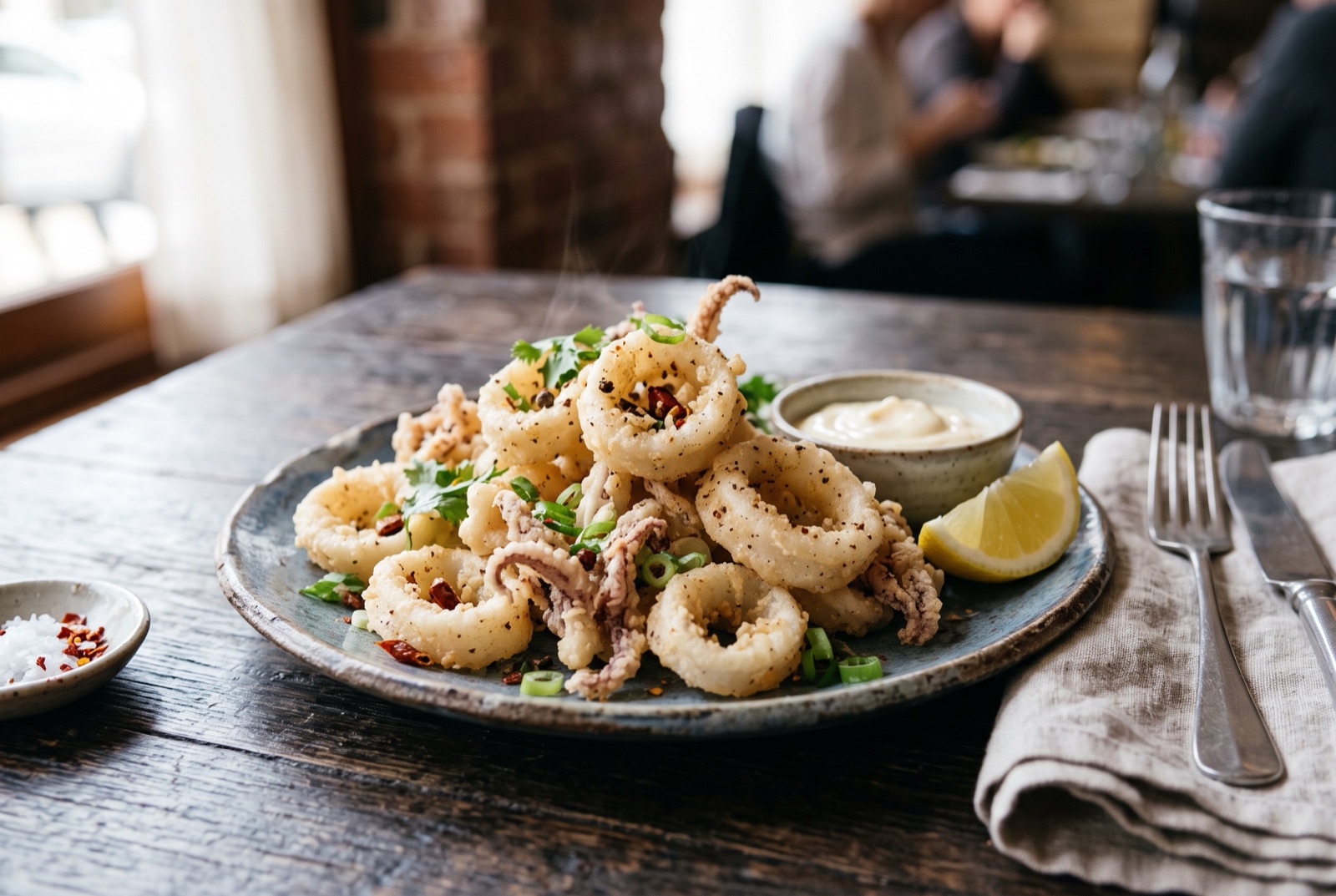
Salt and pepper squid is squid cut into rings or scored panels, dusted in a rice-flour coating spiked with toasted Sichuan and white pepper, and deep-fried for barely ninety seconds. Rice flour is what makes it: it fries to a thin, dry, glassy crust rather than the thick puffy batter of fish-shop calamari, so you taste squid first and coating second. The pepper does something specific — Sichuan pepper is not hot but numbing and citrusy, and against sweet squid and a squeeze of lemon it is the reason people order this again. Served with garlic aioli, it is the most reliably good thing on many Australian pub menus.

- Gate
- Australia
- Prep
- 25 min
- Cook
- 15 min
- Total time
- 1 hr incl. 20 min rest
- Serves
- 4
- Status
- Easy
- Nutrition / serving · estimated
- Calories 480 kcal
- Protein 30 g
- Carbs 31 g
- Fat 26 g
- Fiber 1 g
- Sodium 1050 mg
Why this recipe works.
- Uses rice flour and cornflour rather than a wet batter, which is what gives the thin, brittle, non-greasy crust.
- Toasts and grinds the peppercorns fresh — pre-ground pepper loses the citrus note that names the dish.
- A short buttermilk or milk soak tenderises the squid without turning the coating gluey.
- Explicit about the ninety-second window, the single thing that separates crisp squid from rubber bands.
Ingredients.
13 itemsFor the squid
For the pepper salt
For the coating
To serve
Equipment
- Heavy pot or wok for frying
- Cooking thermometer
- Mortar and pestle or spice grinder
- Spider or slotted spoon
- Wire rack
Instructions.
Prepare and soak the squid
If using whole tubes, slit them open, scrape the insides clean and score the inner face in a light diamond pattern before cutting into 4 cm panels; otherwise slice into 1 cm rings. Cover with the milk and leave in the fridge for 20 minutes.
Toast and grind the pepper
Toast the Sichuan and white peppercorns in a dry pan over medium heat for about 90 seconds, shaking constantly, until they smell distinctly floral and citrusy and a wisp of smoke rises. Cool, then grind with the salt to a coarse powder and pick out any hard black seeds.
Tip Stop the moment the aroma turns sharp and burnt — scorched Sichuan pepper is bitter and there is no fixing it.
Make the aioli
Stir the grated garlic and half the lemon juice through the mayonnaise with a pinch of the pepper salt. Taste and add more lemon until it is clearly sharp — it has to cut through fried food, not sit politely beside it.
Dry and coat
Drain the squid and pat it thoroughly dry on a clean tea towel. Combine the rice flour, cornflour and half the pepper salt in a bowl, add the squid in handfuls and toss until every piece is dusted, then shake off the excess in a sieve.
Heat the oil
Heat the oil in a deep pot to 190°C. A pinch of the coating dropped in should sizzle hard and rise immediately; if it sinks and fizzes lazily the oil is too cool and the squid will absorb it.
Fry in small batches
Fry the squid a small handful at a time for 60–90 seconds, until the coating is set, dry and the palest gold and the pieces float and rustle against the spider. Lift straight onto a wire rack and let the oil come back to temperature between batches.
Season and serve at once
Shower each batch with the remaining pepper salt while it is still hot enough to catch. Pile the squid onto a platter, scatter the coriander and chilli over, and serve immediately with the aioli and lemon wedges.
Tips from our kitchen.
- Dry the squid thoroughly after soaking. Wet squid makes the flour clump and the oil spit violently.
- Toast the Sichuan and white peppercorns in a dry pan until they smell fragrant and slightly floral, then grind — this takes ninety seconds and changes the whole dish.
- Fry at 190°C in small batches. Too many pieces at once drops the oil temperature and the coating soaks up fat instead of crisping.
- Drain on a wire rack over a tray, never on paper towel, or the underside steams soft immediately.
- Salt the squid the second it comes out of the oil, while the surface is still hot enough for the salt to stick.
- If you want the Cantonese finish, flash-fry sliced chilli, garlic and spring onion in a dry hot wok and toss the fried squid through for ten seconds.
Substitutions.
- Sichuan peppercorns → Extra white pepper plus a strip of lemon zest ground into the salt
- You lose the numbing tingle but keep the aromatic lift. It is a different dish, but a good one.
- Squid → Cleaned baby octopus, prawns, or firm tofu in batons
- Salt and pepper tofu is the standard vegetarian version on Australian menus and uses exactly the same coating and timing.
- Rice flour → Half cornflour, half plain flour
- Workable but noticeably heavier and less brittle. Rice flour is cheap and worth buying for this.
Variations.
- Cantonese jiu yim finish
- Skip the aioli. Toss the fried squid in a searing dry wok with sliced red chilli, garlic and spring onion for ten seconds — the original technique this dish came from.
- Salt and pepper soft-shell crab
- The same coating on soft-shell crabs, quartered, fried for two minutes. A staple of Australian-Chinese restaurants.
- Salt and pepper tofu
- Firm tofu pressed, cut into batons and coated identically. Vegetarian, and the crust behaves the same way.
Storage & reheating.
Fried squid does not keep — it is soft within twenty minutes and unpleasant cold. Prepare ahead by cleaning and slicing the squid up to a day in advance and keeping it covered in the fridge, and mixing the coating and the pepper salt days ahead in a sealed jar. Leftover fried squid can be revived a little in an air fryer at 200°C for 3 minutes, but expect toughness. Aioli keeps 3 days refrigerated.
Serve with
Garlic aioli, lemon wedges, and a sharp herb salad of coriander, mint and thinly sliced chilli.
The story behind Salt and Pepper Squid.
This dish sits exactly on the seam where Australian food actually happens. It descends from Cantonese jiu yim — salt-and-pepper deep-frying, applied to squid, soft-shell crab, tofu or chicken, finished with a hot toss of garlic, chilli and spring onion. Chinese restaurants have cooked it in Australia for decades, and as Cantonese cooking moved from Chinatown into the general Australian repertoire, the dish moved with it. Somewhere in the 1990s and 2000s it crossed into pub bistros and modern Australian menus, picked up aioli and a lemon wedge instead of the wok toss, and became something Australians think of as theirs.
That adaptation is not a fault, but it is worth naming honestly: the aioli is European, the pepper and technique are Chinese, and the combination is Australian. The same story explains dim sims, the Chiko roll, and half the food sold at a suburban takeaway. Chinese cooks have been in Australia since the gold rushes of the 1850s, and the country's food would be unrecognisable without that presence.
The cooking rewards two decisions. First, buy the right squid and treat it right — small squid or calamari tubes, cleaned, membrane peeled, and either sliced into rings or opened flat and lightly cross-hatched so they curl into tight scored pieces. Second, respect the timing. Squid is done in seconds and then, if you keep going, needs forty minutes of stewing to become tender again. There is no useful middle ground. Hot oil, small batches, and out onto a rack the moment the coating sets pale gold, not brown.
Questions, answered.
Why is my squid rubbery?
Almost certainly overcooking. Squid is tender for roughly the first ninety seconds of frying, then seizes and stays tough until about forty minutes of slow simmering breaks it down again. There is no useful state in between. Fry in small batches so the oil stays at 190°C, and pull the pieces out when the coating is pale gold — not deep brown.
Should I use squid or calamari?
Either. In Australian fish shops calamari usually means the sweeter, more tender species sold as tubes, while squid is slightly firmer and cheaper. Both work with this method. What matters more is size and freshness: smaller tubes are more tender, and squid that smells of ammonia rather than clean sea should be rejected outright.
Do I need to soak the squid in milk?
It is not essential but it helps. A twenty-minute soak in milk or buttermilk mildly tenderises the flesh and, more usefully, leaves the surface tacky so the flour coating clings evenly. If you skip it, pat the squid dry and toss it with a beaten egg white instead — the goal is a surface the flour can grip.
What is Sichuan pepper and is it spicy?
It is not a chilli and not related to black pepper — it is the dried husk of a citrus-family berry, and it produces a tingling, slightly numbing sensation on the lips along with a strong lemony aroma. It contributes almost no heat. Toast the husks briefly and grind them fresh, discarding any hard black seeds, which are gritty and bitter.
Can I shallow-fry instead of deep-frying?
Yes. Use 2 cm of oil in a wide heavy pan, keep it at the same temperature, and turn the pieces once after about forty-five seconds. The coating browns slightly less evenly and you need to work in smaller batches, but the result is close and the oil is easier to deal with afterwards.
You might also like.
All recipes →
Keep exploring Australia.
Australia has 9 more dishes in the atlas — ANZAC Biscuits and Aussie Meat Pie, and 7 more.
Recipe by The DishRoute Kitchen · published August 20, 2026 · updated August 20, 2026