Bacon and Cabbage.
Boiled Bacon Joint with Parsley Sauce
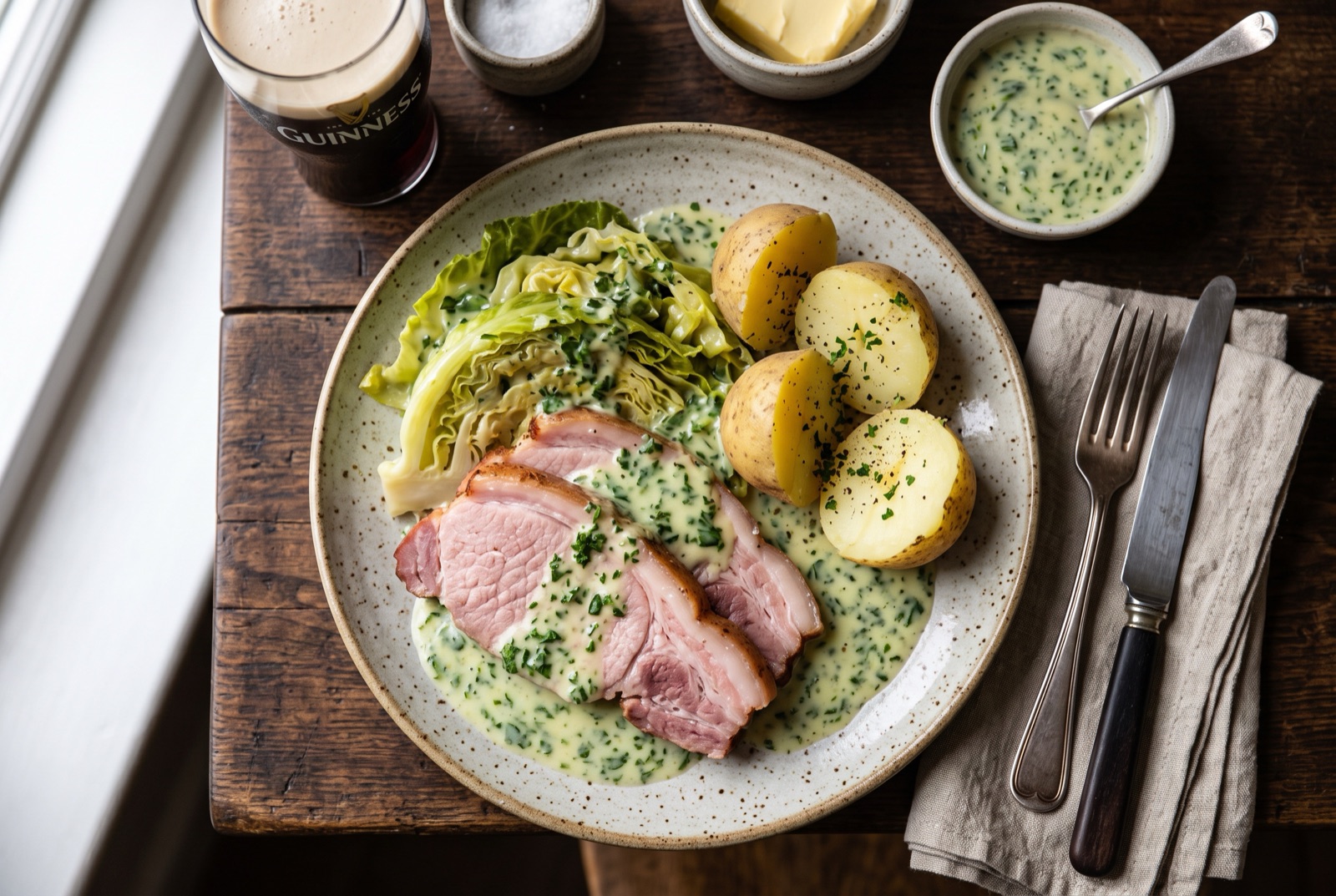
This is the plate most Irish households mean by Sunday dinner: a joint of cured bacon — not the rashers, the whole loin — simmered gently for an hour and a half until a skewer slides through it, then carved into thick, faintly pink slices. The cabbage goes into the bacon's own cooking liquor for the last few minutes, which seasons it all the way through and gives it a savoury depth that plain boiled cabbage never has. Over the top goes a parsley sauce: a plain milk béchamel with far more parsley in it than seems reasonable. The whole thing is salty, sweet, buttery and green, and it is the dish Irish people abroad ask their mothers to make when they visit home.

- Gate
- Ireland
- Prep
- 15 min
- Cook
- 1 hr 30 min
- Total time
- 2 hr incl. 15 min rest
- Serves
- 4
- Status
- Easy
- Nutrition / serving · estimated
- Calories 640 kcal
- Protein 45 g
- Carbs 26 g
- Fat 40 g
- Fiber 5 g
- Sodium 2100 mg
Why this recipe works.
- Tests the joint for saltiness before cooking instead of guessing, so the finished dinner is seasoned rather than brutal.
- Cooks the cabbage in the bacon liquor for six minutes, not thirty — bright green, not grey.
- Builds the parsley sauce partly on the cooking liquor, which links the three elements instead of leaving the sauce bland.
- Explains clearly where corned beef and cabbage came from, and why it is not this dish.
Ingredients.
12 itemsFor the bacon
For the cabbage
For the parsley sauce
Equipment
- Large deep pot with a lid
- Small saucepan for the sauce
- Whisk
- Skewer or thin knife for testing
Instructions.
Soak, then start the joint
If the joint is heavily cured, soak it in cold water for 2 hours or overnight, changing the water once. Put it in a deep pot with the onion, bay leaves and peppercorns and cover with cold water by 3 cm.
Simmer gently and taste the water
Bring slowly to a simmer, skim off the foam, then keep it at a bare tremble. After 20 minutes taste the liquid: if it is punishingly salty, pour it away, cover the joint with fresh hot water and carry on.
Tip A lid tilted half-off keeps the temperature down and stops it creeping into a boil.
Cook to the skewer test
Simmer for a total of 75 to 90 minutes for a 1.5 kg joint, until a thin skewer pushed into the centre meets no resistance and comes out hot. Lift the bacon onto a board, cover loosely with foil and rest for 15 minutes.
Cook the cabbage in the liquor
Bring the pot back to a boil and drop in the cabbage wedges. Cook for 6 to 8 minutes only, until a stalk gives to a knife but the leaves are still bright green, then lift out and toss with the salted butter.
Tip Reserve 150 ml of the hot liquor for the sauce before you drain anything.
Make the parsley sauce
Melt the butter in a small pan, stir in the flour and cook for 2 minutes until the paste smells faintly biscuity rather than raw. Whisk in the warm milk a splash at a time, then the reserved liquor, and simmer for 4 minutes until it coats the back of a spoon.
Finish the sauce and carve
Stir the parsley into the sauce off the heat and season with white pepper, nutmeg and salt only if it needs it. Strip the rind from the joint, carve into thick slices, and serve with the cabbage, boiled potatoes and the sauce poured over.
Tips from our kitchen.
- Ask for an unsmoked bacon loin or collar joint, sometimes sold as boiling bacon, ham hock or gammon. A dry-cured joint has better texture than a wet-injected one.
- Taste the water after 20 minutes of simmering. If it makes you wince, tip it out, refill with fresh hot water and carry on — that single move rescues an over-salted joint.
- Keep the pot at a bare simmer. A boil squeezes the muscle fibres and gives you dry, fibrous bacon no matter how long you cook it.
- Rest the joint for 15 minutes before carving, loosely covered. It carves in clean slices instead of crumbling.
- Cut the cabbage into wedges through the core so the leaves hold together, then remove the core at the table.
- Make the parsley sauce last, with the pot still hot — it thickens as it stands and turns claggy if it waits.
Substitutions.
- Irish bacon loin → Gammon joint, smoked ham hock, or pork collar
- Gammon is the closest supermarket equivalent. Smoked joints work but push the flavour away from the traditional unsmoked profile.
- Savoy or York cabbage → Green pointed cabbage, kale or spring greens
- Avoid red cabbage, which bleeds and turns the whole pot purple, and avoid white cabbage, which stays squeaky.
- Parsley sauce → A mustard sauce, or simply butter and pepper on the cabbage
- Mustard sauce is a common Irish alternative and cuts the fat sharply. Neither is wrong.
Variations.
- With a glazed finish
- After simmering, strip the rind, score the fat, brush with wholegrain mustard and brown sugar and blast it at 220°C for 15 minutes for a sticky crust.
- Bacon, cabbage and champ
- Serve with champ instead of plain potatoes — mash beaten with hot milk and a large handful of scallions, with a well of melted butter in the middle.
- Cider-simmered
- Replace half the cooking water with dry cider and add an onion and a few cloves. Sweeter and more aromatic, common in Cork kitchens.
Storage & reheating.
Cooked bacon keeps 4 days refrigerated and is arguably better cold: carved thin for sandwiches with mustard, or diced into soup. Keep a jar of the strained cooking liquor for pea or potato soup, but taste before using — it is salty enough that it usually needs diluting by half. Parsley sauce keeps 2 days and reheats with a splash of milk whisked in. Do not freeze the cabbage or the sauce; the joint itself freezes well for 2 months.
Serve with
Plain boiled floury potatoes in their own bowl, and a spoonful of wholegrain mustard on the side of the plate.
The story behind Bacon and Cabbage.
The pig was the household animal in rural Ireland — cheap to keep, fed on scraps and small potatoes, and slaughtered for a cure that would last the year. That is why Irish pork cooking is so overwhelmingly about cured meat: bacon joints, hams, rashers, black and white pudding. Cabbage grew reliably in the same wet ground and needed nothing, so bacon and cabbage became the default meat dinner of a country where meat was occasional. It was eaten on Sundays, at Christmas and on St Patrick's Day, and it survives today as the plate that says home more loudly than any other.
Almost every visitor arrives expecting corned beef and cabbage instead, which is the source of a small, permanent national irritation. Corned beef and cabbage is an Irish-American dish. Emigrants who reached cities like New York in the nineteenth century found Irish bacon expensive or unavailable and cheap salt beef sitting in the butchers of neighbouring Jewish immigrant communities, so they substituted, and the swap stuck hard enough to become the world's idea of Irish food. Ireland cured plenty of beef historically — Cork was a major salt-beef export port — but it was a commodity for ships and colonies, not the family dinner. In Ireland, the joint on the table is pork.
The cooking method is where the dish earns its reputation. Boiling the bacon produces a pot of intensely savoury, salty liquor that is far too good to throw away, so it becomes the cooking medium for the cabbage and the base for the sauce. Nothing is wasted, nothing is browned, and the seasoning of the entire meal comes from the cure on the meat. Getting it right is mostly about two things: soaking the joint if it is heavily salted, and cooking the cabbage for minutes rather than the half-hour that gave Irish vegetables their old reputation.
Questions, answered.
Is bacon and cabbage the same as corned beef and cabbage?
No. Bacon and cabbage, made with a cured pork joint, is the Irish dish. Corned beef and cabbage is its Irish-American descendant, created by emigrants who found salt beef cheaper and easier to buy than Irish bacon in nineteenth-century American cities. Both are real dishes with real histories, but only one of them is what is actually eaten in Ireland.
How do I stop the bacon coming out too salty?
Soak the joint in cold water for a few hours or overnight before cooking, changing the water once. Then taste the simmering water after about 20 minutes: if it is aggressively salty, discard it, cover the joint with fresh hot water and continue cooking. Doing this costs you nothing and is the single most useful trick in the recipe.
How long do I cook a bacon joint per kilo?
Roughly 45 to 50 minutes per kilogram at a bare simmer, plus 15 minutes standing time, so a 1.5 kg joint takes about 75 minutes. It is done when a thin skewer slides into the centre with no resistance and comes out hot to the touch on your lip. Overcooking makes it dry rather than more tender, so start checking early.
Why does my parsley sauce taste of flour?
The roux was not cooked long enough. Butter and flour need a full minute or two of stirring over medium heat before any liquid goes in, until the paste smells faintly nutty rather than raw and pasty. After the milk is added, the sauce also needs a few minutes of gentle simmering — pulling it off the heat the moment it thickens leaves the starch undercooked.
Can I cook the whole meal in one pot?
Yes, and that is how it was traditionally done. Simmer the bacon, add the potatoes to the same pot for the last 25 minutes and the cabbage wedges for the last 6 to 8, then lift everything out to a warm dish. The only thing that needs a second pan is the parsley sauce, and you can make that while the joint rests.
You might also like.
All recipes →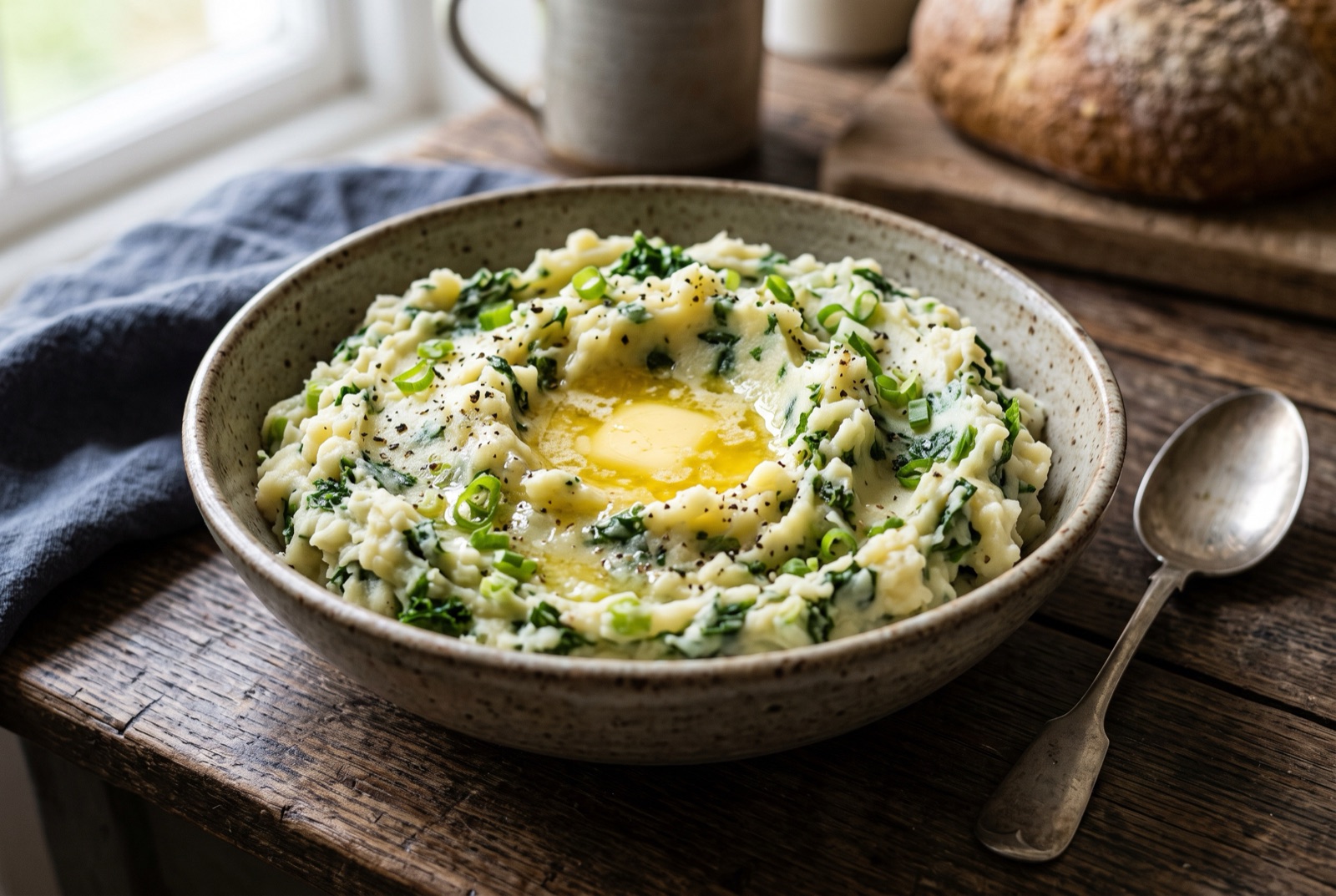

Keep exploring Ireland.
Ireland has 9 more dishes in the atlas — Barmbrack and Beef and Guinness Stew, and 7 more.
Recipe by The DishRoute Kitchen · published August 19, 2026 · updated August 19, 2026