Dublin Coddle.
Sausage and Rasher Potato Pot
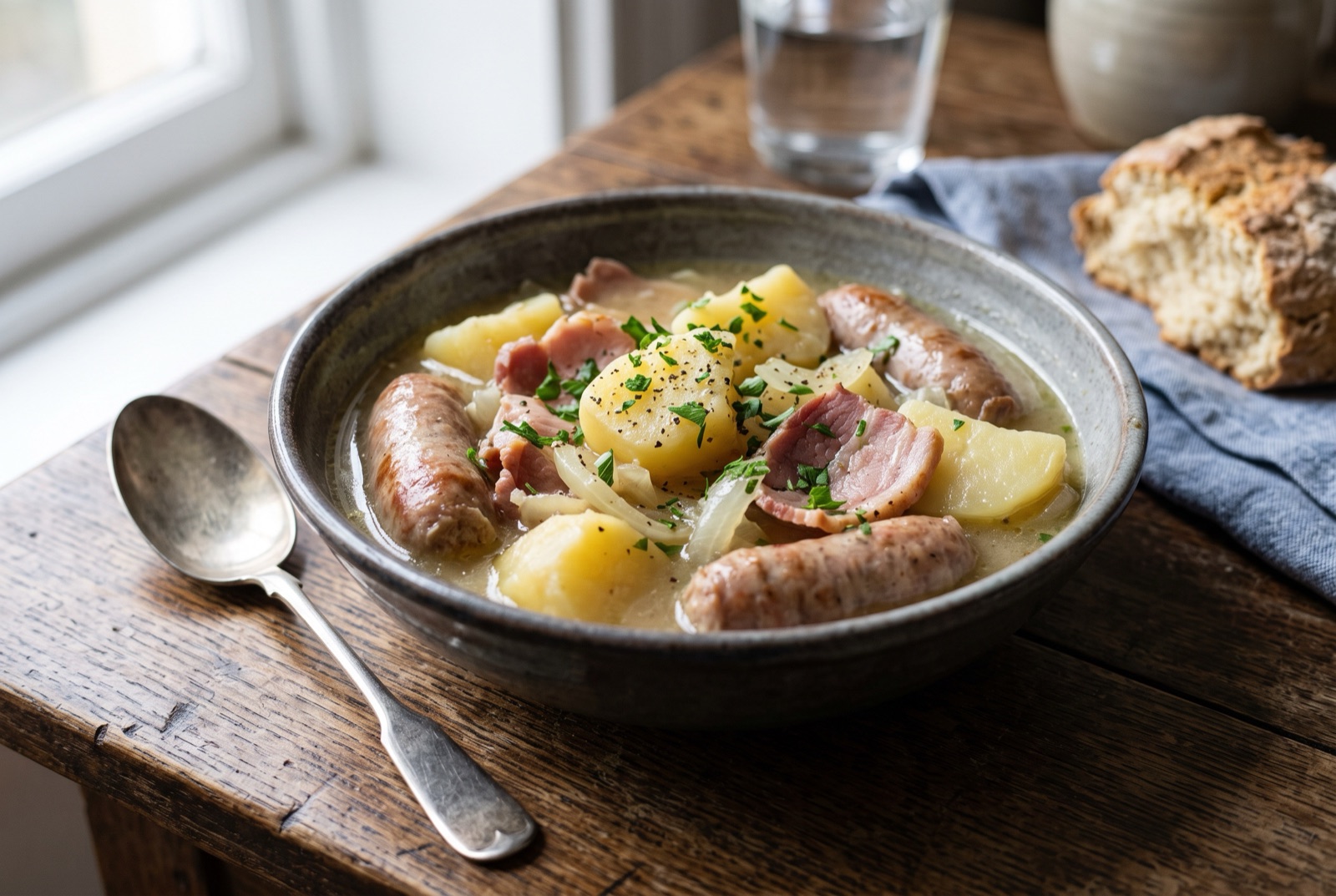
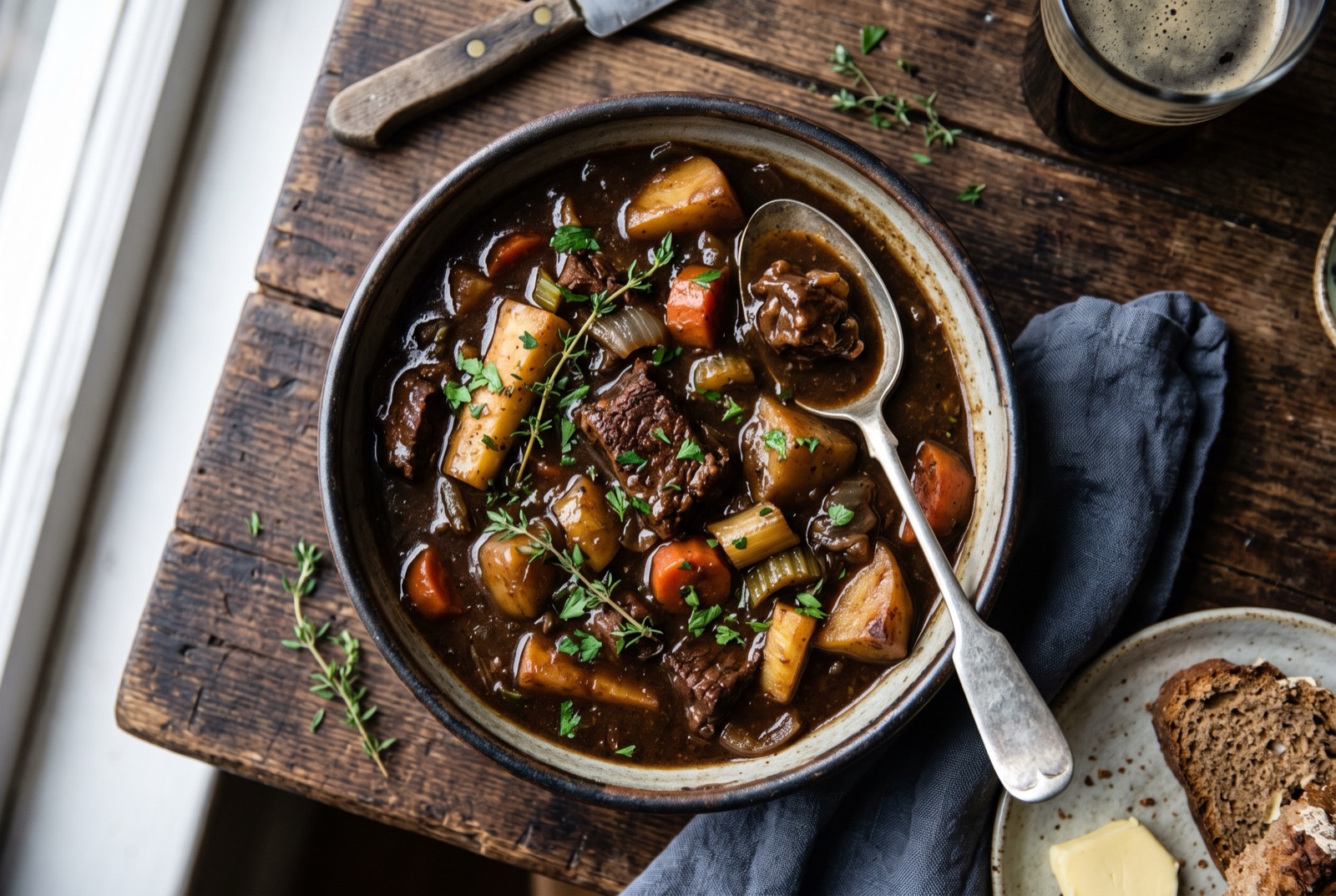
Coddle is Dublin's own supper: whole pork sausages and thick bacon rashers set among potatoes and onions, barely covered with stock, and cooked at a temperature so low that nothing colours. To coddle something is to keep it just below a simmer, and the name is the recipe. The flavour is salty, porky and gently sweet from the onions, with a broth thickened only by potato starch, and the sausages take on a silky, poached texture that is completely unlike a fried one. It looks pale and unpromising in the pot and it is one of the most comforting things you can eat on a wet evening. This version leans on good sausages and a proper simmer, because with four ingredients there is nowhere to hide.

- Gate
- IrelandDublin
- Prep
- 20 min
- Cook
- 1 hr 30 min
- Total time
- 1 hr 50 min
- Serves
- 4
- Status
- Easy
- Nutrition / serving · estimated
- Calories 690 kcal
- Protein 32 g
- Carbs 48 g
- Fat 41 g
- Fiber 5 g
- Sodium 1600 mg
Why this recipe works.
- Layers the bacon at the bottom so its fat and salt season the pot from below as it renders.
- Gives the traditional pale method in full, and tells you exactly how to brown it if you prefer that.
- Uses stock rather than plain water, which fixes the one real weakness of the old recipe.
- Times the potatoes so they thicken the broth without turning the whole pot to mash.
Ingredients.
10 itemsTo finish
Equipment
- Large heavy casserole or Dutch oven with a lid
- Ladle
Instructions.
Render the bacon lightly
Warm the bacon pieces in a dry casserole over medium-low heat for 5 minutes, just until the fat turns translucent and slides out. Stop well before they colour — you want the fat, not a crust.
Tip Skip this step entirely for the strictest traditional version and simply layer the bacon in raw.
Layer the pot
Spread the bacon and its fat across the base, then add the onions in an even layer, then the sausages side by side, then the potatoes and carrots on top. Tuck in the bay leaves and grind over the black pepper.
Add stock and bring it to a shiver
Pour in enough stock to come about three-quarters of the way up the contents, roughly 800 ml, so the potatoes on top steam rather than boil. Heat until the surface just trembles, with a bubble breaking here and there.
Coddle, covered
Cover and cook on the lowest possible heat for 1 hour 15 minutes. The finished pot should have plump, intact sausages, potatoes that yield completely to a knife tip, and onions that have gone soft and translucent.
Tip If a lid-off peek shows the liquid rolling, drop the heat immediately or move the pot to a 150°C oven.
Thicken and season
Crush two or three potato pieces against the side of the pot and stir them through to cloud and thicken the broth. Taste now and add salt — after 75 minutes with bacon it may need none, or it may need a teaspoon.
Finish and serve
Skim any pooled fat from the surface, stir in half the parsley and scatter the rest on top. Serve in wide bowls with plenty of broth and thick buttered bread alongside.
Tips from our kitchen.
- Buy the best pork sausages you can — coarse, high-meat Irish or English style. Cheap, heavily rusked sausages swell and go pasty in liquid.
- Use thick-cut streaky or back bacon with a good fat rim; thin supermarket rashers dissolve into shreds and give nothing back.
- Never let it boil. The surface should barely shiver, or the sausage skins split and the meat tightens.
- Cut the potatoes into big pieces, at least 5 cm. Small ones disintegrate long before the sausages are ready.
- Season the broth only at the end. Bacon salt levels vary enormously and it is easy to overshoot.
- A generous amount of black pepper is not optional here — it is doing the work that spices do in other cuisines.
Substitutions.
- Irish pork sausages → Bratwurst, Cumberland or any coarse fresh pork sausage
- Avoid heavily seasoned Italian or chorizo-style sausages: fennel, chilli or paprika will completely take over a dish this plain.
- Bacon rashers → Thick-cut pancetta or unsmoked streaky bacon
- Irish rashers are usually unsmoked; heavily smoked bacon pushes the pot in a different direction, though many cooks like it.
- Chicken or ham stock → Water plus a bay leaf
- The traditional recipe is water-only. Stock is an improvement rather than a requirement.
Variations.
- Browned coddle
- Fry the sausages and rashers until golden before layering, then proceed as normal. Deeper flavour, less authentic to old Dublin, and by far the more common version in kitchens today.
- Coddle with stout
- Replace 200 ml of the stock with stout. It darkens the broth and adds a faint bitterness that cuts the fat — a divisive but popular addition.
- Oven-finished
- After simmering, take the lid off and give it 20 minutes at 200°C so the top layer of potato and the sausage tops colour and crisp.
Storage & reheating.
Coddle is better on the second day. Refrigerate for up to 3 days in the broth and reheat gently on the hob, adding a splash of water as the potatoes will have absorbed liquid overnight. It freezes for up to 2 months, but the potatoes turn slightly grainy — acceptable in a dish this rustic. Do not reheat in a hard boil or the sausages will go tough.
Serve with
Thick buttered white or brown bread, and a bottle of stout — the broth is meant to be soaked up, not left in the bowl.
The story behind Dublin Coddle.
Coddle is working-class Dublin food, tied to the city rather than the countryside. The logic behind it is thrift: sausages and rashers were the cheap end of the pork butcher's counter, potatoes and onions were always in the house, and the dish was traditionally assembled from whatever pork was left at the end of the week and left to sit on the range while people came and went. It kept well, it reheated better than it started, and it needed no attention — which suited a household where meals happened around shift work rather than at a set hour.
The defining argument about coddle is colour. The old Dublin version is resolutely pale: nothing is browned, the sausages go into the pot raw, and the finished dish is grey-beige, which is exactly why outsiders recoil at photographs of it. A large number of modern Dublin cooks now brown the sausages and rashers first, or finish the pot uncovered in the oven to colour the top, and will tell you the browned version tastes better. Both are made in Dublin today. What is not negotiable is the slow, low cooking: coddle that boils turns the sausages rubbery and splits their skins, and the whole point of the name is lost.
The rest of the ingredient list is contested in a friendlier way. Carrots are common outside the strictest households, barley turns up in some family versions, and there is a long-running division over whether pearl barley or a splash of stout belongs in the pot. Almost everyone agrees on the finish: a lot of black pepper, a heap of parsley, and thick slices of buttered bread on the side to mop the broth.
Questions, answered.
Why does Dublin coddle look so pale?
Because nothing is browned. The traditional method puts raw sausages and rashers straight into liquid and cooks them below a simmer, so no Maillard browning happens and the finished pot is beige. That paleness is the authentic look, and it is why photographs of coddle do the dish no favours. If it bothers you, brown the meat first or finish the pot uncovered in a hot oven.
What does "coddle" actually mean?
To coddle is to cook something gently in liquid kept just below boiling point — the same word used for coddled eggs. The name describes the technique rather than the ingredients, which is why the temperature matters more than anything else in this recipe. If the pot boils, you are no longer coddling and the sausages will suffer for it.
Can I make coddle without a hob, in the oven?
Yes, and it is arguably easier to control. Assemble everything in a lidded casserole, bring the liquid to a simmer on the hob first, then cook at 150°C for about 90 minutes. The oven surrounds the pot with steady low heat, which is exactly what coddle wants, and there is no risk of the base catching.
Do carrots belong in coddle?
Not in the strictest Dublin version, which is sausage, rasher, potato and onion only. Carrots are nonetheless extremely common in family recipes and add useful sweetness against all that salt pork. Include them if you like; nobody will be able to tell you it has never been done.
My broth is thin and greasy — what went wrong?
Two likely causes. Waxy potatoes release no starch, so the liquid never thickens; use floury varieties and mash a few pieces into the broth at the end. Greasiness comes from cooking too hot, which emulsifies rendered bacon fat into the liquid instead of letting it settle on top where you can skim it off.
You might also like.
All recipes →
Keep exploring Ireland.
Ireland has 9 more dishes in the atlas — Bacon and Cabbage and Barmbrack, and 7 more.
Recipe by The DishRoute Kitchen · published August 19, 2026 · updated August 19, 2026