Beef and Guinness Stew.
Stout-Braised Beef
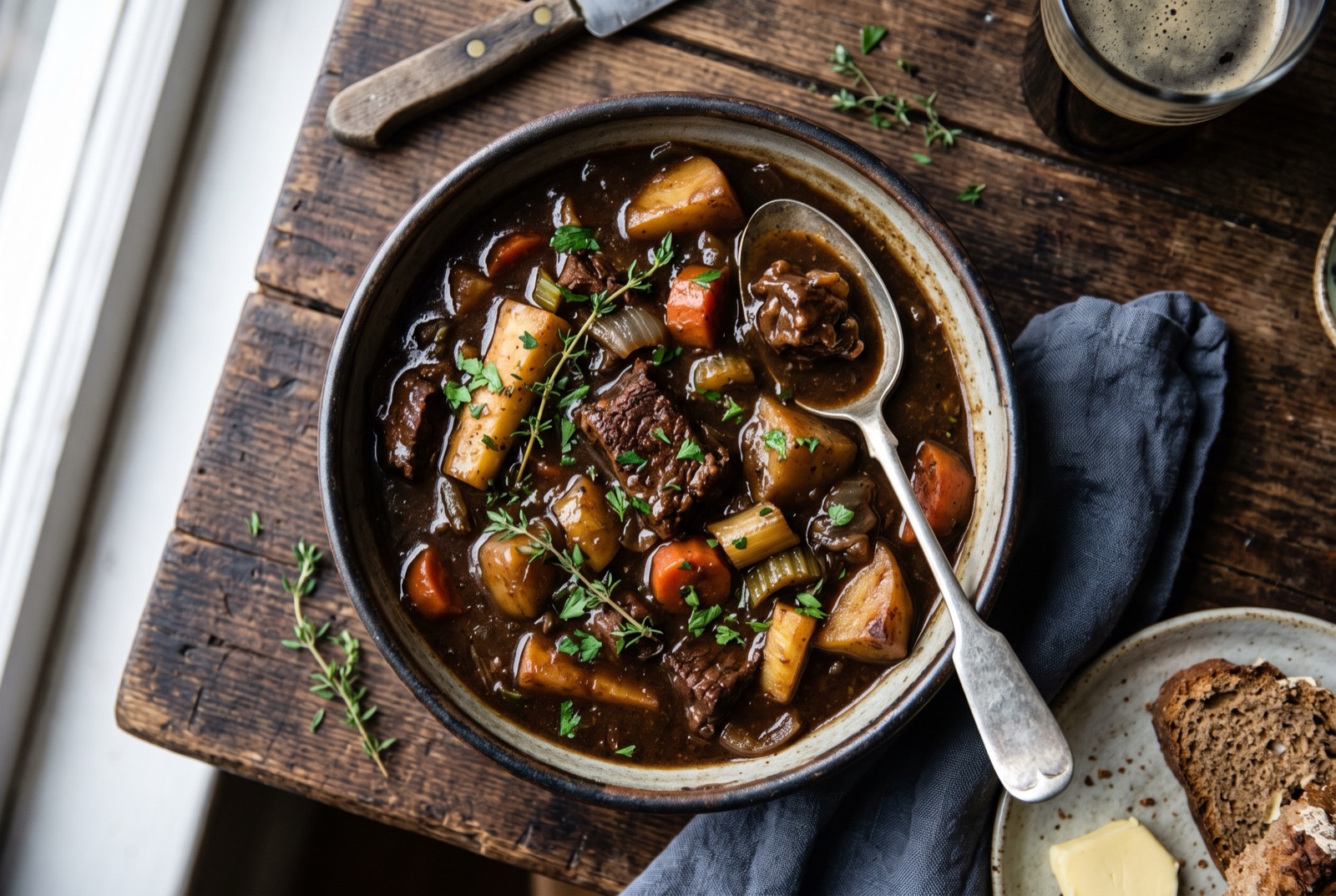
This is the dark counterpart to pale Irish stew: chunks of beef shin or chuck seared until the pan is nearly burnt, then braised for three hours in stout with onions, carrots and thyme until the meat gives way under a spoon and the gravy is thick, glossy and close to black. Stout brings roasted-barley bitterness and a faint coffee note, which is why the recipe needs a counterweight — a spoonful of treacle or dark sugar, which does not make the stew sweet but stops the bitterness taking over. The flavour is deep, savoury and slightly malty, and unlike most stews it genuinely improves for a day in the fridge. Serve it with mash or a heap of buttered soda bread and expect the bowl to be wiped clean.

- Gate
- Ireland
- Prep
- 25 min
- Cook
- 3 hr 10 min
- Total time
- 3 hr 35 min
- Serves
- 4
- Status
- Medium
- Nutrition / serving · estimated
- Calories 580 kcal
- Protein 47 g
- Carbs 24 g
- Fat 28 g
- Fiber 4 g
- Sugar 10 g
Why this recipe works.
- Cuts the stout with stock in a two-to-one ratio, which is the difference between rich and bitter.
- Uses beef shin, the cut whose collagen turns the gravy silky without any flour thickening at the end.
- Browns the meat in batches and deglazes properly, so the fond ends up in the pot instead of stuck to the pan.
- Balances with treacle and a splash of vinegar rather than pretending stout is sweet on its own.
Ingredients.
15 itemsTo finish
Equipment
- Heavy casserole or Dutch oven with a lid
- Tongs
- Wooden spoon for deglazing
Instructions.
Sear the beef hard
Pat the beef dry and season it. Heat the oil in the casserole until it shimmers and sear the cubes in three batches, 4 minutes a side, until each piece has a genuinely dark brown crust rather than a grey-tan blush. Set the meat aside.
Tip If the base starts to go black rather than deep brown, splash in a little stout to loosen it before it burns.
Soften the vegetables
Drop the heat to medium, add the onion, carrot and celery to the same pot and cook for 8 minutes, scraping the base as the vegetables release moisture. Add the garlic for the last minute, until it smells sweet rather than raw.
Cook out the tomato purée and deglaze
Stir in the tomato purée and fry it for 2 minutes until it darkens from red to brick and coats the vegetables. Pour in the stout, bring it to a boil and scrape every brown patch off the base of the pot as the liquid bubbles.
Tip Let the stout boil hard for 3 minutes here — it drives off the raw, yeasty edge.
Braise low and slow
Return the beef and any resting juices, add the stock, treacle, thyme and bay leaves, and bring back to a bare simmer. Cover and cook on the lowest heat, or at 150°C in the oven, for 3 hours.
Check the meat and the gravy
The beef is ready when a piece falls apart under light pressure from a spoon and the gravy coats the back of it, dark and slightly sticky. If it is still thin, lift out the meat and boil the liquid down for 10 minutes.
Balance and serve
Taste and adjust: salt first, then a few drops of vinegar if it tastes heavy, or another half-teaspoon of treacle if the bitterness bites. Scatter with parsley and serve over mash with the gravy spooned generously over.
Tips from our kitchen.
- Choose beef shin, chuck or brisket. Lean cuts such as topside or rump go stringy and dry no matter how long you braise them.
- Dry the meat on kitchen paper before searing. Wet beef steams grey instead of building the dark crust the gravy depends on.
- Sear in batches with space between the pieces. Crowded meat drops the pan temperature and the whole point is lost.
- Taste before serving and adjust with a teaspoon of treacle if it is sharp, or a few drops of vinegar if it tastes flat and heavy.
- Do not boil off all the liquid. If the gravy tightens too far, add hot stock — reducing stout past a certain point makes it bitter, not concentrated.
- Make it the day before. The bitterness rounds out overnight in a way that an hour of extra simmering cannot achieve.
Substitutions.
- Guinness or Irish stout → Any dry stout or porter, or a dark ale
- Avoid sweet or milk stouts, which turn the gravy cloying, and avoid imperial stouts above about 8% — they are far too bitter when reduced.
- Black treacle → Molasses, dark brown sugar, or a tablespoon of honey
- The role is balance, not sweetness. Start with less than you think and taste.
- Beef shin → Chuck, brisket or oxtail
- Oxtail makes an outstanding version with the richest gravy of all, but needs an extra hour and skimming.
Variations.
- Beef and stout pie
- Cool the finished stew completely, pile it into a dish, top with puff pastry and bake at 200°C for 30 minutes until deep gold. A pub standard.
- With mushrooms and pearl onions
- Brown 250 g of mushrooms and a handful of peeled pearl onions separately and fold them in for the last 20 minutes so they keep their shape.
- Guinness and cheddar cobbler
- Drop scones of soda-bread dough with grated mature cheddar on top of the stew and bake uncovered for 25 minutes until risen and browned.
Storage & reheating.
Refrigerate for up to 4 days — day two is the best it will ever taste. Reheat covered over low heat or at 160°C until it steams throughout, loosening with stock if the gravy has set solid. It freezes very well for up to 3 months, better than most stews because there are no potatoes in the pot to go grainy. Thaw overnight in the fridge before reheating.
Serve with
Champ or plain buttered mash to catch the gravy, and a wedge of soda bread for the last of it.
The story behind Beef and Guinness Stew.
Stout has been brewed at St James's Gate in Dublin since 1759, and porter of one kind or another has been the everyday drink of Irish cities for most of the time since. Cooking with it followed naturally: beer was in the house, it was cheap, and the same roasted grain that makes stout taste of coffee and chocolate does remarkable things to browned beef over a long braise. Compared with the older water-simmered stews of the countryside, beef and stout is city food — pub food, in fact — and it belongs to a period when beef was affordable enough for ordinary households rather than an export commodity.
It should be said plainly that this is not an ancient peasant dish and nobody in Ireland pretends otherwise. It reads as a national classic today because it is genuinely good and because it uses two things Ireland is known for, and it has been on pub menus from Galway to Kilkenny for decades. The technique is closer to a French daube or a Flemish carbonnade than to anything cooked over an open hearth, and the resemblance to carbonnade — Belgian beef braised in dark beer, sweetened and thickened — is close enough that the two dishes are cousins.
The one thing that separates a good version from a grim one is respect for the bitterness. Stout reduces, and everything bitter in it concentrates as it does. Cooks who simply tip in a pint and walk away end up with a stew that tastes harsh and metallic. The fixes are all traditional: brown the meat properly so there is sweetness to push against, use some stock rather than all beer, add carrot and onion for their sugars, and finish the balance with a small amount of treacle. Get that right and the stout tastes like depth rather than beer.
Questions, answered.
Why is my beef and Guinness stew bitter?
Usually too much stout and too much reduction. Roasted barley compounds concentrate as the liquid boils down, so a stew made with beer alone and simmered hard turns harsh. Use roughly two parts stout to one part beef stock, keep the braise at a bare simmer with the lid on, and balance at the end with a teaspoon of treacle or dark brown sugar.
Does the alcohol cook off?
Most of it does over three hours of covered braising, but not all — trace alcohol survives long cooking, which is worth knowing if you are serving children or anyone avoiding it. The flavour that remains is malt and roasted grain rather than beer. There is no direct non-alcoholic substitute, though alcohol-free stout plus a spoonful of strong coffee comes surprisingly close.
Do I need to flour the beef before browning?
No, and it is often better not to. Flour on the meat burns in a hot pan and can make the gravy pasty. Beef shin releases enough collagen over a long braise to thicken the sauce by itself; if you want it thicker still, lift out the meat and reduce the liquid for ten minutes, or stir in a teaspoon of cornflour slaked in cold water.
Can I make this in a slow cooker or pressure cooker?
Yes to both, but brown the meat and deglaze the pan on the hob first — that step supplies most of the flavour and no appliance can do it for you. In a slow cooker, use a third less liquid and cook on low for 8 hours. In a pressure cooker, use the same reduced liquid and cook at high pressure for 45 minutes, then reduce the sauce uncovered.
What is treacle and what if I cannot find it?
Black treacle is a thick, dark, faintly bitter sugar syrup, very close to blackstrap molasses and sold in tins in Ireland and Britain. Molasses is the direct swap. Failing that, use a tablespoon of dark brown sugar or a spoon of honey — you are looking for enough sweetness to round the stout's edge, not enough to taste sweet.
You might also like.
All recipes →
Keep exploring Ireland.
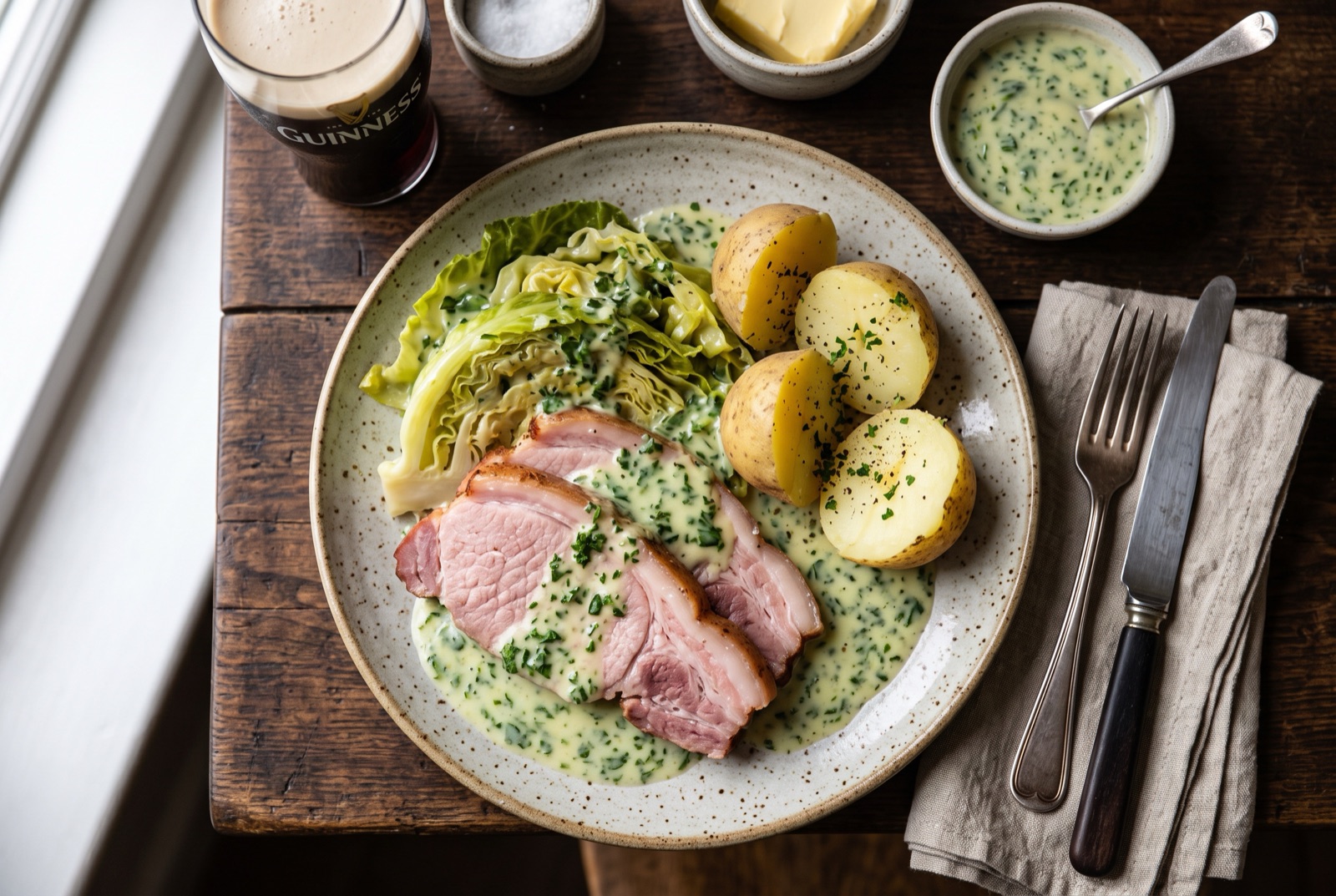
Ireland has 9 more dishes in the atlas — Bacon and Cabbage and Barmbrack, and 7 more.
Recipe by The DishRoute Kitchen · published August 19, 2026 · updated August 19, 2026