Bakso.
Indonesian Beef Meatball Noodle Bowl
Bakso · say it: BAHK-soh
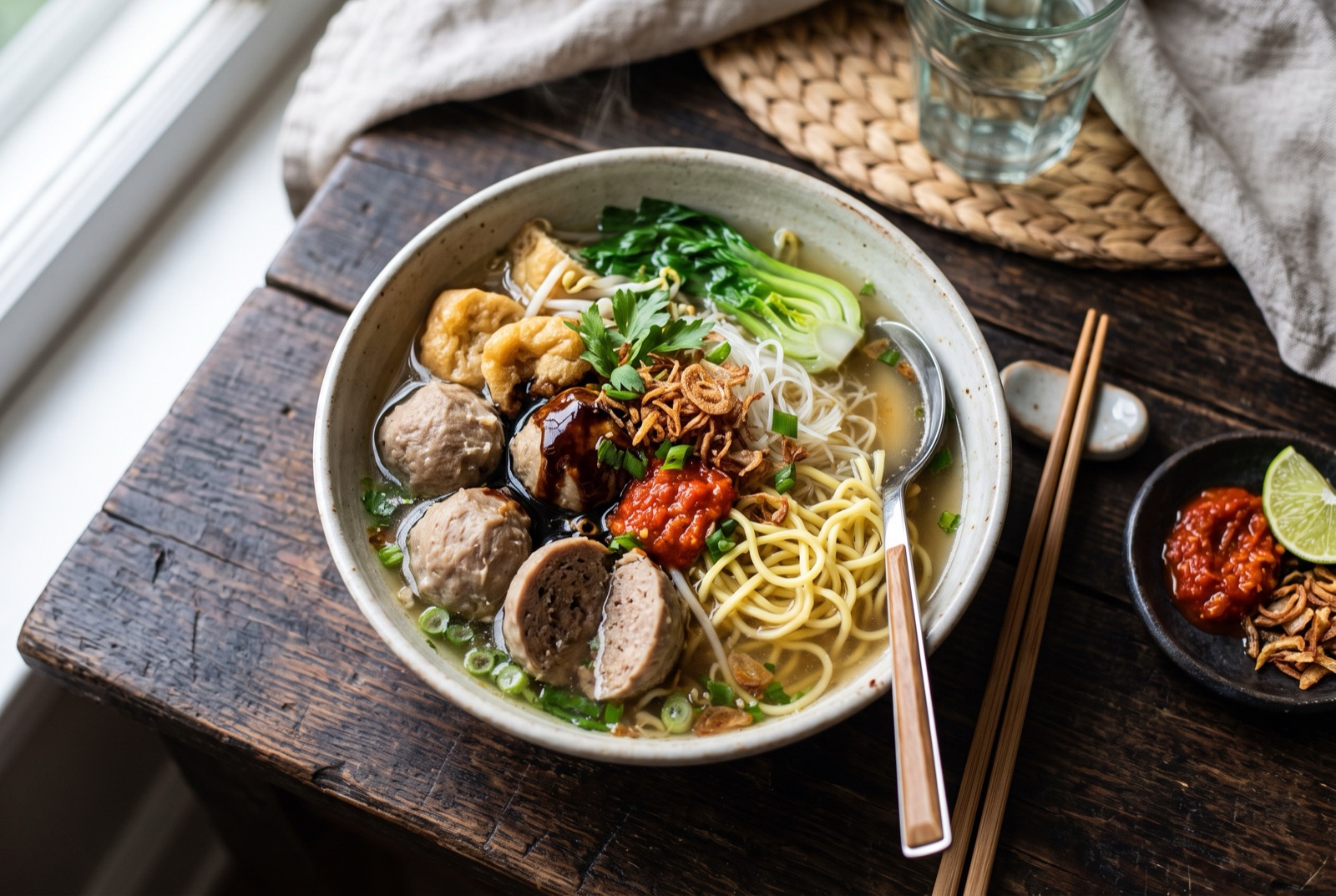
The point of bakso is texture. These are not soft, crumbly meatballs — the beef is pulverized with ice-cold water and tapioca starch into a paste that sets into something dense and springy, closer to a fish cake than a Western meatball, and Indonesians judge a bakso seller almost entirely on that bounce. They sit in a clear, garlicky beef broth with yellow noodles and glass noodles, cubes of fried tofu, a few leaves of greens, and then the table condiments do the rest: kecap manis for sweetness, sambal for heat, vinegar for sharpness, fried shallots for crunch. It is the most eaten street food in the country and the one Indonesians abroad describe missing most.

- Gate
- IndonesiaJava
- Prep
- 40 min
- Cook
- 1 hr 30 min
- Total time
- 2 hr 40 min incl. 30 min rest
- Serves
- 4
- Status
- Medium
- Nutrition / serving · estimated
- Calories 620 kcal
- Protein 42 g
- Carbs 58 g
- Fat 24 g
- Fiber 4 g
- Sugar 5 g
- Sodium 1450 mg
Why this recipe works.
- Explains the actual mechanism behind the springy texture — cold, salt and starch — instead of just saying to blend the meat.
- Builds the broth from beef bones and toasted garlic so it tastes like a bakso cart rather than a beef consommé.
- Poaches the meatballs below boiling, which is the difference between smooth and pockmarked ones.
- Sets the bowl up with the full condiment tray so everyone finishes their own the Indonesian way.
Ingredients.
21 itemsFor the meatballs
For the broth
For the bowls
To finish
Equipment
- Food processor
- Large pot for the broth
- Second pot for poaching
- Slotted spoon
- Instant-read thermometer (helpful)
Instructions.
Start the broth
Cover the beef bones with cold water, bring to a boil for 3 minutes, then drain and rinse them — this washes off the scum that would otherwise cloud the pot. Return them to the clean pot with the fresh water, smashed garlic, ginger, white pepper and salt.
Simmer the broth
Bring to a boil, then hold at a bare simmer for 90 minutes, skimming once or twice. The broth should end up clear, faintly golden and strongly garlicky, with the pepper coming through as a warm background heat rather than a spike.
Freeze the beef
Spread the cubed beef on a tray and freeze for 30 minutes until the edges are firm but the centre is not solid. Chill the food processor bowl and blade at the same time — the whole texture of bakso depends on nothing warming up.
Process to a paste
Blitz the cold beef with the salt, garlic, white pepper and sugar until it clumps together. Add the ice water and ice cubes in three additions, running the machine between each, until you have a smooth, pale, sticky paste that pulls away from the bowl in one mass.
Tip Touch the paste. If it feels cool and tacky like putty, it is right; if it feels greasy or looks separated, chill it 15 minutes and process again.
Add the starch
Add the tapioca starch and baking powder and pulse just until incorporated — 20 to 30 seconds. Overworking after the starch goes in makes the meatballs dense rather than springy. Chill the paste for 15 minutes while you set up the poaching water.
Shape and poach
Heat a wide pot of salted water to 80–85°C — steaming, with a shiver on the surface but no bubbles. Squeeze the paste up through a wet fist and scoop off 4 cm balls with a wet spoon, dropping each straight into the water. Poach until they float, then 2 minutes more.
Tip Poach one test meatball first and cut it open. It is easier to correct the paste than a whole batch of finished meatballs.
Cook the bowl components
Boil the yellow noodles for 2 minutes and drain, soak the glass noodles in hot water for 5 minutes, and blanch the greens for 30 seconds until just bright and tender-crisp. Strain the beef broth, taste, and correct the salt and white pepper.
Assemble and season at the table
Divide both noodles, tofu puffs and greens between four bowls, add 5–6 meatballs each, and ladle over the hot broth. Scatter scallions and fried shallots on top, then put kecap manis, sambal and vinegar on the table so everyone finishes their own bowl.
Tips from our kitchen.
- Everything must stay cold. Freeze the cubed beef for 30 minutes, use ice water not cold water, and if the paste in the processor ever feels above fridge temperature, stop and chill it before continuing.
- Use beef with some fat — chuck at around 15% fat is ideal. Very lean meat makes hard, dry meatballs no matter how well you handle the paste.
- Add the salt early and process it in thoroughly before the starch. Salt is what makes the proteins bind, and skipping it gives you crumbly meatballs even with the right starch.
- Shape with a wet spoon and wet hands, squeezing the paste up between thumb and forefinger the way street vendors do. Rinse both often so nothing sticks.
- Poach at 80–85°C, where the water steams and shivers but never bubbles. A real boil roughens the surface and can split the meatballs.
- Test one meatball before shaping the rest. Poach it, cut it open, and if the texture is soft rather than springy, process the remaining paste for another minute with a little more ice.
Substitutions.
- Tapioca starch → Potato starch, or cornstarch at three-quarters of the quantity
- Tapioca gives the cleanest bounce. Cornstarch works but produces a slightly softer, more floury bite, so use a little less of it.
- Beef bones for the broth → 1.5 l good beef stock, simmered 20 minutes with garlic, white pepper and a knob of ginger
- The bones give body you cannot fully fake, but the shortcut broth is respectable, and many small warungs cook it much the same way.
- Fresh yellow noodles → Any wheat noodle, or all glass noodles for a gluten-free bowl
- The classic bowl uses both wheat and glass noodles at once. Using only glass noodles is a normal variation and not a compromise.
- Fried tofu puffs → Firm tofu cut in cubes and shallow-fried until golden
- Ready-made puffs soak up broth better because they are hollow, but home-fried tofu tastes fresher.
Variations.
- Bakso Malang
- The East Javanese assembly: meatballs of several sizes plus fried wontons, steamed siomay and stuffed tofu, so the bowl is half soup and half snack platter.
- Bakso urat
- Made with beef tendon and sinew mixed into the paste, giving a coarser, chewier meatball with visible strands. The version most Indonesian regulars order.
- Mie bakso goreng
- No broth at all: the noodles are tossed dry with kecap manis, sesame oil and sambal, the meatballs piled on top and a small bowl of soup served on the side.
Storage & reheating.
Cooked meatballs keep 4 days refrigerated in a little broth, or 3 months frozen; freeze them on a tray first so they do not fuse, then bag them. Reheat straight from frozen in simmering broth for 5 minutes. Store broth, noodles and meatballs separately — noodles left in broth turn to mush overnight. Uncooked meat paste should be shaped and poached the same day, not stored raw.
Serve with
A tray of condiments — sambal, kecap manis, white vinegar, fried shallots and prawn crackers — so everyone builds their own bowl.
The story behind Bakso.
Bakso arrived with Chinese immigrants — the name comes from Hokkien, roughly "minced meat" — and Indonesia rebuilt it around beef, because pork does not work in the world's largest Muslim-majority country. That single substitution turned an imported dish into a national one. Today bakso sellers work every neighborhood in Java and far beyond, some from gerobak carts pushed slowly through the streets, some from motorbike sidecars, some from permanent shops with lines out the door. The carts announce themselves by sound: a spoon rung against a porcelain bowl, a rhythm every Indonesian recognizes from childhood without looking up.
The regional signatures are all about size and stuffing. Malang, in East Java, is the acknowledged bakso capital and sells bakso Malang as an assembly of components — meatballs of several sizes, fried wontons, siomay dumplings, fried tofu — so a bowl is half soup and half snack platter. Solo makes them smaller and the broth cleaner. Then there is bakso beranak, "pregnant meatball", a giant ball cut open at the table to reveal smaller meatballs and a boiled egg inside, which began as a novelty and became genuinely popular. Bakso urat, shot through with tendon and sinew, is the version connoisseurs order.
Getting the bounce is the whole craft, and it is mechanical rather than mysterious. The beef must stay near freezing throughout, so the fat does not smear and the proteins stay intact; the salt and pounding pull those proteins into a sticky, elastic network; the tapioca starch sets it firm when cooked. Street vendors traditionally pound the meat by hand with a heavy mallet for a long time. A food processor and a bowl of ice water gets a home cook remarkably close, provided nothing in the machine ever gets warm. When Barack Obama, who spent part of his childhood in Jakarta, name-checked bakso during a speech there, Indonesians took it as confirmation of something they already knew.
Questions, answered.
Why are my bakso soft and crumbly instead of springy?
The paste got too warm, or it was underworked. Bounce comes from salt-soluble proteins forming an elastic network, and that only happens when the meat stays near freezing and is processed long enough to turn genuinely sticky and glossy. If the fat smears and the mixture looks greasy or grainy rather than paste-like, it has warmed up — chill it hard and process again with a couple of ice cubes.
Can I make bakso without a food processor?
Yes, and traditionally it is done by hand. Ask the butcher for finely minced beef, then pound it in a large mortar or with a heavy mallet on a board for 15–20 minutes, adding ice water in splashes, until it becomes a sticky paste that clings to the pestle. It is genuine work, and it produces the texture street vendors get. A stand mixer with a paddle on high is a middle route.
How do I know when the meatballs are cooked?
They float. Drop the shaped balls into water held just below a simmer and they sink at first, then rise to the surface after roughly 8–12 minutes depending on size. Give them two more minutes after they float, then cut one open — the interior should be uniformly pale grey-brown and firm, with no darker raw centre.
Is bakso made with pork?
Almost never in Indonesia. The dish has Chinese origins where pork would be standard, but Indonesia is majority Muslim and bakso is made with beef, sometimes chicken or fish. Pork bakso exists in a few Chinese-Indonesian and Balinese establishments and is always labelled as such, since selling it unmarked would be a serious problem.
What goes in the bowl besides meatballs?
Typically both yellow wheat noodles and glass noodles, fried tofu, a few leaves of choy sum or bok choy, and sometimes a fried wonton or a hard-boiled egg. The broth is poured over and then you season your own bowl with sweet soy, sambal, vinegar and fried shallots — the seller does not season it for you, which surprises first-timers.
You might also like.
All recipes →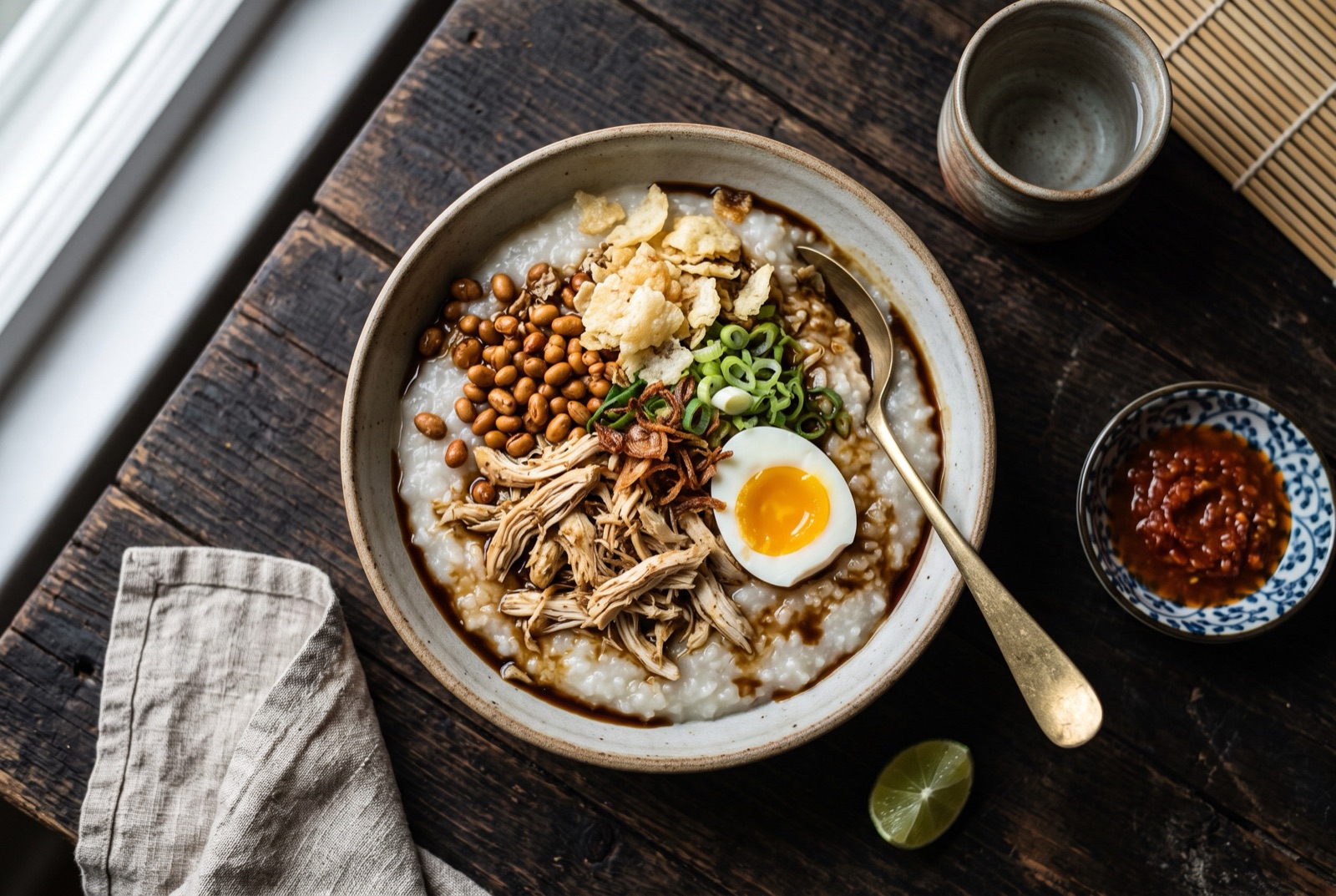
Keep exploring Indonesia.
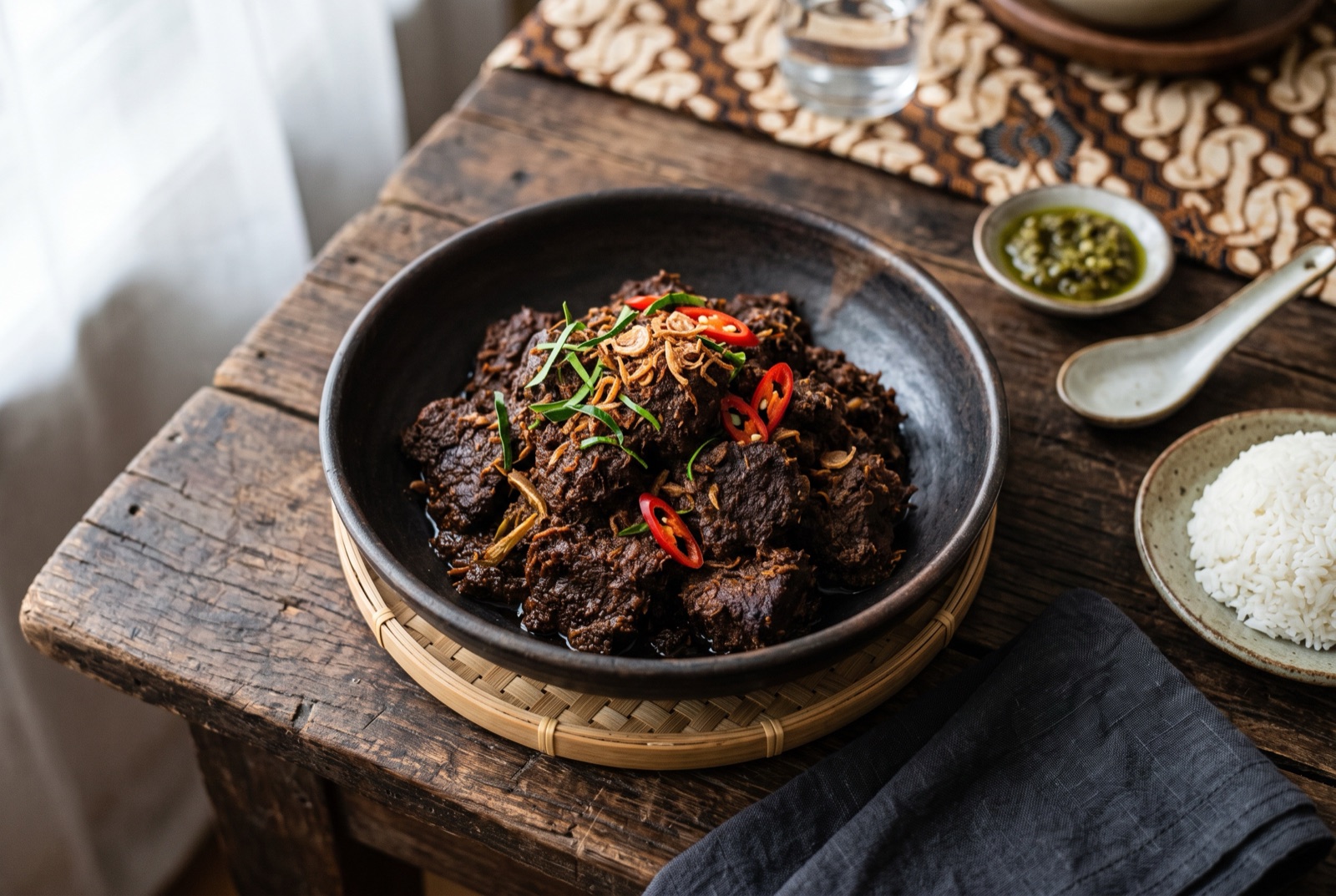
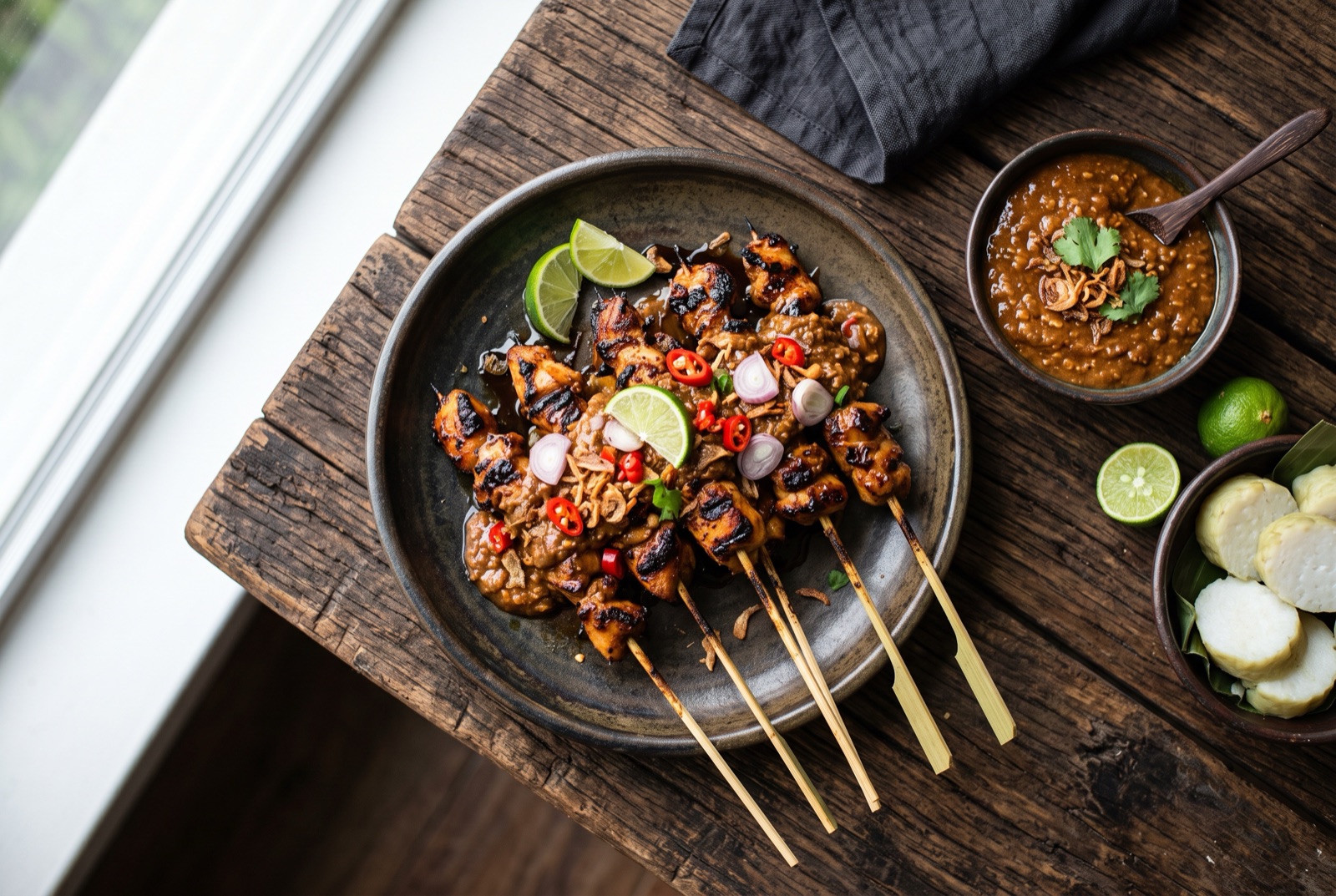
Indonesia has 9 more dishes in the atlas — Bubur Ayam and Chicken Satay with Peanut Sauce, and 7 more.
All Indonesia recipes Beef chuck recipes Tofu recipes Garlic recipes street foodmainsoupdairy freehalal friendlyRecipe by The DishRoute Kitchen · published August 19, 2026 · updated August 19, 2026