Balochi Sajji.
Salt-Cured Whole Roast Chicken
سجی · Sajji · say it: SUJ-jee
Sajji is a whole chicken rubbed with coarse salt and grated green papaya, left to cure for a few hours, then roasted slowly until the skin goes crisp and papery and the meat underneath stays wet enough to tear off in sheets. There is no marinade paste, no yogurt, no chile and no colouring — that restraint is the whole point. What you taste is chicken, salt, and smoke, with the papaya enzyme having quietly softened the flesh from the inside. The seasoning comes last and comes from the diner: a shake of sour, cumin-heavy chaat masala and a squeeze of lemon at the table. In Balochistan it is served on a plate with plain rice cooked inside the bird or alongside it.
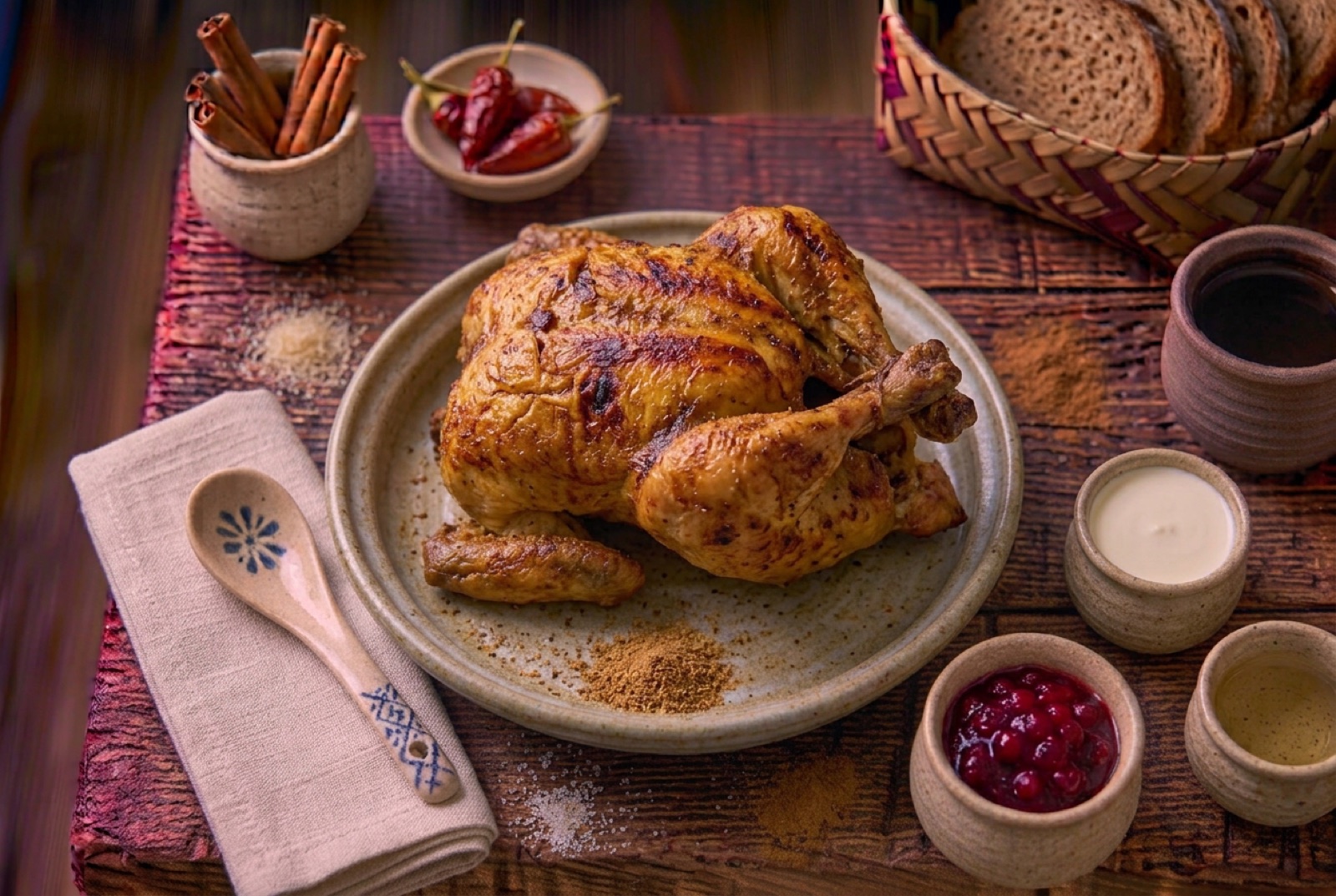

- Gate
- PakistanBalochistan
- Prep
- 20 min
- Cook
- 1 hr 20 min
- Total time
- 5 hr 40 min incl. 4 hr rest
- Serves
- 4
- Status
- Medium
- Nutrition / serving · estimated
- Calories 640 kcal
- Protein 44 g
- Carbs 58 g
- Fat 26 g
- Fiber 2 g
- Sodium 980 mg
Why this recipe works.
- Keeps the Balochi salt-and-papaya cure intact instead of turning sajji into another tandoori chicken.
- Uses a low-then-high oven method that gets crackling skin without overcooking the breast.
- Explains how much papaya is safe — too much turns the surface of the meat to mush, and nobody says so.
- Includes the rice cooked in the bird's own dripping, which is half the dish in Balochistan.
Ingredients.
12 itemsFor the cure
For roasting
For the rice
To serve
Equipment
- Roasting tin with a rack
- Meat thermometer
- Box grater
- Kitchen string
Instructions.
Cure the bird
Pat the chicken completely dry and slash the thighs and breast twice each, down to the bone. Rub the coarse salt, grated papaya, lemon juice and cracked pepper all over and into the cuts, working some under the skin of the breast where you can loosen it with your fingers.
Rest in the fridge
Put the chicken on a rack over a plate and refrigerate uncovered for at least 4 hours and up to 8. The skin should look dry and slightly translucent by the end — that dryness is what will crisp in the oven.
Tip Do not push past 8 hours with papaya in the cure or the outer layer of meat starts to go pasty.
Start low, breast down
Heat the oven to 160C. Truss the legs, tuck the wing tips under, and set the chicken breast down on a rack in a roasting tin. Brush all over with oil and roast for 50 minutes, basting once with the fat that collects in the tin.
Cook the rice in the drippings
Spoon three tablespoons of the hot fat from the tin into a pan, fry the sliced onion and cumin seeds until golden, then stir in the rice and 600 ml of salted water. Cover and cook on low for 12 minutes, then leave it covered off the heat.
Turn and blast
Turn the chicken breast up, brush with the remaining oil, raise the oven to 230C and roast for another 20 to 25 minutes. It is ready when the skin is deep golden and audibly crisp under a spoon and a thermometer in the thickest part of the thigh reads 75C.
Rest before carving
Move the chicken to a board and leave it for 15 minutes, loosely tented. Pour any juices from the tin over the rice and fork it through.
Season at the table
Pile the rice on a platter, set the whole bird on top and carry it out uncut. Dust the chicken with chaat masala and serve with lemon wedges and whole green chiles so each person seasons their own piece.
Tips from our kitchen.
- Use coarse salt, not fine, and rub it under the skin as well as over it. Fine salt dissolves too fast and draws surface moisture without seasoning the meat.
- Grate the papaya on the coarse side of a box grater and use it sparingly. More than two tablespoons on a whole chicken and the outer few millimetres of meat go pasty.
- Leave the cured bird uncovered in the fridge for the last hour so the skin surface dries. Dry skin crisps; damp skin steams and stays flabby.
- Truss the legs and tuck the wing tips under, otherwise the extremities blacken long before the thighs reach temperature.
- The chicken is done when the juices from the thigh run clear and a probe reads 75C at the thickest part of the thigh, not by clock alone.
- Rest the bird a full 15 minutes before cutting. Sajji carved straight out of the oven bleeds its juices onto the board and the rice never gets them.
Substitutions.
- Green papaya → Two tablespoons of plain yogurt, or a teaspoon of grated pineapple
- Both are enzymatic tenderisers, though pineapple is aggressive and should not sit longer than an hour. Skipping the tenderiser entirely is fine for a good free-range chicken.
- Whole chicken → A bone-in leg of lamb, 2 kg
- Lamb sajji is the original Balochi form. Cure it the same way and roast at 150C for about three hours before the final high-heat blast.
- Chaat masala → Ground cumin, dried mango powder and black salt in equal parts
- The sourness is the essential part. Plain salt and lemon will do at a pinch, but the dish loses the tang that balances all that rendered fat.
Variations.
- Lamb sajji
- The version Quetta is famous for: a whole leg or half a lamb cured in salt and roasted upright beside an open fire for hours, carved at the table.
- Masala sajji
- The Karachi adaptation, with red chile, ginger and garlic in the cure and often a brush of butter. Popular, and firmly disowned by Baloch traditionalists.
- Sajji rice
- Plain long-grain rice cooked with a little of the roasting fat and whole cumin, served in a mound under the bird so it catches the carving juices.
Storage & reheating.
Roast sajji keeps three days refrigerated. The skin will go soft in the fridge, which is unavoidable, but ten minutes in a hot oven brings most of the crackle back — a microwave never will. Strip any leftover meat off the bones the same day and store it separately in a sealed box, because meat left on the carcass dries out fast. The bones make an excellent stock for the next batch of rice. Cooked chicken freezes for two months, though the texture of the breast suffers more than the thigh.
Serve with
Plain cumin rice, a fresh onion and tomato salad with lemon, and a sharp green chutney of cilantro, mint and green chile.
The story behind Balochi Sajji.
Sajji belongs to Balochistan, the vast and arid southwest of Pakistan, where the traditional method has nothing to do with ovens. A whole lamb or chicken is skewered on a green wood stake, driven into the ground at an angle beside a bed of embers, and left to roast by radiant heat while the cook turns the stake by hand. The heat is indirect and unhurried, the fat renders slowly down the outside of the bird, and the effect is closer to slow rotisserie than to grilling. Quetta is the city most associated with it, and sajji houses there work through whole lambs on rows of stakes.
The seasoning philosophy separates Balochi cooking sharply from the rest of the country. Where Punjab and Sindh reach for chile, tomato and a dozen ground spices, Balochistan starts from the position that good meat needs salt and fire and very little else. Sajji is the clearest statement of that view. The papaya is not a flavouring but a tool: unripe papaya contains papain, an enzyme that breaks down muscle protein, and Balochi cooks have used it as a tenderiser for generations, the same way it is used across South Asia for tough goat.
The dish has travelled since, and it has changed on the way. Karachi and Lahore now sell chile-rubbed sajji, sajji brushed with butter, even sajji with a masala-stuffed cavity, and Baloch purists regard all of this the way a Neapolitan regards pineapple. What almost every version keeps is the rice — traditionally packed into the cavity so it cooks in the dripping fat, and served in a mound under the bird. This recipe uses a domestic oven, which cannot reproduce wood smoke, but a long low roast followed by a short blast of high heat gets the two things that actually matter: skin that shatters and meat that has not dried out.
Questions, answered.
Why is papaya used in sajji?
Unripe green papaya contains papain, an enzyme that breaks down muscle protein and tenderises meat from the surface inward. Balochi cooks have used it as a tenderiser for generations, particularly for tougher lamb and goat. It contributes almost no flavour, which is exactly why it suits a dish whose seasoning is meant to be nothing but salt. Use it sparingly, though, since too much turns the outer layer of the meat unpleasantly soft.
Can I make sajji without an open fire?
Yes. A domestic oven cannot reproduce wood smoke, but it can reproduce the two things that matter most: slow indirect heat, and skin that dries and crisps. Roast low at 160C until the thigh reaches temperature, then finish with a short blast at 230C. If you have a charcoal kettle grill, cooking with the coals banked to one side and the lid down gets you closer still.
Why is sajji not spicy like other Pakistani dishes?
Because Balochi cooking works from a different premise. In the arid southwest, good meat has traditionally been treated with salt, fat and fire rather than layered with spice, and sajji is the clearest expression of that. Heat and sourness are added at the table by the diner, through chaat masala, green chutney and lemon, rather than built into the cooking. Chile-rubbed sajji exists in Karachi and Lahore but is a later adaptation.
How long should the chicken cure?
Between four and eight hours in the fridge for a whole chicken. Less than four and the salt has not penetrated past the skin; much more than eight, with papaya in the cure, and the surface of the meat starts to break down and turn mushy. For a lamb leg you can go to twelve hours, since the muscle is denser and the enzyme works more slowly through it.
How do I stop the breast drying out?
Roast the bird breast down for the first two-thirds of the cooking time so the thighs, which need more heat, are exposed while the breast is shielded and bathed in fat. Turn it breast up only for the final high-heat blast that crisps the skin. Pulling the chicken out at 75C in the thigh rather than cooking to a fixed time also makes a large difference.
You might also like.
All recipes →
Keep exploring Pakistan.
Pakistan has 9 more dishes in the atlas — Chana Chaat and Chapli Kebab, and 7 more.
All Pakistan recipes Chicken recipes Lemon recipes Basmati rice recipes mainhalal friendlydairy freegluten freeRecipe by The DishRoute Kitchen · published August 20, 2026 · updated August 20, 2026