Bifana.
Portuguese Marinated Pork Sandwich
Bifana · say it: bee-FAH-nah
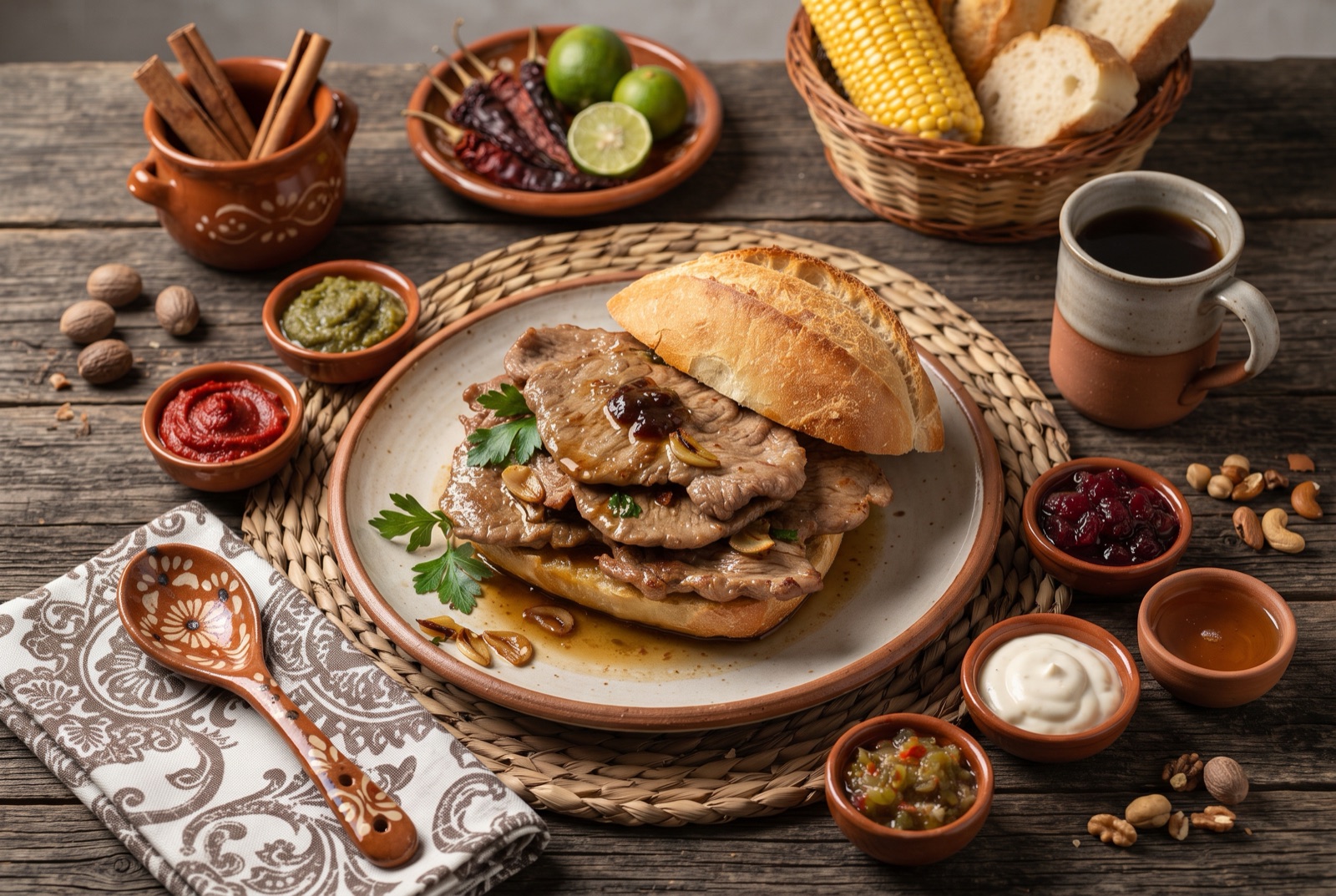
The bifana is Portugal's everyday sandwich and a lesson in what four ingredients can do. Pork is sliced almost transparently thin, left overnight in white wine crushed with garlic, bay and paprika, then cooked fast in a hot pan and finished by letting the marinade reduce around it into a loose, garlicky sauce. It goes into a papo-seco — a crusty white roll with a soft interior — with a spoon of that sauce poured over, and usually a smear of mustard and a shake of piri-piri. The meat is tender to the point of falling apart, the wine and bay give it a sharp herbal lift, and the roll does the rest. It costs almost nothing, takes twenty minutes at the stove, and is sold in every café and roadside stand in the country.

- Gate
- PortugalLisbon and the Alentejo
- Prep
- 20 min
- Cook
- 20 min
- Total time
- 8 hr 40 min incl. 8 hr rest
- Serves
- 4
- Status
- Easy
- Nutrition / serving · estimated
- Calories 560 kcal
- Protein 42 g
- Carbs 40 g
- Fat 24 g
- Fiber 2 g
- Sodium 1050 mg
Why this recipe works.
- A real overnight marinade in white wine and crushed garlic, which is where all the flavour comes from — not a fast rub applied at the stove.
- Cooks the meat and the sauce in the same pan and in the right order, so the marinade reduces into something you can spoon rather than boiling the pork grey.
- Names the cut, the thickness and the direction of the slice, which matters far more here than any other variable.
- Includes the roll trick that Portuguese counters use and most written recipes leave out.
Ingredients.
13 itemsFor the pork
For the marinade
To cook
To serve
Equipment
- Wide heavy frying pan
- Mortar and pestle or the flat of a knife
- Non-reactive bowl for marinating
Instructions.
Slice the pork thin
Firm the pork in the freezer for 30 minutes, then slice it against the grain into 3–5 mm sheets. Lay any thicker pieces between sheets of baking paper and flatten them with the base of a pan until they are even.
Tip Hold a slice up to the light — you should almost be able to see through the thin edges.
Marinate overnight
Whisk the garlic paste, wine, torn bay leaves, paprika, olive oil, piri-piri, salt and pepper together in a non-reactive bowl. Turn the pork slices through it so every piece is coated and no two are stuck together, cover, and refrigerate for at least 2 hours and ideally overnight.
Separate meat from marinade
Lift the pork out with tongs and let it drain briefly, keeping every drop of the marinade — it becomes the sauce. Pat the slices dry on one side only; a wet surface will not brown, but you do not want to wipe the seasoning off.
Sear in batches
Melt the lard in a wide pan over high heat until it shimmers. Lay in a single layer of pork slices, leaving space between them, and cook for 45–60 seconds a side until the edges catch gold. Remove to a plate and repeat with the rest — three batches is normal for this quantity.
Tip If the pan fills with liquid rather than sizzling, it is too crowded or not hot enough. Pour the liquid into the marinade bowl and carry on.
Reduce the sauce
Pour all the reserved marinade into the hot pan and let it bubble hard for 3–4 minutes, scraping the browned bits off the base, until it has reduced by about half and smells of cooked garlic and wine rather than raw alcohol. Whisk in the butter if using, for gloss.
Return the pork
Slide all the pork and any juices from the plate back into the pan, lower the heat and turn the slices through the sauce for 2 minutes until everything is coated and hot. Taste the sauce for salt — it should be sharp, garlicky and just salty enough to season the bread.
Fill the rolls and serve
Split the rolls, press the cut faces down into the sauce in the pan for a couple of seconds, then pile in three or four slices of pork per roll and spoon over more sauce until it threatens to run out. Serve at once with mustard and piri-piri on the table.
Tips from our kitchen.
- Slice the pork 3–5 mm thick, against the grain, and pound any thicker pieces flat between sheets of baking paper. Thickness is the single thing that decides whether the meat is tender or chewy.
- Freeze the pork for 30 minutes before slicing. Firm meat cuts far more evenly than soft meat, and the slices come out closer to what a butcher would give you.
- Crush the garlic to a paste with salt rather than chopping it. A paste dissolves into the wine and coats every slice; chopped garlic sits in the bottom of the bowl.
- Marinate overnight if you can, at minimum two hours. This is not a marinade that works in twenty minutes — the wine needs time to get through the meat.
- Sear the pork in batches in a properly hot pan. Crowding drops the temperature and the slices poach in their own liquid instead of browning.
- Press the cut face of the roll into the sauce in the pan for a couple of seconds before filling it. It is how the counters do it and it transforms the bread.
Substitutions.
- Pork loin or collar → Thin-cut pork leg steaks, or turkey breast sliced very thin
- Leaner cuts need a shorter cook and benefit from a little extra olive oil in the pan. Turkey is a common Portuguese variation sold as a bifana de peru.
- Dry white wine → Equal parts chicken stock and white wine vinegar, or a dry cider
- You need the acidity to tenderise and cut the fat. Plain stock alone leaves the marinade flat and one-dimensional.
- Papo-seco rolls → Crusty white rolls, small ciabatta, or a demi-baguette cut into lengths
- You want a firm crust and an open, absorbent crumb. Soft burger buns turn to mush the moment the sauce hits them.
- Lard for frying → Olive oil, or a mix of olive oil and butter
- Lard is traditional and gives a rounder flavour, but olive oil is common in home kitchens and nobody will complain.
Variations.
- Bifana à moda de Vendas Novas
- The roadside town's own style: slices cut even thinner, cooked very fast in a lot of garlic and lard, and the roll dunked in the pan juices before filling.
- Bifana com queijo
- A slice of mild flamengo cheese laid over the hot pork in the roll so it half melts. Common in northern cafés and treated as an upgrade rather than a different sandwich.
- Prego no pão
- The bifana's beef sibling — a thin garlicky steak in the same roll, usually served after a fish course or at the end of a long lunch.
Storage & reheating.
Cook the pork and refrigerate it in its sauce for up to 3 days — it reheats better than most sandwich fillings because the sauce keeps it moist. Warm it gently in a pan rather than a microwave, adding a splash of water if the sauce has tightened. The marinated raw pork can sit in the fridge for 2 days and actually improves on the second, or freeze it in the marinade for up to 3 months and thaw overnight before cooking. Never assemble a bifana ahead; the roll has minutes, not hours.
Serve with
Yellow mustard and piri-piri sauce on the table, a small draught beer, and a coffee standing at the counter afterwards.
The story behind Bifana.
The bifana is roadside food in the most literal sense. Vendas Novas, a town on the old main road between Lisbon and the Alentejo, built an entire local identity on it: drivers stopped, ate bifanas at the counter, and the town became known for little else. The Vendas Novas style is its own school — thinner slices, a quicker cook, more garlic, and the roll often dipped in the pan juices before it is filled. Lisbon cafés tend towards a wetter, saucier version with more liquid in the pan, while further south in the Alentejo you find more paprika and more heat. None of these are wrong, and locals will defend theirs at length.
What unites them is the marinade rather than the meat. Portuguese cooking leans on a small set of flavours — garlic, bay, white wine, paprika, olive oil — and the bifana is close to their purest expression, with nothing else in the pan to distract. The pork itself is chosen for thinness rather than for prestige: loin, leg or collar, cut against the grain to a few millimetres so it cooks in under a minute a side and never has time to toughen. Butchers in Portugal sell pork already sliced for bifanas, which tells you how routine the dish is.
It is also a sandwich with a clear set of rules about what goes with it. Yellow mustard, applied by the person eating and not the cook. Piri-piri sauce from the bottle on the counter. A bica afterwards, or an imperial — a small draught beer — alongside. In some places the roll is briefly pressed face-down in the pan so the cut surface takes up the sauce, which is an improvement worth stealing. And the sauce level is never negotiable: a bifana that does not drip is a bifana that was made in a hurry.
Questions, answered.
What cut of pork should I use for bifanas?
Loin or collar (cachaço) are the usual choices — loin for a leaner, cleaner bite, collar for more fat and more flavour. Leg works too. What matters far more than the cut is the thickness: three to five millimetres, sliced against the grain. A thick piece of prime loin makes a worse bifana than a thin piece of cheap leg.
How long should the pork marinate?
Overnight is ideal, and eight to twelve hours in the fridge gets the wine and garlic all the way through the thin slices. Two hours is the practical minimum and still produces a good sandwich. Beyond about twenty-four hours the acid starts to firm the surface of the meat, so it is worth cooking it by then.
Why is my pork tough?
Two likely causes. Either the slices were cut too thick, so they needed a longer cook than the pan gave them, or they were cut with the grain instead of against it, leaving long muscle fibres running through each piece. A third possibility is overcrowding the pan, which steams the meat rather than searing it and toughens it as it releases liquid.
What kind of bread is a papo-seco?
A small Portuguese white roll with a thin crisp crust and a light, slightly dry interior — dry being the point, since it has to absorb sauce without collapsing. Outside Portugal, small crusty white rolls, mini ciabatta or a cut length of baguette all do the job. Avoid anything soft, sweet or enriched.
Can I make bifanas for a crowd ahead of time?
Cook the pork in its sauce up to three days in advance and keep it refrigerated, then reheat it gently in a wide pan just before serving. That is how cafés handle volume, and the flavour holds up well. Split and warm the rolls at the last minute and let people fill their own, because an assembled bifana starts going soggy within a few minutes.
You might also like.
All recipes →

Keep exploring Portugal.
Portugal has 9 more dishes in the atlas — Arroz de Marisco and Bacalhau à Brás, and 7 more.
All Portugal recipes Pork shoulder recipes Garlic recipes Bay leaf recipes street foodmaindairy freeRecipe by The DishRoute Kitchen · published August 19, 2026 · updated August 19, 2026