Salteñas.
Bolivian Juicy Baked Meat Pastries
Salteñas · say it: sahl-TEH-nyas
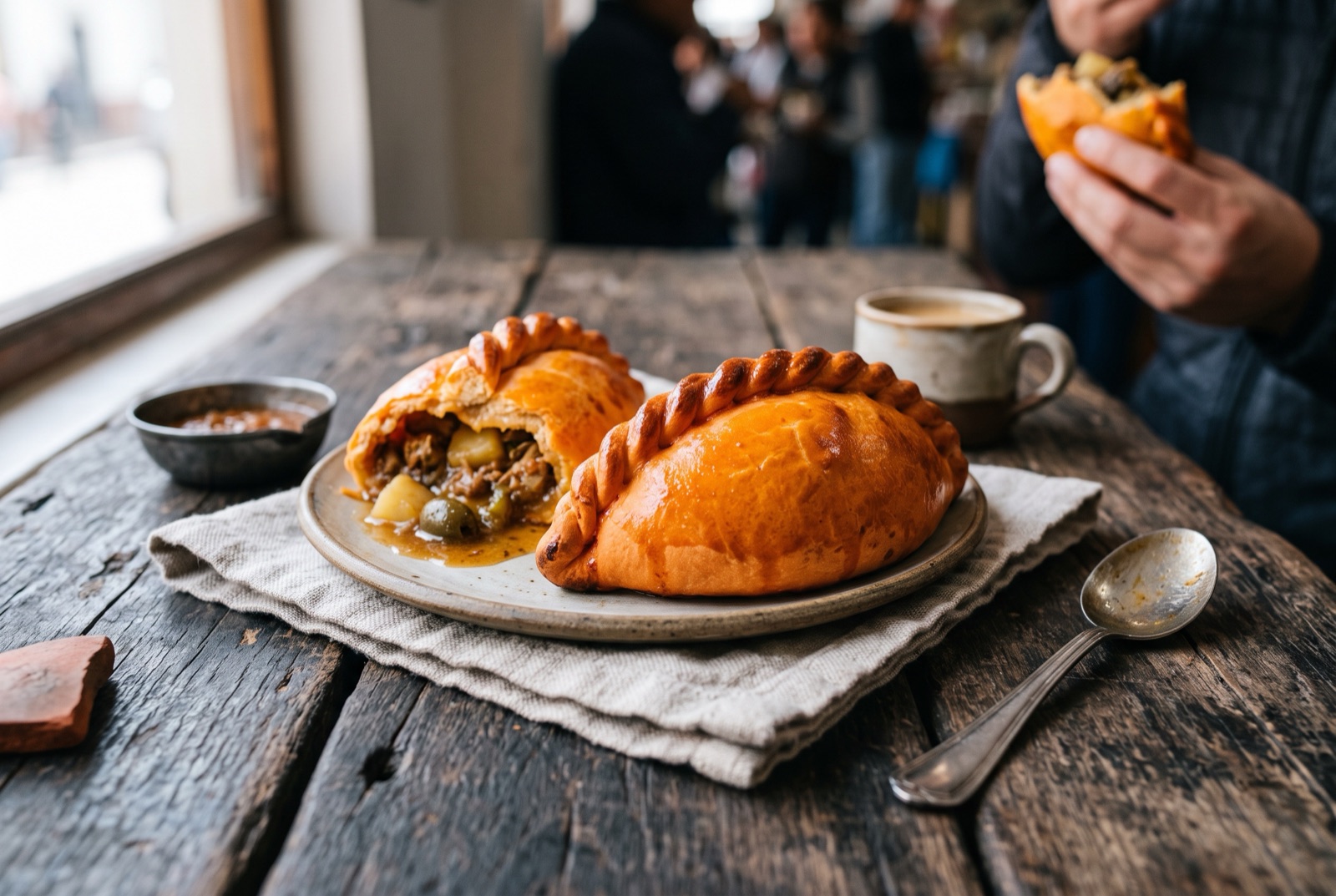
A salteña is a baked pastry engineered to be soup. The filling — beef or chicken with potato, peas, yellow chilli, cumin and a whisper of sugar — is cooked the day before and stiffened with gelatin so it can be cut into cold cubes and wrapped in dough without leaking. In the oven that jelly liquefies again, and by the time the crust is deep gold the inside is a small reservoir of hot, faintly sweet, gently spiced broth. The pastry itself is sweeter and sturdier than an Argentine empanada, coloured with achiote and pleated shut along the top in a rope-like braid. Bitten wrong, it runs down your wrist, which is why every Bolivian holds it upright like a cup.

- Gate
- BoliviaTarija and La Paz
- Prep
- 1 hr
- Cook
- 25 min
- Total time
- 13 hr 25 min incl. 12 hr rest
- Serves
- 12
- Status
- Takes skill
- Nutrition / serving · estimated
- Calories 420 kcal
- Protein 17 g
- Carbs 45 g
- Fat 19 g
- Fiber 3 g
- Sugar 6 g
- Sodium 620 mg
Why this recipe works.
- The gelatin ratio is tuned so the filling cuts cleanly when cold but runs freely at oven heat — the whole point of the pastry.
- Dough is made with warm fat and achiote for the correct colour and a crust that stays crisp against wet filling.
- Filling and dough are split across two days, which is how salteñerías actually work and the only realistic way to do it at home.
- A freeze-then-blast-heat bake sets the seam before the jelly melts, so the broth stays inside.
Ingredients.
25 itemsFor the filling
To fill
For the dough
Equipment
- Shallow tray or dish for setting the filling
- Rolling pin
- Pastry cutter or 14 cm bowl
- Baking stone or heavy tray
Instructions.
Build the chilli base
Sweat the onions and garlic in the oil over medium heat until they collapse and turn glassy, about 10 minutes, then stir in the ají pastes, cumin and oregano. Keep frying until the mixture darkens and a rim of orange oil separates around the edge of the pan — that is the base finished.
Simmer the stew
Add 600 g of diced beef and the stock, bring to a gentle simmer and cook uncovered for 40 minutes. Drop in the potato and cook 10 minutes more, until it is tender but still holds a square edge, then stir through the peas, sugar, salt and pepper. Season it slightly stronger than tastes right — it will be eaten cold-set and enclosed in bland pastry.
Set the filling
Sprinkle the gelatin over 100 ml of cold water, let it swell for 5 minutes, then stir it into the hot stew off the heat until completely dissolved. Pour into a shallow tray to a depth of about 3 cm, cool, cover and refrigerate overnight until it is firm enough to cut into clean cubes.
Make the dough
Steep the achiote seeds in the melted butter over low heat for 3 minutes until the fat runs deep orange, then strain. Rub the coloured fat into the flour, sugar and salt with your fingers, add the beaten eggs and warm water, and knead 5 minutes to a smooth, slightly tacky dough. Rest it covered for 30 minutes.
Tip The dough should feel like soft modelling clay, not like bread dough. If it springs back hard when pressed, it needs a little more water and another rest.
Cut and fill
Roll the dough 3 mm thick and cut twelve 14 cm discs. Cut the set filling into cubes and place a generous 100 g mound slightly off-centre on each disc, then top with a slice of egg, half an olive and a few raisins. Work quickly so the jelly stays cold.
Seal and pleat
Brush the rim with water, fold the dough over into a half-moon and press the edges together hard, squeezing out any air. Starting at one corner, fold the sealed edge over itself in small overlapping pinches to build the rope-like braid along the top, and finish by tucking the last pleat under.
Tip If any filling smears onto the rim, wipe it clean before sealing — grease on the seam is the single most common cause of a blowout.
Chill hard, then bake hot
Sit the salteñas seam-up on a lined tray and freeze for 15 minutes while the oven heats to 220 °C with a heavy baking tray inside. Brush with the egg glaze, slide them onto the hot tray and bake 18–22 minutes, until the crust is deep amber, blistered along the pleat and firm when tapped.
Rest and eat upright
Let them sit 5 minutes so the broth stops boiling inside, then serve immediately. Hold each one braid-upwards, bite a small hole in one end and drink the broth before eating the pastry.
Tips from our kitchen.
- Chill the filling until it is genuinely firm — overnight, not two hours. If it wobbles on the knife it will leak, and no amount of careful pleating will save it.
- Cut the beef by hand into 5 mm dice rather than mincing it. Minced meat turns the broth cloudy and muddy; hand-cut pieces stay distinct in the liquid.
- Roll the discs slightly thicker than you think — about 3 mm. Thin dough tears under the weight of the jelly cube and the egg slice.
- Freeze the assembled salteñas for 15 minutes before baking. A cold seam holds its shape long enough to set in the oven.
- Bake on a preheated tray or stone at full heat. A slow oven melts the filling before the pastry has any structure, which is exactly how blowouts happen.
- At Andean altitudes dough dries out fast in the thin air — keep the discs under a cloth while you work, and add a splash more water than the recipe says if the dough feels tight.
Substitutions.
- Ají amarillo paste → 2 tbsp mild chilli powder mixed to a paste with a little warm water, plus a pinch of turmeric
- You lose the fruitiness but keep the colour and the mild heat. Latin grocers and online sellers carry the real paste in jars, and it keeps for months once opened.
- Beef chuck → Boneless chicken thigh, cut the same size
- Salteñas de pollo are equally standard in Bolivia. Simmer the chicken for only 20 minutes instead of 45.
- Powdered gelatin → Agar-agar, using about half the weight
- Agar sets firmer and melts at a much higher temperature, so the filling stays gelled instead of turning to broth. It solves the leaking but sacrifices the defining texture.
Variations.
- Salteña de pollo
- The chicken version, usually a little sweeter and milder, with the same potato, pea, egg and olive furniture inside.
- Picante
- Half a finely chopped locoto stirred into the filling before it sets, which turns the gentle background warmth into an obvious burn.
- Salteña vegetariana
- Diced potato, peas, carrot and broad beans in the same yellow chilli broth, with vegetable stock and a little extra gelatin to compensate for the missing meat juices.
Storage & reheating.
Baked salteñas are at their best within an hour and are never as good reheated, because the filling reabsorbs into the crust as it cools. They keep 2 days refrigerated; revive them at 180 °C for 8–10 minutes rather than in a microwave, which steams the pastry soggy. Better: freeze them raw on a tray after shaping, bag them once solid, and bake from frozen at 220 °C for 25–28 minutes. The filling alone keeps 3 days in the fridge and freezes well for a month.
Serve with
Black coffee or api, eaten standing at a counter mid-morning, with plenty of napkins.
The story behind Salteñas.
The salteña is the most demanding thing in Bolivian home baking and the most casually eaten. It is sold from mid-morning at street counters and dedicated salteñerías in every city, ordered by the pair, eaten in ten minutes on the way somewhere, and gone by early afternoon — vendors simply run out, and asking for one at dinner marks you out as a visitor. Ordering also involves a choice most outsiders miss: de carne or de pollo, and picante or no picante, which in practice is the difference between a warm background hum and a genuine sting from the chilli in the broth.
The name points at Salta in northern Argentina, and the origin most commonly repeated in Bolivia credits Juana Manuela Gorriti, a nineteenth-century Argentine writer who spent years exiled in Tarija — "la salteña" being what people called her. It is a story told confidently and documented thinly, so it is better treated as tradition than as history. What is not in doubt is that the baked stuffed pastry belongs to a family that runs continuously across this whole border zone, from Argentine empanadas salteñas through Tarija to the Bolivian highlands. Where one ends and the next begins is genuinely blurry; what makes the Bolivian version its own is the deliberate liquid filling, the sugar in the dough, and the pleat.
Inside, past the meat and potato, sit fixed extras that read almost like a signature: a slice of hard-boiled egg, a green olive, sometimes raisins, and in some regional versions the olive is left whole with its stone in, which is worth knowing before you bite. The technique of setting a stew with gelatin so it can be enclosed cold is a straightforwardly clever workaround, and it is the single thing that separates a real salteña from a dry meat pie in the shape of one.
Questions, answered.
Why is my salteña filling leaking during baking?
Almost always because the filling was not cold enough or the seam was not properly sealed. The stew must be refrigerated until it is solid jelly you can cut into cubes, the pastry edge must be pressed together with no filling smeared on it, and the shaped pastries should go into the freezer for 15 minutes before hitting a hot oven. A slow oven also causes leaks, because the jelly melts before the dough sets.
What is the difference between a salteña and an empanada?
A salteña is a Bolivian baked pastry with a slightly sweet, achiote-tinted dough and a filling deliberately set with gelatin so it turns to broth in the oven. Empanadas across Latin America are usually drier inside, are often fried, and have unsweetened dough. They belong to the same family — the border between Bolivian and northern Argentine versions is genuinely fuzzy — but the liquid interior is what makes a salteña a salteña.
Can I make salteñas without gelatin?
You can, but you get a meat pie rather than a salteña. Some cooks thicken the stew heavily with flour and chill it instead, which holds together well enough to wrap but never becomes soup in the oven. Agar-agar seals just as reliably and is the vegetarian option, though it stays set at eating temperature. Gelatin is the only ingredient that gives the classic result.
How do you eat a salteña without spilling it?
Hold it upright with the pleated braid pointing at the ceiling, bite a small opening off one end, and sip the broth out before eating the rest. Bolivians treat this as basic table competence. Eating it flat on a plate with a fork works too, but the broth escapes immediately and the pastry goes soggy in seconds.
Why is there sugar in the pastry dough?
The faint sweetness is a defining feature, not an error. It balances the cumin, chilli and salty broth inside, and it also helps the crust brown deeply in the short, hot bake. Cutting the sugar out gives a paler, blander shell that tastes like a generic meat pie.
You might also like.
All recipes →
Keep exploring Bolivia.
Bolivia has 9 more dishes in the atlas — Api con Pastel and Cuñapé, and 7 more.
Recipe by The DishRoute Kitchen · published August 20, 2026 · updated August 20, 2026