Api con Pastel.
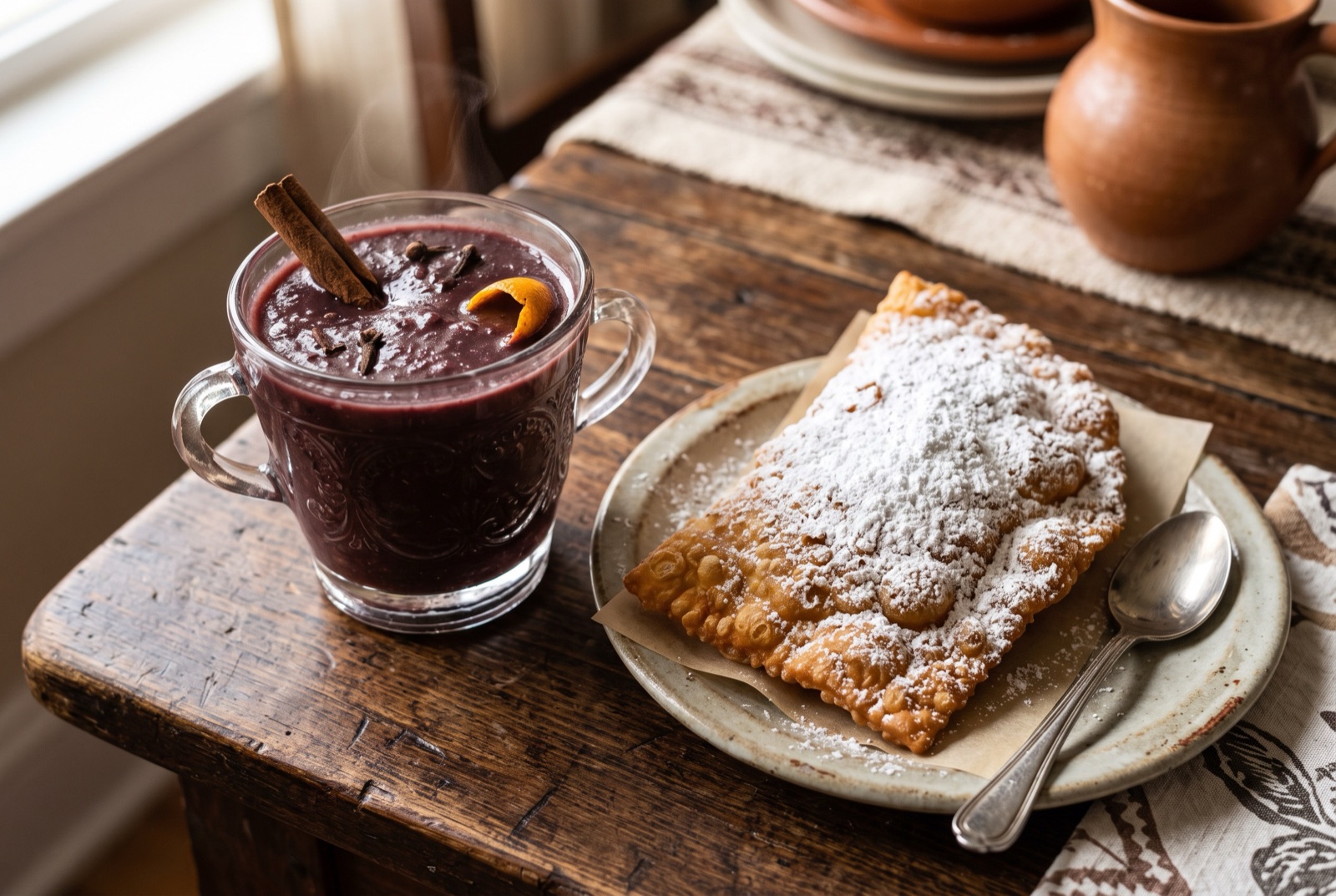
Purple Corn Drink and Fried Cheese Pastry
Api con pastel · say it: AH-pee kon pahs-TELL
Api is a hot drink of ground purple maize cooked with water, sugar and whole spices until it thickens to the consistency of pouring cream — deep violet, faintly grainy, sweet and sharply scented with cinnamon and clove. Pastel is its fixed partner: a thin round of wheat dough folded over cheese, deep-fried until it blisters and puffs, and buried under icing sugar. Neither is eaten alone. Together they are the standard cold-weather breakfast of the Bolivian highlands, sold from market stalls in the dark before work and drunk hot enough that the first sip has to be taken carefully.

- Gate
- BoliviaLa Paz, Oruro and Potosí
- Prep
- 30 min
- Cook
- 35 min
- Total time
- 1 hr 35 min incl. 30 min rest
- Serves
- 4
- Status
- Easy
- Nutrition / serving · estimated
- Calories 540 kcal
- Protein 13 g
- Carbs 82 g
- Fat 18 g
- Fiber 3 g
- Sugar 34 g
- Sodium 560 mg
Why this recipe works.
- Both halves of the breakfast in one recipe, because ordering api without pastel is not a thing anybody does.
- The maize is slaked in cold water before it meets heat, which is the only way to avoid a lumpy drink.
- A pastry dough with the right slack hydration, so it puffs and blisters rather than frying into a hard cracker.
- Honest about sourcing purple maize flour and what happens to the drink if you use whole kernels instead.
Ingredients.
14 itemsFor the api
For the pastel
To finish
Equipment
- Large saucepan
- Whisk
- Rolling pin
- Deep frying pan or wok
- Slotted spoon
- Fine sieve for dusting
Instructions.
Slake the maize
Whisk the purple maize flour into 300 ml of cold water until completely smooth, then leave it to stand for 10 minutes. The slurry should look like thin violet paint with no dry pockets clinging to the bowl.
Make the pastel dough
Rub the butter into the flour and salt, then work in the egg and enough warm water to bring it together into a soft, slightly tacky dough. Knead for 5 minutes until smooth and elastic, then cover and rest for 30 minutes.
Tip A slack dough is what puffs. If it feels stiff like pasta dough, work in another spoonful of water.
Infuse the spices
Bring the remaining 1.5 litres of water to the boil with the cinnamon sticks, cloves and orange peel, then lower the heat and simmer for 10 minutes until the kitchen smells clearly of clove and the water has turned pale amber.
Cook the api
Pour the maize slurry into the simmering spiced water through a sieve, whisking hard. Add the sugar and cook at a bare simmer for 20 to 25 minutes, stirring often and scraping the base, until the drink is deep purple and coats the back of a spoon.
Tip Taste for grittiness — properly cooked api is smooth on the tongue, raw maize is chalky.
Roll and fill the pastel
Divide the rested dough into 8 pieces and roll each into a thin round about 15 cm across and 2 mm thick. Lay cheese over one half, fold the other half across, and press the edges firmly with a fork, pushing out any trapped air.
Fry until blistered
Heat the oil to 180 °C and fry the pastels one or two at a time for about 90 seconds a side, spooning hot oil over the top, until they balloon, the surface breaks into blisters and the colour is uneven gold. Drain on a rack, never on paper.
Dust and serve together
Sieve icing sugar generously over the hot pastels and pour the api into tall glasses while it is still steaming. Serve them side by side and eat immediately — the pastry starts softening within minutes.
Tips from our kitchen.
- Whisk the maize flour into cold water first and let it sit ten minutes. Tipping dry flour into hot liquid produces lumps that no amount of whisking will break down.
- Cook the api at a bare simmer and stir often with a flat spoon, scraping the base — maize starch settles and scorches faster than it looks like it should.
- Judge thickness by the spoon, not the clock: it should coat the back and run off slowly. It thickens further as it cools, so pull it slightly looser than you want it.
- Roll the pastel dough genuinely thin, about 2 mm. Thick dough fries into a dense biscuit instead of puffing into blistered layers.
- Seal the cheese in properly and press out air, or the pastel will burst in the oil and spit hot fat across the stove.
- Dust the pastel with icing sugar the moment it comes out of the oil while it is still slightly damp on the surface, so the sugar clings instead of sliding off.
Substitutions.
- Purple maize flour (harina de maíz morado) → Whole dried purple corn cobs, boiled and the liquid thickened with 3 tbsp cornstarch
- Sold in Latin grocers as maíz morado. The colour comes out well but the drink is thinner and lacks the mealy body of milled maize.
- Queso fresco for the pastel → Low-moisture mozzarella, or a firm salty white cheese such as halloumi
- Bolivian queso criollo is salty and semi-firm. Avoid anything that runs when melted or the filling will escape into the oil.
- Orange peel → A strip of lemon peel, or a splash of orange juice at the end
- Citrus peel is common but not universal in api. Some stalls use only cinnamon and clove.
Variations.
- Api combinado
- Purple api and white api made separately and poured into the same glass side by side so the two colours stay distinct — how most Bolivian stalls serve it.
- Api amarillo
- The same method with white or yellow maize flour, giving a paler, milder drink that is usually sweetened a little less.
- Pastel de carne
- The pastry filled with seasoned minced beef instead of cheese, fried the same way but served without the icing sugar.
Storage & reheating.
Api keeps two days in the fridge and sets almost solid as the starch firms up, which is normal. Reheat it gently with a good splash of water, whisking until it flows again — it will never be quite as silky as the first pour, but it is entirely drinkable. The pastel does not keep at all: within an hour the crust goes limp and the cheese turns waxy, and no reheating recovers it. What you can prepare ahead is the dough, which rests happily overnight in the fridge, and the filled uncooked rounds, which hold a few hours covered before frying.
Serve with
Nothing else. This is a complete breakfast in Bolivia, eaten standing or on a plastic stool with the glass held in both hands.
The story behind Api con Pastel.
Purple maize has been cultivated in the Andes for a very long time, and boiling ground maize into a thick hot drink is one of the oldest ways the region eats its staple crop. The word api comes from Quechua, and the drink belongs to a wider Andean family that includes Peru's chicha morada, though the two are not the same thing — chicha morada is made by boiling whole cobs to extract colour and is drunk cold and thin, while api is made from the milled kernel itself and is thick, hot and eaten almost with a spoon. Bolivians also make api amarillo from white or yellow maize, and stalls often pour the two together in one glass, purple and pale side by side, sold as api combinado.
The pairing with a deep-fried wheat pastry is colonial arithmetic. Wheat, cheese from cattle, frying fat and refined sugar all arrived after the Spanish; the maize drink did not. What resulted is a breakfast that puts an indigenous Andean staple and a European fried pastry in the same order, which describes a great deal about highland Bolivian food generally. The pastel is not sweet in itself — the dough is plain and the cheese is salty — and the icing sugar on top exists to bridge it to the drink.
The setting matters as much as the recipe. Api is market food and street food, sold from covered stalls with plastic stools where people sit shoulder to shoulder at six in the morning in La Paz, Oruro or Potosí, and it is inseparable from the cold. At nearly four thousand metres the pre-dawn air is genuinely freezing, and a scalding, sweet, starchy drink is a rational response to it. It appears again in a different register at Carnival and at festivals, and in Oruro especially it is what people drink through the night. Nobody in Bolivia is surprised that a hot maize drink is breakfast; what surprises visitors is how much of it they can drink standing in the cold.
Questions, answered.
Where do I find purple maize flour?
Latin American grocers stock it as harina de maíz morado, and it is widely available online. If you can only find whole dried purple cobs, boil them with the spices for about 40 minutes to extract the colour, strain, then thicken the liquid with cornstarch. The result is thinner and less mealy but recognisably api.
Why did my api turn out lumpy?
The maize flour went into hot liquid. Starch grains gelatinise on contact with heat and seal into lumps before they can disperse. Always whisk the flour into cold water first, let the slurry stand, and pour it into the pan through a sieve while whisking. If it does lump, a stick blender rescues it while it is still hot.
How thick should api be?
Thick enough to coat the back of a spoon and run off slowly, but still clearly a drink rather than a porridge — you should be able to sip it from a glass. It thickens noticeably as it cools, so take it off the heat while it seems slightly too loose. If it stiffens too far, whisk in hot water a splash at a time.
Can I bake the pastel instead of frying it?
You can, and it will be pleasant, but it stops being a pastel. The characteristic blistered, bubbled surface comes from thin dough hitting hot oil, which forces steam between the layers in seconds. A baked version browns rather than puffs and comes out closer to a cheese turnover. If you bake, brush with butter and use 200 °C for about 15 minutes.
Is api the same as chicha morada?
No. Both use Andean purple maize, but chicha morada is Peruvian, made by boiling whole cobs with fruit and spices, strained, sweetened and drunk cold as a refreshment. Api is Bolivian, made from milled maize so the starch stays in, served hot and thick, and eaten as breakfast. The colour is the main thing they share.
You might also like.
All recipes →
Keep exploring Bolivia.
Bolivia has 9 more dishes in the atlas — Cuñapé and Fricasé Paceño, and 7 more.
All Bolivia recipes Corn recipes Cinnamon recipes Flour recipes breakfastdrinkstreet foodvegetariannut freeRecipe by The DishRoute Kitchen · published August 20, 2026 · updated August 20, 2026