Bolón de Verde.
Ecuadorian Green Plantain and Cheese Ball
Bolón de verde · say it: boh-LON deh VEHR-deh
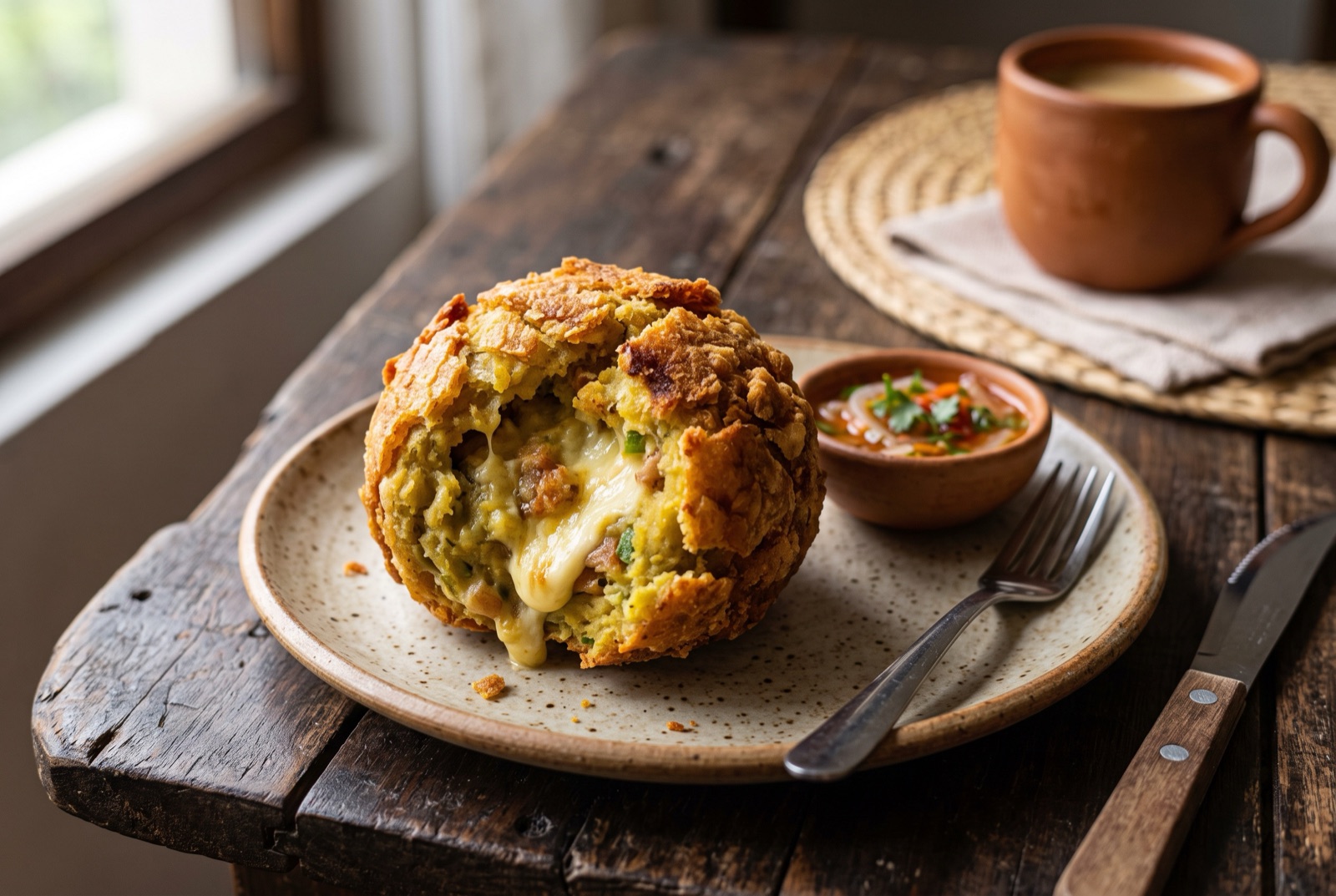
A bolón is a ball of mashed green plantain about the size of a fist, studded with fresh cheese or crisp pork, fried once to cook the plantain through and a second time to build a crust. Green plantain is a starch rather than a fruit — there is no sweetness in it at all — so the flavor is closer to a very dense potato dumpling, salty and rich from the butter worked into it, with soft pockets of cheese inside. On the Ecuadorian coast this is breakfast: one bolón, a mug of black coffee, and often a fried egg on the side, eaten standing at a market counter before seven in the morning.

- Gate
- EcuadorGuayas and Manabí
- Prep
- 15 min
- Cook
- 25 min
- Total time
- 40 min
- Serves
- 4
- Status
- Easy
- Nutrition / serving · estimated
- Calories 495 kcal
- Protein 13 g
- Carbs 64 g
- Fat 22 g
- Fiber 5 g
- Sugar 22 g
- Sodium 690 mg
Why this recipe works.
- Fries the plantain rather than boiling it, which is what gives a bolón its density instead of a wet, gummy mash.
- Insists on mashing while the plantain is still steaming, the only window in which it comes together as a dough.
- Gives the doneness cue for the first fry, where the usual mistake is browning the plantain instead of softening it.
- Covers both the cheese and chicharrón fillings rather than pretending there is only one correct bolón.
Ingredients.
8 itemsFor the dough
For the filling
To serve
Equipment
- Deep pan or fryer
- Slotted spoon
- Wooden mortar or sturdy mixing bowl
- Kitchen thermometer (helpful)
Instructions.
Peel and cut the plantains
Trim both ends off each plantain, run a knife lengthwise through the skin in three places without cutting into the flesh, and lever the strips away with your thumb. Cut the flesh into chunks about 3 cm thick.
Tip If the skin fights back, soak the scored plantain in warm water for two minutes and it will release.
Fry them soft
Heat the oil to 160°C and fry the chunks for 6 to 8 minutes. Pull them out while they are still pale gold and a knife slides in with a little resistance — you are cooking them through, not colouring them. Drain briefly on paper.
Mash while steaming
Tip the hot plantain into a mortar or sturdy bowl with the butter and salt and crush it hard until it comes together as a coarse, sticky dough that holds its shape when squeezed in your fist. Work fast — once it cools it goes crumbly and will not bind.
Fill and shape
Fold most of the cheese, or the chicharrón, through the warm dough, keeping a little back. Oil your hands, divide the dough into 4, press a hollow into each portion, tuck the reserved filling inside, and close the dough over it into a firm ball with no visible cracks.
Fry again for the crust
Raise the oil to 180°C and fry the balls for 3 to 4 minutes, turning once, until the outside is deep gold and blistered and taps firm with a spoon. Lift onto paper and salt lightly while they are still glistening.
Serve hot
Break each bolón open at the table so the steam escapes and the cheese shows. Serve with a fried egg, a spoonful of ají and a mug of black coffee, and eat it immediately — the crust softens within about fifteen minutes.
Tips from our kitchen.
- Peeling green plantain is nothing like peeling a banana. Cut off both ends, score the skin lengthwise through to the flesh in three places, then lever the strips off with your thumb.
- The first fry should soften, not colour. A knife should slide in with slight resistance and the pieces should still be pale gold — brown at this stage means the outside will be hard in the finished ball.
- Mash immediately and mash hot. Plantain that has cooled for five minutes turns crumbly and refuses to bind, and no amount of pressing will fix it.
- A wooden mortar or the base of a heavy glass beats a fork. You want to crush the fibres, not slice through them.
- Wet your hands with a little oil before shaping. The dough is sticky when hot and will otherwise take half of itself with you.
- Press each ball slightly flatter than a sphere before the second fry, so it sits still in the pan and browns evenly instead of rolling.
Substitutions.
- Queso fresco → Mozzarella, mild feta rinsed of some salt, or a young cheddar
- Mozzarella stretches more than the original does, feta is closer in crumb and saltiness. Either is a fine breakfast; neither behaves exactly like Ecuadorian fresh cheese.
- Chicharrón → Crisped bacon lardons, or shop-bought pork scratchings crushed roughly
- The role is salt and shatter. Bacon brings smoke that the original does not have, so use a little less than you would expect.
- Deep-frying the plantain → Shallow-fry in 2 cm of oil, turning the pieces
- It takes a few minutes longer and needs more attention, but uses a fraction of the oil. Boiling is the one method to avoid — it makes the mash wet and slack.
Variations.
- Bolón de chicharrón
- Filled and studded with crisp fried pork instead of cheese, and usually salted a little harder. The workman's version and arguably the original.
- Tigrillo lojano
- The same fried plantain mashed in the pan with egg, cheese and spring onion and served loose rather than shaped. A plate you eat with a fork.
- Bolón mixto
- Both cheese and chicharrón in one ball. Widely sold, mildly frowned upon by purists in both camps.
Storage & reheating.
Shaped raw balls keep 2 days refrigerated, well wrapped, and can be fried straight from cold with an extra minute. Cooked bolones are best eaten within the hour; after that the crust softens. Reheat in a dry pan or a hot oven for 8 minutes rather than a microwave, which turns them uniformly soft. They freeze well shaped but unfried, for up to 2 months.
Serve with
Strong black coffee, a fried egg, and a spoonful of ají criollo on the side.
The story behind Bolón de Verde.
Green plantain is the coastal counterpart to the potato of the highlands, and Ecuador puts it through more transformations than almost any other country. Sliced paper-thin and fried it becomes chifles; cut into rounds, flattened and fried twice it becomes patacones; boiled and mashed with onion and cilantro it becomes a base for stews. The bolón is the breakfast form, and its whole logic is that plantain fried soft can be mashed while hot and then re-formed into something that holds its shape and crisps again.
What goes inside splits opinion along fairly firm lines. Bolón de queso uses crumbled fresh cheese, which softens rather than melts. Bolón de chicharrón uses pork that has been simmered and then fried until it shatters, and it is generally the version ordered by people who have real work to do that day. Mixto exists and both camps are suspicious of it. In Guayaquil and across Manabí, stalls sell all three from early morning until the plantain runs out, and by mid-morning most have closed.
A close relative is worth knowing about: tigrillo, from the southern province of Loja, uses the same fried and mashed plantain but scrambles it loose with egg and cheese in the pan instead of forming a ball. Same ingredients, entirely different plate. The bolón is the portable one — you can hold it in a napkin and walk — which explains a good deal about why it became the breakfast standard on a coast where people leave for work in the dark.
Questions, answered.
Can I use ripe yellow plantains?
No — you would be making a different dish. Ripe plantains have converted their starch to sugar, so they cannot form a dough and will caramelise and fall apart in the pan. Buy plantains that are hard and completely green, with no yellow patches at all, and use them within a few days before they start ripening on the counter.
What is the difference between a bolón and a patacón?
Both start from fried green plantain. A patacón is a single round slice that is flattened after its first fry and fried again into a crisp disc, served as a side. A bolón is mashed plantain mixed with cheese or pork, formed into a ball and re-fried, and it is a meal in itself, typically breakfast.
Why did my bolón fall apart in the oil?
Usually because the plantain was mashed after it cooled, so the starch could no longer bind. It can also happen if the balls were packed loosely — squeeze them firmly enough that no cracks show on the surface before frying, and chill them for fifteen minutes if the kitchen is warm.
Can I bake them instead of frying twice?
You can finish them in a 200°C oven for about 20 minutes with a brush of oil, and they will be perfectly good, but the crust will be drier and less blistered than a second fry produces. The first stage genuinely needs frying — baked raw plantain will not mash into a workable dough.
How many bolones is a portion?
One per person for breakfast, which is what this recipe makes with four plantains. They are much heavier than they look, since a whole plantain goes into each ball. If you are serving them alongside eggs and coffee as part of a bigger spread, half a bolón per person is more realistic.
You might also like.
All recipes →
Keep exploring Ecuador.
Ecuador has 9 more dishes in the atlas — Ceviche de Camarón and Colada Morada, and 7 more.
All Ecuador recipes Plantain recipes Queso fresco recipes Butter recipes breakfastvegetariangluten freeRecipe by The DishRoute Kitchen · published August 20, 2026 · updated August 20, 2026