Higos con Queso.
Ecuadorian Figs in Panela Syrup with Cheese
Higos con queso · say it: EE-gohs kohn KEH-soh
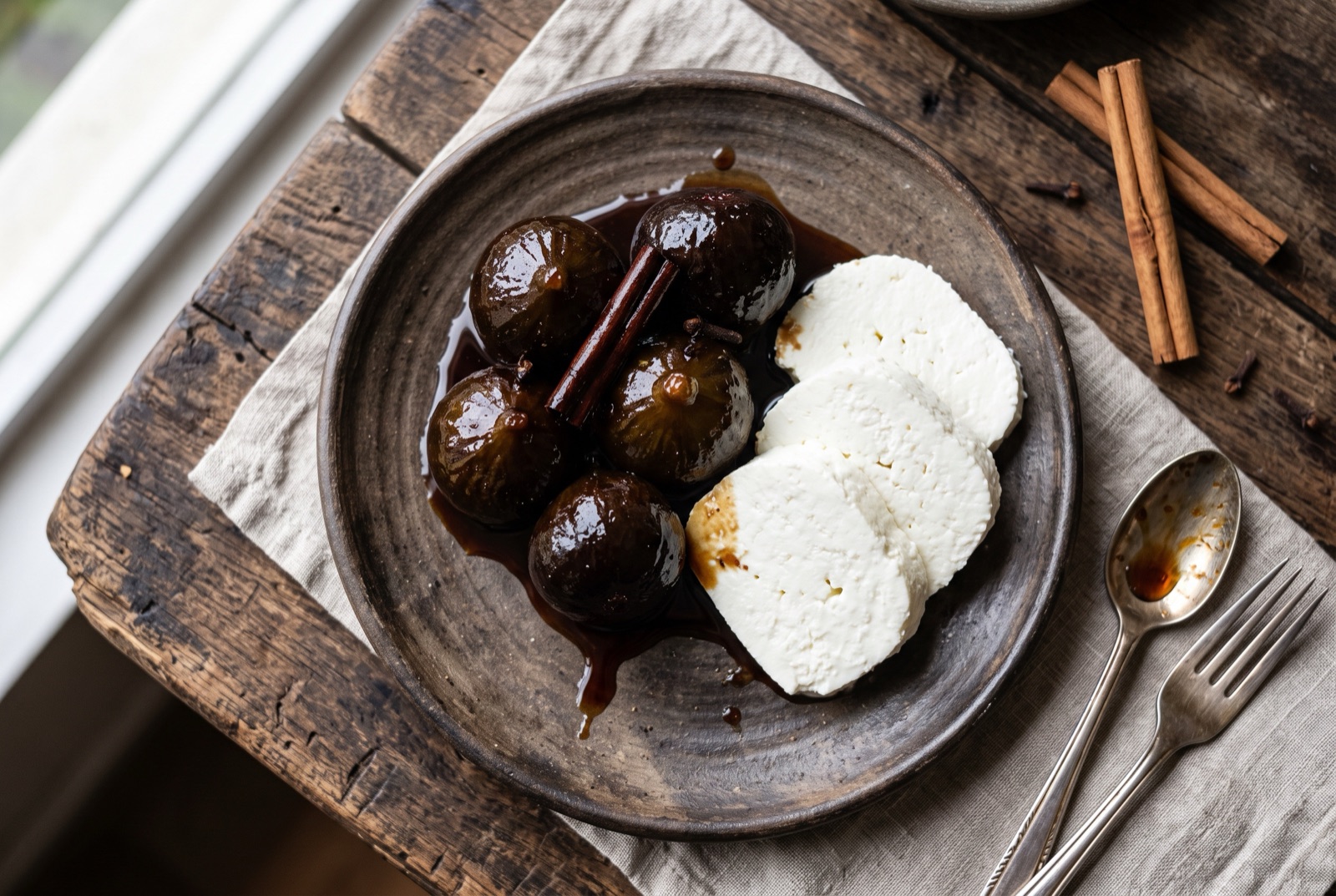
Dulce de higos is a pot of whole figs cooked down in unrefined cane sugar until they are dark, heavy and slick with syrup, and higos con queso is how Ecuador serves them: two or three figs in a bowl with their syrup, a wedge of cold fresh cheese leaning against the side. The figs go into the pot green and unripe, are boiled through several changes of water to strip out the bitter latex, then candied gently with cinnamon and cloves until the flesh turns almost translucent and the skin goes near-black. The taste is deep and molasses-heavy rather than simply sweet, with a faint resinous edge from the fig skin — and the cheese is not decoration. It is the salt that keeps the whole thing from becoming too much.

- Gate
- EcuadorTungurahua and Azuay
- Prep
- 20 min
- Cook
- 2 hr 30 min
- Total time
- 10 hr 50 min incl. 8 hr rest
- Serves
- 6
- Status
- Easy
- Nutrition / serving · estimated
- Calories 425 kcal
- Protein 9 g
- Carbs 82 g
- Fat 8 g
- Fiber 5 g
- Sugar 72 g
- Sodium 260 mg
Why this recipe works.
- Explains the several-water boil properly — the step that removes fig latex and decides whether the dish is pleasant or astringent.
- Candies the figs in stages, so the syrup thickens around fruit that is already tender rather than toughening it.
- Uses panela weights that actually set into a pourable syrup at room temperature instead of a thin sugar wash.
- Treats the cheese as a component with rules, not a garnish — which side of the bowl, what temperature, what kind.
Ingredients.
9 itemsFor the figs
For the syrup
To serve
Equipment
- Large saucepan
- Heavy-based pan for the syrup
- Slotted spoon
- Small sharp knife
- Clean glass jar for storing
Instructions.
Score and first-boil the figs
Wash 1 kg of green figs and cut a shallow cross about 1 cm deep into the base of each one. Cover with cold water in a large pan, add the bicarbonate if using, bring to the boil and cook for 20 minutes, until a skewer slides into a fig without the skin tearing.
Tip The water will turn cloudy and slightly grey — that is the latex coming out, and it is meant to be thrown away.
Change the water and repeat
Drain, rinse the figs under cold running water, cover with fresh water and boil for another 15 minutes. Do this a second time, then taste a sliver: it should be bland and soft, with no pucker or scratch at the back of the throat. If it still bites, give it one more change of water.
Soak, then press dry
Leave the drained figs in cold water for at least 8 hours or overnight, then lift each one out and squeeze it gently between your palms until water runs out and the fig looks slightly deflated. Do not crush them — they should still hold their shape.
Start the panela syrup
Melt the panela in the water in a heavy pan over medium heat with the cinnamon, cloves, orange peel and salt, stirring until no grains remain and the liquid is a clear dark brown. Simmer 10 minutes so the spices open up and the syrup smells of molasses rather than raw sugar.
Candy the figs slowly
Slide the figs into the syrup and hold it at a lazy simmer, uncovered, for 60 to 90 minutes. They are ready when they have plumped back up, gone dark and glossy almost to black, and the syrup runs off a spoon in a thin ribbon that leaves a brief trail on the surface.
Tip Turn the figs every 20 minutes so the ones on top do not stay pale on their exposed side.
Rest, then serve warm with cold cheese
Take the pan off the heat and let the figs sit in the syrup for at least 30 minutes so they draw in the last of it. Serve two or three per bowl while still warm, with plenty of syrup spooned over and a cold slice of queso fresco laid alongside, never on top.
Tips from our kitchen.
- Buy the figs hard, green and unripe, roughly the size of a walnut. Soft purple figs collapse into jam within twenty minutes and cannot be candied whole.
- Score a shallow cross in the base of each fig, about a centimetre deep, before the first boil. The syrup travels inside through those cuts and the fig stays intact.
- Change the boiling water at least twice and taste one. If it still puckers your mouth, boil it once more — no amount of panela hides fig latex.
- Press the figs gently between your palms after boiling to squeeze out water. Fruit still full of water will dilute the syrup and never take up sugar.
- Keep the syrup at a slow simmer, never a boil. A hard boil drives the sugar past the point where it stays pourable and gives you toffee around a shrunken fig.
- Serve the figs warm and the cheese straight from the fridge. The temperature gap is most of the pleasure, and a room-temperature plate of both tastes flat.
Substitutions.
- Panela → Piloncillo, jaggery, or dark muscovado sugar with a tablespoon of molasses
- All are unrefined or barely refined cane sugars carrying molasses. Plain white sugar makes a clear, sharp syrup that tastes like tinned fruit — technically the same dish, entirely different flavour.
- Queso fresco → Firm ricotta, a mild young feta rinsed under water, or fresh mozzarella patted dry
- You want low salt, no sharpness and a crumbly-to-springy texture. Aged, tangy cheeses fight the syrup instead of balancing it.
- Green figs → Dried figs, soaked overnight
- A real shortcut used in Ecuadorian kitchens when fresh green figs are out of season. Skip the multiple boils entirely — dried figs have no latex — and cut the syrup time to about 40 minutes.
Variations.
- Higos rellenos
- The candied figs split open at the base and stuffed with a spoonful of fresh cheese before serving, so each one arrives already assembled.
- Dulce de higos con manjar
- Served with dulce de leche instead of cheese, more common in restaurants than in homes and considerably sweeter.
- Higos en almíbar claro
- Made with white sugar and a strip of lemon peel for a pale golden syrup — lighter, sharper, and the version usually canned for export.
Storage & reheating.
Packed into a clean jar with enough syrup to submerge them, the figs keep 3 weeks refrigerated and improve for the first few days as the syrup works further into the fruit. They also keep at cool room temperature for a week or so if the syrup is thick and the jar was scalded first, which is how they are sold in highland markets. Warm portions gently in a small pan with a spoonful of their syrup before serving; the microwave heats the syrup faster than the fig and can scald. Do not freeze — the flesh turns mushy and weeps water into the syrup on thawing. The cheese is always added fresh at the table, never stored in the syrup.
Serve with
A wedge of cold queso fresco, and a small cup of black coffee to cut the sugar.
The story behind Higos con Queso.
Figs are not native to the Andes. They came with the Spanish, took extremely well to the temperate valleys between the two cordilleras, and are now grown seriously around Patate, Baños and Gualaceo, where the climate lets a tree carry fruit for most of the year. What Ecuador did with them is a technique the Iberian peninsula brought across the Atlantic and every colony adapted: preserve the fruit whole in cane syrup, cook it long enough that sugar replaces water inside the flesh, and you have something that keeps for months without refrigeration. Versions of the same idea run from Mexico to Argentina under a dozen names. The Ecuadorian one is distinguished by panela — cane juice boiled down and set into hard blocks, unrefined, still carrying its molasses — which is why the finished syrup is brown-black rather than clear.
The cheese pairing is the part that surprises visitors and that no Ecuadorian thinks about twice. Queso fresco here is barely salted, curdled that morning, closer to a firm ricotta than to anything aged, and it is eaten with sweet things routinely rather than as a novelty: with fig preserve, with sliced fresh figs, spooned over hot maize dishes. Higos con queso turns up as the dessert after fanesca in Holy Week, when the salt-cod soup has already made the point that Ecuadorian holiday food does not draw sharp lines between sweet and savoury. Outside that week it is sold in jars in every highland market and served in glass bowls at roadside restaurants along the Panamericana, where the syrup is ladled over generously enough to drink afterwards.
The recipe demands patience rather than skill. Green figs contain a milky latex that is genuinely unpleasant and mildly irritating to the mouth, so the first stage — repeated boiling and soaking in fresh water — is not optional fussiness but the entire reason the dish works. Cooks argue about the rest. Some add a pinch of bicarbonate to the first boil to keep the skins from splitting and to darken the colour; others insist it makes the figs slippery and refuse. Some score a cross in the base of each fig so syrup can get inside, which is standard in the highlands and rarer on the coast. All of them agree that rushing the syrup gives you sweet fruit floating in sugar water instead of a preserve.
Questions, answered.
Why do I have to boil the figs in several changes of water?
Unripe figs are full of a milky white latex that tastes bitter and can leave a scratchy, irritating feeling in the mouth and on the lips. Boiling the figs and discarding the water two or three times draws that latex out. Skip the step and the finished preserve will taste astringent no matter how much sugar goes into the syrup, which is the single most common reason a first attempt fails.
Can I use ripe purple figs instead of green ones?
Not for this dish. Ripe figs are soft, already sweet and full of water, so they fall apart in the pot and give you a loose jam rather than whole candied fruit. Green figs are firm, low in sugar and structurally strong enough to survive an hour of simmering in syrup — that firmness is exactly what the recipe is built around.
What is panela and where do I find it?
Panela is whole cane juice boiled down and poured into moulds to set as a hard brown block, sold across Latin America and known as piloncillo in Mexico, chancaca in Chile and rapadura in Brazil. It is unrefined, so it keeps the molasses that white sugar strips out. Latin American and South Asian grocers carry it, often near the flour, and it grates or chops easily once you attack a corner of the block with a heavy knife.
Why is fresh cheese served with a sweet dessert?
Because the syrup is intensely sweet and needs salt against it. Ecuadorian queso fresco is mild, barely salted and slightly milky, so it works the way a good cheese does beside quince paste or honey — it resets the palate between bites rather than adding another flavour. Highland cooking pairs fresh cheese with sweet foods routinely, including hot maize drinks and fruit, so nobody there regards it as an unusual combination.
My syrup went hard as it cooled. What happened?
It was cooked too far. Sugar syrup passes quickly from pourable to caramel, and once the water content drops below a certain point it will set solid around the fruit at room temperature. Pull the pan off the heat while the syrup still runs freely from a spoon in a thin stream — it thickens noticeably as it cools. If it has already set, add a few tablespoons of hot water and warm it gently until it loosens again.
You might also like.
All recipes →
Keep exploring Ecuador.
Ecuador has 9 more dishes in the atlas — Bolón de Verde and Ceviche de Camarón, and 7 more.
Recipe by The DishRoute Kitchen · published August 20, 2026 · updated August 20, 2026