Broa de Milho.
Portuguese Corn and Rye Bread
Broa de milho · say it: BROH-ah deh MEE-lyoo
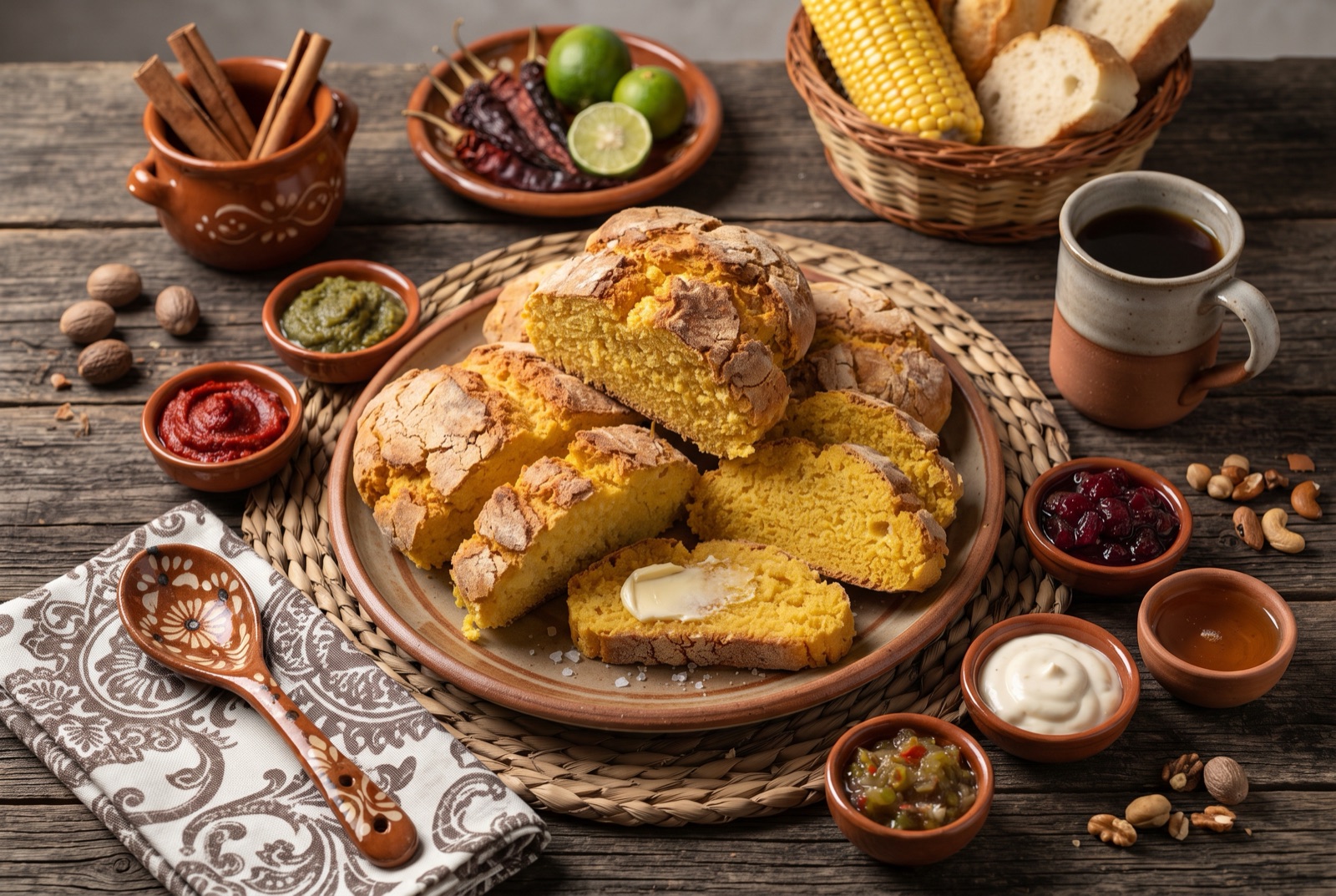
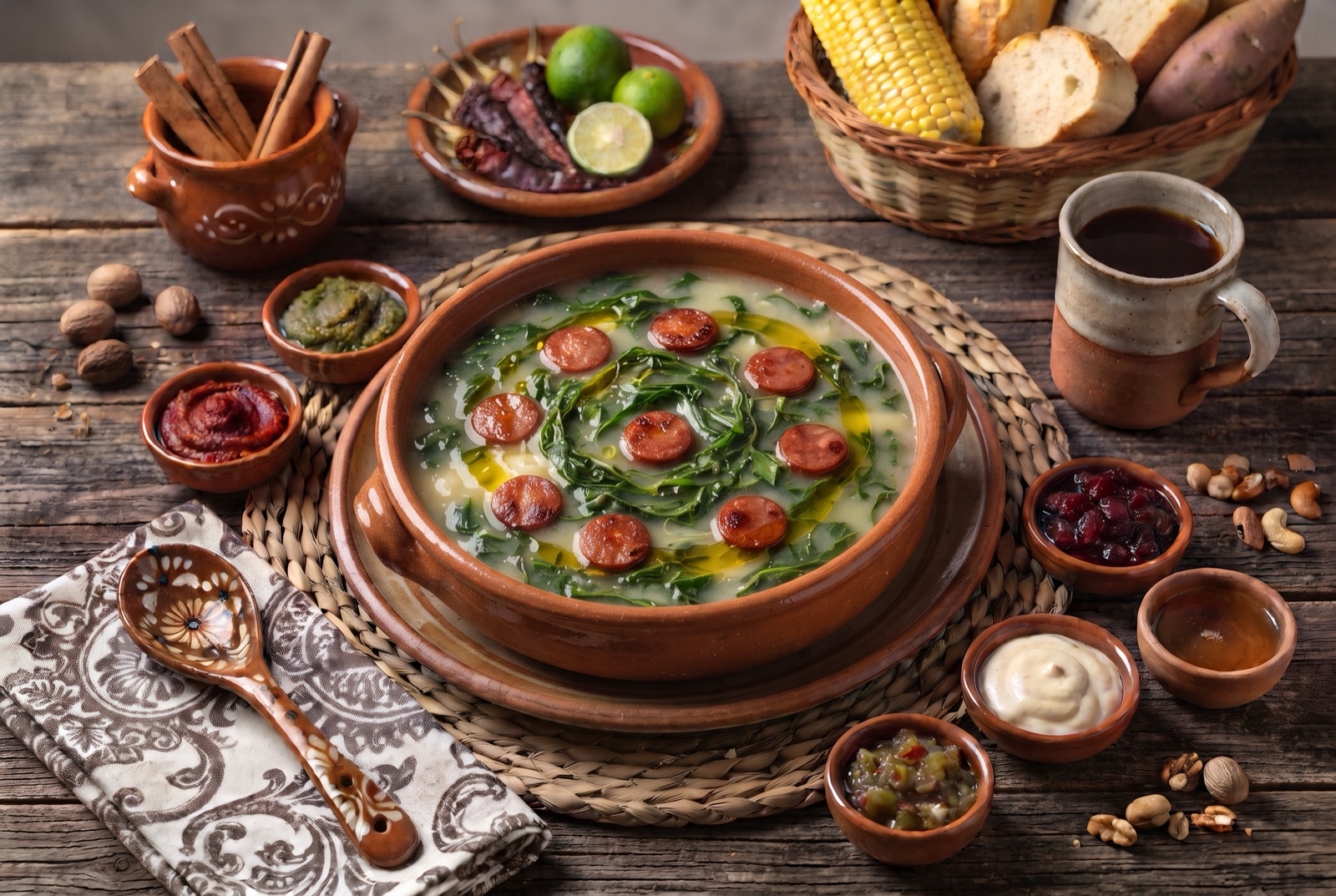
Broa de milho is a squat, domed loaf built mostly from maize flour, with enough rye and wheat in it to hold together. The crust is thick, matte and split with wide cracks; the crumb is dense, damp and bright yellow, with a texture closer to polenta than to sandwich bread, and a faintly sweet corn flavour underneath the sourness the rye contributes. It does not slice thin and it is not meant to — you cut it into wedges the width of two fingers and use it to mop, dunk and soak. In the north of Portugal it is what caldo verde is served with, what grilled sardines are eaten on, and what turns leftover greens into a meal.

- Gate
- PortugalMinho and Trás-os-Montes
- Prep
- 30 min
- Cook
- 50 min
- Total time
- 4 hr 20 min incl. 3 hr rest
- Serves
- 10
- Status
- Medium
- Nutrition / serving · estimated
- Calories 235 kcal
- Protein 6 g
- Carbs 48 g
- Fat 2 g
- Fiber 5 g
- Sugar 1 g
- Sodium 470 mg
Why this recipe works.
- Builds the loaf on a proper scald, the step that separates real broa from dry crumbly corn bread.
- A rye and wheat balance that gives enough structure to rise without turning it into ordinary brown bread.
- Shaped and baked without a tin, so you get the cracked dome and thick crust the loaf is known for.
- Realistic about home ovens: steam, temperature and the visual cues that tell you it is actually done.
Ingredients.
9 itemsFor the scald
For the dough
To finish
Equipment
- Large heatproof mixing bowl
- Baking stone or heavy baking tray
- Small tray for steam
- Dough scraper
Instructions.
Scald the maize flour
Put 300 g of maize flour and the salt in a large heatproof bowl and pour over the boiling water all at once, stirring hard with a wooden spoon until you have a thick, lumpless yellow paste. Cover and leave for 45 minutes, until it has swollen and cooled to just warm.
Tip Test with a finger before moving on. If it is hotter than a comfortable bath it will kill the yeast.
Build the dough
Whisk the yeast into the lukewarm water and let it stand for 5 minutes until it froths. Add it to the scalded maize with the rye flour, bread flour and olive oil, and mix with a scraper until no dry flour remains.
Work it, briefly
Turn out onto a lightly floured surface and work the dough for 6–8 minutes, pushing and folding rather than stretching. It will stay stiff, slightly tacky and a little rough — stop when it holds a smooth ball for a few seconds before slumping.
Tip Do not chase a windowpane. There is not enough gluten here to get one and over-working just tightens the crumb.
First rise
Return the dough to a clean, oiled bowl, cover, and leave in a warm place for about 2 hours. It will look sluggish compared to wheat dough — expect it to grow by half rather than double, with a domed, slightly cracked surface.
Shape the dome
With wet hands, gather the dough into a tight round on a maize-dusted peel or lined tray, tucking the edges underneath and rotating to build surface tension. Dust the top heavily with maize flour, cover, and leave for 45 minutes until it looks softly swollen and the flour on top has started to crack.
Bake with steam
Heat the oven to 230°C with a stone or heavy tray inside and an empty tray on the base. Slide in the loaf, pour a cup of boiling water into the lower tray, and bake for 15 minutes. Drop to 200°C and bake another 35 minutes, until the crust is deep brown with wide open cracks and the base sounds hollow.
Tip Internal temperature should read 98°C. Broa is heavy enough that the tap test alone can mislead you.
Cool completely before cutting
Move the loaf to a rack and leave it at least 2 hours. Cutting into warm broa gives you a gummy, compressed crumb — the starch is still setting. Cut in thick wedges rather than thin slices.
Tips from our kitchen.
- Use fine or medium maize flour, not the coarse yellow polenta grain. Coarse meal never fully softens and the crumb stays sandy.
- The scalded maize must cool to below 40°C before the yeast goes anywhere near it, or you kill the yeast outright.
- This dough will never feel like wheat dough. It is stiff, slightly sticky and tears rather than stretches — that is correct, do not knead it into submission.
- Wet your hands to shape the loaf. A dry hand drags the surface and the dome cracks unevenly.
- Bake it darker than you think. A pale broa tastes raw, and the thick crust is half the reason to make it.
- Wait for it to cool completely before cutting. Hot broa is gummy inside and the crumb collapses under the knife.
Substitutions.
- Rye flour → Wholemeal wheat flour
- Perfectly workable, but you lose the faint sourness rye brings. Keep the same weight and expect a slightly milder, sweeter loaf.
- Instant dried yeast → 20 g fresh yeast, or 150 g active sourdough starter
- Sourdough is the older method and gives a superior crust, but add 3–4 hours to the rise and hold back 50 ml of the water.
- Fine maize flour → Masa harina at half quantity, made up with more wheat flour
- Masa harina is nixtamalised and tastes of tortillas rather than of sweet corn — a usable emergency, not an equivalent.
Variations.
- Broa de Avintes
- A very dark, almost black loaf from a parish near Porto, made with a long bake and a higher proportion of rye. Slightly sweet, intensely flavoured, and protected by its own regional designation.
- Bacalhau com broa
- Not a bread variation but the loaf's best second life: stale broa blitzed with garlic, parsley and olive oil, packed over roast salt cod and baked until the crust crisps.
- Broinhas
- The same dough divided into small individual rolls of about 120 g. Bake at 220°C for 25 minutes — more crust per bite, and ready in half the time.
Storage & reheating.
Broa keeps remarkably well for a yeasted loaf — 4 to 5 days wrapped in a cloth at room temperature, thanks to the gelatinised maize starch holding moisture. Never refrigerate it; the crumb goes chalky within hours. It freezes cleanly for 3 months, either whole or in wedges, and thaws well at room temperature. Once it is genuinely stale, do not throw it out: it is the correct bread for açorda, for migas, and for the garlic-and-olive-oil crust that tops northern baked cod.
Serve with
Caldo verde, with the wedge sitting on the rim of the bowl Charcoal-grilled sardines laid straight on a thick slice Young Portuguese cheese and a glass of vinho verde
The story behind Broa de Milho.
Maize reached Portugal from the Americas in the sixteenth century and settled into the wet, green north as though it had always been there. The Minho and Trás-os-Montes had a climate that suited it and a population that needed calories from land that could not reliably support wheat, and within a few generations maize had displaced millet as the everyday grain. Broa is the direct result: a bread made from what the region actually grew, softened by whatever rye was to hand, and baked in the communal wood-fired ovens that used to stand in every village. The stone granaries on stilts you still see across the north — espigueiros — were built to dry and store the maize this bread depends on.
That history explains the bread's status. In Portugal broa is not a novelty or a health loaf; it is the bread of poorer rural households, and it carries the affection that food eaten out of necessity tends to acquire once nobody is forced to eat it any more. It appears in the two dishes people abroad most associate with Portuguese cooking — caldo verde, where a wedge sits on the side of the bowl, and grilled sardines, laid on a thick slice so the oil and juices soak straight in. It also gets a second life in the kitchen: crumbled with garlic and coriander into açorda, or mixed with olive oil and herbs into the broa crust that tops bacalhau and pork loin in northern restaurants.
The defining technique is escaldar — scalding. Maize flour has no gluten and its starch will not hydrate properly in cool water, so the flour is drenched with boiling water and left to swell before anything else happens. This gelatinises the starch, which is what gives broa its moist, close crumb and its unusually long keeping quality. Skip the scald and you get a dry, crumbling loaf that stales in a day, which is the single most common failure with this bread at home.
Questions, answered.
Why do I have to pour boiling water over the maize flour?
Maize flour contains no gluten and its starch granules will not absorb cold water properly. Scalding with boiling water gelatinises the starch so it can hold moisture, which is what produces broa's moist, close crumb and its unusual keeping quality. If you mix the maize flour in cold, the loaf bakes up dry and crumbly and stales within a day.
Why is my broa so dense — did it fail to rise?
Probably not. Broa is meant to be dense; roughly two-thirds of the flour has no gluten, so it can never rise like a wheat loaf and it typically gains only about half its volume. Worry only if the crumb is wet and streaky rather than merely close, which points to underbaking, or if the dough did not move at all, which usually means the scald was still too hot when the yeast went in.
Can I make broa gluten-free?
Not with this recipe as written — the rye and wheat provide all the structure that holds the loaf together, and rye contains gluten. A fully maize loaf is possible but it is a different bread, closer to a baked cornmeal cake, and it needs binders and a tin. Broa de milho by definition is a mixed-grain bread.
What is the difference between broa and American cornbread?
Broa is a yeast-raised, kneaded and shaped hearth loaf with a thick cracked crust, made from scalded maize flour with rye and wheat, and it takes several hours. American cornbread is chemically leavened with baking powder, poured as a batter into a pan, often enriched with eggs, butter and buttermilk, and baked in under half an hour. They share an ingredient and nothing else.
Do I need a wood-fired oven?
No, though that is where the bread comes from. A domestic oven at 230°C with a preheated baking stone or heavy tray and a tray of boiling water for the first ten minutes gets you a very good crust. The main difference is that a wood oven falls in temperature over the bake, so mimic that by dropping to 200°C after the first fifteen minutes.
You might also like.
All recipes →
Keep exploring Portugal.
Portugal has 9 more dishes in the atlas — Arroz de Marisco and Bacalhau à Brás, and 7 more.
Recipe by The DishRoute Kitchen · published August 19, 2026 · updated August 19, 2026