Chana Chaat.
Chickpea, Potato and Tamarind Salad
چنا چاٹ · Chana chaat · say it: CHUH-nah CHAAT
Chana chaat is a cold bowl of boiled chickpeas and potato cubes dressed with tamarind chutney, chaat masala, lemon and enough green chile to make it interesting, with raw onion and tomato folded through for crunch. There is no cooking beyond boiling, and no fat at all — the whole dish is a balancing act between sour, salty, sweet and hot, which is why it tastes sharper and cleaner than almost anything else on a Pakistani table. It is what appears at iftar during Ramadan, alongside fried things, precisely because it is the one item on the plate that cuts rather than adds. Made an hour ahead it is better than made to order.
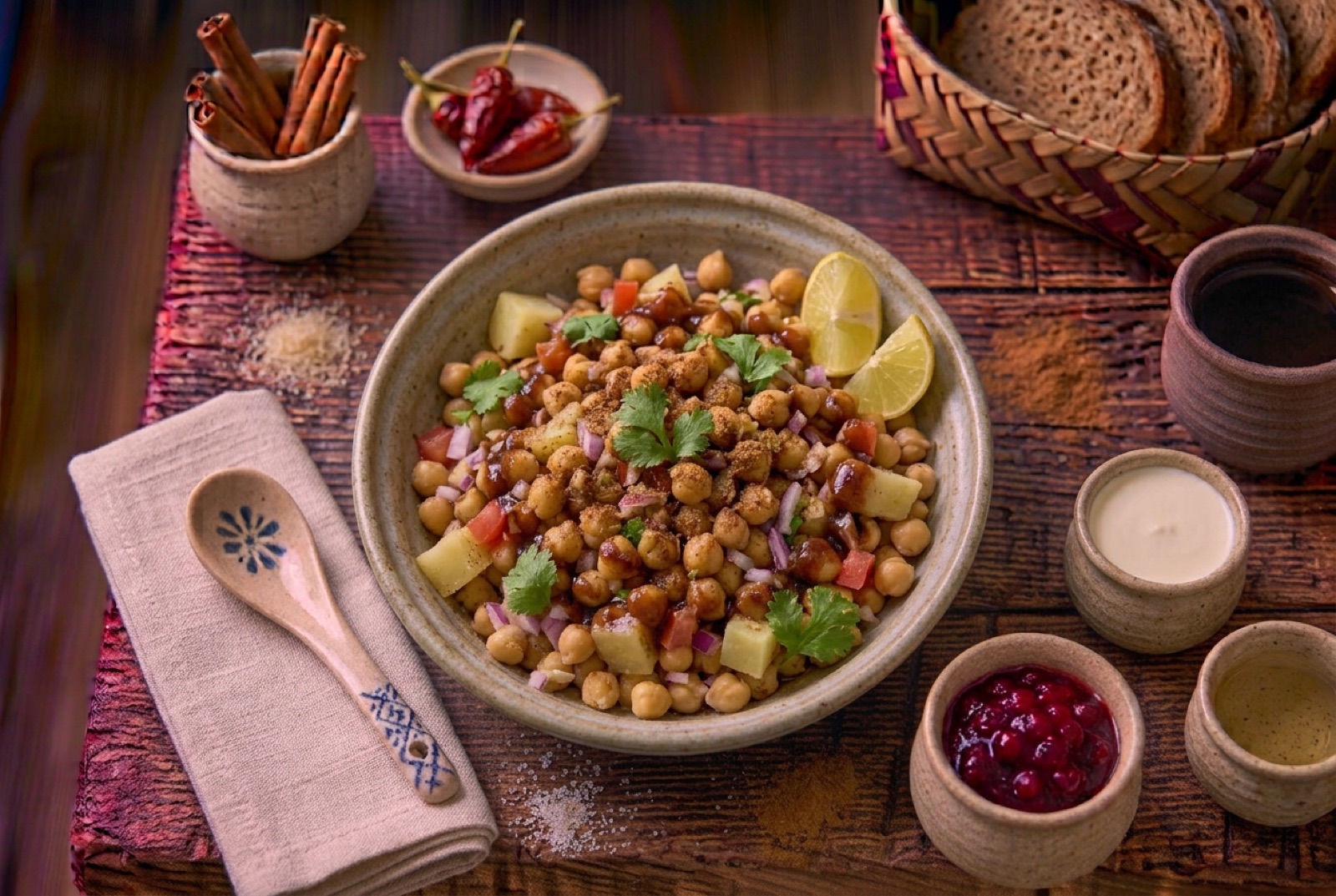

- Gate
- PakistanKarachi and Lahore
- Prep
- 20 min
- Cook
- 20 min
- Total time
- 55 min incl. 15 min rest
- Serves
- 4
- Status
- Easy
- Nutrition / serving · estimated
- Calories 290 kcal
- Protein 11 g
- Carbs 55 g
- Fat 3 g
- Fiber 11 g
- Sugar 14 g
- Sodium 690 mg
Why this recipe works.
- Makes the tamarind chutney from scratch in five minutes, which is the difference between a real chaat and dressed chickpeas.
- Salts and rests the chaat before serving so the seasoning actually penetrates the chickpeas instead of sitting on the outside.
- Deals with the watery-bowl problem directly, by deseeding the tomatoes and holding back the wet ingredients until the end.
- Gives a sourness benchmark you can taste against, rather than telling you to season to taste and leaving you there.
Ingredients.
17 itemsBase
For the tamarind chutney
To dress
Equipment
- Medium pot
- Small saucepan for the chutney
- Sieve
- Large mixing bowl
Instructions.
Cook the chickpeas soft
Drain the soaked chickpeas, cover with fresh water and simmer for about an hour until one squashes to a paste with no resistance in the middle. Salt them in the last ten minutes, then drain and spread them out to cool to room temperature.
Tip Slightly overcooked is better than slightly underdone here. Firm chickpeas refuse to take on the dressing.
Make the tamarind chutney
Simmer the tamarind pulp, jaggery and water in a small pan for 5 minutes, stirring, until it coats the back of a spoon and drips slowly rather than running. Take it off the heat, stir in the crushed cumin, chile powder and black salt, and let it cool completely.
Tip It thickens noticeably as it cools, so pull it while it still looks slightly thin.
Prepare the vegetables
Dice the boiled potatoes, onion, deseeded tomatoes and green chiles into pieces roughly the size of the chickpeas, so every spoonful gets a bit of each. Keep the tomato in a separate bowl for now.
Dress the base
Tip the cooled chickpeas, potatoes, onion, chiles and half the cilantro into a large bowl. Add the chaat masala, salt and two thirds of the chutney and fold gently with a spatula, lifting from underneath rather than stirring, so the potato cubes stay whole.
Rest, then correct
Leave the bowl for 15 minutes so the seasoning works into the chickpeas, then taste. It should be clearly sour and salty enough to make you blink slightly — if it tastes merely pleasant, add more chaat masala and salt now, before the lemon goes in.
Finish and serve cold
Fold in the tomatoes, the lemon juice, the remaining chutney and the rest of the cilantro and mint. Serve straight away in small bowls, with papri or sev handed round separately for anyone who wants crunch.
Tips from our kitchen.
- Boil the chickpeas until they are properly soft, not just cooked. A chickpea with a firm centre will not take on the dressing and stays bland in a bowl of well-seasoned everything else.
- Cut the potatoes into 1.5 cm cubes and let them cool completely before dressing. Warm potato turns the chutney cloudy and the cubes break up as you fold.
- Deseed the tomatoes. The jelly and seeds are almost pure water and they are the main reason a chaat goes soupy after ten minutes.
- Toast the cumin seeds in a dry pan until they darken and smell smoky, then crush them. Ground cumin straight from the jar tastes dusty here, where there is nothing to hide behind.
- Season, wait fifteen minutes, then taste again before you serve. Salt and lemon both flatten out as they sit, and the first tasting always under-reads.
- Add anything crunchy — papri, sev, fried noodles — at the table and not before, or it turns to paste in three minutes.
Substitutions.
- Tamarind pulp → 3 tbsp shop-bought tamarind chutney, or 2 tbsp lemon juice plus 1 tbsp brown sugar
- Bottled chutney is already sweetened, so cut the sugar in the recipe. The lemon-and-sugar version tastes brighter and less deep, but it works and nobody at the table will complain.
- Chaat masala → Equal parts ground roasted cumin, amchur and black salt, plus a pinch of black pepper and chile
- Chaat masala is a blend, not a single spice, and the mix above covers most of what it does. Black salt is the one component with no real substitute — its sulphurous edge is much of the flavour.
- Dried chickpeas → Two 400 g tins, drained and rinsed well
- Perfectly acceptable and what most people actually use. Rinse them thoroughly to lose the tinny brine, and let them drain in a sieve for ten minutes so they are dry when dressed.
Variations.
- Dahi chana chaat
- Whisked yogurt spooned over the top just before serving, with the chutney drizzled on that. Cooler and creamier, and the standard version in many Punjabi households.
- Fruit chaat crossover
- Diced apple, banana and unripe guava folded in with the chickpeas. Common at iftar tables and better than it sounds — the chaat masala treats fruit exactly as it treats potato.
- Papri chaat
- Built on a base of crisp fried flour discs with the chickpea mixture piled on top and everything drizzled at the last second. Textural rather than different in flavour, and it must be eaten immediately.
Storage & reheating.
Undressed, the boiled chickpeas and potatoes keep three days refrigerated in separate containers, and the tamarind chutney keeps two weeks in a jar. Once assembled, chana chaat is at its best between thirty minutes and three hours old. After that the onion goes strong and slightly bitter, the tomato leaks and the potato softens into the dressing, though a refrigerated bowl is still perfectly edible the next day if you drain off the liquid and refresh it with fresh lemon, cilantro and a shake of chaat masala. Do not freeze it — the potatoes come back mealy and the whole thing collapses.
Serve with
Fried snacks that need cutting through — pakoras, samosas, chicken rolls — and a cold drink, which is how it appears at iftar.
The story behind Chana Chaat.
Chaat is a category rather than a recipe: a family of cold, sour, aggressively seasoned snacks sold from carts and small counters across the subcontinent, whose defining move is the collision of tamarind sweetness with black-salt funk and dried mango sourness. Chana chaat is the plainest and most forgiving member of that family, which is exactly why it became a fixture of the Pakistani home kitchen rather than staying on the street. It needs no frying, no dough, no chutney grinder and no special equipment, and it can be assembled by anyone in the house who is old enough to hold a knife.
Its association with Ramadan is total. During the fasting month, evening tables across the country carry a near-standard set — dates, fried pakoras, samosas, a jug of Rooh Afza, and a bowl of chana chaat — and the chaat has a specific job in that lineup. After a day without food or water, the fried items are welcome for about four bites before they become heavy. The chaat is what resets the palate: cold, wet, sour and salty, closer to a drink than a salad in the way it revives you. Households make it in enormous quantities and eat the leftovers for the pre-dawn meal.
Beyond Ramadan it is picnic food, school-canteen food and the thing that gets made when guests arrive unannounced. Regional habits differ in the details: Karachi tends toward more tamarind and more chutney, Lahore toward more raw onion and a heavier hand with chaat masala, and some families add diced apple or slices of unripe guava, which sounds unlikely and works. The one rule that holds everywhere is that it must be sour enough to make you wince slightly on the first spoonful. Chaat that tastes merely pleasant has been under-seasoned.
Questions, answered.
Why did my chaat turn watery in the bowl?
Salt pulls liquid out of raw onion and tomato within minutes, and tomato seeds are almost entirely water to begin with. Deseed the tomatoes, chop them slightly larger than you think, and hold both the tomato and the salt back until the last fifteen minutes rather than dressing everything at once. If it has already pooled, tip the bowl and spoon off the liquid — do not stir it back in, because it dilutes the dressing that is still clinging to the chickpeas.
What is chaat masala and can I use garam masala instead?
No, they do very different jobs. Chaat masala is a cold-use souring blend built on amchur or dried pomegranate, black salt, roasted cumin and pepper, and it is sprinkled on finished food. Garam masala is a warm blend of cinnamon, cloves, cardamom and pepper meant to be cooked into a dish, and it tastes wrong and slightly soapy on something cold and sour. Every South Asian grocer sells chaat masala cheaply, or use the mix given in the substitutions.
How far ahead can I make chana chaat for a party?
Boil and cool the chickpeas and potatoes and make the chutney up to two days before. Chop the onion, tomato, chile and cilantro on the day and keep them in a covered box in the fridge. Combine everything about half an hour before people eat, taste it once more for salt and lemon at that point, and add any crisp topping at the table. Fully assembling it hours early is the one thing that reliably ruins it.
Is chana chaat the same thing as chana masala?
They share an ingredient and nothing else. Chana masala is a hot cooked curry in which chickpeas simmer in a fried onion and tomato gravy, eaten with rice or bread as a meal. Chana chaat is cold, uncooked beyond the boiling, dressed rather than sauced, and eaten as a snack in a small bowl with a spoon. One is dinner; the other is what you eat while dinner is still cooking.
How do I stop it being too sour or too sweet?
Adjust in that order: get the salt right first, because under-salted chaat reads as flat rather than sour, then balance the tamarind against the sugar in the chutney, and add lemon last since it is the sharpest and the easiest to overshoot. The target is a first spoonful that makes you blink slightly and immediately want a second. If it is too sour, a little more boiled potato absorbs the excess better than adding sugar does.
You might also like.
All recipes →
Keep exploring Pakistan.
Pakistan has 9 more dishes in the atlas — Balochi Sajji and Chapli Kebab, and 7 more.
All Pakistan recipes Chickpeas recipes Potato recipes Onion recipes snackappetizervegetarianvegandairy freeRecipe by The DishRoute Kitchen · published August 20, 2026 · updated August 20, 2026