Claclo.
Ivorian Sweet Plantain Fritters
Claclo · say it: KLAH-kloh
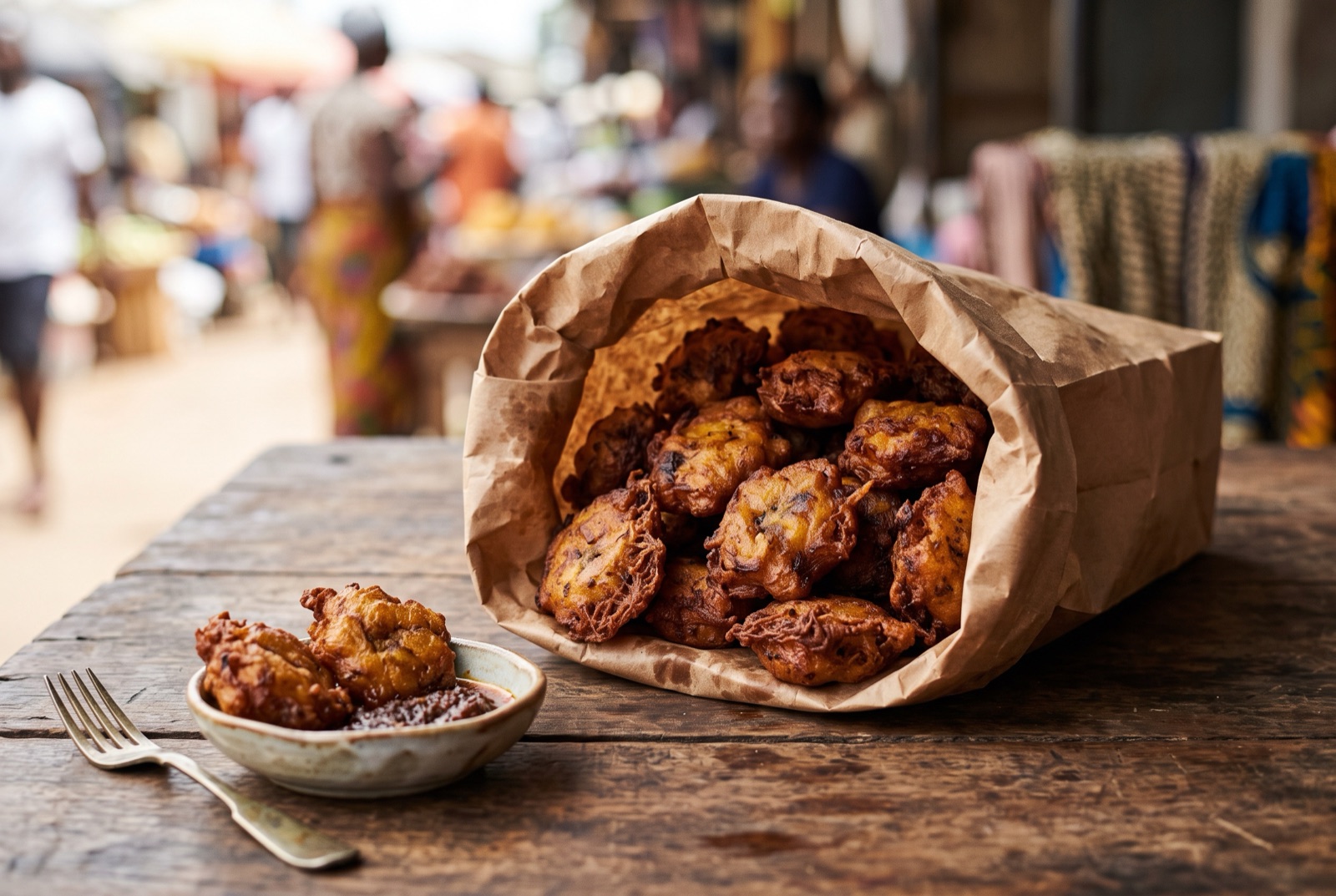
Claclo turns plantains that have gone too far to fry into something better than they were. The blackened fruit is mashed to a lumpy purée, bound with a little flour, seasoned with grated nutmeg, a pinch of ground chilli and a small amount of onion, then dropped into hot oil in spoonfuls. The fritters puff slightly, crisp at the ragged edges and stay dense and custardy in the middle, tasting sweet with a warm spiced finish and a faint chilli tingle that stops them being cloying. They are a snack rather than a dessert, eaten warm at any hour, and they use up fruit that would otherwise be thrown away. Fifteen minutes of preparation and no equipment beyond a fork and a pan.

- Gate
- Ivory CoastSouthern Côte d'Ivoire
- Prep
- 15 min
- Cook
- 20 min
- Total time
- 35 min
- Serves
- 6
- Status
- Easy
- Nutrition / serving · estimated
- Calories 290 kcal
- Protein 3 g
- Carbs 51 g
- Fat 9 g
- Fiber 3 g
- Sugar 22 g
- Sodium 210 mg
Why this recipe works.
- Uses plantain at the exact stage most people throw away, and explains why that stage is the right one.
- Adds the flour by feel with a clear texture target, since plantain wetness varies enormously.
- Keeps the chilli and nutmeg in the mix, which is what makes these savoury-adjacent rather than sugary.
- Fries at a lower temperature than most fritters, because the sugar content makes them burn easily.
Ingredients.
8 itemsEquipment
- Mixing bowl
- Fork or potato masher
- Deep or shallow frying pan
- Slotted spoon
Instructions.
Mash the plantain
Peel 4 of black plantains — the skins should slip off in strips — and mash the flesh in a bowl with a fork until it is a thick, uneven purée with some small lumps still visible.
Tip Stop before it is smooth. The lumps are what keep the fritters from turning into pancakes.
Season the mixture
Stir in the grated onion, nutmeg, ground chilli, salt and the sugar if you are using it. Taste a little of the raw mixture: it should be clearly sweet with a slow warmth arriving behind it.
Bring it together with flour
Fold in two thirds of the flour and check the consistency. A heaped spoonful should hold its shape for a few seconds before slumping; if it runs off the spoon, work in the rest of the flour a tablespoon at a time.
Heat the oil and test one
Bring the oil to 165°C in a deep pan and slide in a single spoonful. It should hold together, bubble steadily around the edge and colour to golden in about 2 minutes a side. Adjust the mixture before frying the rest.
Fry in batches
Drop in heaped tablespoons, four or five at a time, and fry for 2 to 3 minutes a side until deep golden with darker crisp frills at the edges and no wet-looking seams. Turn them once with a slotted spoon.
Tip If they darken in under 90 seconds, pull the pan off the heat for a minute — sugar burns long before the middle sets.
Drain and serve warm
Lift the fritters onto a rack and let them stand for 2 minutes so the centres finish setting. Eat them warm, when the outside is still crisp and the middle is soft enough to give under a thumb.
Tips from our kitchen.
- The plantains should be black all over and almost collapsing. If they still peel with any effort, leave them another two days on the counter.
- Mash with a fork, not a blender. Small lumps give the fritters their character; a smooth purée makes them dense and pancake-like.
- Start with less flour than the recipe says and add more only if the mixture will not hold on a spoon. Wetter plantains need more, drier ones need almost none.
- Test-fry one spoonful before committing the batch. If it spreads and falls apart, work in another tablespoon of flour; if it stays in a tight ball, loosen with a splash of water.
- Keep the oil at about 165°C. These are sugary and will go dark brown outside while raw inside if the pan is too hot.
- Rest the fried fritters on a rack rather than paper if you can — sitting in their own steam softens the crisp edges within minutes.
Substitutions.
- Plain flour → Rice flour, cornmeal, or a gluten-free blend
- Rice flour gives a crisper edge and keeps the fritters gluten-free. Cornmeal adds a pleasant grittiness but needs a few minutes to hydrate before frying.
- Nutmeg → Grated fresh ginger, or a mix of ginger and cinnamon
- Ginger is more common in the Ghanaian tatale version and works just as well against the plantain sweetness.
- Deep frying → Shallow-fry as small pancakes in a film of oil
- Widely done, and easier to control. Flatten each spoonful slightly and give it about 3 minutes a side.
Variations.
- Savoury claclo
- Sugar left out entirely, with more onion, chilli and salt, so the fritters go alongside a sauce rather than being eaten as a snack.
- Tatale
- The closely related Ghanaian version, seasoned with ginger and often more pepper, and usually fried flatter.
- Claclo with corn
- A handful of fresh sweetcorn kernels stirred through the mixture, giving pops of sweetness and a looser texture.
Storage & reheating.
Best eaten within an hour, while the edges still have some crispness. They keep 2 days in an airtight container in the fridge and reheat acceptably in a dry pan or a 180°C oven for 5 minutes; microwaving makes them soggy. The raw mixture does not hold well, since mashed plantain oxidises and darkens within an hour, so mix and fry in the same session. Fried fritters freeze for a month and reheat from frozen in an oven.
Serve with
On their own, warm, or beside a spicy onion relish if you have made the savoury version.
The story behind Claclo.
Claclo sits in a large family of West African plantain fritters — Ghana has tatale, made almost identically with mashed overripe plantain, flour, ginger and pepper, and versions turn up along the coast under other names. Where borders run through communities that have always traded and intermarried, these things are not neatly divisible, and an Ivorian and a Ghanaian would each reasonably call this fritter their own. The Ivorian spelling and pronunciation are what mark it out here, along with the frequent use of nutmeg.
The reason it exists everywhere is agricultural. Plantain is grown and sold in bunches, and a bunch ripens all at once, so households routinely face several fruits that are suddenly black, soft and unsuitable for boiling or for frying as alloco. Mashing solves it. The sugars are at their highest at that stage, which is why claclo needs so little added sweetening and why it browns so fast in oil. A cook is turning a surplus into a snack, which is what most of the world's good fritters are for.
In Abidjan the fritters are sold from the same kind of roadside pan as alloco, often by the same seller, and bought in small bagfuls for the walk home or as something to give children in the afternoon. The chilli is not a garnish or a modern twist; a small amount of ground pepper in a sweet plantain batter is standard across the region and it is what keeps a plate of these from tasting like dessert. Home cooks adjust the flour by feel, because how much a batch needs depends entirely on how wet the plantains were.
Questions, answered.
How ripe do the plantains need to be?
Completely black and soft enough to squash between your fingers — well past the stage you would want for frying as alloco. At that point the starch has fully converted to sugar, which is what makes the fritters sweet without much added sugar and gives them their soft interior. Yellow plantain will produce something starchy and bland.
Why are my fritters falling apart in the oil?
The mixture is too wet, which happens when the plantains are especially juicy. Add flour a tablespoon at a time until a spoonful holds its shape when scooped and only slowly slumps. It also helps to make sure the oil is properly hot, since a lukewarm pan lets the outside soak and collapse before it sets.
Are claclo sweet or savoury?
Both, and deliberately so. The plantain brings a lot of natural sugar, but the standard mix also carries onion, salt and ground chilli, so the fritters land somewhere between a snack and a side dish. Ivorian cooks make sweeter or more savoury batches depending on how they plan to eat them.
What is the difference between claclo and Ghanaian tatale?
Very little, honestly. Both are mashed overripe plantain fritters bound with flour and seasoned with pepper. Tatale usually leans on ginger and is often fried flatter; claclo commonly uses nutmeg. They come from neighbouring cooking cultures that share this fritter rather than one having borrowed it from the other.
Can I bake them instead of frying?
You can, with a change in character. Spoon the mixture onto an oiled tray and bake at 190°C for about 20 minutes, turning once. They come out softer and more cake-like, without the lacy crisp edge that frying produces, but they are still good and use far less oil.
You might also like.
All recipes →
Keep exploring Ivory Coast.
Ivory Coast has 9 more dishes in the atlas — Alloco and Attiéké, and 7 more.
All Ivory Coast recipes Plantain recipes Flour recipes snackstreet foodveganvegetariandairy freenut freeRecipe by The DishRoute Kitchen · published August 20, 2026 · updated August 20, 2026