Zagorski Štrukli.
Baked Cottage Cheese Dough Rolls
Zagorski štrukli · say it: ZAH-gor-skee SHTROOK-lee
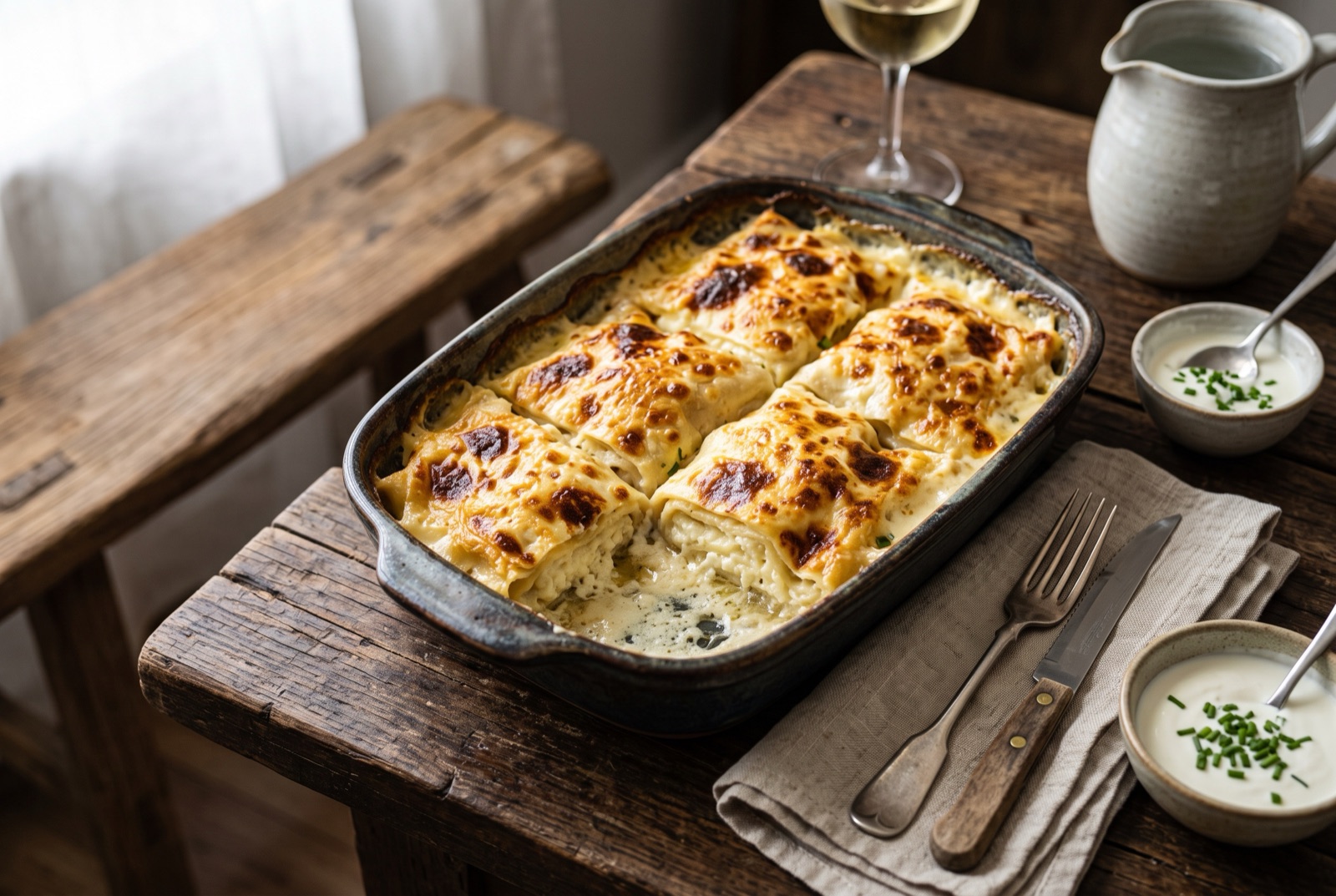
Štrukli are the signature dish of Hrvatsko Zagorje, the green hill country north of Zagreb: a very thin, hand-stretched dough spread with fresh cottage cheese beaten with egg and sour cream, rolled up, cut into squat pillows, and baked in a dish with more cream poured over. They come out puffed at the edges, blistered brown on top, and creamy in the middle, tasting mildly tangy and comforting rather than rich. Confusingly they can be a starter, a main course, or — with sugar and sometimes apples — a dessert, and Zagreb restaurants serve all three. The dough is the one part that demands attention, but it is a forgiving dough that wants to be stretched, and there is a boiled version if you would rather not bake.

- Gate
- CroatiaHrvatsko Zagorje
- Prep
- 45 min
- Cook
- 40 min
- Total time
- 1 hr 55 min incl. 30 min rest
- Serves
- 6
- Status
- Medium
- Nutrition / serving · estimated
- Calories 520 kcal
- Protein 22 g
- Carbs 42 g
- Fat 30 g
- Fiber 2 g
- Sugar 5 g
Why this recipe works.
- Rests the dough properly before stretching, which is the difference between a sheet that pulls thin and one that tears in three places.
- Loosens the cottage cheese with sour cream and egg so the filling sets creamy instead of grainy and dry.
- Gives both the baked and the boiled method, since Croatian households genuinely split between the two.
- Uses a rustic hand-cut shape and explains why the ragged sealed edges are correct, not a mistake.
Ingredients.
13 itemsFor the dough
For the filling
For baking
Equipment
- Large clean tea towel or tablecloth for stretching
- Rolling pin
- Baking dish about 25 x 20 cm
- Pastry brush
Instructions.
Make the dough
Mix the flour and salt in a bowl, add the egg, oil, vinegar and warm water, and bring it together into a shaggy mass. Turn it out and knead for 8–10 minutes until the surface is smooth and satiny and the dough springs back slowly when pressed.
Rest it warm
Shape the dough into a ball, brush it with a little oil, cover it with a warm bowl and leave it at room temperature for 30 minutes. It should feel noticeably softer and slacker afterwards — that slackness is what lets it stretch.
Beat the filling
Mash the drained cottage cheese with a fork, then beat in the eggs, sour cream and salt until it is loose and spreadable but still holds a soft shape on the spoon. Taste it: it should be clearly salty and faintly tangy, since the dough is bland.
Stretch the sheet
Spread a tea towel on the table and dust it with flour. Roll the dough out thin, then work the backs of your hands underneath and stretch it outwards from the centre until it covers the cloth and you can see its weave through the dough. Trim off the thick outer rim.
Tip Move around the table as you stretch rather than pulling from one spot — even tension prevents tearing.
Fill and roll
Brush the sheet with the melted butter, then spread the cheese filling over roughly two-thirds of it in an even layer, leaving a clear border along the far edge. Using the cloth to lift it, roll the dough up into a long log, sealing the final edge underneath.
Cut into pillows
Press down firmly across the log at 6 cm intervals with the side of your hand or a wooden spoon handle so each section seals shut at both ends, then cut through the pressed lines. The edges should look ragged and pinched, which is correct.
Assemble and bake
Butter a baking dish, arrange the pillows in a single layer with a little space between them, and pour the cream around them rather than over the tops. Dot the surface with the extra sour cream and bake at 190°C for 35–40 minutes.
Check and rest
They are ready when the tops are blistered deep gold, the cream has thickened and bubbles slowly at the edges, and a skewer pushed into the centre of one comes out hot. Let the dish stand 5 minutes before serving so the filling firms enough to hold together.
Tips from our kitchen.
- Knead the dough until it is smooth and satiny, then rest it warm for a full 30 minutes. Under-rested dough springs back and will not stretch, however hard you pull.
- Stretch over a floured tea towel with the backs of your hands, working from the centre outwards. Fingertips and nails make holes.
- Aim for thin enough that the pattern of the cloth shows through. Small tears in the middle do not matter — they get rolled up and hidden.
- Drain the cottage cheese if it is wet. A soupy filling soaks the dough and the rolls collapse instead of puffing.
- Cut the rolled log by pressing down with the side of your hand or a wooden spoon handle rather than slicing, so each pillow seals itself at both ends.
- Pour the cream around the štrukli, not over their tops, if you want the surface properly blistered and brown.
Substitutions.
- Fresh cottage cheese (svježi sir) → Full-fat ricotta, quark, or well-drained curd cheese
- Quark is the closest match for tang and texture. Ricotta is milder and slightly sweeter, so add a little extra salt and a squeeze of lemon.
- Hand-stretched dough → Ready-made filo, three sheets brushed with melted butter and stacked
- A real shortcut that works, though filo bakes drier and crisper. The traditional dough is chewier and softer where the cream soaks in.
- Sour cream and double cream → Crème fraîche thinned with milk
- Keeps the tang and the body. Avoid low-fat cream, which splits into a watery layer under oven heat.
Variations.
- Kuhani štrukli
- The boiled version: simmer the pillows in salted water for 12–15 minutes, then serve either in a little of the cooking water or drained and topped with butter-toasted breadcrumbs.
- Sweet štrukli
- Sugar, lemon zest and a handful of raisins added to the cheese filling, baked under cream and dusted with icing sugar — served as dessert, not as a starter.
- Apple štrukli
- Grated apple and cinnamon replacing part of the cheese, common in autumn in Zagorje households and closer to a strudel in character.
Storage & reheating.
Baked štrukli keep 3 days refrigerated. Reheat covered in a 170°C oven for 15 minutes with an extra spoonful of cream to stop the top drying out. They freeze well unbaked: assemble in the dish without the cream, freeze solid, then bake from frozen at 180°C for about 50 minutes, adding the cream halfway. Boiled štrukli do not keep or reheat nearly as well — make only as many as you plan to eat.
Serve with
On their own as a starter, or with a green salad as a light main. A glass of dry Graševina is the local pairing.
The story behind Zagorski Štrukli.
Štrukli come from Hrvatsko Zagorje, the hilly region between Zagreb and the Slovenian border, and they are one of those dishes that a region has effectively trademarked in the national imagination — say štrukli anywhere in Croatia and people picture Zagorje. The dough is closely related to strudel pastry, which makes sense given the centuries of Austrian and Hungarian influence on continental Croatia: a lean flour-and-water dough with a little fat and vinegar, rested until relaxed, then stretched by hand until it is thin enough to read newsprint through. The filling is local and unglamorous — fresh cow's milk cottage cheese, the kind sold loose at Zagreb's Dolac market, loosened with egg and sour cream.
There are two schools, and they are not variations so much as different dishes. Kuhani štrukli are boiled: the rolls are simmered in salted water, drained, and served either plain with butter and breadcrumbs or in their cooking liquid as a kind of soup — soft, pale, and deeply old-fashioned. Zapečeni štrukli, the version most visitors meet, are baked under cream until the top browns and blisters, and this is what fills the pans in Zagreb's restaurants and at the stalls around the market. Households usually have a firm preference and a slightly dismissive view of the other camp.
The sweet-versus-savoury question is equally open. The standard filling is savoury — cheese, egg, sour cream, salt — but sweetened štrukli with sugar and lemon zest, or with apples or walnuts folded through, are entirely traditional and often served as a dessert course at the same meal. Zagorje itself treats them as everyday food rather than a delicacy, which is worth remembering when you make them: this is not a fussy pastry, and the traditional shape is deliberately rustic, cut with the side of the hand or a wooden spoon rather than trimmed neat.
Questions, answered.
What is the difference between baked and boiled štrukli?
Boiled štrukli (kuhani) are simmered in salted water and served soft and pale, either in a little of their cooking liquid or dressed with butter and toasted breadcrumbs. Baked štrukli (zapečeni) are arranged in a dish, covered with cream and baked until the tops blister golden. Both are traditional in Hrvatsko Zagorje, the baked version is the one most restaurants serve, and households tend to have a firm preference.
What cheese should I use for the filling?
Fresh, loose cow's milk cottage cheese — svježi sir — is the traditional choice, sold by weight at Croatian markets. Outside Croatia, quark is the closest equivalent in both tang and texture, and full-fat ricotta or a well-drained curd cheese also work. Whatever you use, drain it if it looks wet, because excess liquid soaks the dough from the inside.
My dough keeps tearing when I stretch it. What went wrong?
Almost always insufficient resting. The gluten needs at least half an hour to relax before it will stretch thin without springing back or ripping, and a warm rest works better than a cold one. Working on a floured cloth with the backs of your hands rather than your fingertips also prevents punctures. Small holes in the centre are not a problem — they disappear when the sheet is rolled up.
Can I use filo pastry instead of making the dough?
Yes, and it is a reasonable shortcut. Stack three sheets brushed with melted butter to approximate the thickness and strength of a hand-stretched sheet, then fill and roll as normal. The result bakes drier and crisper than traditional štrukli, which are softer and chewier where the cream soaks into the dough, but it is genuinely good.
Are štrukli a starter or a dessert?
Both, depending on the filling. The standard savoury version with cheese, egg and sour cream is served as a starter or a light main course. Sweetened versions with sugar, lemon zest, raisins or apple are served as dessert, and it is entirely normal in Croatia to encounter both at the same meal.
You might also like.
All recipes →
Keep exploring Croatia.
Croatia has 9 more dishes in the atlas — Brudet and Crni Rižot, and 7 more.
Recipe by The DishRoute Kitchen · published August 20, 2026 · updated August 20, 2026