Sayadeya.
Alexandrian Fisherman's Rice with Fish
صيادية · Ṣayyādiyya · say it: sa-ya-DEE-ya
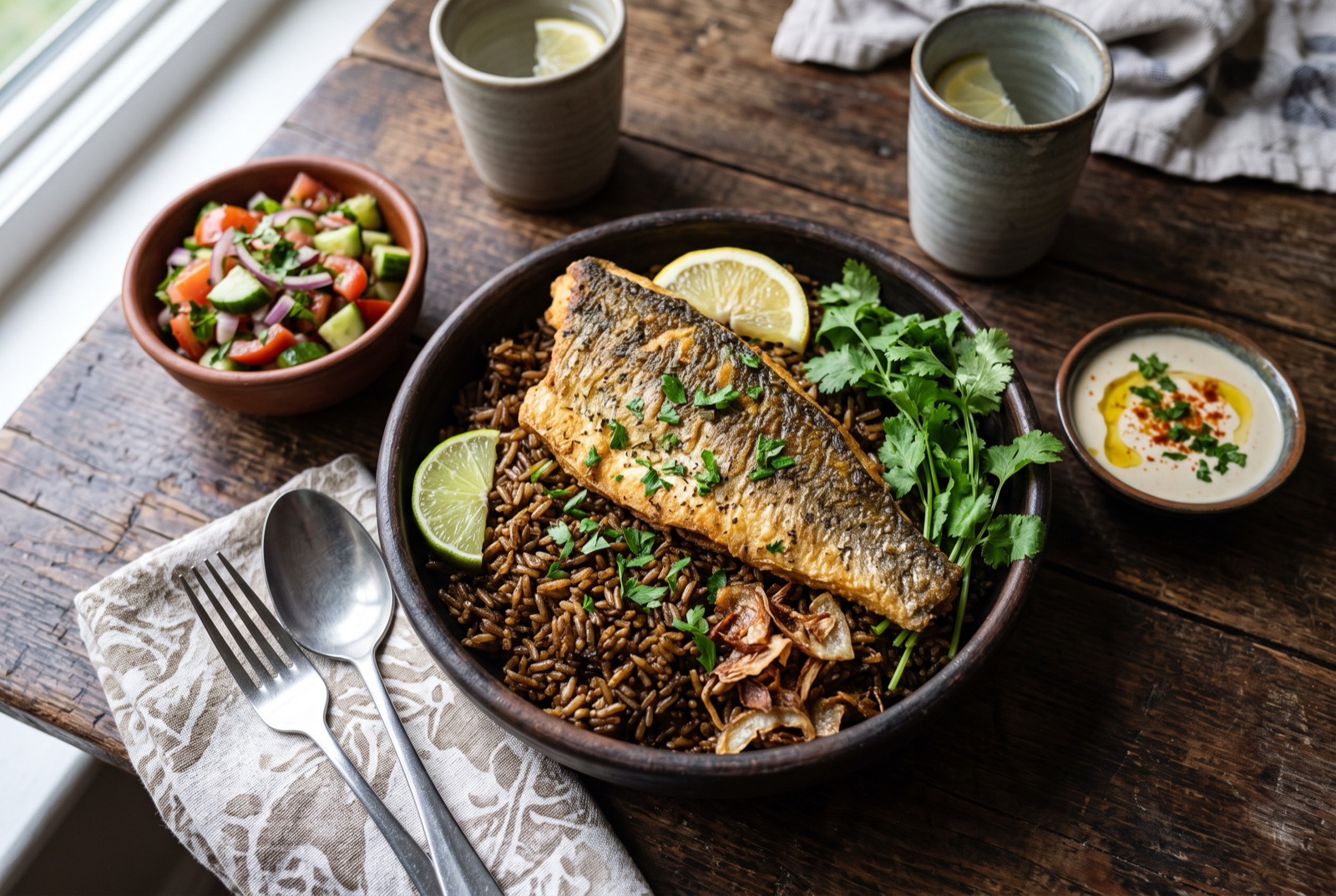
Sayadeya is rice cooked in two things a fisherman has at hand — the stock from the bones of the catch and a large quantity of onions taken far past golden, almost to the edge of burnt. Those onions give the dish its colour, a deep tobacco brown that surprises anyone expecting white rice under a fillet, and its sweetness. The spicing is restrained: cumin and coriander lead, a little turmeric and cardamom sit underneath, and lemon goes on at the table. The fish itself is fried separately and put on top at the end, so it stays crisp-skinned rather than steaming into the rice. The technique is simple; the timing of the onions is the only part that demands attention.

- Gate
- EgyptAlexandria
- Prep
- 25 min
- Cook
- 1 hr
- Total time
- 1 hr 35 min incl. 10 min rest
- Serves
- 4
- Status
- Medium
- Nutrition / serving · estimated
- Calories 650 kcal
- Protein 42 g
- Carbs 79 g
- Fat 18 g
- Fiber 4 g
- Sugar 7 g
- Sodium 820 mg
Why this recipe works.
- Browns the onions to the dark stage that actually colours the rice, with clear signs for when to stop before they turn bitter.
- Builds a quick fish stock from the frames in 20 minutes, which is the whole flavour of the dish and takes no real work.
- Fries the fish separately so the skin stays crisp instead of softening on top of steaming rice.
- One pan does the onions, the fish and the rice, and the rest is unattended cooking time.
Ingredients.
17 itemsThe fish
The stock
The rice
To finish
Equipment
- Wide heavy pan for the onions and fish
- Saucepan for the stock
- Sieve
- Heavy pot with a tight lid for the rice
Instructions.
Season the fish and make the stock
Rub the fillets with half the lemon juice and a good pinch of salt and refrigerate them. Rinse the heads and frames well, put them in a saucepan with the bay leaf, cardamom, peppercorns and 1.2 litres of cold water, and simmer for 20 minutes. Strain and keep the stock hot.
Tip Pull the gills out of the heads before they go in — they are the main source of bitterness in fish stock.
Brown the onions
Heat 4 tablespoons of the oil in a wide pan and cook 4 of sliced onions over medium heat, stirring every few minutes. They will go translucent, then straw-coloured, then slowly to a deep tobacco brown — about 25 to 30 minutes in all. Take them off the heat the moment they reach the colour of strong tea.
Tip If they start smelling acrid rather than sweet, they have gone too far. Start again — bitter onions ruin the whole pot.
Colour the stock
Scoop out a third of the onions and set them aside for the top. Blend the rest with 300 ml of the hot fish stock until smooth, then stir this back into the remaining stock. It should now be the colour of weak coffee and taste sweet and savoury at once.
Fry the fish
Pat the fillets completely dry, dust them lightly with flour and shake off the excess. Heat the rest of the oil in the pan until it shimmers and fry the fish skin-side down for 4 minutes without moving it, then turn and give it 2 to 3 minutes more. The skin should lift away from the pan on its own and the flesh should turn from glassy to opaque at the thickest point.
Tip If the fish resists when you try to lift it, the crust has not formed yet. Wait rather than forcing it.
Toast and cook the rice
Pour off all but 2 tablespoons of the fish oil, add the garlic and stir for 20 seconds until it smells sweet. Add the drained rice, cumin, coriander, turmeric, cinnamon and salt and stir for 2 minutes, until every grain is coated and the spices smell toasted rather than dusty.
Simmer covered
Pour in 750 ml of the onion-coloured stock, bring to a boil, then cover and cook on the lowest heat for 15 minutes. Do not lift the lid and do not stir. Take the pot off the heat and leave it covered for 10 minutes more.
Assemble and serve
Fluff the rice with a fork — it should be brown, loose and glossy, with no wet patches at the bottom. Pile it onto a platter, lay the fried fish over it, scatter the reserved dark onions, coriander and parsley on top, and serve with the remaining lemon and tahini sauce.
Tip Put the fish on at the last second. Left sitting on hot rice, the skin you just crisped goes soft in a couple of minutes.
Tips from our kitchen.
- Simmer the fish stock for 20 minutes and no more. Fish bones give everything they have quickly, and long boiling turns the stock bitter and gluey.
- Slice the onions evenly and cook them in a wide pan over medium heat, not high. Rushing gives you black shreds and pale patches in the same batch.
- Stop the onions the moment they reach the colour of strong tea. They keep darkening in the residual heat, and burnt onion turns the whole pot acrid.
- Salt and lemon the fish 15 minutes before frying, then pat it dry. Wet fish sticks to the pan and tears when you turn it.
- Do not stir the rice once the stock is in. Stirring releases starch and you lose the separate grains that make sayadeya look right.
- Let the pot stand covered off the heat for 10 minutes before you lift the lid, so the top layer finishes in its own steam.
Substitutions.
- Sea bass → Grey mullet, bream, snapper or any firm white fish
- Grey mullet is the traditional Alexandrian choice and is oilier and stronger. Avoid very delicate fillets, which break apart when turned in the pan.
- Homemade fish stock → Shop-bought fish stock, or vegetable stock with a strip of kombu
- Usable, but noticeably flatter. If you buy fillets, ask the fishmonger for a frame and a couple of heads — they are usually free and take 20 minutes.
- Egyptian short-grain rice → Basmati, soaked 20 minutes and drained
- Basmati gives longer, drier, more separate grains. Reduce the stock slightly, since it absorbs a little less than short-grain.
Variations.
- Sayadeya with shrimp
- Fry peeled prawns for 90 seconds in the fish oil and scatter them over the finished rice with the fish, adding their shells to the stock pot for extra depth.
- Baked sayadeya
- Layer the fried fish on top of the half-cooked rice, cover tightly and finish in a 180°C oven for 20 minutes so the fish perfumes the whole pot.
- Tomato sayadeya
- A version common further along the coast: a tablespoon of tomato paste stirred into the onions gives a redder rice and a rounder, less bitter flavour.
Storage & reheating.
Sayadeya keeps 2 days refrigerated, but store the fish and rice separately or the fish softens and the rice takes on a strong flavour overnight. Reheat the rice covered with a splash of stock over low heat until it steams, and warm the fish in a hot dry pan skin-side down for 2 minutes rather than in the microwave. Cooked fish does not freeze well; the rice on its own freezes for a month and reheats acceptably.
Serve with
Tahini sauce loosened with lemon and a little garlic, a sharp salad of tomato, cucumber and rocket, and plenty of lemon wedges.
The story behind Sayadeya.
The name comes from sayyad, the word for fisherman, and versions of it are cooked all along the eastern Mediterranean coast — Lebanon, Syria, Palestine and Gaza all have a sayadeya, and each argues for its own spicing and its own degree of onion. The Egyptian claim is centred on Alexandria and the northern coast, where the fish are sea bass, grey mullet, bream and whatever the boats bring in, and where the cooking has absorbed Greek and Levantine habits over a long period of shared harbour life.
The logic of the dish is the logic of a boat kitchen. Nothing is wasted: the heads and frames that would be thrown away become the stock the rice drinks, the frying oil from the fish carries flavour into the onions, and one pan produces both components. Rice absorbs everything a fish gives up, which is why sayadeya tastes distinctly of the sea without any fish being visible in the pot itself.
The onions are what people argue about. Cooked to pale gold, the rice comes out sweet and mild, which some cooks prefer. Taken to a dark mahogany — the point where a batch is genuinely at risk — the rice turns brown, slightly bitter at the edges, and much more interesting, and this is the Alexandrian style most associated with the dish. Some households blend the browned onions into the stock so the colour is even; others fold them through whole so there are soft dark strands running through the rice. Neither is wrong, and both are defended vigorously in a city where seafood restaurants are judged largely on this one plate.
Questions, answered.
Why is my rice pale instead of brown?
The onions were not cooked far enough. Pale gold onions add sweetness but almost no colour — you need to take them to a genuine dark brown, roughly the shade of strong tea, which takes 25 to 30 minutes over medium heat. Blending some of them into the stock also spreads the colour more evenly through the grains.
How do I stop the fish sticking to the pan?
Dry the surface thoroughly with kitchen paper, dust it lightly with flour, and get the oil properly hot before the fish goes in. Then leave it alone. Fish releases itself from the pan when the crust has formed, usually after 3 or 4 minutes; if it resists when you try to lift it, it is not ready to turn.
Can I make sayadeya without fish stock?
You can, but it is the main flavour of the dish. A quick stock from heads and frames takes 20 minutes and most fishmongers give the bones away. If that is impossible, use shop-bought fish stock, or vegetable stock with a piece of kombu simmered in it, and expect a milder result.
What fish should I buy for sayadeya?
Firm white fish that survives frying and turning: sea bass, bream, snapper, or grey mullet, which is the traditional Alexandrian fish. Buy it whole if you can, so you get the frame for stock. Thin flat fillets like sole or plaice fall apart in the pan and are not worth using here.
Is sayadeya an Egyptian dish or a Levantine one?
Both, genuinely. Fisherman's rice with a fish stock base is cooked across the eastern Mediterranean, and Lebanon, Syria, Palestine and Egypt all have versions with real local histories. The Egyptian style is associated with Alexandria and is defined by very dark browned onions and a cumin-and-coriander spicing rather than by any exclusive claim to the dish.
You might also like.
All recipes →
Keep exploring Egypt.
Egypt has 9 more dishes in the atlas — Aish Baladi and Fattah, and 7 more.
Recipe by The DishRoute Kitchen · published August 20, 2026 · updated August 20, 2026