Eru.
Cameroonian Wild Leaf and Waterleaf Stew
Eru / Okok · say it: EH-roo
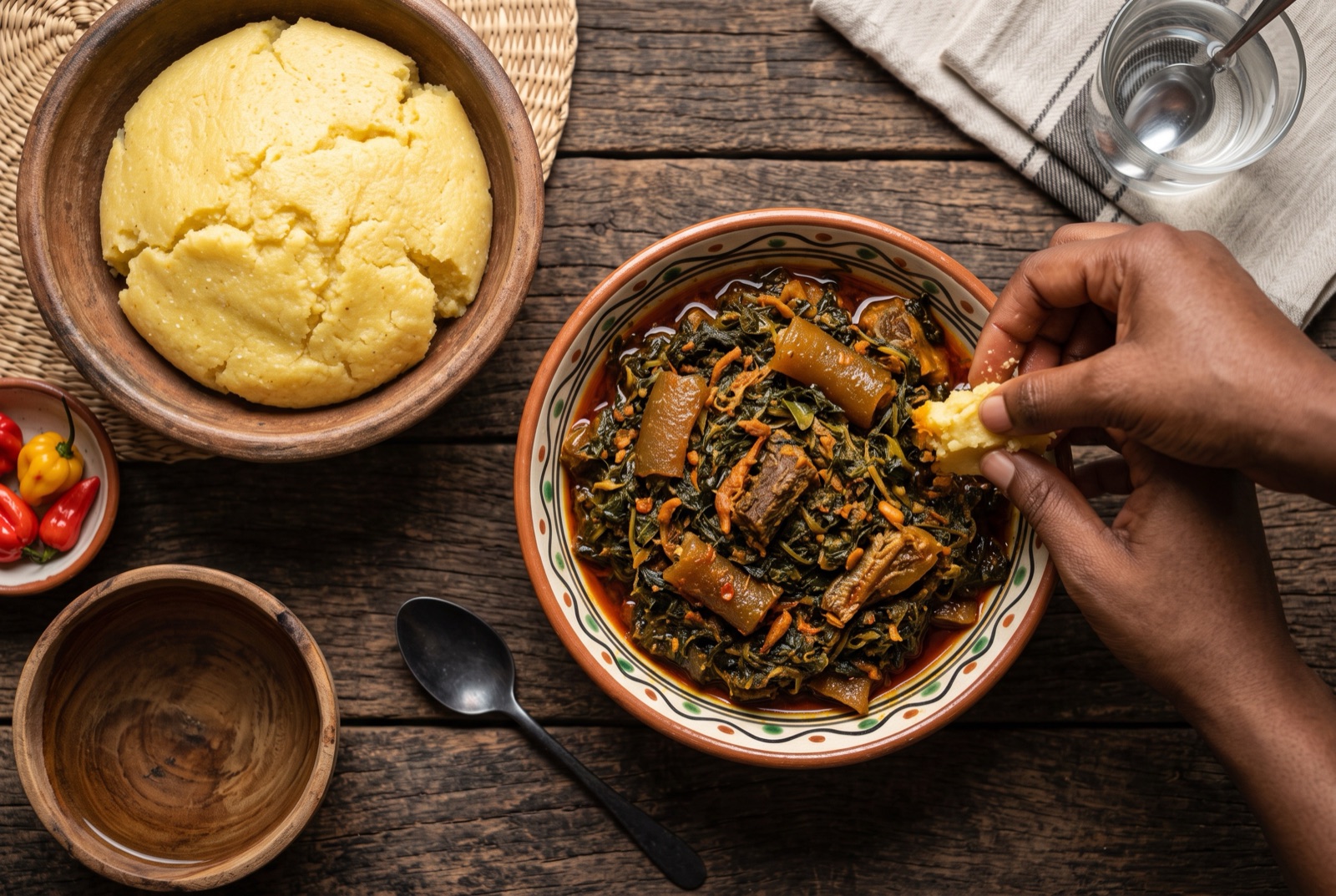
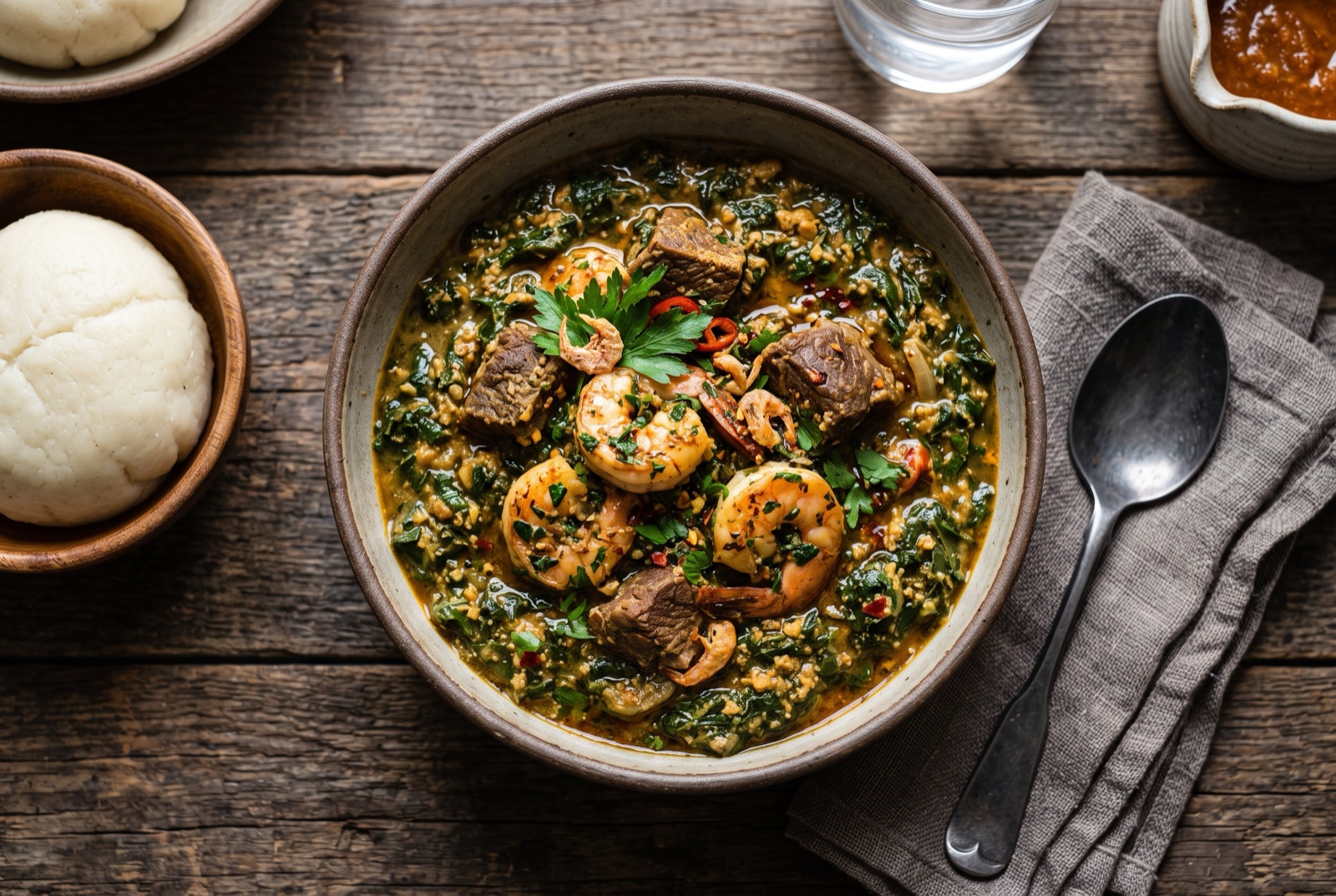
Eru is a dense, dark green stew of two leaves doing two different jobs. The eru vine is shredded to threads and stays firm and slightly chewy through long cooking; waterleaf collapses into it and supplies the moisture that keeps the pot from drying out. Red palm oil binds them into something glossy and almost jammy, while ground crayfish, smoked fish and slow-simmered cow skin push the flavour deep into savoury, faintly smoky territory. There is very little liquid at the end — this is a stew you scoop, not one you spoon. It belongs to the Bayangi people of the South West and is eaten across anglophone Cameroon with water fufu or garri, usually with fingers.

- Gate
- CameroonSouth West and North West
- Prep
- 25 min
- Cook
- 1 hr 40 min
- Total time
- 2 hr 5 min
- Serves
- 6
- Status
- Medium
- Nutrition / serving · estimated
- Calories 580 kcal
- Protein 34 g
- Carbs 11 g
- Fat 45 g
- Fiber 6 g
- Sodium 1010 mg
Why this recipe works.
- Cooks the two leaves in the right order, so eru softens without waterleaf turning to sludge.
- Uses the traditional near-dry method rather than adding stock, which is what concentrates the flavour.
- Gives realistic timings for cow skin, the ingredient most recipes gloss over entirely.
- Offers a workable substitute leaf combination and is clear that it changes the texture, not just the taste.
Ingredients.
10 itemsFor the meat
For the stew
Equipment
- Heavy-based pot with a lid
- Sharp knife for shredding
- Small pot for the cow skin
Instructions.
Cook the cow skin and beef
Scrub the cow skin, then simmer it with the beef shank, halved onion and a teaspoon of salt in water to cover for 60 minutes, until the skin is soft enough to cut with the side of a spoon and has turned translucent at the edges. Drain, reserving a cup of the liquid.
Tip If the skin still springs back like a rubber band, give it another 20 minutes. There is no shortcut here.
Wilt the waterleaf
Put the chopped waterleaf or spinach in a dry pot over medium heat with a pinch of salt, cover, and cook for 5 minutes until it collapses and floods the pan with its own liquid. Drain it in a sieve, pressing lightly, and keep both leaves and liquid.
Start the eru
Return the drained waterleaf liquid to the pot, add the shredded eru, cover and cook over medium heat for 20 minutes. Stir every few minutes; the threads should darken from bright to deep green and lose their raw stiffness.
Add the palm oil and savoury base
Pour in the red palm oil, then stir through the ground crayfish, flaked smoked mackerel, chopped scotch bonnets and the cooked cow skin and beef. The pot should turn a glossy dark orange-green almost immediately.
Cook it down
Fold the drained waterleaf back in and cook uncovered over medium-low heat for 20 to 25 minutes, stirring regularly. The stew is ready when the free liquid has gone, the palm oil sheens on top, and a spoonful holds its shape instead of slumping.
Tip Add a splash of the reserved meat liquid only if the pan starts to catch — the target is dry, not soupy.
Season and rest
Taste and add salt carefully, remembering that the crayfish and smoked fish already carry a lot. Let the pot stand off the heat for 10 minutes before serving so the oil settles back into the leaves, then serve with garri or water fufu.
Tips from our kitchen.
- Shred frozen eru while it is still part-frozen if it came in whole leaves — it slices into fine threads far more cleanly than when fully thawed and floppy.
- Cow skin needs an hour of simmering before it goes anywhere near the stew. Undercooked kanda is rubbery in a way that no later cooking will fix.
- Resist adding water. The waterleaf releases plenty, and a wet eru is considered badly made.
- Use unrefined red palm oil, not refined palm cooking oil — the colour and the faint violet aroma are the whole point of the fat here.
- Taste for salt only at the end. Crayfish, smoked fish and any bouillon you use are all salty, and the stew concentrates as it reduces.
- The finished stew should mound on a spoon and leave a clean orange sheen on the pan, with no free liquid pooling at the bottom.
Substitutions.
- Eru (Gnetum africanum) → 400 g collard greens or kale, stems removed and sliced into the finest ribbons you can manage
- Collards get you closest because they hold their texture through long cooking. What you lose is eru's particular chewy, almost noodly bite and its mild resinous flavour — a substituted version tastes like a good palm oil greens stew rather than like eru. Frozen shredded eru is sold in African grocers and is worth the trip.
- Waterleaf → Spinach, or a mix of spinach and Swiss chard
- Spinach releases a similar amount of water and wilts on the same schedule, so it works well functionally. Waterleaf is slightly more mucilaginous, which gives the traditional stew a little more cling.
- Cow skin (kanda) → Beef shank with its connective tissue left on, or pork skin
- Both bring collagen and turn silky with long cooking. Leaving it out entirely is fine — the stew loses body and a characteristic slipperiness, but nothing about the flavour breaks.
Variations.
- Okok
- The Beti version from the Centre and South, where the shredded leaf is cooked with ground peanuts instead of leaning entirely on palm oil, giving a softer, nuttier result.
- Eru with stockfish
- Dried stockfish soaked and added alongside the smoked fish, contributing a firmer, more pungent protein that holds its shape completely.
- Meat-free eru
- Built on palm oil, both leaves and a generous amount of ground crayfish only. Still pescatarian rather than vegan, but much faster and common as an everyday version.
Storage & reheating.
Eru keeps 4 days refrigerated and many Cameroonians think it is better on day two, once the palm oil has fully permeated the leaves. Reheat in a pan over low heat, covered, stirring once or twice — no extra liquid needed, as the stew loosens on its own. It freezes well for 3 months and thaws without any texture loss, which makes it a good candidate for a large batch. The palm oil solidifies orange when cold; this is normal and it melts back cleanly.
Serve with
Garri (granular fermented cassava) softened with hot water, or water fufu — both are eaten by hand alongside. A cold beer or palm wine, which is how it is usually served at home.
The story behind Eru.
Eru takes its name from Gnetum africanum, a slow-growing forest vine harvested wild across the Congo Basin rather than farmed in any serious quantity. In Cameroon it is a Bayangi dish above all, closely identified with Manyu division in the South West, though it travelled with people and now turns up in Douala, Yaoundé and every Cameroonian diaspora kitchen from London to Maryland. In the francophone centre and south a very close relative is called okok, cooked with the same shredded leaf but often with a groundnut base instead of palm oil, and the two camps do not entirely agree on which is the original.
The leaf is the constraint. Eru grows slowly, resists cultivation, and is harvested by hand from the forest, which has made it both expensive and a genuine conservation concern as demand across Central Africa outpaces what the wild population regenerates. Shredding it is its own labour — traditionally rolled into a tight bundle and sliced into hair-fine strands, a skill that separates a good plate from a coarse one. Frozen pre-shredded eru sold abroad exists precisely because nobody wants to do that job twice.
The pairing with waterleaf is not decorative. Eru alone would scorch; waterleaf is roughly ninety per cent water and releases enough liquid to steam the tougher leaf into submission without adding stock, which is why the traditional method uses almost no added water at all. Palm oil goes in generously and unapologetically — this is not a light dish and was never meant to be. Cow skin, called kanda, is the other signature: simmered until soft and gelatinous, it adds body and a slippery texture that Cameroonians consider essential and that newcomers usually need one plate to get used to. Served with garri, the granular fermented cassava that sours slightly on the tongue, the whole thing balances.
Questions, answered.
What exactly is eru?
Eru is the leaf of Gnetum africanum, a wild forest vine found across Central Africa and known as okazi in Nigeria and okok in francophone Cameroon. It is harvested from the wild rather than farmed, has a firm texture that survives long cooking, and is almost always sold shredded into fine threads, fresh or frozen, in African grocery shops.
Why are two different leaves used?
They do opposite jobs. Eru is tough and needs long cooking but adds almost no moisture, while waterleaf is very high in water and collapses quickly. Cooking them together means the waterleaf steams the eru soft without any stock being added, which keeps the flavour concentrated. Using only one leaf gives you either a dry, scorched pot or a watery green mush.
Can I use ordinary palm oil from the supermarket?
Refined palm oil will cook the dish but leaves it pale and neutral. Eru depends on unrefined red palm oil, which is deep orange, unfiltered, and carries a distinct earthy aroma. It is sold in African, Caribbean and Brazilian shops, often labelled zomi or dendê, and keeps for months at room temperature.
Do I have to use cow skin?
No, though it is traditional and Cameroonians would notice it missing. Cow skin is simmered until soft and gelatinous and gives the stew body and a slippery texture rather than a strong flavour of its own. Beef shank, pork skin, or simply more smoked fish all make a perfectly good pot if kanda is not available or not to your taste.
Why is my eru still tough after an hour?
Either the leaf was shredded too coarsely, or there was not enough moisture in the pot to steam it. Very fine shredding is what makes eru cook down at all. If it is still firm late in the cooking, cover the pan tightly and add a few splashes of hot water rather than more oil, and give it another 20 minutes over low heat.
You might also like.
All recipes →
Keep exploring Cameroon.
Cameroon has 9 more dishes in the atlas — Achu Soup and Beignets Haricots, and 7 more.
All Cameroon recipes Spinach recipes Dried shrimp recipes Beef shank recipes maindairy freegluten freeRecipe by The DishRoute Kitchen · published August 20, 2026 · updated August 20, 2026