Filipino Adobo.
Soy-Vinegar Braised Chicken and Pork
Adobong manok at baboy · say it: ah-DOH-boh
Adobo is meat cooked in vinegar, soy sauce, garlic, bay leaf and whole black pepper until the liquid reduces to a salty, sour, faintly sweet glaze that clings to every piece. This version uses both chicken thighs and pork belly, the pairing most Filipino households treat as the full-dress version — the chicken stays juicy, the pork renders into something soft and rich, and the two flavour the same sauce differently. It tastes sharp at first and rounder with every reheating, which is why adobo is often deliberately cooked a day early. Nothing about it is difficult: brown, pour, wait.
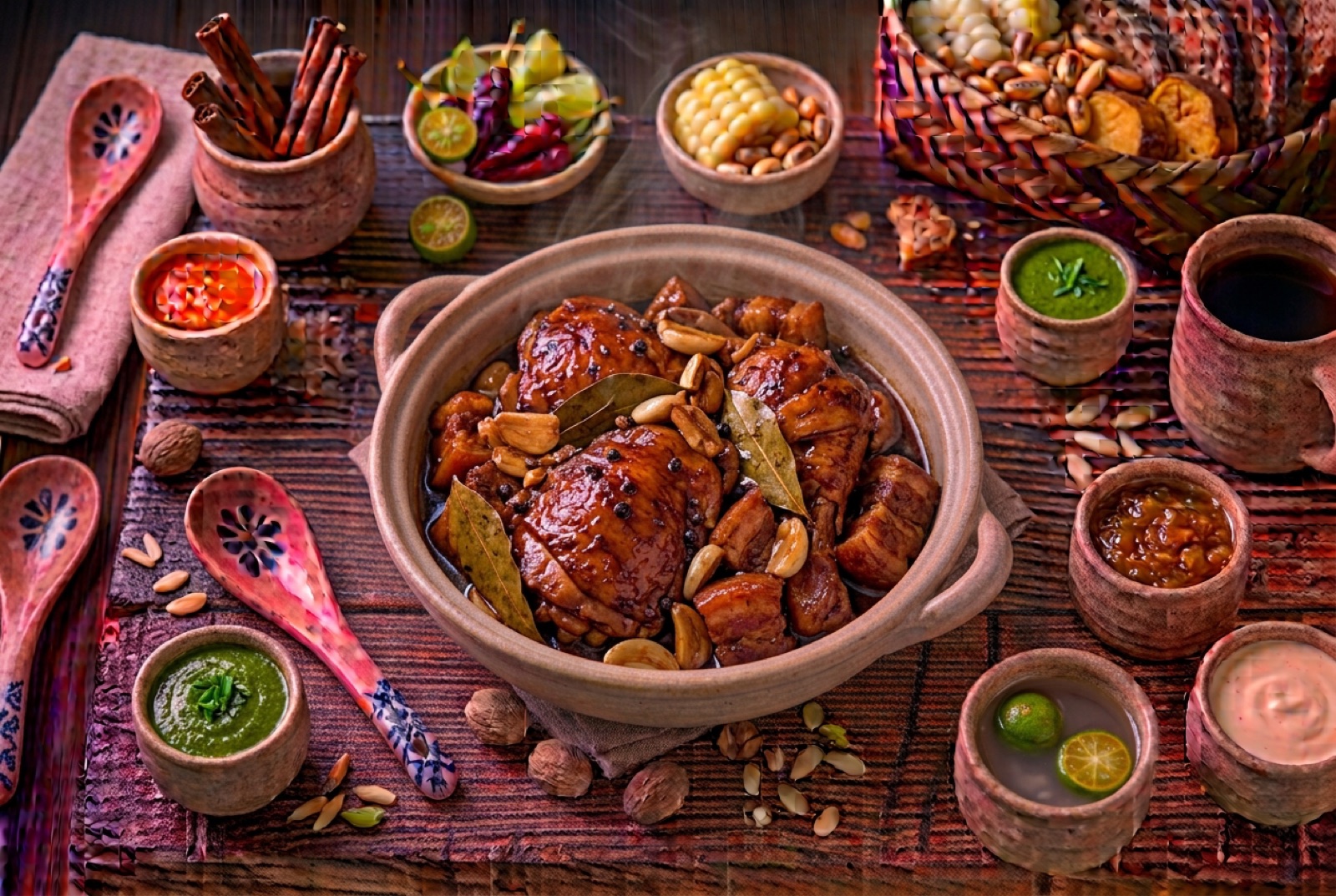

- Gate
- Philippines
- Prep
- 15 min
- Cook
- 1 hr
- Total time
- 1 hr 15 min
- Serves
- 4
- Status
- Easy
- Nutrition / serving · estimated
- Calories 640 kcal
- Protein 41 g
- Carbs 6 g
- Fat 49 g
- Fiber 1 g
- Sugar 2 g
- Sodium 1450 mg
Why this recipe works.
- Uses both chicken and pork, the way most Filipino homes cook it for company, so the sauce gets richness from the belly and body from the bones.
- Explains the one rule that separates good adobo from harsh adobo: let the vinegar boil off its sharpness before you stir.
- The meat is browned first and crisped at the end, so you get texture as well as sauce.
- Pantry-stable ingredients only — no specialty shopping, and it tastes better on day two.
Ingredients.
11 itemsMeat
Braise
To finish
Equipment
- Heavy pot or Dutch oven with a lid
- Tongs
- Fine sieve or ladle for skimming fat
Instructions.
Brown the meat
Heat the oil in a heavy pot over medium-high and lay in the pork belly cubes fat-side down. Let them sit undisturbed for 5 minutes until deep golden and a pool of clear fat has rendered out, then add the chicken skin-side down and brown that too.
Tip Work in two batches if the pot is crowded. Meat that steams instead of browning gives a flat, pale sauce.
Bloom the aromatics
Push the meat to one side and drop the crushed garlic, bay leaves and cracked peppercorns into the hot fat. Stir for about a minute, until the garlic turns pale gold at the edges and smells sweet rather than raw.
Add the vinegar and leave it alone
Pour in 120 ml of vinegar, raise the heat and let it boil hard for 4 minutes without stirring or covering the pot. The sharp fumes will subside and the smell will shift from acrid to savoury — that is the signal the acid has cooked off its edge.
Tip This is the single rule of adobo. Stirring during these minutes locks a raw sourness into the meat that no amount of later simmering removes.
Braise
Now stir in the soy sauce and water, bring back to a simmer, cover and cook over low heat for 45 minutes. The pork should give completely when pressed with a spoon and the chicken should be pulling away from the bone.
Reduce and glaze
Uncover, lift out the meat and boil the sauce hard for 8–10 minutes until it darkens, thickens and coats the back of a spoon. Taste it now and add the brown sugar only if the sourness still dominates.
Tip The sauce should taste slightly too strong on its own — it is going onto plain rice.
Crisp and serve
Return the meat to the pot and turn the pieces in the reduced sauce over medium heat until the edges catch and the surfaces turn mahogany. Scatter with scallions and serve straight away with steamed rice.
Tips from our kitchen.
- Add the vinegar and let it boil uncovered for three or four minutes without stirring. Stirring early drives the raw, throat-catching sharpness into the meat and it never fully leaves.
- Use bone-in, skin-on chicken thighs. Breast meat dries out long before the pork belly is tender, and the bones give the sauce the body it needs.
- Cane vinegar or coconut vinegar are the authentic acids and are milder than distilled white. If you only have white vinegar, cut it with a splash of water.
- Crack the peppercorns lightly under a pan rather than grinding them — you want visible pepper that perfumes the sauce, not a gritty grey haze.
- Cook it a day ahead if you can. Adobo is one of the few braises that genuinely tastes better reheated, and the fat lifts off the cold sauce for easy skimming.
- Do not salt until the very end. Soy sauce reduces hard, and an adobo that tasted balanced at the start can turn punishing by the time it is glazed.
Substitutions.
- Cane vinegar → Rice vinegar, or distilled white vinegar diluted with a third water
- Filipino cane and coconut vinegars are softer and slightly sweet. Apple cider vinegar works too, though it pushes the dish towards a fruitier flavour.
- Pork belly → Pork shoulder in large cubes, or all chicken
- Shoulder needs a little longer to turn tender and yields less fat, so add a spoonful of oil when you brown it.
- Soy sauce → Tamari for a gluten-free version, or plain salt for adobong puti
- Salt-only adobo is the older style — pale, sharper and arguably more traditional. Start with two teaspoons and adjust at the end.
Variations.
- Adobo sa gata
- Southern version: stir 200 ml coconut milk into the sauce in the last ten minutes and let it reduce until the oil breaks out. Sweeter, softer, and very good with chile.
- Adobong puti
- White adobo, made with vinegar and salt only, no soy sauce. Cleaner and sharper, and closer to what was being cooked before Chinese soy arrived.
- Adobo flakes
- Shred leftover adobo meat, dry it in a pan, then fry it crisp and serve over garlic rice with a fried egg. Standard practice for the second-day pot.
Storage & reheating.
Adobo keeps 4 days refrigerated and freezes well for 3 months, both meat and sauce together. Chill it and lift off the solid cap of fat before reheating if you want a lighter dish. Reheat in a pan rather than a microwave so the sauce re-glazes; add a splash of water if it has tightened too far. Traditionally it was kept at room temperature for a day or two — the vinegar and salt do preserve it — but with modern pork, refrigerate.
Serve with
Plain steamed rice — non-negotiable — and a side of sliced tomatoes or blanched greens to cut the fat.
The story behind Filipino Adobo.
Adobo carries a Spanish name for a method the Spanish did not bring. When Magellan's crew reached the archipelago in 1521, cooks were already preserving meat and fish by simmering them in vinegar and salt — a rational technology in a hot, humid country with no refrigeration, since acid and salt together keep a pot edible on the counter for days. Spanish chroniclers recorded what they saw and reached for the closest word in their own kitchen vocabulary, adobar, meaning to marinate. The name stuck, the technique was already there, and soy sauce joined later through Chinese trade, gradually replacing plain salt in much of Luzon and turning the sauce dark.
There is no single adobo, and Filipinos argue about it with real energy. Some households use only vinegar and salt, keeping the dish pale — adobong puti, the version closest to the pre-colonial original. Others add coconut milk (adobo sa gata, common in the south), or sugar, or pineapple, or potatoes. Some cooks fry the meat crisp after braising and reduce the sauce to a syrup; others serve it swimming. Whether to include the soy sauce at all is a live question, and whether to stir the vinegar early is not — everyone agrees you must not.
What unites every version is its role. Adobo is the dish sent with children to school, packed for long bus journeys, cooked in enormous batches for fiestas, and made by Filipinos abroad when they are homesick, because the ingredients are available in any country on earth. It keeps without refrigeration for days, improves overnight as the meat absorbs the sauce, and asks for nothing but a mound of hot rice. If the Philippines has a national dish by common consent rather than decree, this is it.
Questions, answered.
Why does my adobo taste harshly sour?
Almost always because the vinegar was stirred too soon. Vinegar needs to boil undisturbed for three to four minutes so the volatile acetic edge cooks off; stirring during that window drives it into the meat, where it stays. If it has already happened, simmer the sauce longer uncovered and add a teaspoon of sugar to round it out.
Is adobo supposed to be saucy or dry?
Both exist and both are correct. Manila home cooking tends towards a generous pool of sauce for spooning over rice, while many restaurants and some provinces reduce it until the sauce is a sticky glaze and the meat is fried crisp at the edges. This recipe lands in between: enough sauce for the rice, with browned edges on the meat.
Can I make adobo with only chicken?
Yes, and adobong manok is probably the most common version in the country. Use bone-in thighs and drumsticks, cut the braising time to about 30 minutes, and add a tablespoon of oil at the browning stage since chicken renders far less fat than pork belly.
Do I need to marinate the meat first?
Not for this method. Many recipes marinate the meat in the soy and vinegar for a few hours, but since the meat then braises in that same liquid for an hour, the difference is small. If you do marinate, drain and pat the pieces dry before browning or they will steam instead of colouring.
What kind of vinegar do Filipinos actually use?
Cane vinegar (sukang maasim) and coconut vinegar (sukang tuba) are the everyday choices, both milder and slightly sweeter than distilled white vinegar. Palm and nipa vinegars appear regionally. Any of them work; if you use harsh distilled white vinegar, dilute it with a third water or the sauce will be aggressive.
You might also like.
All recipes →



Keep exploring Philippines.
Philippines has 9 more dishes in the atlas — Chicken Inasal and Halo-Halo, and 7 more.
Recipe by The DishRoute Kitchen · published August 20, 2026 · updated August 20, 2026