Frittatensuppe.
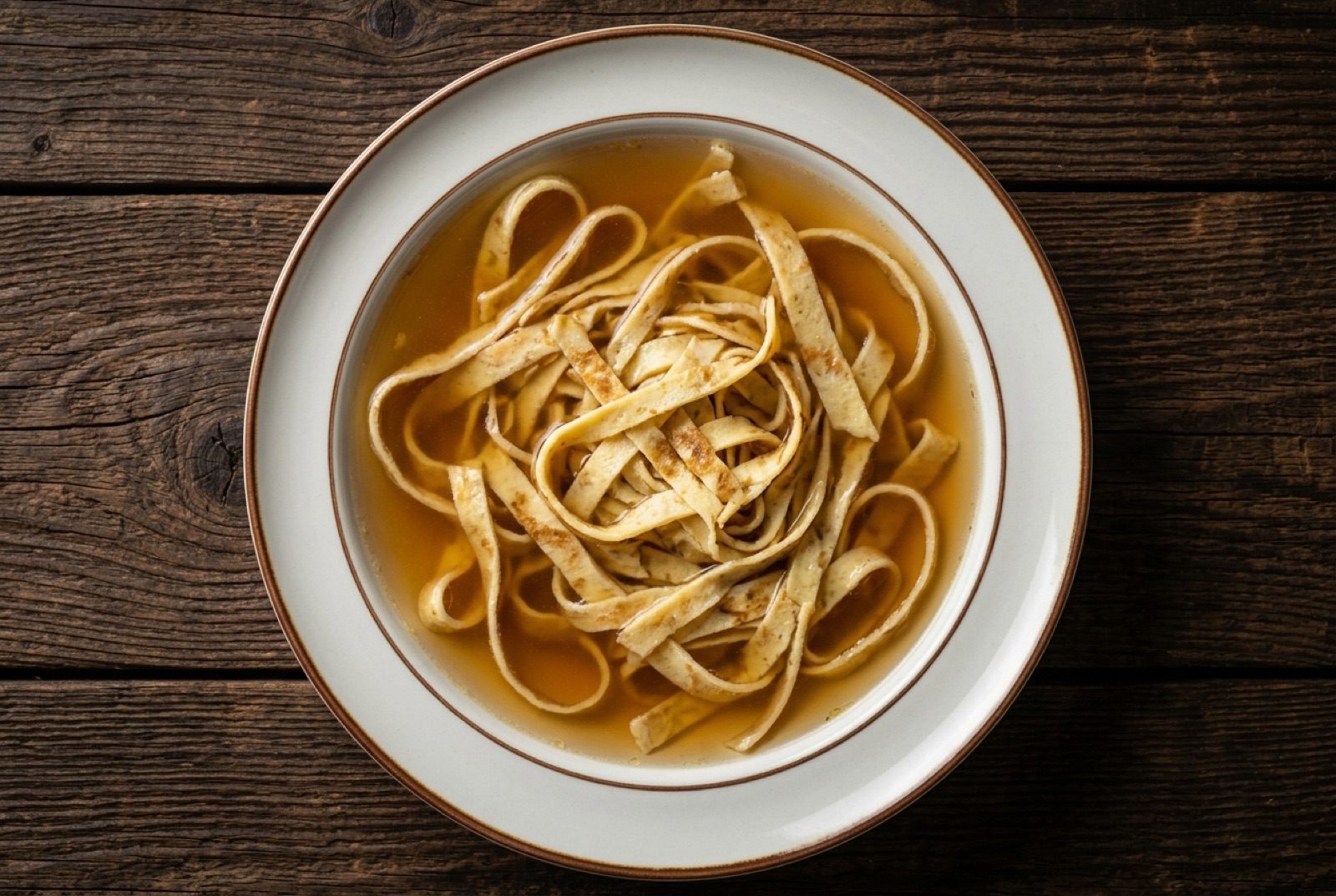
Beef Broth with Sliced Pancakes
Frittatensuppe · say it: fri-TAH-ten-zoo-peh
Frittatensuppe is a bowl of clear beef broth with strips of thin, unsweetened pancake floating in it. The pancakes are made like crêpes, rolled into cigars while still warm and sliced across into ribbons that soften in the hot soup without dissolving, so each spoonful carries a little chew against the clean, savoury broth. It tastes of good beef stock and browned butter, which is the whole point — there is nothing to hide behind. Every Austrian Gasthaus has it on the menu, it is the standard first course before boiled beef or a roast, and it is the easiest way into Austrian cooking if you have a decent broth in the freezer.

- Gate
- AustriaVienna
- Prep
- 15 min
- Cook
- 25 min
- Total time
- 1 hr 10 min incl. 30 min rest
- Serves
- 4
- Status
- Easy
- Nutrition / serving · estimated
- Calories 280 kcal
- Protein 13 g
- Carbs 32 g
- Fat 11 g
- Fiber 1 g
- Sodium 980 mg
Why this recipe works.
- Rests the batter so the pancakes come out thin, tender and free of bubbles.
- Rolls and slices the Frittaten warm, which gives clean even ribbons instead of torn strips.
- Adds the pancake to the bowl rather than the pot, so it keeps texture instead of turning to pulp.
- Includes an honest shortcut for the broth, plus what to fix if you are using a shop-bought one.
Ingredients.
8 itemsFor the soup
For the pancakes
To serve
Equipment
- 20 cm non-stick or well-seasoned crêpe pan
- Ladle
- Sharp knife
- Fine sieve
Instructions.
Mix and rest the batter
Whisk the flour, salt, eggs and milk to a smooth batter about as thick as single cream, then cover and leave it at room temperature for 30 minutes so the flour hydrates and the bubbles settle.
Fry thin pancakes
Heat a 20 cm pan over medium heat and wipe it with buttered kitchen paper. Add a small ladle of batter, swirl to coat the base thinly, and cook for about a minute until the surface looks matt and the underside is patched with pale gold.
Tip The first pancake is a test — adjust heat and batter thickness before committing the rest.
Finish and stack
Flip and cook the second side for 30 seconds, then slide onto a plate. Continue with the remaining batter, stacking the pancakes on top of each other and covering them with a cloth so they stay soft.
Roll and slice
Roll each pancake into a tight cigar and cut across into 5 mm ribbons with a sharp knife. Shake the ribbons loose with your fingers so they do not stay clumped.
Heat the broth
Bring the beef broth to a gentle simmer and taste it carefully for salt — it should taste properly seasoned on its own, since the pancakes add almost nothing.
Assemble at the table
Divide the ribbons between four warm bowls, ladle the hot broth over them and scatter with chives and a scrape of nutmeg. Serve immediately, while the Frittaten still have some bite.
Tips from our kitchen.
- Let the batter stand for 30 minutes. The flour hydrates, the bubbles rise out, and the pancakes fry smooth instead of blistered and brittle.
- The batter should be the consistency of single cream. If it coats the back of a spoon thickly, thin it with milk — thick Frittaten go doughy in the broth.
- Wipe the pan with butter on kitchen paper between pancakes rather than adding more fat. Excess butter fries the surface and gives you a lacy, greasy pancake.
- Stack the finished pancakes on a plate under a cloth. Steaming each other keeps them pliable enough to roll without cracking.
- Cut the ribbons about 5 mm wide. Thinner and they disintegrate in hot broth, thicker and they feel like noodles rather than Frittaten.
- Never boil the pancake strips in the soup pot. Put them in the bowl and pour hot broth over them at the table.
Substitutions.
- Homemade beef broth → Good shop-bought beef stock, simmered for 20 minutes with a charred onion half, a carrot and a few peppercorns
- This is the honest fix. Commercial stock is thin and often over-salted, and twenty minutes with fresh aromatics gets it much closer to the real thing.
- Beef broth → A strong vegetable broth built on celeriac, leek, carrot and dried mushroom
- Makes the dish vegetarian. It will taste different rather than worse, but you need real depth — a pale vegetable stock leaves the bowl watery.
- Plain flour pancakes → Half plain flour, half buckwheat flour
- A rustic Alpine variation with a nuttier taste. Buckwheat pancakes are more fragile, so roll them gently.
Variations.
- Grießnockerlsuppe
- The same broth with soft semolina dumplings poached in it instead of pancake ribbons — the other great Austrian soup garnish.
- Kaspressknödelsuppe
- The Tyrolean answer: flat, pan-fried cheese and bread dumplings sitting in the broth, substantial enough to be lunch on its own.
- Frittaten with herbs
- Chives, parsley or chervil beaten into the batter so the ribbons are flecked green — common in spring in Austrian homes.
Storage & reheating.
Keep the two elements separate and the soup keeps well. Broth holds 4 days refrigerated or 3 months frozen. Rolled, unsliced pancakes keep 2 days wrapped in the fridge and freeze for a month with baking parchment between them — slice them straight from the fridge, which is actually easier than slicing them warm. Never store the assembled soup: the pancake ribbons swell overnight into a soft mass and the broth goes cloudy. Slice and combine only at the moment of serving.
Serve with
A first course before Tafelspitz or a Sunday roast, with a bread roll and chives on top.
The story behind Frittatensuppe.
Austrian soup culture is organised around a distinction that has no neat English equivalent: the broth and the Einlage, the thing put into it. Rindsuppe, the clear beef broth simmered from shank and root vegetables, is treated as a neutral base, and the character of the soup comes from what is added at the last moment. The list is long and every Austrian has a ranking — semolina dumplings, liver dumplings, tiny fried batter pearls called Backerbsen, filled pasta squares, egg custard cubes, and Frittaten.
The name gives away the borrowing. Frittata is Italian, and the northern Italian lands were part of the Habsburg state for long stretches, so Italian words and Italian kitchen habits crossed into Austrian usage the same way Bohemian dumplings and Hungarian paprika did. In Italy the word means a set egg cake; in Austria it came to mean a thin flour-and-egg pancake made specifically to be cut into strips for soup. The same idea exists across the old empire — Hungary has a near-identical version, and southern Germany makes Flädlesuppe from the identical concept.
What keeps Frittatensuppe alive is its usefulness. Broth was made in quantity because boiled beef was cooked in quantity, and pancakes used up flour, eggs and milk that every household had. The soup is now the standard opening course of an Austrian Sunday lunch and of practically every wedding and funeral meal, served before Tafelspitz or a roast, and it is one of the few restaurant dishes where the kitchen has nowhere to hide: if the broth is weak or greasy, the whole bowl announces it immediately.
Questions, answered.
What are Frittaten exactly?
Frittaten are thin unsweetened pancakes made from flour, egg and milk, rolled up and cut across into narrow ribbons to be used as a soup garnish. The name comes from the Italian frittata, borrowed during the centuries when northern Italy and Austria shared a state, though the Austrian version is a crêpe rather than a set egg cake. Southern Germany makes the same thing and calls it Flädle.
Can I use shop-bought beef stock?
Yes, but improve it first. Simmer it for twenty minutes with a halved onion charred cut-side down in a dry pan, a carrot, a piece of celeriac and a few peppercorns, then strain. Commercial stock tends to be thin and heavily salted, and since this soup is essentially broth plus pancake there is nothing to disguise a weak base.
Why did my pancakes go soggy?
They sat in the broth too long. Frittaten should meet hot liquid only in the bowl, at the table, so they soften but keep some bite. If you add the ribbons to the soup pot or let a bowl stand for ten minutes, they absorb broth and turn to pulp. Cutting them too thin has the same effect — aim for 5 mm.
Can I make Frittatensuppe vegetarian?
Yes, by swapping the beef broth for a deeply flavoured vegetable one — celeriac, leek, carrot, onion and a few dried mushrooms give it enough body. The pancakes themselves contain no meat. Be aware that the dish is defined by clear beef broth in Austria, so a vegetable version is a departure rather than a regional variant.
How far ahead can I make the pancakes?
Up to two days if refrigerated rolled and wrapped, or a month frozen with parchment between them. Chilled pancakes are firmer and slice into neater ribbons than warm ones, so making them the day before is a genuine advantage. Just do not slice and store them loose, as the strips dry out and stick together.
You might also like.
All recipes →
Keep exploring Austria.
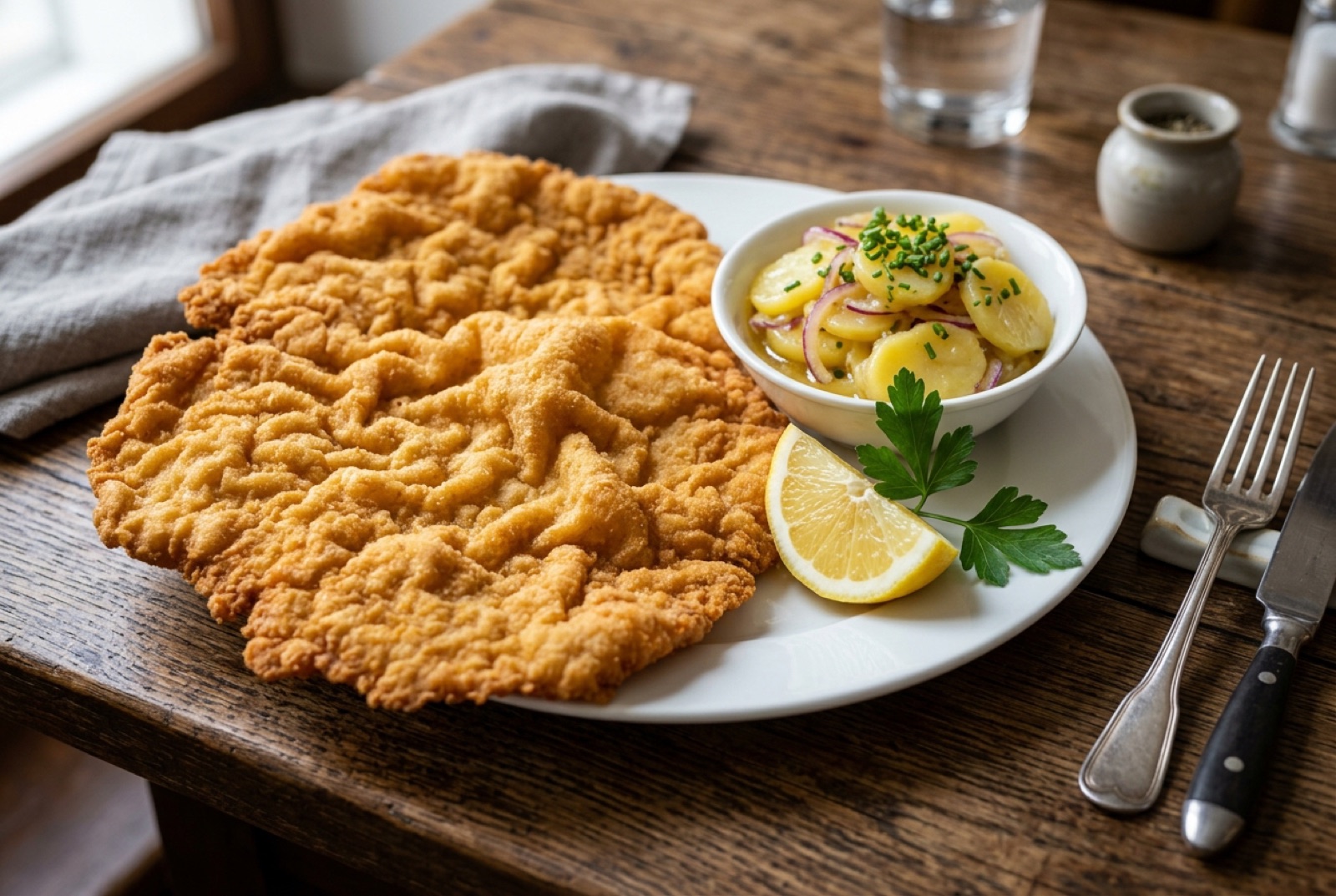
Austria has 9 more dishes in the atlas — Backhendl and Erdäpfelsalat, and 7 more.
Recipe by The DishRoute Kitchen · published August 19, 2026 · updated August 19, 2026