Fuchka.
Bangladeshi Crisp Shells with Spiced Filling
ফুচকা · say it: FOOCH-kah
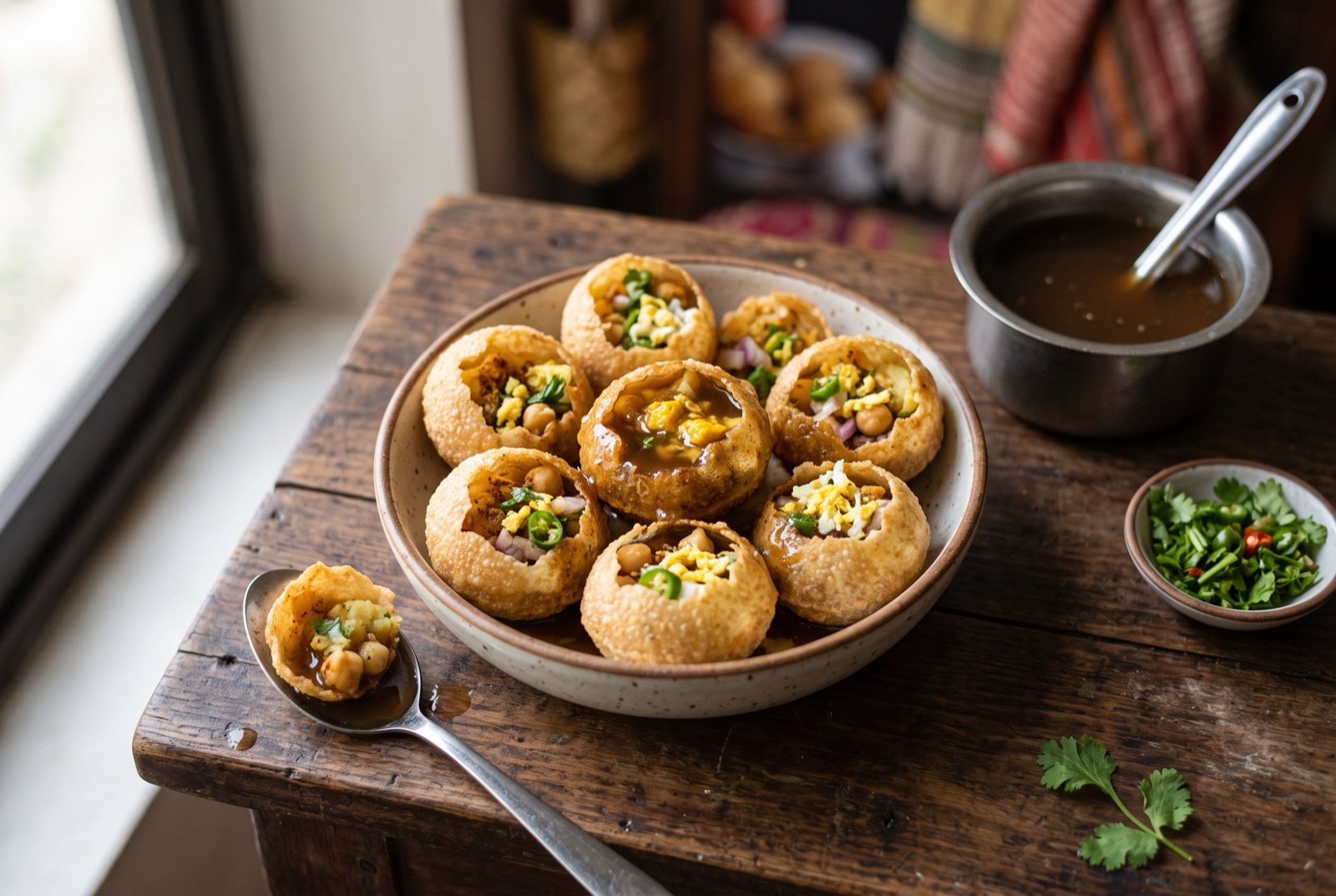
Fuchka is the Bangladeshi member of the pani puri family, and it differs from its Indian cousins in one obvious way: it is a mouthful of food rather than a mouthful of liquid. The shells are hollow, brittle spheres of fried semolina dough about the size of a walnut. You crack a hole in the top, stuff it hard with a mash of boiled potato, soft chickpeas or yellow peas, chopped onion, green chile and coriander, add a slice of boiled egg, and then pour cold spiced tamarind water in on top and eat the whole thing in one bite before it collapses. The taste hits in a fixed order — crack, then sour, then heat, then the starchy filling — and the texture only works for about four seconds, which is why fuchka is street food and not restaurant food.

- Gate
- BangladeshDhaka and Chattogram
- Prep
- 45 min
- Cook
- 30 min
- Total time
- 2 hr 15 min incl. 1 hr rest
- Serves
- 4
- Status
- Medium
- Nutrition / serving · estimated
- Calories 430 kcal
- Protein 14 g
- Carbs 62 g
- Fat 14 g
- Fiber 8 g
- Sugar 7 g
- Sodium 1100 mg
Why this recipe works.
- Covers both routes honestly — frying your own shells, and the shop-bought shortcut nearly every Bangladeshi household actually uses.
- A tamarind water with the black salt and roasted cumin that give it its distinctive sourness, not just tamarind and chile.
- The heavier Bangladeshi filling with egg and chickpeas, which is what separates fuchka from Indian pani puri.
- Assembly instructions timed for the four-second window before a filled shell goes soft.
Ingredients.
18 itemsFor the shells
For the filling
For the tamarind water
Equipment
- Rolling pin
- Deep pan for frying and a slotted spoon
- Small round cutter, about 5 cm
- Fine sieve for the tamarind
Instructions.
Make and rest the shell dough
Mix the semolina and flour with a large pinch of salt, then work in warm water a little at a time until you have a very stiff dough that resists your thumb. Knead hard for 6 minutes, cover with a damp cloth and rest 30 minutes.
Tip If the dough feels pliable and soft, it is too wet. Work in more semolina — soft dough will not puff.
Make the tamarind water
Soak the tamarind pulp in 200 ml of hot water for 15 minutes, then press it through a sieve. Blend the strained pulp with the mint, a green chile, black salt, roasted cumin, sugar and the remaining cold water. Taste — it should be sharply sour and clearly salty. Chill it hard.
Tip Season it stronger than seems sensible. Inside a stuffed shell it gets diluted immediately.
Mix the filling
Combine the mashed potato, crushed chickpeas, chopped egg, onion, green chile, coriander, roasted cumin, chile powder and salt. Work it with your fingers until it holds together in a lump when squeezed but is still loose enough to spoon.
Roll and fry the shells
Roll the dough out to about 1.5 mm and cut 5 cm rounds, keeping the offcuts under the cloth. Heat the oil to 180°C and fry three or four rounds at a time, pressing each one under the surface with a slotted spoon for the first 3 seconds until it balloons, then turning until pale gold and rigid — about 90 seconds each.
Tip Test the oil with one disc first. If it sinks and sits, the oil is too cool; if it browns before puffing, too hot.
Drain and cool
Lift the shells out onto paper and let them cool completely — they crisp fully as they cool and stay hollow. Tap one against the counter before assembling; it should sound hard and hollow, not soft.
Assemble and eat immediately
Crack a hole in the top of a shell with your thumb, pack it hard with the filling, dunk it into the cold tamarind water so it floods the cavity, and eat it whole in one bite. Do one at a time — a filled fuchka goes soggy within a minute.
Tips from our kitchen.
- Knead the semolina dough much stiffer than you think is right — it should be hard to press with a thumb. Soft dough gives flat, greasy discs instead of hollow spheres.
- Rest the dough under a damp cloth for at least 30 minutes so the semolina hydrates fully. Unrested dough cracks when you roll it thin.
- Roll to about 1.5 mm and cut small rounds. Too thick and the shell will not puff; too thin and it tears in the oil.
- Fry at around 180°C and press each disc down under the oil with a slotted spoon for the first three seconds — that pressure is what forces it to balloon.
- Make the tamarind water at least an hour ahead and chill it hard. Warm pani makes the shells go soft even faster and tastes flat.
- Fill and serve one at a time. A tray of pre-filled fuchka is a tray of soggy fuchka within a minute.
Substitutions.
- Homemade shells → Shop-bought puri or golgappa shells from a South Asian grocer
- This is what most Bangladeshi homes use. Refresh them in a 150°C oven for 4 minutes before assembling to make sure they are properly crisp.
- Tamarind pulp → Tamarind concentrate, about one third of the quantity, thinned with water
- Concentrate is much stronger and often saltier, so add it gradually and taste. Lime juice can fill part of the sour role but not all of it.
- Black salt (kala namak) → Ordinary salt plus a very small pinch of ground asafoetida
- Black salt has a sulphurous tang that defines the flavour of the water. The substitute is a rough approximation; if you make fuchka often, buy the real thing.
- Boiled egg → Extra chickpeas, or leave it out
- Egg is standard in Bangladeshi fuchka but not structurally necessary, and omitting it makes the dish vegan if you also skip it in the filling.
Variations.
- Doi fuchka
- Filled shells arranged on a plate and covered in beaten yogurt, tamarind chutney, chopped onion and sev. Eaten with a spoon, and it survives sitting for a minute.
- Chotpoti-topped fuchka
- Crushed fuchka shells scattered over chotpoti, the spiced chickpea and potato stew sold from the same carts. Common when the shells break in transit.
- Kolkata puchka
- The West Bengal version — mashed potato filling seasoned with black salt and green chile, no egg, and a sharper tamarind water.
Storage & reheating.
Assembled fuchka cannot be stored at all — the shells collapse within a minute. The components keep separately: the potato and chickpea filling for 2 days refrigerated, the tamarind water for 4 days in a sealed jar in the fridge, improving as it sits. Unfilled fried shells keep 2 weeks in a completely airtight container at room temperature and can be re-crisped in a 150°C oven for 4 minutes if they soften.
Serve with
Eat standing, straight from the plate, with extra tamarind water in a cup to drink at the end — and chotpoti from the same cart if you can.
The story behind Fuchka.
The pani puri family spans the subcontinent under a dozen names — golgappa in Delhi, puchka in Kolkata, pani puri in Mumbai, gup chup in Odisha, fuchka in Bangladesh — and every region insists its own version is the correct one. The arguments are real and specific. Bangladeshi fuchka is heavier: the filling is dense, generously spiced, almost always includes boiled egg, and often gets a spoon of hot chickpea curry, while a Mumbai pani puri is lighter and more about the flavoured water. Kolkata puchka sits somewhere between, with a tamarind-heavy water and a mashed potato filling seasoned with black salt.
What makes it street food rather than home food is the assembly. A fuchkawala works a stack of shells and a row of steel bowls with both hands, cracking, filling, dipping and handing over one at a time onto a small plate or a dried leaf, keeping pace with a customer eating at the speed the shells go soggy. Nobody sits down. In Dhaka you find the carts near university gates, in Dhanmondi and around Chattogram's beaches in the evening, and there is a widely shared understanding that the best fuchka comes from a cart with a queue and questionable hygiene, which is a risk people knowingly take.
The shells themselves are the technical part. They are made from semolina, sometimes with a little flour, kneaded stiff, rested, rolled very thin and fried in oil hot enough that the disc puffs into a hollow ball within seconds. Getting them to puff reliably at home is a matter of dough stiffness, rolling thinness and oil temperature, and most Bangladeshi households simply buy the shells ready-made from a shop and make only the filling and the water. That is not cheating; it is what almost everyone does.
The tamarind water is the part worth taking seriously at home. Made properly it is sour, salty, sharp with black salt and roasted cumin, cut with mint and coriander, and served genuinely cold. Made lazily it is brown water.
Questions, answered.
What is the difference between fuchka and pani puri?
Fuchka is the Bangladeshi version and it is heavier: the shells are stuffed with a dense mash of potato, chickpeas, onion and chile, almost always with boiled egg, and the tamarind water is poured on at the end. Mumbai-style pani puri has a lighter filling and treats the flavoured water as the main event. Kolkata puchka sits between the two and skips the egg.
Why did my fuchka shells not puff up?
Usually the dough was too soft or the discs were rolled too thick. The semolina dough needs to be very stiff and rested for at least 30 minutes, then rolled to about 1.5 mm. The oil also has to be genuinely hot, around 180°C, and each disc should be held under the surface with a slotted spoon for the first few seconds so steam is forced into the centre.
Can I use shop-bought shells?
Yes, and most Bangladeshi households do. Ready-made puri or golgappa shells are sold in every South Asian grocery and are perfectly good. Warm them in a 150°C oven for four minutes before assembling to drive off any moisture they picked up in the packet, and check for cracks before filling — a cracked shell leaks the moment the water goes in.
How far ahead can I prepare fuchka?
Prepare all the components ahead but never assemble ahead. The tamarind water is better after a few hours in the fridge and keeps four days, the filling keeps two days refrigerated, and unfilled shells keep two weeks airtight. Assembly happens one shell at a time at the moment of eating, because a filled fuchka goes soft in about a minute.
What is the water made of?
Tamarind pulp thinned with cold water and seasoned with black salt, roasted ground cumin, chile powder, green chile, mint and coriander, plus a little sugar to balance the sourness. It should be aggressively sour and salty on its own — it is diluted by the filling once it goes into the shell, so tasting it neutral means it will taste of nothing in the fuchka.
You might also like.
All recipes →
Keep exploring Bangladesh.
Bangladesh has 9 more dishes in the atlas — Beef Bhuna and Beef Shatkora, and 7 more.
All Bangladesh recipes Potato recipes Chickpeas recipes Tamarind recipes street foodsnackvegetariandairy freenut freeRecipe by The DishRoute Kitchen · published August 20, 2026 · updated August 20, 2026