Kaq Ik.
Q'eqchi' Maya Turkey and Chile Soup
Kaq’ Ik · say it: kahk-EEK
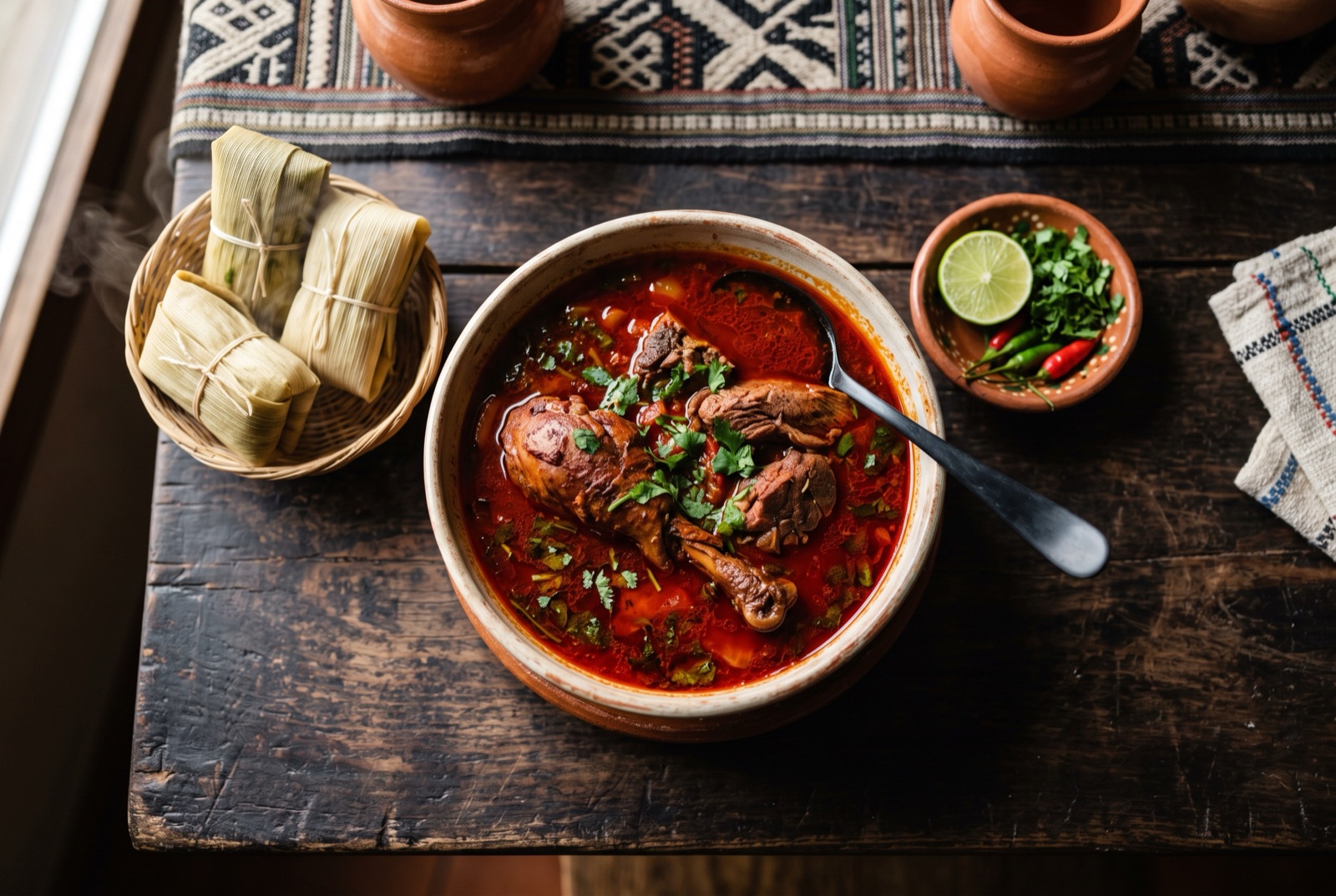
Kaq ik is a brick-red turkey soup from the Q'eqchi' Maya of Alta Verapaz, and the name says exactly what it is — kaq means red, ik means chile. Turkey pieces are poached, then simmered in a broth built from charred tomato and tomatillo, achiote, coriander seed, mint and the smoke-dried chile cobanero that grows in the cloud forests around Cobán. The result is thinner and cleaner than pepián, more soup than stew, with a genuine chile heat that most Guatemalan food avoids, cut by a distinct herbal note from fresh mint and culantro. It arrives with tamalitos — plain thumb-sized corn parcels — for dunking, and it is served at weddings, births and community celebrations rather than on an ordinary Tuesday.

- Gate
- GuatemalaCobán, Alta Verapaz
- Prep
- 30 min
- Cook
- 1 hr 30 min
- Total time
- 2 hr
- Serves
- 4
- Status
- Medium
- Nutrition / serving · estimated
- Calories 480 kcal
- Protein 52 g
- Carbs 34 g
- Fat 15 g
- Fiber 5 g
- Sugar 7 g
- Sodium 950 mg
Why this recipe works.
- Built as a soup rather than a stew, which is what kaq ik actually is — most foreign versions thicken it wrongly.
- The chile cobanero problem is addressed head on with a smoke-plus-heat substitution that gets close.
- Includes the tamalitos, since the soup is genuinely incomplete without something corn-based to dunk.
- Herbs go in late so the mint and coriander stay green and bright instead of stewing into the broth.
Ingredients.
20 itemsFor the soup
For the red broth
To finish
For the tamalitos
To serve
Equipment
- Large soup pot
- Dry frying pan or comal
- Blender
- Fine sieve
- Steamer for the tamalitos
Instructions.
Poach the turkey
Bring the turkey, water, halved onion and salt to a simmer in a large pot. Skim the foam that rises in the first ten minutes, then cook at a bare bubble for 50 minutes, until the meat pulls away from the bone but the pieces stay whole. Lift out the turkey and keep the broth.
Tip Never let it boil. A rolling boil makes the broth cloudy and greasy, and this soup is judged on clarity.
Toast the aromatics
Toast the coriander seeds in a dry pan for about a minute, until they smell warm and citrusy, and grind them. In the same pan, press the dried chiles flat for 20 seconds a side until fragrant, then soak them in hot broth for 10 minutes to soften.
Char the vegetables
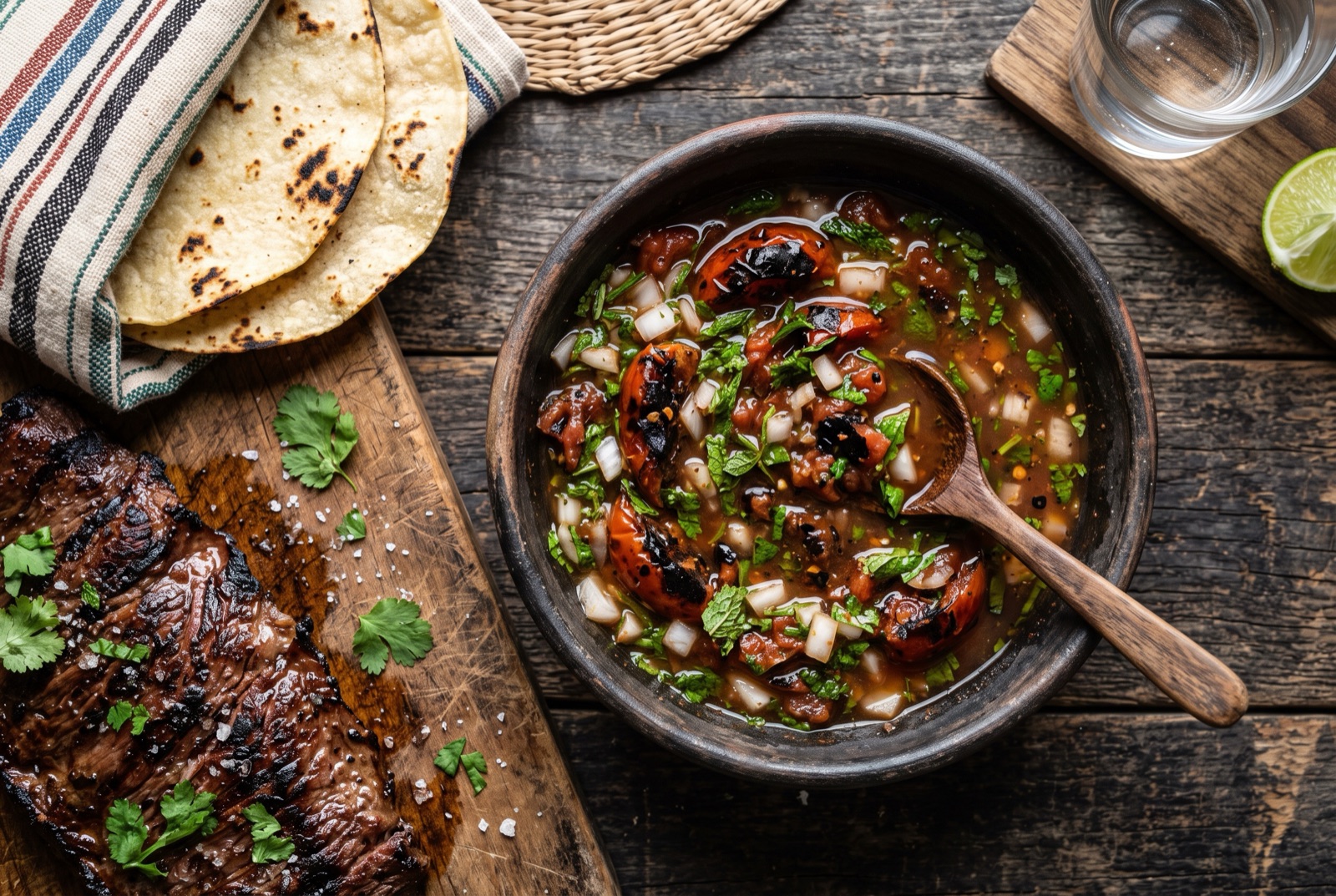
Char the tomatoes, tomatillos, quartered onion and unpeeled garlic on the dry pan over medium-high heat for 8–10 minutes, turning, until the skins blister, split and blacken in patches and the tomatoes collapse.
Blend and strain
Peel the garlic and blend the charred vegetables with the soaked chiles, achiote, ground coriander and 500 ml of the turkey broth until smooth and deep red. Push the mixture through a fine sieve into a clean pot, pressing hard on the solids and discarding the skins left behind.
Tip Straining is what turns this from a sauce into a soup. Do not skip it.
Build the soup
Add another 1.2 litres of turkey broth to the strained base and bring it to a gentle simmer. Cook uncovered for 20 minutes, until the raw chile edge softens and the broth turns glossy and clear scarlet with a thin film of orange fat on top.
Make the tamalitos
Mix the masa harina with the lard, salt and about 250 ml warm broth into a soft dough that holds a fingerprint. Roll into eight small logs, wrap each in a piece of banana leaf or foil, and steam for 25 minutes until firm to the touch.
Finish and serve
Return the turkey to the broth, add the scallions and simmer 8 minutes to warm through. Stir in the mint, cilantro and culantro, cook 2 minutes more, then taste for salt and heat. Ladle into deep bowls with a piece of turkey standing in each, with tamalitos and lime alongside.
Tips from our kitchen.
- Turkey legs and thighs beat breast here by a wide margin. Dark meat survives a long simmer and gives the broth the gelatin it needs to taste like more than water.
- Char the tomatoes and tomatillos on a dry pan until the skins split and blister black in places. That smoke is doing half the work in this broth.
- Toast the coriander seed before grinding until it smells warm and citrusy. Ground coriander from a jar tastes dusty by comparison and this soup has nowhere to hide it.
- Strain the blended base through a sieve. Kaq ik should be a clean, pourable broth you can see through slightly, not a thick sauce.
- Add the mint and culantro in the last five minutes only. Long cooking turns mint bitter and grey.
- Taste for heat after the soup has simmered, not before. Dried chiles keep releasing capsaicin as they cook and a broth judged mild at the start can be fierce twenty minutes later.
Substitutions.
- Chile cobanero → 1 chipotle in adobo plus 2 dried chiles de árbol
- Cobanero is smoke-dried and grown only around Cobán, so nothing matches it exactly. Chipotle supplies the smoke and árbol the heat; use both and accept it is an approximation.
- Turkey → Bone-in chicken thighs and drumsticks
- Widely done in Guatemalan homes when turkey is expensive. Reduce the simmering time to about 35 minutes since chicken cooks much faster.
- Culantro → A larger handful of cilantro
- Culantro is stronger and more pungent than cilantro but the same family. Use roughly double the cilantro to get in range.
Variations.
- Kaq ik de gallina
- Made with an old laying hen instead of turkey, simmered two hours or more for a deeper, more gelatinous broth.
- Restaurant-style kaq ik
- Served with rice and avocado alongside the tamalitos, the way it is plated in Cobán hotels and in the capital.
- Milder family version
- The cobanero reduced to a single chile and the seeds removed, so children can eat it and the smoke comes through ahead of the heat.
Storage & reheating.
Kaq ik keeps 3 days refrigerated and the broth deepens overnight, though the mint fades — add a few fresh leaves when reheating. Warm it gently rather than boiling, since hard heat toughens the turkey. The broth freezes well for 3 months on its own; freeze it without the meat and add freshly poached turkey when you reheat, or the meat comes out dry and stringy.
Serve with
Steamed corn tamalitos, white rice, and lime wedges for squeezing over the broth.
The story behind Kaq Ik.
Kaq ik is one of the oldest dishes still cooked in Guatemala, and unlike most of the national repertoire it is not mestizo. There is no pork, no olive, no cinnamon, no Spanish inheritance in it at all: turkey, chile, tomato, achiote and corn are all native to the region, and the Q'eqchi' were making some version of this soup long before contact. In 2007 the Guatemalan government declared it part of the country's intangible cultural patrimony along with pepián, jocón and plátanos en mole, which brought a Cobán village dish onto national restaurant menus.
In its home context, kaq ik is ceremonial. It is cooked for weddings, for baptisms, for the arrival of a guest who matters, and the cooking itself is communal — the turkey is often one raised in the household yard, and the broth is made in a volume that assumes a crowd. Traditionally the bird is cut so that everyone at the table receives a specific piece, and the giving of certain parts to certain people carries meaning. The soup is served in a deep bowl with the turkey standing in it, sometimes with the leg bone left long and sticking out of the broth, which is how you will see it photographed.
The chile is the part that cannot really be replaced. Chile cobanero is a small red chile smoke-dried over wood in Alta Verapaz, and it brings both heat and a distinct smokiness that no fresh chile offers. Outside Guatemala the honest workaround is a mix of chipotle for the smoke and a hotter dried chile such as chile de árbol for the bite. It will not be identical, and any Q'eqchi' cook would say so, but it lands in the right neighbourhood — and the rest of the soup, especially the achiote, coriander seed and mint, carries more of the character than people expect.
Questions, answered.
What does kaq ik mean?
It is Q'eqchi' Maya: kaq means red and ik means chile, so the name literally describes a red chile soup. The colour comes from achiote and dried red chiles rather than from tomato alone, and the spelling appears variously as kaq ik, kak ik or kak’ik depending on the transliteration used.
What can I use instead of chile cobanero?
Chile cobanero is smoke-dried in Alta Verapaz and has no true equivalent, but a combination of one chipotle in adobo for the smoky depth and two dried chiles de árbol for heat gets reasonably close. Smoked paprika plus a hot chile flake also works if dried chiles are unavailable, though the result is noticeably rounder and less sharp.
Is kaq ik very spicy?
It is the spiciest dish in the mainstream Guatemalan repertoire, which is not saying much by Mexican or Thai standards but is real heat. A properly made bowl has a clear chile burn that builds. Reduce the number of chiles and remove their seeds if you want the smoke without the fire.
What are tamalitos and do I need them?
Tamalitos are small plain corn masa parcels steamed in leaves, with no filling, and they are the traditional accompaniment. They function like bread — you tear off pieces to soak up the broth. Plain white rice or warm corn tortillas serve the same purpose if you do not want to make them.
Why is my broth cloudy and greasy?
The turkey was boiled too hard, which emulsifies fat into the liquid and breaks up proteins. Keep the pot at a bare simmer where bubbles rise only occasionally, skim the foam in the first ten minutes, and spoon off surface fat before serving. Chilling the broth and lifting off the solidified fat is the easiest fix if you have time.
You might also like.
All recipes →
Keep exploring Guatemala.
Guatemala has 9 more dishes in the atlas — Atol de Elote and Chiles Rellenos Guatemaltecos, and 7 more.
Recipe by The DishRoute Kitchen · published August 20, 2026 · updated August 20, 2026