Hangikjöt.
Icelandic Smoked Lamb with White Sauce
Hangikjöt · say it: HOWNG-i-kyurt
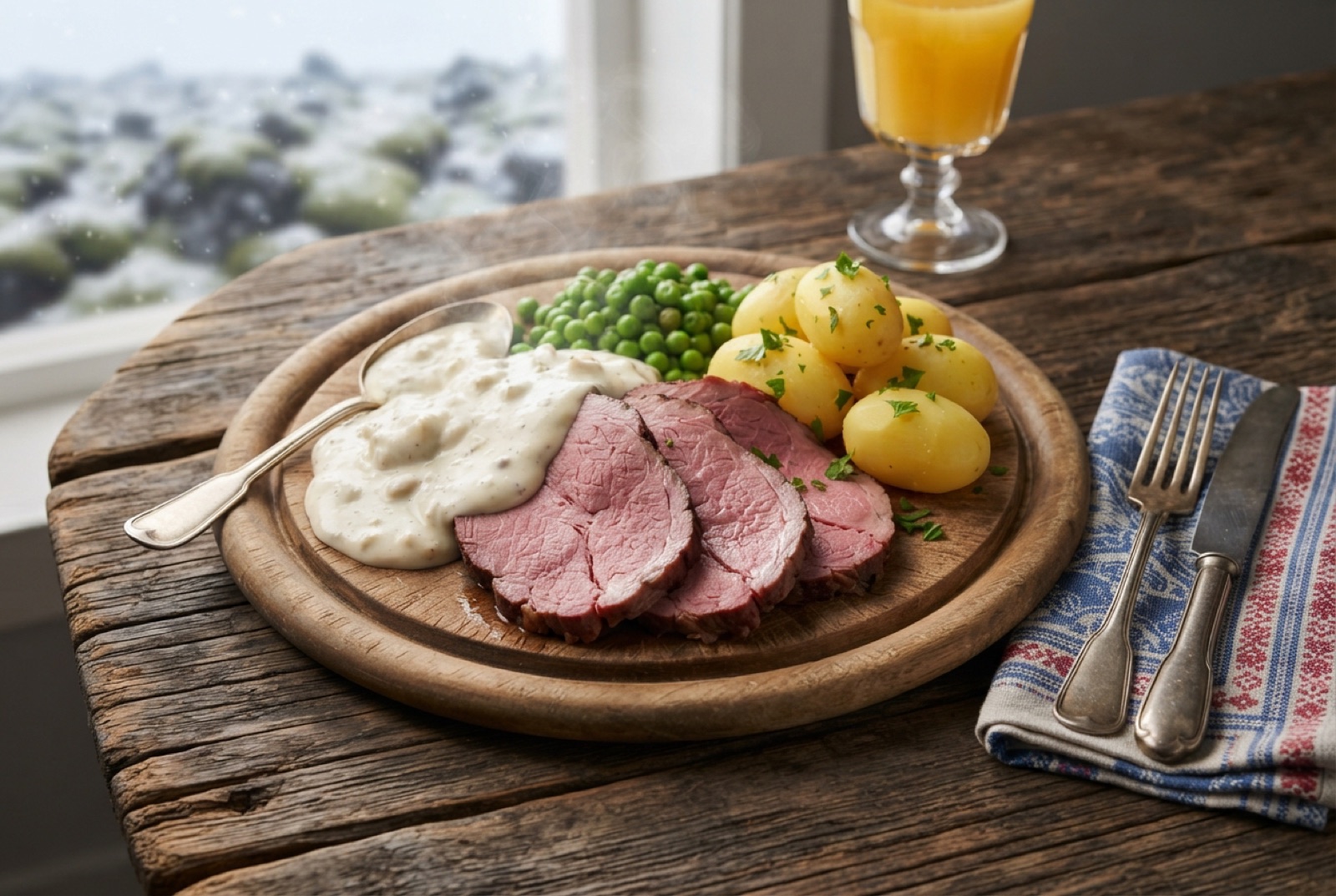
Hangikjöt means hung meat, and that is exactly what it is: a leg or shoulder of Icelandic lamb salted, then hung in cold smoke until it takes on a firm texture and a dense, campfire-and-cured perfume. Cooking it at home is mostly patience — a long, quiet simmer in plain water that softens the salt, relaxes the fibres and fills the whole house with smoke and lamb. Served hot it is sliced thick onto boiled potatoes and flooded with uppstúfur, a plain white sauce sweetened by nothing but milk and warmed with nutmeg, with green peas alongside. Served cold it is shaved into near-transparent slices and laid on buttered flatbread. Both versions are considered correct, and most Icelandic households eat it both ways within the same week.

- Gate
- IcelandNorth Iceland
- Prep
- 20 min
- Cook
- 1 hr 40 min
- Total time
- 2 hr 20 min incl. 20 min rest
- Serves
- 6
- Status
- Medium
- Nutrition / serving · estimated
- Calories 620 kcal
- Protein 45 g
- Carbs 42 g
- Fat 29 g
- Fiber 6 g
- Sodium 1650 mg
Why this recipe works.
- Gives the actual doneness signal for a smoked leg — the bone loosening and the fork test — instead of a fixed number of minutes.
- Simmers below boiling point, which is the difference between meat that carves and meat that shreds into dry threads.
- Includes the full Christmas plate: uppstúfur, potatoes and peas, all timed to finish together.
- Explains how to serve the same leg hot on the day and cold on flatbread afterwards, which is how Icelanders actually eat it.
Ingredients.
12 itemsFor the meat
For the uppstúfur
To serve
Equipment
- Large stockpot deep enough to submerge the leg
- Instant-read thermometer
- Whisk
- Sharp carving knife
Instructions.
Start the leg
Put 1.5 kg of smoked lamb into a deep pot, add the bay leaves and peppercorns, and cover with cold water by at least 5 cm. Bring it slowly up to heat over medium — around 20 minutes — and skim off the grey foam that gathers as it approaches a simmer.
Check the salt
Once the surface trembles, taste a spoonful of the water. If it tastes like seawater, ladle out half the liquid and replace it with fresh boiling water; if it tastes pleasantly savoury, leave it — that broth is worth keeping for the sauce.
Tip Different producers cure to wildly different salt levels, so this check matters more than any instruction in the recipe.
Simmer gently
Hold the pot at 85–90°C, uncovered or barely lidded, for about 75–90 minutes for a 1.5 kg leg. The water should show a few lazy bubbles at the edge and never break into a boil. The meat is ready when a fork enters with almost no push and the bone twists freely in the joint.
Rest the meat
Turn off the heat and let the leg sit in its liquid for 20 minutes. It reabsorbs juice as it cools slightly, and it will carve into clean slices instead of collapsing. Ladle off 200 ml of the broth and set it aside.
Boil the potatoes and peas
While the meat rests, boil 1 kg of potatoes in salted water for 20 minutes until a knife meets no resistance, and drop the peas into the same water for the last 3 minutes. Drain and keep them warm under a lid with a knob of butter.
Make the uppstúfur
Melt the butter in a saucepan over medium-low heat, stir in the flour and cook for 2 minutes until it smells like biscuits and turns a pale sand colour without browning. Whisk in the warm milk a third at a time, waiting for the sauce to thicken and go glossy before each addition.
Finish the sauce
Simmer for 4–5 minutes, whisking, until the sauce is thick enough to coat a spoon but still pourable. Season with nutmeg, white pepper and salt, and loosen with a little of the reserved broth only if the meat tasted mild. Keep it warm with a butter wrapper laid on the surface to stop a skin forming.
Carve and serve
Carve the lamb across the grain into slices about 5 mm thick, laying them over the hot potatoes. Pour the uppstúfur generously over the meat and potatoes, spoon the peas alongside, and put the pickled red cabbage on the table for sharpness.
Tips from our kitchen.
- Taste the cooking water after 20 minutes. If it is aggressively salty, tip half of it out and top up with fresh boiling water — cures vary enormously between producers.
- Keep the pot at 85–90°C, with bubbles rising lazily at the edge only. A rolling boil tightens the muscle and drives out moisture you cannot get back.
- Let the leg cool for at least 20 minutes in its liquid before carving; slicing it straight out of the pot loses juice all over the board.
- If you plan to serve it cold, let it cool completely in the cooking liquid overnight — it stays moist and slices far more thinly.
- Make the uppstúfur while the meat rests and thin it with a ladle of the cooking liquid only if the meat was mild; otherwise the sauce turns salty.
Substitutions.
- Icelandic hangikjöt leg → Any cold-smoked, cured lamb or mutton leg from a Nordic or Middle Eastern butcher
- Norwegian fenalår and other cured lamb legs behave similarly, though they are usually drier and saltier. Soak those in cold water for a few hours before simmering.
- Bought smoked lamb → Home hot-smoked lamb leg: dry-cure a 1.5 kg boned leg in 3 tbsp salt and 1 tbsp sugar for 48 hours in the fridge, rinse, dry overnight, then hot-smoke over birch chips at 100°C until the centre reaches 65°C.
- Be honest with yourself about what this is — hot smoke cooks the meat rather than curing it, so you get a smoked roast rather than true hangikjöt. It is excellent, but the texture is roast-like and the smoke sits on the surface instead of running through.
- Uppstúfur (white sauce) → A béchamel loosened with a little of the meat stock
- Icelandic uppstúfur is deliberately plain — flour, butter, milk, nutmeg. Resist adding cheese, mustard or stock cubes; the smoke on the meat is the seasoning.
Variations.
- Taðreykt hangikjöt
- Smoked over dried sheep dung rather than birch. Much more pungent and slightly acrid in a way its devotees insist is the only real version. Sold as a premium product in Iceland.
- Cold on flatkaka
- The leftovers ritual: chill the leg in its liquid, shave it paper-thin and pile it on buttered rye flatbread. Eaten at Christmas coffee tables and at almost every Icelandic buffet.
- Hangikjöt with laufabrauð
- Served with the thin, patterned deep-fried leaf bread that Icelandic families cut and fry together in December. Crisp, faintly sweet, and the traditional partner to the hot plate.
Storage & reheating.
Cooked hangikjöt keeps 5 days refrigerated, and it keeps best sitting in a little of its own cooking liquid so the surface does not dry out. Slice as you need it rather than in advance. Cooked meat freezes acceptably for 2 months in slices with a spoonful of liquid, though the texture tightens. The uppstúfur is best made fresh; reheat leftovers gently with extra milk and whisk hard to bring it back.
Serve with
Boiled potatoes, uppstúfur, green peas and pickled red cabbage — with flatkaka for the cold slices later.
The story behind Hangikjöt.
Smoking meat in Iceland was never a flavour project; it was how a household without refrigeration got through winter. Sheep were slaughtered in autumn after the highland round-up, and what could not be eaten fresh was salted and hung in the rafters of a smokehouse above a smouldering fire. The problem was fuel. Iceland lost almost all of its woodland within a few centuries of settlement, so the traditional smoke came from what was actually available: birch scrub where it survived, driftwood off the beaches, and dried sheep dung, tað, which burns slowly and cool and is genuinely prized rather than tolerated. Meat smoked over dung, taðreykt hangikjöt, is sharper and more pungent than the birch-smoked kind, and Icelanders who grew up with it consider the birch version the polite, watered-down option.
The meat became a festival food because its season lined up with the calendar. Slaughter in September, weeks of curing and smoking, and by late December there was a leg ready to be boiled. Hangikjöt is now one of the most fixed items in the Icelandic Christmas repertoire, boiled and served hot on Christmas Day with uppstúfur, potatoes and peas, then reappearing cold for the rest of the holiday on flatkaka, the charred rye flatbread, and in sandwiches. Slicing the cold leg thin enough is a point of pride; the slices should be almost translucent.
Almost nobody smokes their own any more. Hangikjöt is bought at the butcher or supermarket, already cured and smoked, cooked or uncooked, and the household job is the boiling. That is not laziness so much as division of labour: proper cold smoking runs for days at a temperature that will not cook the meat, and it needs a smokehouse rather than a kitchen. What the home cook controls is the simmer — hard enough and you get dry, stringy, aggressively salty meat, gentle enough and the leg gives way under a fork while keeping its smoke.
Questions, answered.
What exactly is hangikjöt?
Hangikjöt is Icelandic lamb or mutton — usually leg or shoulder — that has been salted and then cold-smoked, traditionally over birch, driftwood or dried sheep dung. The name literally means hung meat, from the practice of hanging it in the rafters of a smokehouse. It is sold cured and smoked but often uncooked, so the buyer simmers it before eating.
How long do you boil hangikjöt?
Roughly 45–55 minutes per kilogram at a gentle simmer, so a 1.5 kg leg takes around 75–90 minutes. Time is only a guide: the meat is ready when a fork slides in with almost no resistance and the bone twists loose in the joint. Keep the water below boiling point throughout, or the meat turns dry and stringy.
Why is my smoked lamb too salty?
Cures differ a lot between producers, and some legs are salted for keeping rather than for immediate eating. Taste the cooking water 20 minutes in; if it is harsh, pour off half and replace it with fresh boiling water. For a very salty leg, soak it in cold water for 3–4 hours before cooking, changing the water once.
What is uppstúfur?
Uppstúfur is the plain Icelandic white sauce served with smoked lamb: butter and flour cooked into a roux, whisked with milk, and seasoned with nothing more than salt, white pepper and a grating of nutmeg. It is deliberately mild, because its job is to soften the salt and smoke of the meat rather than to add flavour of its own.
Can I eat hangikjöt without cooking it?
Only if the packet says it is fully cooked, which some supermarket hangikjöt is — that kind is sold sliced and eaten cold straight away. Raw cured hangikjöt must be simmered first, unlike air-dried hams such as prosciutto. If you are unsure which one you have bought, cook it; simmering harms nothing.
You might also like.
All recipes →
Keep exploring Iceland.
Iceland has 9 more dishes in the atlas — Fiskibollur and Harðfiskur, and 7 more.
Recipe by The DishRoute Kitchen · published August 19, 2026 · updated August 19, 2026