Gulyás.
Hungarian Beef and Paprika Soup
Gulyásleves · say it: GOO-yash-leh-vesh
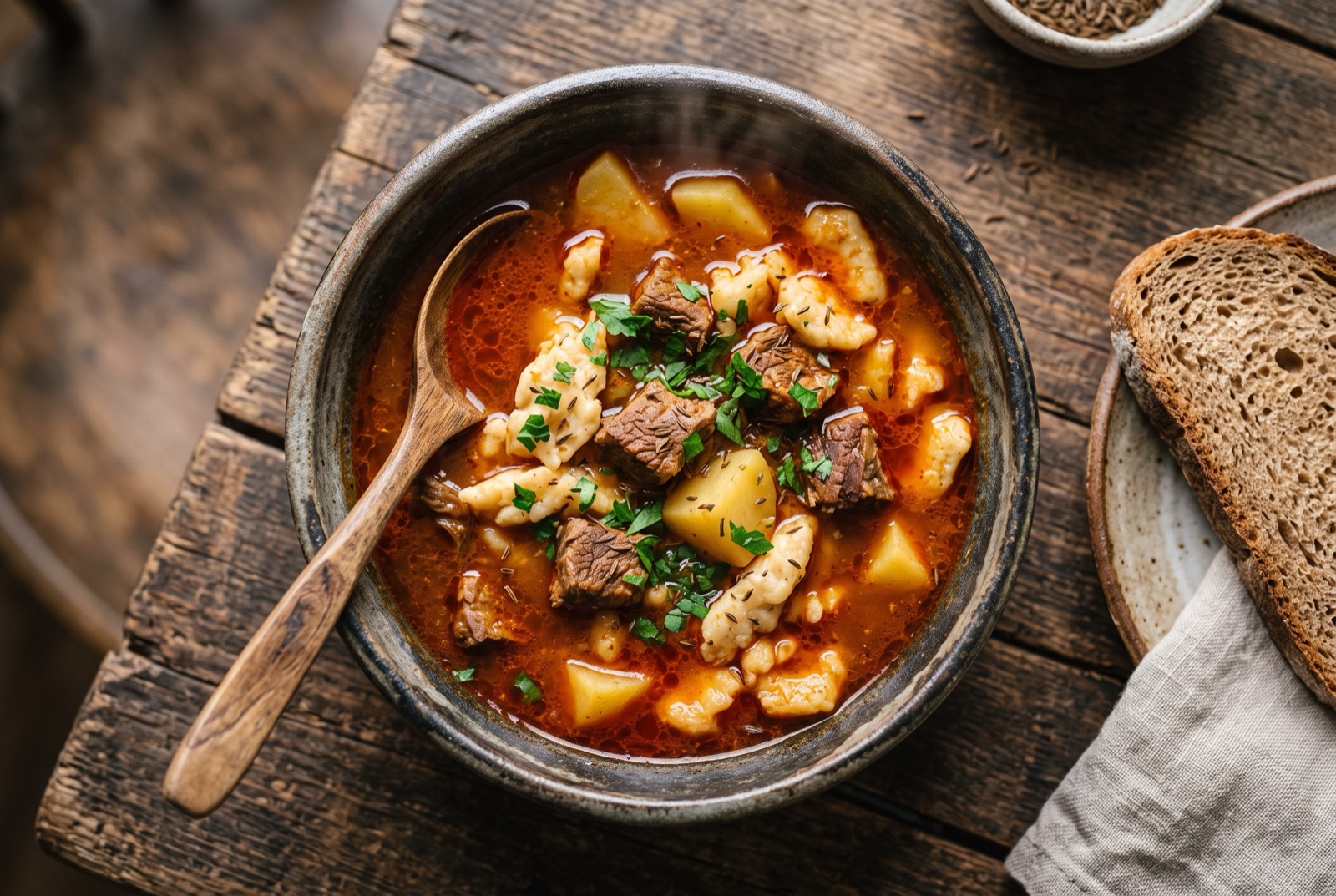
Gulyás is a soup, not a stew — and in Hungary that distinction is not negotiable. Beef shin is cooked down with an almost improper quantity of onion, sweet paprika stirred in off the heat, caraway, garlic and root vegetables, then loosened with enough water that you eat it with a spoon from a bowl. The taste is deeply savoury and faintly sweet from the onions, with paprika giving warmth and colour rather than heat, and caraway providing the resinous note that tells you where you are. Potatoes go in near the end, and small pinched noodles called csipetke cook directly in the broth. There is no flour thickening, no cream, and no tomato paste hiding the paprika. What thickness there is comes from onions that have collapsed entirely and potato starch shed into the pot.

- Gate
- HungaryThe Great Plain
- Prep
- 30 min
- Cook
- 2 hr 45 min
- Total time
- 3 hr 15 min
- Serves
- 6
- Status
- Medium
- Nutrition / serving · estimated
- Calories 430 kcal
- Protein 32 g
- Carbs 35 g
- Fat 18 g
- Fiber 5 g
- Sodium 780 mg
Why this recipe works.
- Treats gulyás as the soup it actually is — no roux, no cream, no tomato paste covering weak paprika.
- The onions get the time they need to collapse, which is where the body of the broth comes from.
- Csipetke are pinched by hand in five minutes and cook in the soup, so there is no second pot to wash.
- Clear timing for when the paprika goes in, which is the one step that ruins the pot if rushed.
Ingredients.
17 itemsFor the soup
For the csipetke
Equipment
- Heavy-bottomed pot or Dutch oven, 5 litres or larger
- Sharp knife for the onions
- Mortar or the back of a knife for the caraway
Instructions.
Melt the onions down
Warm the lard in a large heavy pot over medium-low heat and add 700 g of chopped onions with a good pinch of salt. Cook for 20 to 25 minutes, stirring often, until the volume has halved and the onions are soft, glossy and pale gold with no raw white pieces left. Do not brown them hard.
Tip This is the longest unglamorous step and the one that decides how the soup tastes. Rushing it gives you a thin, sharp broth.
Bloom the paprika off the heat
Stir in the garlic and crushed caraway and cook for 30 seconds until fragrant. Slide the pot completely off the heat, wait five seconds, then stir in the paprika so every onion is coated and the fat turns deep red — it should smell sweet and toasty, never acrid.
Tip Have your water measured and standing by before you do this. You have about ten seconds of safe window.
Add the meat and the liquid
Return the pot to the heat, tip in the beef and stir for a minute so each cube takes on the red coating. Pour in the water, add the bay leaves, tomato and green pepper, and bring to a bare simmer with the surface barely trembling.
Simmer until the beef gives way
Cover with the lid slightly ajar and simmer very gently for 1 hour 45 minutes to 2 hours, skimming any grey foam in the first ten minutes. The beef is ready when a cube crushes against the side of the pot under light pressure from a spoon but still holds its shape.
Pinch the csipetke
While the meat cooks, knead the flour, egg and a pinch of salt into a stiff, slightly dry dough — add water a teaspoon at a time only if it will not come together. Rest it for 15 minutes, then flatten it between your palms and pinch off irregular pieces the size of a fingernail onto a floured board.
Tip They should look rough and uneven. Neatly rolled pieces cook like pasta and lose the point of csipetke.
Add the vegetables
Add the carrot and parsnip to the pot and simmer for 10 minutes, then add the potato cubes and cook for a further 12 to 15 minutes, until a knife slides into a potato with only slight resistance. Top up with hot water if the soup has reduced below a properly soupy consistency.
Cook the csipetke in the broth
Scatter the csipetke into the simmering soup, stir once so they do not clump, and cook for 4 to 5 minutes until they float and are cooked through with no chalky centre. They will thicken the broth very slightly as they release starch.
Season and rest before serving
Fish out the bay leaves, then season assertively with salt and black pepper — a two-hour simmer flattens seasoning, so it will take more than you expect. Let the pot stand off the heat for 10 minutes so the fat rises and the flavours settle, then ladle into deep bowls with plenty of broth.
Tips from our kitchen.
- Use beef shin, shank or chuck with connective tissue. Lean stewing steak stays dry and never gives the broth its silky finish.
- Weigh the onions rather than counting them — you want roughly the same weight of onion as meat, which always feels like too much and never is.
- Take the pot off the heat before the paprika goes in and add liquid within about ten seconds. Scorched paprika turns bitter and cannot be rescued.
- Buy fresh Hungarian sweet paprika and smell it: it should be bright brick red and faintly sweet. Dull brown powder makes dull brown soup.
- Crush the caraway between your fingers or in a mortar before adding it, so the flavour disperses instead of sitting in whole seeds.
- Salt properly only at the end. The liquid reduces over two hours, and salting early gives you a broth you cannot fix.
Substitutions.
- Lard → Sunflower oil, or a mix of oil and butter
- Lard is traditional and gives a rounder flavour, but sunflower oil is what most Hungarian home cooks use on a weekday and no one will notice in the finished bowl.
- Hungarian sweet paprika → Spanish sweet pimentón dulce
- The closest widely available stand-in. Avoid smoked paprika here — the smoke reads as Spanish, not Hungarian, and it dominates the caraway.
- Csipetke → Small dried soup pasta, or simply more potato
- Csipetke take five minutes to pinch, but the soup is complete without them. Do not use a large pasta shape; the point is little irregular scraps.
- Beef shin → Lamb shoulder, or veal shank
- Both are traditional variants on the plain. Reduce the simmering time by about thirty minutes for lamb, which softens faster than beef shin.
Variations.
- Bográcsgulyás
- The same recipe cooked outdoors in a hanging iron cauldron over wood. Nothing changes but the fire, and the fire changes a surprising amount.
- Székelygulyás
- Despite the name it is not a soup at all — pork and sauerkraut cooked down with paprika and finished with sour cream. A different dish that borrowed the word.
- Babgulyás
- Bean gulyás: dried beans replace the potato and go in early. Common in the north, and heartier in a way that suits genuinely cold weather.
Storage & reheating.
Gulyás improves overnight and keeps for 3 days refrigerated. Reheat gently on the hob rather than at a rolling boil, and expect it to have thickened — the potato and csipetke keep absorbing broth, so loosen with a splash of water and re-season. It freezes well for 3 months if you leave out the potato and csipetke and add them fresh when you reheat; frozen and thawed potato turns grainy.
Serve with
Dense white or rye bread, pickled peppers, and a shaker of hot paprika on the table so each person adjusts their own bowl.
The story behind Gulyás.
Gulyás takes its name from gulyás, the Hungarian word for a herdsman who tends cattle — the dish is literally herdsman soup. On the Great Plain, drovers moving cattle across open grassland cooked in a bogrács, a round-bottomed iron cauldron hung from a tripod over a fire, using the meat they had, the onions they carried, and water from wherever they camped. The dish that resulted was portable, forgiving, and made almost entirely from things that keep. Paprika, which now defines it, was a later arrival: peppers came to Hungary from the Americas by a roundabout route and only became a mass-market ground spice in the eighteenth and nineteenth centuries, at which point gulyás changed colour permanently and became inseparable from the national identity being built around it.
The confusion abroad is worth clearing up, because it causes genuine irritation in Budapest. What most of Europe calls goulash — a thick, dark, sauce-clinging beef stew served with dumplings or noodles — is pörkölt in Hungary, and its Viennese cousin is Saftgulasch. Gulyás proper is the soupy one. Add sour cream and it becomes something else again. Thicken it with a roux and a Hungarian cook will tell you, politely but firmly, that you have made a different dish.
It is still cauldron food. Village festivals, hunting weekends, family gatherings and rural competitions all revolve around a bogrács over an open flame, tended by someone who considers themselves an authority, with plenty of unsolicited advice from everyone else. The wood smoke genuinely does something no kitchen hob replicates, and Hungarians are honest about it. Made in a heavy pot at home, though, it is still superb — the onion-and-paprika technique carries almost all of the flavour, and the smoke is a bonus rather than the point.
Questions, answered.
What is the difference between goulash soup and goulash stew?
In Hungary, gulyás is a soup — plenty of thin broth, potato, root vegetables and small pinched noodles, eaten from a bowl with a spoon. The thick, dark beef stew served with dumplings that most other countries call goulash is called pörkölt in Hungarian. Both start from the same onion-and-paprika base, but the liquid level and the serving format make them different dishes.
Why did my goulash turn bitter?
Almost certainly burnt paprika. Ground paprika contains sugars that scorch within seconds in hot fat, and once it turns bitter there is no way to correct the pot. Always slide the pan off the heat before stirring the paprika in, and add the liquid immediately afterwards so the powder never sits in dry, very hot fat.
Can I make goulash in a pressure cooker or slow cooker?
Yes, with one condition: brown the onions and bloom the paprika properly in a pan first, because neither appliance will do that step for you. After that, pressure cook the meat for about 35 minutes at high pressure, or use a slow cooker on low for 7 to 8 hours, then add potato and csipetke at the end on the hob so they do not disintegrate.
Should goulash have tomato and peppers in it?
A little of both is standard in most Hungarian home versions — one ripe tomato and one sweet green pepper, added for background sweetness and acidity. What it should not have is tomato paste in any quantity that colours the broth, because that masks the paprika and pushes the flavour towards a generic red stew.
Is goulash supposed to be spicy?
Not by default. The dominant paprika is sweet, so the soup is warming and richly coloured rather than hot. Heat is added at the table from a shaker of hot paprika, a pinch of the paprika paste sold in tubes as Erős Pista, or a pickled cherry pepper eaten alongside, which lets everyone at the table set their own level.
You might also like.
All recipes →
Keep exploring Hungary.
Hungary has 9 more dishes in the atlas — Dobos Torta and Halászlé, and 7 more.
Recipe by The DishRoute Kitchen · published August 20, 2026 · updated August 20, 2026