Jeow Mak Len.
Lao Roasted Tomato Chili Dip
ແຈ່ວໝາກເລັ່ນ · Jaew mak len · say it: jeh-oh mahk len
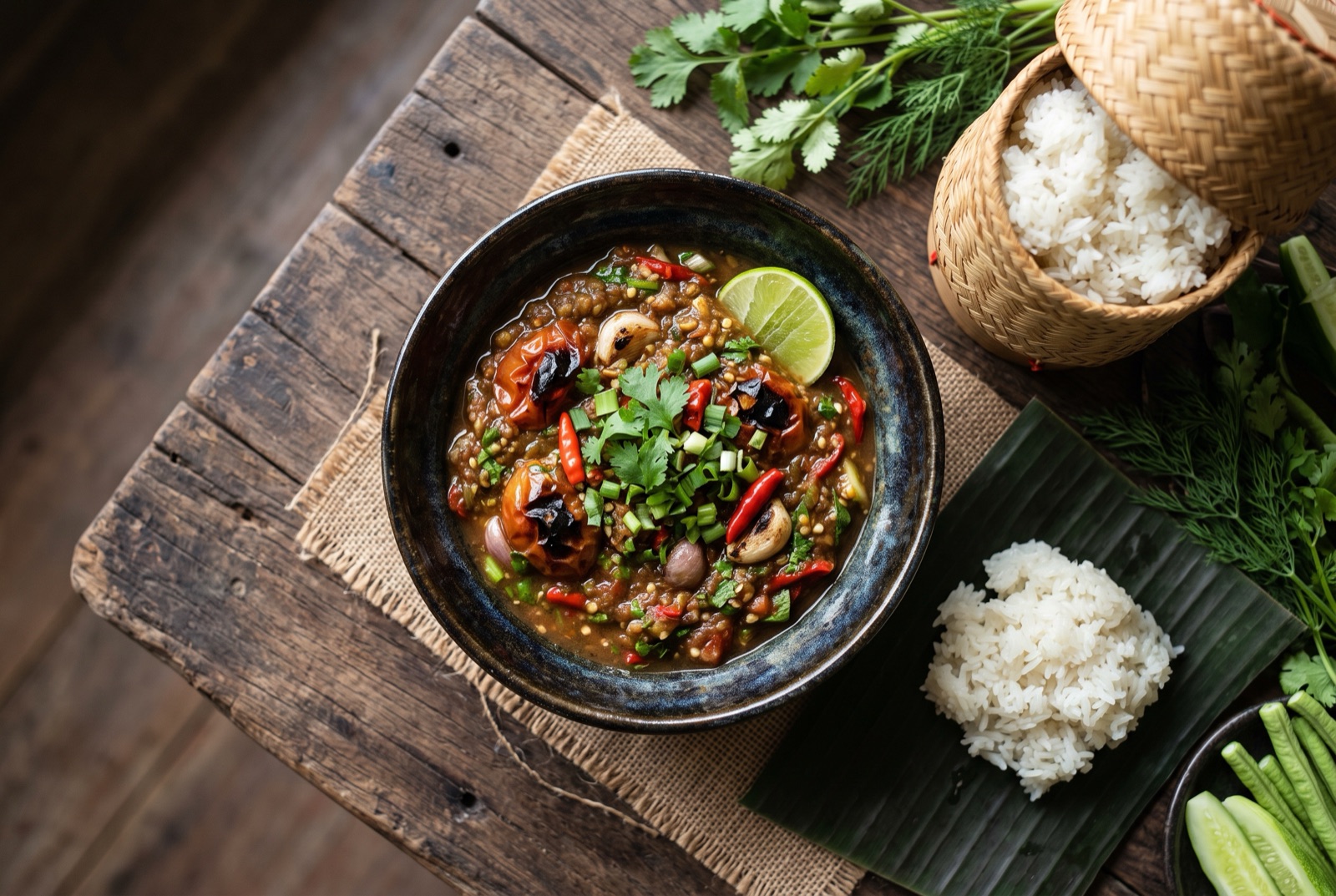
Jeow mak len is a smoky tomato dip, and it exists because sticky rice needs something to be dipped into. Whole tomatoes, unpeeled garlic, shallots and chiles go straight onto a flame or into a dry pan until their skins blacken and split, then everything is peeled and pounded in a mortar with fish sauce, lime and coriander into a rough, chunky sauce. It is not a salsa and not a chutney: it is looser than the first, less sweet than the second, and dominated by char. Ten minutes of work, four ingredients you already have, and it turns a plain basket of rice into a meal.

- Gate
- LaosNationwide
- Prep
- 5 min
- Cook
- 15 min
- Total time
- 20 min
- Serves
- 6
- Status
- Easy
- Nutrition / serving · estimated
- Calories 45 kcal
- Protein 2 g
- Carbs 8 g
- Fat 0 g
- Fiber 2 g
- Sugar 5 g
- Sodium 620 mg
Why this recipe works.
- Chars the vegetables directly over flame rather than roasting them, which is the difference between jeow and a tomato sauce.
- Pounds rather than blends, so the dip stays chunky enough to cling to a lump of sticky rice.
- Seasoned to be eaten with plain rice, not straight off the spoon — the salt level is deliberate.
- Ready in fifteen minutes from four things most kitchens already have.
Ingredients.
9 itemsTo char
For the dip
Equipment
- Gas burner with tongs, or a heavy dry pan
- Mortar and pestle
- Small bowl for serving
Instructions.
Char the aromatics
Set the unpeeled garlic, shallots and chiles directly on a gas burner grate or in a dry heavy pan over high heat. Turn them with tongs for 5–6 minutes, until the skins are blistered and blackened in patches and they smell sweet and smoky. Remove and set aside.
Tip Chiles blacken fastest — pull them a minute or two before the rest.
Char the tomatoes
Char the whole tomatoes the same way for 8–10 minutes, turning, until the skins split, blister and go black in places and the flesh has visibly slumped. Some juice will run and that is fine.
Peel and prep
Squeeze the garlic and shallots out of their skins. Slip most of the tomato skins off but leave a few blackened pieces in — they carry the smoke. Discard the chile stems.
Pound the base
Pound the chiles, garlic, shallots and salt in a mortar until they collapse into a rough, wet paste with no whole cloves remaining, about a minute of firm work.
Add the tomatoes
Add the charred tomatoes a couple at a time and pound with lighter strokes, turning the mixture from the bottom, until you have a chunky sauce with visible pieces of tomato rather than a smooth purée.
Tip Chunky is functional, not rustic styling — smooth jeow slides off sticky rice.
Season and finish
Stir in the fish sauce and lime juice, then fold through the coriander and spring onion. Taste it on a pinch of plain rice and adjust the salt and chile from there.
Serve at the table
Spoon into a small bowl and set it in the middle of the table with a basket of sticky rice, grilled meat and a plate of raw vegetables for dipping. Serve at room temperature, not chilled.
Tips from our kitchen.
- Leave the skins on everything while charring. The blackened skin on tomato, garlic and shallot is where the smoke comes from, and it peels away easily afterwards.
- If you have a gas hob, char directly on the burner grate with tongs — it is faster than any pan and gets closer to the coal-roasted original.
- Peel the garlic and shallots but leave some blackened flecks of tomato skin in; they carry flavour that fully peeled tomatoes lose.
- Pound the chiles and garlic first with salt so they break down, then add the soft tomatoes, or the garlic stays in raw lumps.
- Keep it chunky. A blender turns jeow into thin soup that slides straight off the rice instead of clinging to it.
- Taste it on a pinch of plain rice rather than alone — on its own it will always seem too salty and too hot.
Substitutions.
- Open flame charring → A dry cast-iron pan over high heat, turning until blackened in patches
- Slower and slightly less smoky, but it works. An oven grill is the third choice and gives the mildest result.
- Fish sauce → Light soy sauce plus a pinch of salt
- Makes the dip vegan. It loses some savoury depth, so add a little more lime and a scrap of charred spring onion to compensate.
- Bird's eye chiles → Red serrano or Fresno chiles, or dried chile flakes toasted in the pan
- Use roughly twice the volume of the larger, milder chiles, and remember that charring softens their heat noticeably.
Variations.
- Jeow mak keua
- The eggplant version, made by charring whole aubergines until collapsed, then pounding the smoky flesh with the same aromatics. Softer and creamier.
- Jeow bong
- The Luang Prabang speciality: a dark, sweet-hot paste of dried chile, galangal and strips of dried buffalo skin, cooked down and jarred.
- Jeow mak len with padaek
- A funkier version with a spoonful of fermented fish sauce pounded in, which deepens the dip considerably and takes it further from a salsa.
Storage & reheating.
Jeow mak len keeps 4 days refrigerated in a sealed jar and the flavour deepens after the first day as the char settles into the tomato. Bring it back to room temperature before serving; straight from the fridge it tastes flat and the smoke goes muted. It does not freeze well, since the tomatoes weep on thawing and the texture turns watery. If it separates in the jar, just stir it back together — that is normal for a pounded dip with no emulsifier.
Serve with
Sticky rice, first and foremost — the dip exists to be scooped with it Grilled chicken or pork, raw cabbage, cucumber, long beans and blanched greens
The story behind Jeow Mak Len.
Jeow is a whole category rather than a single recipe. Every Lao table has one, and the word covers dozens of dips: jeow bong with dried buffalo skin and chile from Luang Prabang, jeow padaek built on fermented fish, jeow som the thin sour one served with grilled meat, jeow mak keua made with charred eggplant. What they share is a method. Something is burnt whole in the fire, peeled, and pounded with chile, garlic and fish sauce until it is chunky enough to cling to a lump of rice.
The charring is the entire technique and rewards being taken seriously. Blackened skin is not a mistake to be minimised; it is the flavour. Tomatoes roasted in an oven give a sweet, concentrated sauce that tastes fine and tastes nothing like jeow, because what is missing is the acrid, smoky bitterness of skin cooked directly on coals. In Lao kitchens the vegetables sit in the embers of the same fire that grilled the chicken, which is efficient and also why the dip so often carries a faint memory of whatever was cooked before it.
What jeow does at a Lao meal is act as the seasoning for the rice. Because sticky rice is eaten plain and by hand, nothing is poured over it — the intensity has to come from something on the side, concentrated enough that a fingertip-sized dab flavours a whole mouthful. That explains why jeow is salty and hot out of proportion to its volume, and why tasting it alone off a spoon can be alarming. Judge it the way it is eaten: on rice, with grilled meat and raw vegetables, where it stops being a fierce condiment and starts being the thing that ties the table together.
Questions, answered.
What is jeow?
Jeow is the Lao word for a family of dipping sauces eaten with sticky rice. Most are made by charring vegetables whole over fire, then pounding them in a mortar with chile, garlic and fish sauce. Common versions use tomato, eggplant, fermented fish or dried chile, and at least one appears on almost every Lao table.
Can I roast the vegetables in the oven instead of charring them?
You can, but the result is a different sauce. Oven roasting concentrates sweetness without producing the acrid smoky note of skin cooked directly on flame, which is the defining flavour of jeow. If the oven is your only option, use the top grill at maximum heat and let the skins genuinely blacken rather than merely brown.
How spicy should jeow mak len be?
Quite hot by design, because it is eaten in tiny amounts with large mouthfuls of plain sticky rice. Four to six bird's eye chiles for this quantity is normal in Laos. If you are unsure, start with two, taste it on a pinch of rice rather than alone, and pound in more chile from there.
Is jeow mak len the same as salsa?
They look similar and both are pounded or chopped tomato with chile, but the flavour profiles differ. Jeow is built on char and fish sauce, with no raw onion, no coriander seed and no vinegar, and it is saltier because it seasons plain rice. Mexican salsa asada made with fire-roasted tomatoes is its closest relative.
Can I make it vegan?
Yes. Replace the fish sauce with light soy sauce and a pinch of salt, and add a little extra lime juice. A charred spring onion pounded in helps replace some of the savoury depth. Everything else in the dip is already plant-based, and the char does most of the flavour work regardless.
You might also like.
All recipes →
Keep exploring Laos.
Laos has 9 more dishes in the atlas — Khao Piak Sen and Khao Poon, and 7 more.
All Laos recipes Tomato recipes Garlic recipes Fish sauce recipes sauceappetizerdairy freegluten freeRecipe by The DishRoute Kitchen · published August 20, 2026 · updated August 20, 2026