Louvi me Lahana.
Cypriot Black-Eyed Peas with Chard
Λούβι με λάχανα · say it: LOO-vee meh LAH-hah-nah
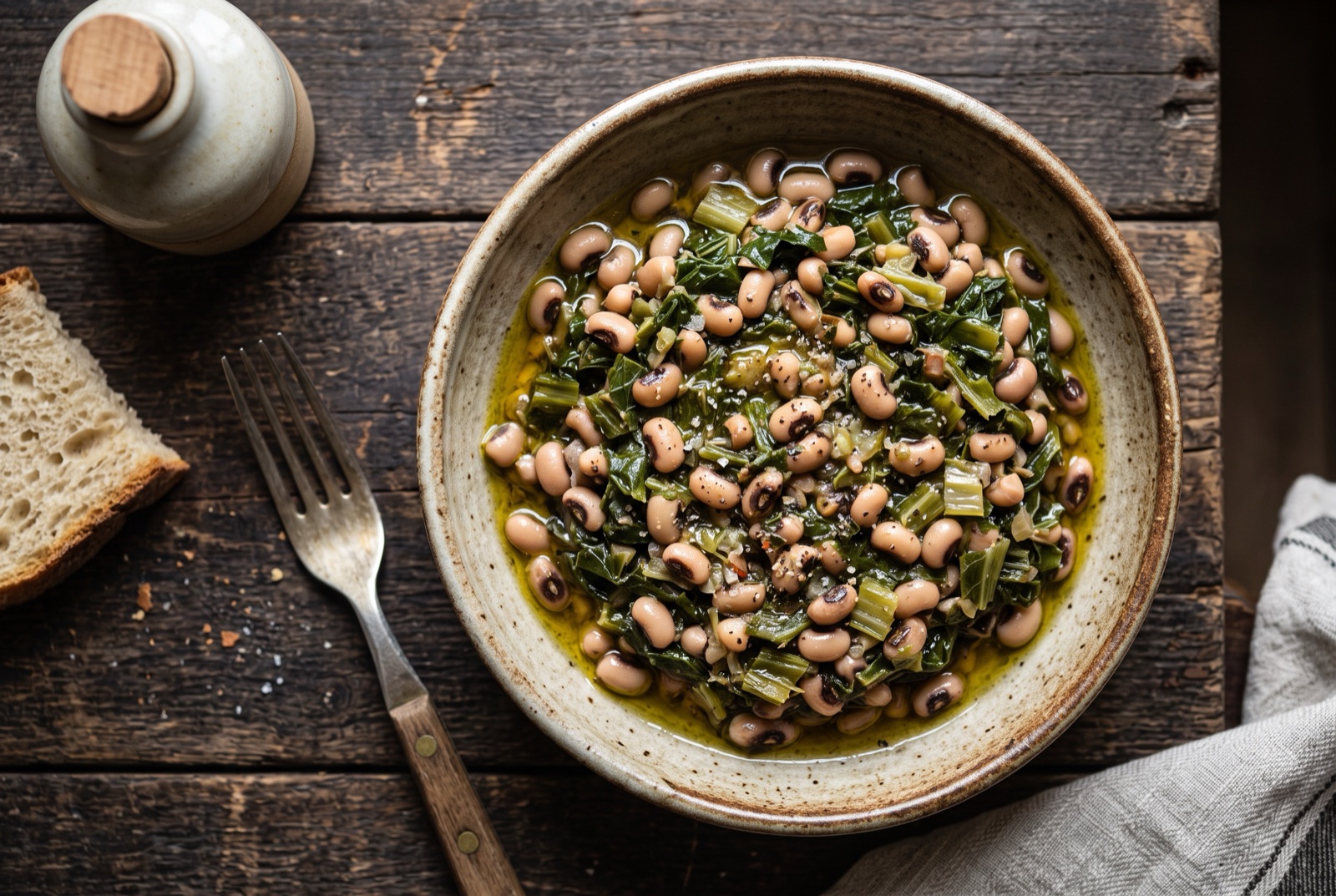
Louvi me lahana is boiled black-eyed peas and greens, dressed at the table with far more olive oil and lemon than seems reasonable, and eaten warm or at room temperature rather than hot. There is no stock, no onion frying, no spice: the peas cook in plain water with the chard thrown in near the end, and all the flavour comes from the quality of the oil and the sharpness of the lemon. What makes it work is texture — the peas break slightly at the edges and thicken the little liquid that remains, while the chard stems stay just short of collapsing. It is fasting food, weeknight food and hangover food, and it costs almost nothing to make.

- Gate
- Cyprus
- Prep
- 15 min
- Cook
- 45 min
- Total time
- 1 hr 20 min incl. 20 min rest
- Serves
- 4
- Status
- Easy
- Nutrition / serving · estimated
- Calories 380 kcal
- Protein 17 g
- Carbs 42 g
- Fat 16 g
- Fiber 12 g
Why this recipe works.
- Salts the peas at the right moment so they end up creamy rather than split or stubbornly firm.
- Adds the chard stems and leaves separately, which is the difference between distinct texture and green sludge.
- Dresses the dish warm and rests it, the way it is actually served in Cyprus, rather than serving it hot from the pot.
- Naturally vegan, gluten-free and cheap, with no substitutions pretending to be something they are not.
Ingredients.
7 itemsTo serve
Equipment
- Large saucepan
- Colander
- Sharp knife
Instructions.
Blanch and drain the peas
Rinse the black-eyed peas, cover them generously with cold water in a large pan and bring to a boil. Let them bubble for five minutes, then drain and discard the water, which will have gone cloudy and grey. This removes the raw, faintly bitter edge dried peas carry.
Simmer until creamy
Return the peas to the pan with fresh water to cover by about 4 cm and simmer, partly covered, for 30 to 35 minutes. They are ready when a pea squashes to a paste between your fingers with no chalky centre and some of the skins have begun to loosen.
Tip Top up with hot water if the level drops below the peas, but keep it tight — you want a small amount of starchy liquid at the end, not soup.
Add the chard in two stages
Cut the chard stems into 3 cm lengths and stir them in for six minutes, then add the roughly torn leaves and the salt and cook another two minutes, until the leaves have wilted to dark green and the stems still hold a slight bite.
Drain, but not completely
Tip most of the cooking water off, leaving about 100 ml in the pan clinging around the peas. That starchy liquid is what carries the oil and lemon; drained bone dry, the dish tastes bare and refuses to come together.
Dress off the heat
Take the pan off the heat and pour in the olive oil and most of the lemon juice, turning everything gently so the peas glisten and the liquid emulsifies slightly against the starch. Grind in black pepper and taste — it should be assertively lemony, because that will soften as it sits.
Rest and serve at room temperature
Leave it for 20 minutes off the heat before serving so the oil soaks in and the flavours settle. Spoon into shallow bowls, add the remaining lemon juice to taste, scatter the raw onion slices if using, and pour a final thread of olive oil over each portion.
Tips from our kitchen.
- Black-eyed peas do not need soaking, unlike chickpeas. A 30-minute soak shortens cooking slightly but skipping it costs you nothing.
- Give them a first boil of five minutes and discard that water. It removes the raw, slightly bitter note and is what every Cypriot cook does.
- Salt only in the last ten minutes. Salted early, the skins toughen and some peas stay hard however long you cook them.
- Separate the chard stems from the leaves: stems go in six minutes before the leaves, which need barely two.
- Use more olive oil than feels correct — around 60 ml for four people, added off the heat so its flavour survives.
- Leave 100 ml or so of cooking liquid in the pot. That starchy water plus the oil and lemon is the sauce; drain it dry and the dish is bare.
Substitutions.
- Chard → Spinach, wild greens, beet tops, mustard greens or kale
- Spinach needs barely a minute; kale needs ten. Cypriot cooks use whatever is in season, so treat the green as a variable, not a rule.
- Dried black-eyed peas → Tinned black-eyed peas, drained and rinsed
- A real time saver: cook the greens in lightly salted water, then warm the tinned peas through for five minutes. The texture is softer and the cooking liquid thinner, so use a little less lemon.
- Lemon juice → Red wine vinegar
- Used in some villages and perfectly traditional. Vinegar is sharper, so start with two-thirds the quantity and taste.
Variations.
- Louvi me kolokassi
- Made with taro root instead of greens — chunks of kolokasi cooked alongside the peas until starchy and soft. Heavier, more filling, and a winter version rather than a summer one.
- Fresh pod louvia
- In early summer, young black-eyed peas are cooked in their whole pods, cut into short lengths. Cooking time drops to about 20 minutes and the result is sweeter and greener.
- Louvi with tomato and onion
- A less austere version where sliced onion and grated tomato are softened in oil before the peas go in. Not the fasting-day original, but common on family tables outside Lent.
Storage & reheating.
Louvi keeps 4 days refrigerated and genuinely improves on the second day, once the oil and lemon have fully penetrated the peas. Bring it back to room temperature before serving rather than reheating — the fridge dulls the olive oil and mutes the lemon. If it has tightened up, loosen with a splash of water and refresh with a little more oil and a new squeeze of lemon. It does not freeze well: the peas go mealy and the chard turns to threads.
Serve with
Fried salt cod or grilled halloumi, a wedge of lemon, sliced raw onion and plenty of bread for the oil at the bottom of the bowl.
The story behind Louvi me Lahana.
The Orthodox fasting calendar shaped Cypriot everyday cooking more than any single ingredient did. For something close to half the year — the Lenten weeks, the fasts before Christmas and the Dormition, and most Wednesdays and Fridays — meat, dairy, eggs and often fish are off the table. What fills that gap is a repertoire of boiled pulses and wild greens finished with oil and lemon, dishes that were vegan long before anyone in the Mediterranean used the word and that never carried the apologetic tone of substitute food. Louvi is the most common of them.
Black-eyed peas, called louvia in Cyprus, are grown across the island and eaten both fresh in their pods in early summer — louvia me to loudzi, cooked pod and all — and dried through the rest of the year. The greens vary with the season and the household. Chard is the reliable cultivated option, but the traditional partner is whatever is growing wild: mustard greens, wild fennel, sow thistle, or the amaranth greens known locally as vlita. Foraging for greens is still a real activity in Cypriot villages rather than a nostalgic one, and the mix genuinely changes the dish month to month.
What surprises visitors is that it is not served hot. Like a great many Mediterranean vegetable dishes, louvi is considered better after it has sat for half an hour — long enough for the oil to soak in and the lemon to stop being a surface note. Restaurants keep it at room temperature on the meze table all day. Reheating it to steaming is not exactly wrong, but Cypriots would look at you oddly.
The accompaniment is fixed by tradition: fried or grilled salt cod on fast days when fish is permitted, or a piece of grilled halloumi and a tomato when it is not. Either way there is bread, and the last of the oily lemony liquid at the bottom of the bowl is mopped up rather than left.
Questions, answered.
Do black-eyed peas need soaking overnight?
No. Unlike chickpeas or large white beans, black-eyed peas have thin skins and cook from dry in 35 to 45 minutes. A short soak of half an hour shaves a little time off but makes no difference to the finished texture, which is why most Cypriot cooks skip it entirely.
Why are my peas still hard after 45 minutes?
Two usual causes: salt added at the start, which toughens the skins, or old dried peas that have been in the cupboard for a year or more. Add salt only in the last ten minutes, and if the peas are simply ancient, keep simmering — they will get there eventually, but buy fresher stock next time.
Should louvi be served hot or cold?
Warm or at room temperature, not hot. This is standard for Mediterranean oil-dressed vegetable dishes: the olive oil tastes flat when steaming and much better once it has cooled a little and soaked into the peas. Cypriot tavernas keep it at room temperature on the meze table all day.
Can I use tinned black-eyed peas?
Yes, with an adjustment. Cook the chard in lightly salted water for six to eight minutes, then add the drained, rinsed peas and warm through for five minutes so they take on some of the green flavour. The cooking liquid will be thinner than with dried peas, so hold back slightly on the lemon.
What greens are traditional if I cannot get chard?
Almost anything leafy and slightly bitter. In Cyprus the greens are often foraged — wild mustard, sow thistle, wild fennel or amaranth tops — and change with the season. Spinach, beet tops, kale or even young dandelion leaves all work; just adjust the cooking time to the toughness of the leaf.
You might also like.
All recipes →
Keep exploring Cyprus.
Cyprus has 9 more dishes in the atlas — Afelia and Daktyla, and 7 more.
All Cyprus recipes Olive oil recipes Lemon recipes sidemainveganvegetariangluten freedairy freenut freeRecipe by The DishRoute Kitchen · published August 20, 2026 · updated August 20, 2026