Daktyla.
Cypriot Almond-Filled Pastry Fingers in Syrup
Δάκτυλα · say it: DAHK-tee-lah
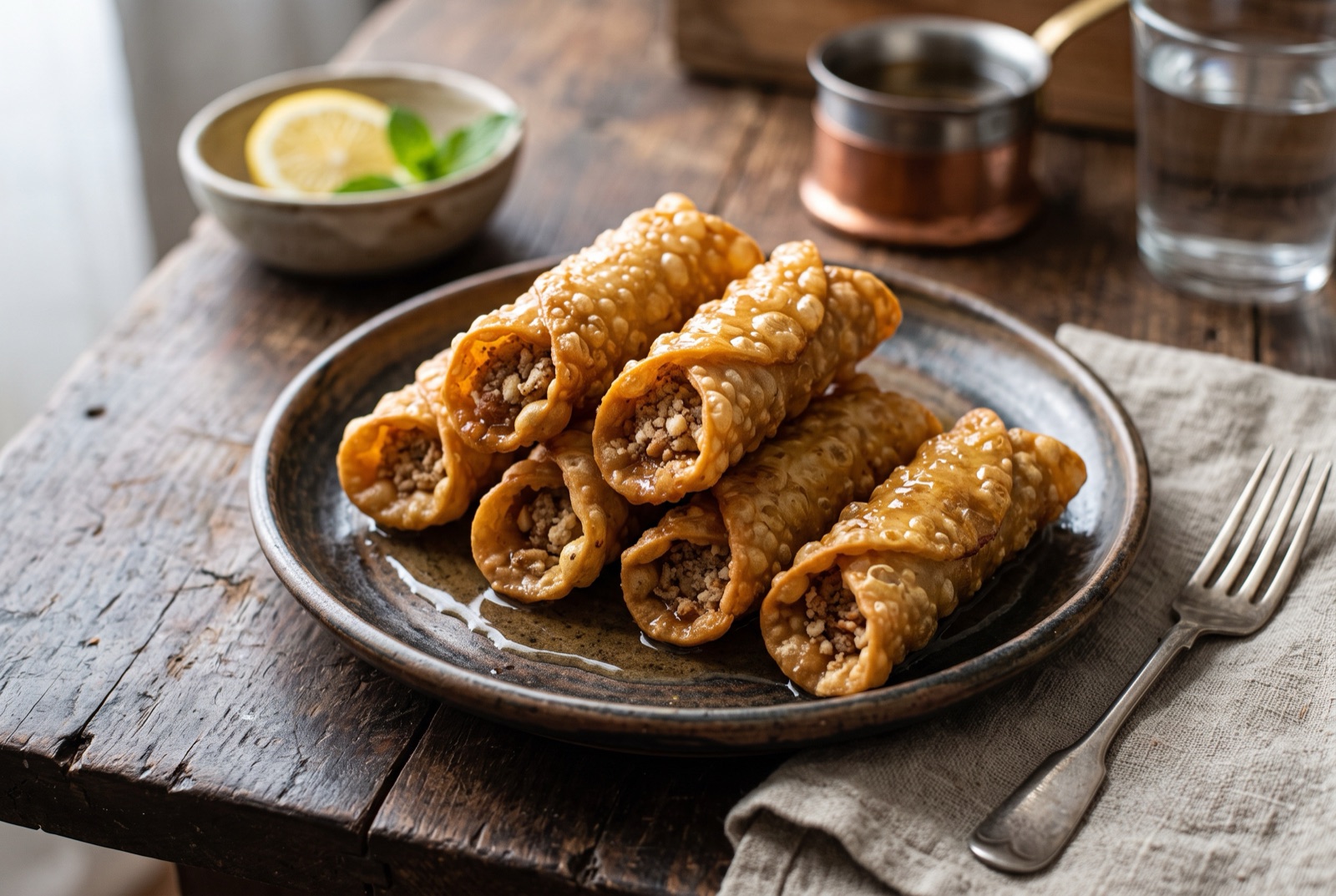
Daktyla are fried pastry cylinders about the length of a finger — the name means fingers, and they are usually called ladies' fingers in English — filled with coarsely ground almonds, sugar, cinnamon and rosewater. The dough is unenriched and rolled very thin, so frying blisters it into a shattering, bubbled shell rather than anything bready. Straight out of the oil they go into cold lemon syrup, which is the trick: the temperature difference pulls syrup into the pastry fast while the crust is still rigid enough to stay crisp. The result is crunchy outside, chewy and perfumed inside, and sticky everywhere. They are made for weddings, Christmas and any occasion with more than ten people at the table.

- Gate
- Cyprus
- Prep
- 45 min
- Cook
- 30 min
- Total time
- 1 hr 45 min incl. 30 min rest
- Serves
- 10
- Status
- Medium
- Nutrition / serving · estimated
- Calories 430 kcal
- Protein 7 g
- Carbs 58 g
- Fat 19 g
- Fiber 3 g
- Sugar 38 g
Why this recipe works.
- Uses the hot-pastry-into-cold-syrup rule that decides whether daktyla stay crisp or turn to mush.
- Rolls the dough thin enough to blister rather than puff into a bready tube.
- Grinds the almonds coarsely so the filling has texture instead of turning to sweet paste.
- Gives a syrup with enough lemon to stop the whole thing being flatly sweet, and tells you when to stop cooking it.
Ingredients.
16 itemsFor the dough
For the filling
For the syrup
To fry
To finish
Equipment
- Deep pan or fryer with a thermometer
- Rolling pin or pasta machine
- Slotted spoon
- Wire rack over a tray
Instructions.
Make the syrup first
Bring the sugar, water, lemon peel and cinnamon stick to a boil, then simmer for 8 to 10 minutes until the syrup coats the back of a spoon in a thin film. Stir in the lemon juice, take it off the heat and leave it to cool completely — it must be cold when the pastries come out of the oil.
Tip Do not reduce it further. A thick syrup sits on the surface instead of soaking in, and crystallises within a day.
Mix and rest the dough
Rub the oil into the flour, sugar and salt, then add the warm water and knead for five minutes until smooth and soft but not sticky. Cover and rest for 30 minutes — the dough should stretch without springing straight back when you pull a corner.
Prepare the filling
Chop the almonds coarsely, leaving plenty of pieces the size of a grain of rice, and mix with the sugar, cinnamon, orange zest and rosewater. Squeezed in your hand it should just clump together; if it is dry and loose, add a teaspoon of water.
Roll and cut
Roll the dough out as thin as you can manage, about 1–2 mm, so you can see the shadow of your hand through it. Cut it into rectangles roughly 8 by 12 cm — work with a quarter of the dough at a time and keep the rest covered so it does not skin over.
Fill and roll into fingers
Lay a heaped teaspoon of filling along the short edge of each rectangle, fold the long sides in over the ends of the filling, then roll up tightly into a finger. Brush the last centimetre with water and press the seam closed, then set them seam-side down on a tray.
Tip Pinch the ends firmly too — filling escapes from the tips before it escapes from the seam.
Fry in batches
Heat the oil to 170°C and fry six or seven at a time for 3 to 4 minutes, turning once, until the surface has blistered into pale bubbles and turned deep gold. Do not crowd the pan — the temperature drops and the pastry absorbs oil instead of crisping.
Dunk in cold syrup
Lift each batch straight from the oil, drain for a few seconds, then submerge in the cold syrup for about 30 seconds, turning once. You should hear them hiss and see bubbles rising as the syrup is drawn in. Lift out onto a wire rack set over a tray.
Finish and cool
Roll them in toasted sesame seeds while still tacky, if using, and leave on the rack until completely cool and no longer dripping. Only then pack them into a tin, layered with parchment. They are good immediately and better after a day.
Tips from our kitchen.
- Make the syrup first so it is completely cold by the time the first batch comes out of the oil. This is not a step you can improvise later.
- Roll the dough to 1–2 mm — thin enough to see the shadow of your hand through it. Thick dough fries into a doughy tube instead of a blistered shell.
- Chop or pulse the almonds coarsely, leaving some pieces the size of a grain of rice. Ground to flour they make a dense paste.
- Seal the seam with a wet fingertip and lay the rolls seam-side down. Any gap lets syrup flood inside and the filling washes out.
- Keep the oil at 170°C. Hotter and the outside colours before the dough has blistered; cooler and the pastry drinks oil.
- Dunk for about 30 seconds only, then lift onto a rack. Left sitting in the syrup they soften right through within a few minutes.
Substitutions.
- Almonds → Walnuts, or half almonds and half pistachios
- Walnuts are common in Greek versions and give a softer, oilier filling. Pistachios look striking but are sweeter, so cut the sugar in the filling slightly.
- Rosewater → Orange blossom water, or the grated zest of an orange
- Both are used in Cypriot households. Orange blossom is more floral and citrusy; plain zest is the safest option if you find floral waters soapy.
- Deep frying → Brush with oil and bake at 190°C for 20–25 minutes
- Considerably lighter, and honestly not the same — baked daktyla are crisp but never develop the blistered, bubbled shell that frying gives.
Variations.
- Sesame-rolled daktyla
- Rolled in toasted sesame seeds straight out of the syrup while still sticky. Adds a nutty crunch and stops them gluing together in the tin.
- Honey syrup version
- Half sugar syrup, half thyme honey, added off the heat so the honey does not scorch. Darker, more floral and noticeably heavier.
- Kataifi daktyla
- The same almond filling wrapped in shredded kataifi pastry instead of thin dough, then baked rather than fried. Crisper and messier, and common at Cypriot bakeries.
Storage & reheating.
Daktyla keep 2 weeks in an airtight tin at room temperature and are not refrigerated — the fridge makes the pastry damp and dulls the crunch. Layer them with baking parchment so they do not stick, and do not seal the tin until they are completely cold and have stopped dripping. They do not freeze usefully: the syrup crystallises on thawing and the shell loses its bubble. If they soften after a week, five minutes in a 160°C oven brings some crispness back.
Serve with
Cypriot coffee served sketo — without sugar — or a small glass of Commandaria. The pastries are sweet enough that anything sweet alongside them is too much.
The story behind Daktyla.
Daktyla sit in the enormous family of eastern Mediterranean nut-filled pastries drenched in syrup — a category that runs from baklava through Turkish şekerpare and Levantine znoud el sit, and whose origins are genuinely contested rather than politely disputed. Almost every claim about who invented syrup pastries is disputed by at least three neighbouring cuisines, and the honest answer is that the technique spread and localised across the Ottoman world over centuries rather than being invented in one place. What Cyprus contributes here is the specific combination: almonds rather than walnuts or pistachios, rosewater rather than orange blossom, and a rolled fried cylinder rather than layered baked phyllo.
The pastries have a defined social function. Along with loukoumia and other syrup sweets, daktyla are wedding food, made in enormous quantities by the women of both families in the days before the ceremony and handed out to guests. That production context explains the shape: cylinders rolled from small squares of dough are fast to assemble in an assembly line, and they fry in batches and keep for weeks in syrup, which matters when you are making six hundred.
Almonds are the traditional filling because Cyprus grows them, particularly in the villages around Pafos and the Troodos foothills, and because ground almonds hold a firm, slightly chewy texture inside the pastry that walnuts do not. Rosewater is the standard perfume, though some families use orange blossom water, and cinnamon appears in almost every version. The syrup is lemon-sharpened sugar syrup rather than honey — honey burns and clouds when reheated for a large batch, and the plainer syrup lets the almond and rosewater carry the flavour.
The technique everyone gets wrong the first time is the temperature contrast. Hot pastry must go into cold syrup, or cold pastry into hot syrup — never hot into hot, which produces a soggy, collapsed sweet. Cypriot cooks make the syrup first and let it chill completely while the frying is under way, then dunk each batch for a count of about thirty seconds and lift it out onto a rack.
Questions, answered.
Why did my daktyla go soggy?
Almost certainly a temperature problem. Hot pastry must meet cold syrup, or cold pastry hot syrup — hot into hot means the pastry absorbs syrup uncontrollably and collapses. Make the syrup well in advance so it is properly chilled, and dunk each fried batch for only about 30 seconds before lifting them onto a rack to drain.
Can I bake daktyla instead of frying them?
Yes — brush them with oil and bake at 190°C for 20 to 25 minutes until golden. They will be crisp and pleasant, but you will not get the blistered, bubbled shell that hot oil creates in thin dough. If you bake them, roll the dough very slightly thicker so it does not dry out and crack.
Why is my filling leaking out during frying?
The seam was not sealed or the rolls were overfilled. Use no more than a heaped teaspoon of filling per finger, brush the far edge with water before the final roll, press the seam firmly and lay each one seam-side down on the tray. Pinching the ends closed also helps, since filling escapes from the tips first.
How long does the syrup need to cook?
About 8 to 10 minutes at a steady simmer, until it has thickened slightly and coats the back of a spoon in a thin film. Do not reduce it to a heavy syrup — thick syrup will not penetrate the pastry and instead sits on the outside as a sticky coating that crystallises within a day.
Can I make daktyla ahead for a party?
They are designed for it. Made properly they keep two weeks in a tin and many Cypriots consider them best after two or three days, once the syrup has fully settled into the pastry. Make them at least a day ahead, store them in a single layer or with parchment between layers, and do not refrigerate.
You might also like.
All recipes →
Keep exploring Cyprus.
Cyprus has 9 more dishes in the atlas — Afelia and Flaounes, and 7 more.
Recipe by The DishRoute Kitchen · published August 20, 2026 · updated August 20, 2026