Rēwena Parāoa.
Māori Potato Sourdough Bread
Rēwena parāoa · say it: REH-weh-nah pah-RAH-oh-ah
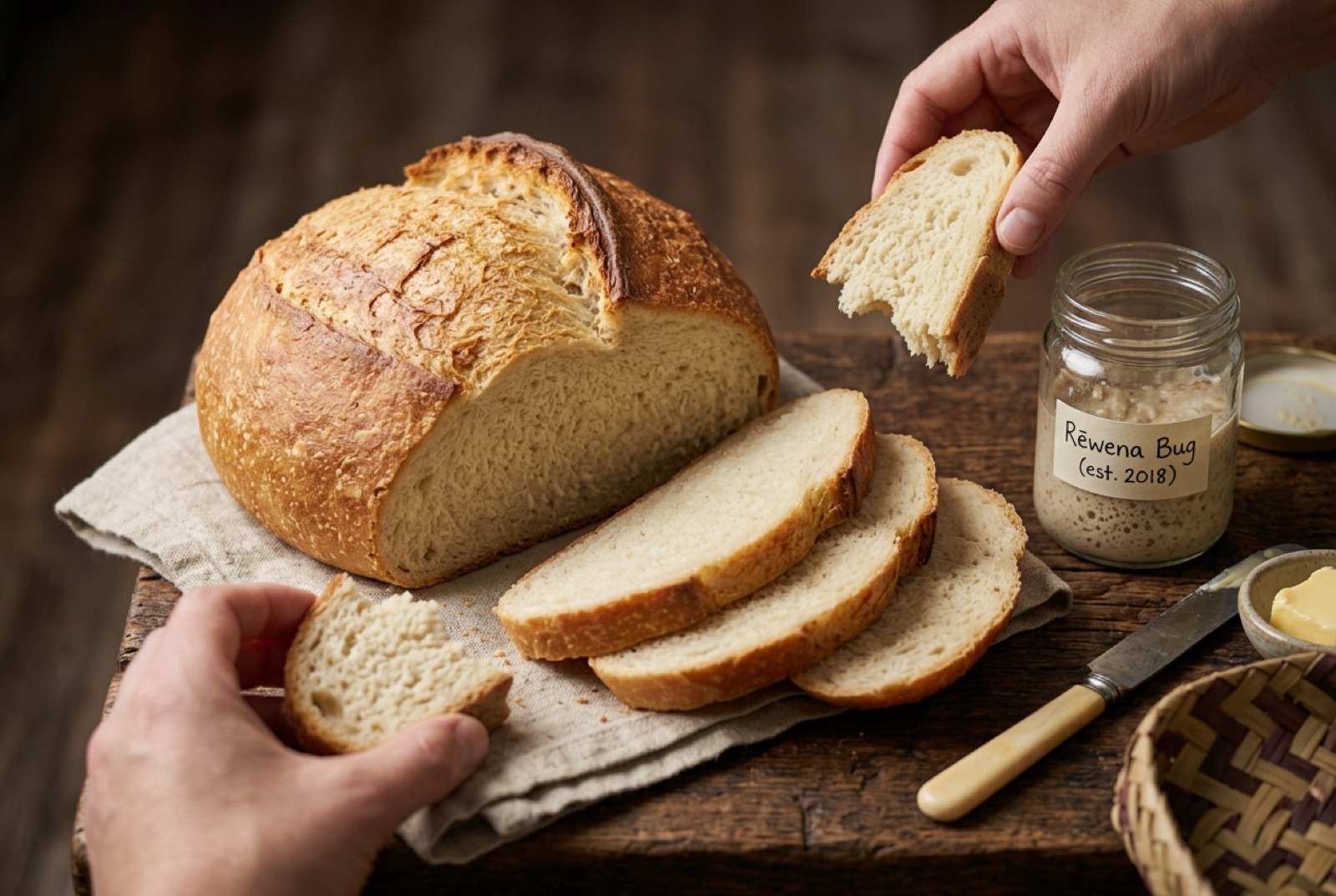
Rēwena parāoa is Māori potato sourdough: a plain white loaf leavened not with packet yeast but with a fermented potato starter, the rēwena bug, kept alive on a bench for years and fed with potato and sugar. The crumb is close and slightly chewy rather than airy, the crust bakes to a hard mid-brown, and the flavour is gently sour with a background sweetness from the potato. Warm from the oven with cold butter it is one of the best breads in the country, and it is the traditional partner for boil up and hāngī. Making it takes patience twice over: three or four days to raise a bug from scratch, then a slow rise on baking day.

- Gate
- New ZealandMāori communities nationwide
- Prep
- 40 min
- Cook
- 45 min
- Total time
- 6 hr 25 min incl. 5 hr rest
- Serves
- 10
- Status
- Takes skill
- Nutrition / serving · estimated
- Calories 240 kcal
- Protein 7 g
- Carbs 50 g
- Fat 1 g
- Fiber 2 g
- Sodium 400 mg
Why this recipe works.
- Builds the rēwena bug from scratch with day-by-day signs of what a healthy ferment looks like.
- Gives a realistic proving window and explains what over-proved rēwena tastes like so you can catch it.
- Uses a hot start with steam to get the hard, dark crust that a proper loaf has.
- Tells you how to keep, feed and revive the bug afterwards, which is most of what people actually want to know.
Ingredients.
9 itemsThe bug (starter)
The dough
Equipment
- Large glass or ceramic jar for the bug
- Wooden spoon
- Large mixing bowl
- Cast-iron pot or heavy baking tray
Instructions.
Start the bug (day one)
Boil the diced potatoes in the water until soft, then mash them into their cooking liquid and cool to lukewarm. Stir in the flour and sugar with a wooden spoon, pour into a glass jar, cover loosely with a cloth and leave in a warm spot.
Feed and watch (days two to four)
Each day stir the bug and add a teaspoon of sugar. By day three or four it should be bubbling across the surface, roughly doubled, and smelling sour and beery — that is a live bug and it is ready to bake with.
Tip A grey liquid on top is normal; stir it back in. A pink or orange tinge means throw it out and start again.
Mix the dough
Tip the flour into a large bowl, scatter over the salt and baking soda and make a well. Pour in the active bug and mix with your hands, adding warm water a little at a time until you have a soft, slightly tacky dough that pulls away from the bowl.
Knead until smooth
Knead on a floured bench for 10 minutes, until the dough turns from rough and shaggy to smooth and elastic and springs back slowly when pressed. Rēwena dough stays softer than yeasted bread dough — do not add flour to fight that.
Prove slowly
Shape into a round, sit it in an oiled bowl, cover and leave in a warm place for 3–5 hours, until roughly doubled and domed. Rēwena rises far more slowly than packet yeast, so judge by size and not the clock.
Bake with steam
Heat the oven to 220°C with a cast-iron pot inside. Turn the loaf into the hot pot, slash the top, cover and bake 25 minutes, then uncover and bake 20 minutes more until the crust is dark brown and the base sounds hollow when tapped.
Cool before cutting
Turn the loaf onto a rack and leave it at least 30 minutes. Cutting hot rēwena drags the close crumb into a gummy paste, and the sour flavour only settles properly as it cools.
Tips from our kitchen.
- Use plain white flour, not bread flour, for a first loaf. High-protein flour fights the modest lift a bug produces and gives a tight, tough crumb.
- The bug must be visibly active before you bake: bubbling on top, smelling sour and beery, and roughly doubled in the jar.
- Keep everything away from metal spoons and bowls where you can. Many Māori bakers insist on wood and glass for the bug, and it costs nothing to follow.
- Do not add salt directly into the bug. Salt slows the ferment and can stall a young starter completely.
- Rēwena rises far more slowly than yeasted bread — plan for three to five hours, not one, and judge by size rather than the clock.
- If the loaf smells sharply of acetone or vinegar before baking, the bug over-fermented. Feed it and wait a day rather than baking a harsh loaf.
Substitutions.
- Rēwena bug → An active wheat sourdough starter plus one mashed boiled potato in the dough
- Not the same bread, and it should not be called rēwena, but it gets you a similar potato-sweet sour loaf while your own bug develops.
- White sugar in the bug → Honey or raw sugar
- Both work. Honey ferments a little slower at first, so give a honey-fed bug an extra day to get going.
- Plain white flour → Half white and half wholemeal
- Wholemeal makes a denser, nuttier loaf and speeds up the ferment, so watch the prove more closely.
Variations.
- Rēwena in a camp oven
- Baked in a cast-iron camp oven buried in embers, which is how it was made before domestic ovens. Gives a much thicker, darker crust.
- Fried rēwena
- Slices of day-old loaf fried in butter or dripping until crisp — the standard breakfast use for bread past its best.
- Rēwena rolls
- The same dough shaped into individual rolls for a shorter bake, useful for feeding a big table at a hui.
Storage & reheating.
Rēwena keeps 3 days wrapped in a cloth at room temperature and stales faster than yeasted bread because of its low fat content. Never keep it in the fridge, which accelerates staling badly. It freezes well sliced for 2 months. The bug itself lives in a covered glass or ceramic jar on the bench, fed with mashed potato, flour and sugar every few days; in the fridge it can go a fortnight between feeds but needs two warm feeds to wake up before baking.
Serve with
Cold butter, boil up, or a bowl of hāngī juices to mop.
The story behind Rēwena Parāoa.
Wheat flour arrived in Aotearoa with European contact in the early nineteenth century, and Māori took to growing and milling it rapidly — by the 1840s there were Māori-owned flour mills and wheat was being traded and exported. What did not arrive reliably was commercial yeast, so bakers did what bakers everywhere do without it: they cultivated wild yeast. Potato provided the sugar and starch to feed it, and the rēwena bug became a fixture of Māori kitchens, passed between households and generations along with instructions on how to keep it happy.
The bug is treated a bit like a pet, and that is not a joke. It is fed, watched, talked about, and given away in jars; a strong one belonging to a particular kuia might have been going for decades. Nobody agrees on the details of feeding — some add sugar every few days, some only when baking, some insist on old potato water, some on new — and the arguments are conducted with warmth and total confidence on all sides. A bug that has gone flat can usually be revived with a fresh potato and a warm spot, which is worth knowing before anyone throws one out.
Rēwena has had a real revival. For decades it was mostly home baking, made for tangi, family gatherings and marae kitchens, and rarely sold. In recent years Māori bakers have put it into shops and markets and taken it seriously as a bread rather than as heritage, which has also brought back attention to technique — hydration, timing, how long to prove before the sourness turns harsh. The recipe below builds a bug from scratch, because that is the only honest way to start, and then bakes a standard round loaf the way it is done at home.
Questions, answered.
What is a rēwena bug?
The rēwena bug is a live starter made from mashed potato, flour, sugar and water, left to capture wild yeast and ferment. It is the leavening for rēwena bread, and it is kept alive indefinitely by regular feeding. Many Māori households have bugs that have been going for years and are shared between families.
How do I know when my bug is ready to bake with?
A ready bug is bubbling actively across the surface, has roughly doubled in volume since its last feed, and smells sour and yeasty like beer rather than sharply of alcohol or nail polish. If it smells like acetone it has gone too far and needs feeding and a day's rest before you use it.
Why is my rēwena dense and heavy?
Either the bug was not active enough, or the dough was not given long enough to rise. Rēwena leavens far more slowly than commercial yeast — three to five hours is normal — and it must roughly double before baking. Cold kitchens make it slower still, so find a warm spot.
Can I use packet yeast instead?
You can make a potato bread that way, and it will be perfectly nice, but it will not be rēwena. The character of the loaf comes from a slow wild ferment, which produces the sour note and the particular chewy crumb. Packet yeast produces a lighter, sweeter, entirely different bread.
Why do people say not to use metal with the bug?
It is a widely followed rule in Māori kitchens, usually explained as metal harming the bug. Reactive metals like unlined aluminium or copper genuinely can affect an acidic ferment, while modern stainless steel is inert and safe. Using wood and glass costs nothing and respects how the bread is normally made.
You might also like.
All recipes →



Keep exploring New Zealand.
New Zealand has 9 more dishes in the atlas — Afghan Biscuits and Boil Up, and 7 more.
Recipe by The DishRoute Kitchen · published August 20, 2026 · updated August 20, 2026