Afghan Biscuits.
New Zealand Cocoa Cornflake Biscuits
afghans · say it: AF-ganz
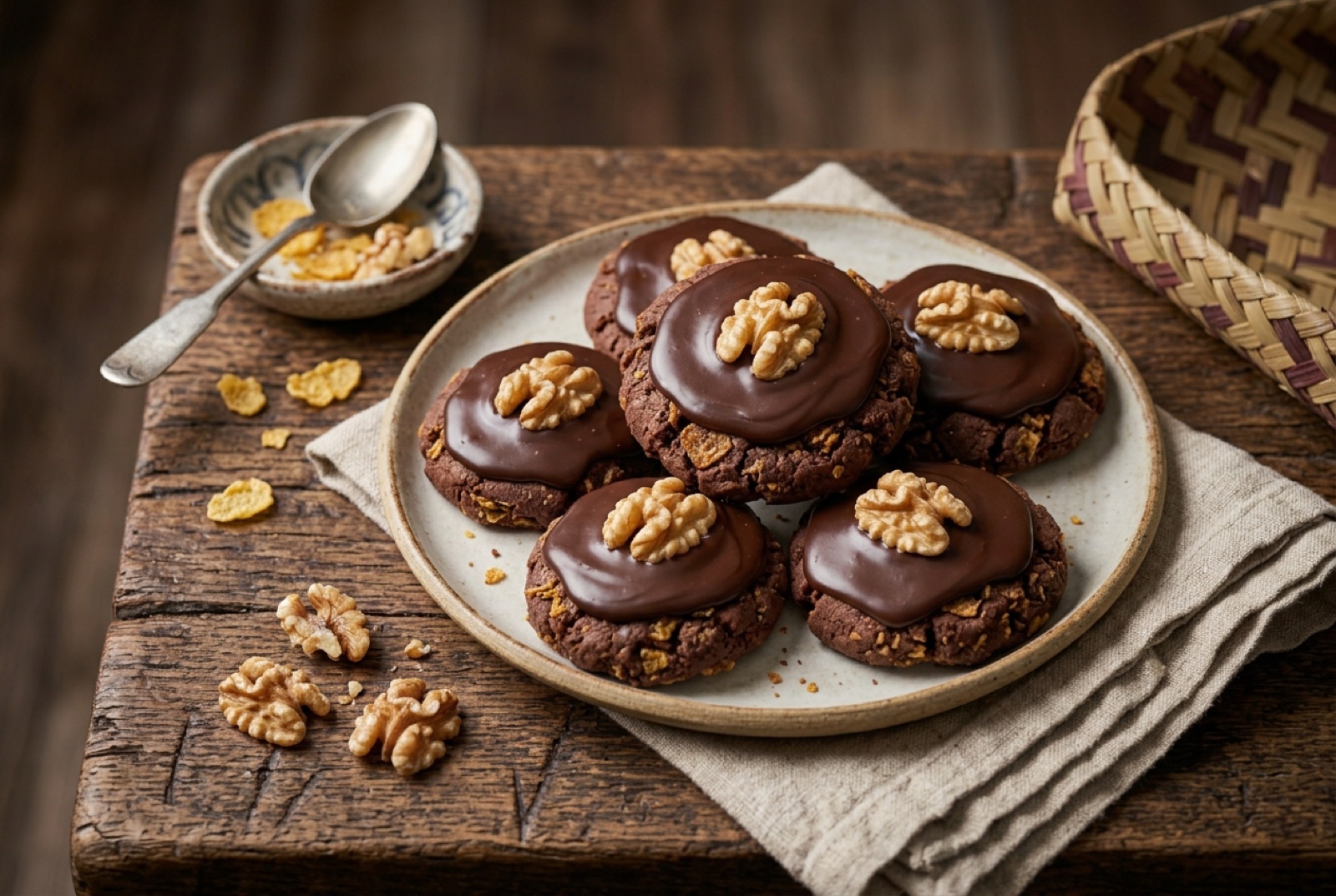
Afghans are a short, dense cocoa biscuit with crushed cornflakes worked through the dough, which gives them a crumbly, slightly crunchy texture unlike any other biscuit in the tin. The dough itself is only just sweet — the sugar arrives on top, as a soft chocolate icing spread thickly over each cooled biscuit and pressed with a walnut half. They barely spread in the oven, so whatever shape you put on the tray is the shape that comes out, and they are deliberately soft in the middle when they come out of the oven because they firm as they cool. Almost every New Zealand household has a version, and almost every version differs by a spoonful of something.

- Gate
- New ZealandNationwide home baking
- Prep
- 20 min
- Cook
- 15 min
- Total time
- 1 hr 5 min incl. 30 min rest
- Serves
- 24
- Status
- Easy
- Nutrition / serving · estimated
- Calories 195 kcal
- Protein 2 g
- Carbs 24 g
- Fat 10 g
- Fiber 1 g
- Sugar 15 g
- Sodium 85 mg
Why this recipe works.
- The dough is barely sweetened, so the biscuit is not overwhelmed once the chocolate icing goes on top.
- Cornflakes are crushed only lightly, keeping enough flake structure to give the crumbly texture the biscuit is known for.
- Baked at a moderate temperature and pulled while still soft, so they set short rather than hard.
- The icing is mixed to a thick spreading consistency that holds a swirl instead of running off the sides.
Ingredients.
11 itemsBiscuits
Icing
To finish
Equipment
- Electric beaters or wooden spoon
- Two baking trays
- Wire cooling rack
Instructions.
Cream the butter and sugar
Heat the oven to 180C and line two trays with baking paper. Beat the softened butter with the caster sugar until just pale and combined, stopping well before it becomes light and airy.
Work in the dry ingredients
Sift the flour, cocoa and salt over the butter and mix on low speed or by hand until a stiff, dry, crumbly dough forms. It will look far too dry to hold together, which is correct for this biscuit.
Fold through the cornflakes
Crush the cornflakes lightly in the bag with your hand, leaving plenty of broken flakes rather than crumbs, and fold them through the dough with a spatula so they stay intact.
Tip A food processor turns cornflakes to powder and takes the entire point of the biscuit with it.
Shape and bake
Squeeze tablespoon lumps of dough firmly into balls, set them on the trays with room between and flatten each slightly with your palm. Bake 13 to 15 minutes, until the surface looks dry and the centres still give under a light press.
Cool completely
Leave the biscuits on the tray for 5 minutes to firm up, then move them to a rack and cool until stone cold, about 30 minutes. Icing a warm afghan simply melts the icing off it.
Ice and top
Beat the icing sugar, cocoa and melted butter with boiling water added a teaspoon at a time until thick and spreadable but not runny. Spread over each cold biscuit and press a walnut half into the centre before it sets.
Tips from our kitchen.
- Beat the butter and sugar only until combined and pale, not until light and fluffy. Too much air makes afghans puffy and cakey rather than short.
- Crush the cornflakes with your hand in the bag, not in a processor. You want broken flakes, not cornflake dust, or the texture disappears entirely.
- Shape each biscuit by hand and flatten it slightly, because this dough barely spreads and unflattened balls bake into domes with raw centres.
- Take them out while the centres still feel soft to a light press. They firm up substantially in the ten minutes after they leave the oven.
- Ice only when the biscuits are stone cold. Warm biscuits melt the icing straight off the top and it pools on the rack.
- If the icing is too runny to hold its shape, beat in more sifted icing sugar rather than chilling it, since chilled icing sets dull and cracks.
Substitutions.
- Cornflakes → Rice bubbles, bran flakes, or rolled oats
- Rolled oats give a chewier, denser biscuit closer to an Anzac; rice bubbles are lighter and more fragile.
- Walnut halves → Pecan halves, a whole almond, or a dusting of desiccated coconut
- Something faintly bitter on top is doing real work against sweet icing, so plain sprinkles are not an equal swap.
- Butter → Dairy-free baking block
- Use a firm block rather than a soft spread; high-water spreads make the dough slack and the biscuits spread flat.
Variations.
- Peanut butter afghans
- A couple of tablespoons of peanut butter beaten into the dough, a common home variation that makes them richer and slightly chewier.
- Coconut afghans
- Desiccated coconut replacing a quarter of the flour, giving a drier crumb and a version that keeps noticeably longer in the tin.
- Ganache-topped
- Set chocolate ganache instead of icing sugar icing. Less sweet and more adult, though it will not hold a firm gloss at room temperature in summer.
Storage & reheating.
Afghans keep for a week in an airtight tin at room temperature and the texture holds up better than most iced biscuits, because the icing sets firm and seals the top. Layer them between sheets of baking paper so the icing on one does not lift onto the base of the next. Do not refrigerate them — the icing sweats and goes tacky. Un-iced biscuits freeze well for 3 months; thaw completely and ice on the day you want them, since freezing iced biscuits dulls the surface and can crack it.
Serve with
A pot of strong tea, mid-morning, with the tin left open on the table.
The story behind Afghan Biscuits.
The afghan is one of the small number of biscuits that appear to be genuinely New Zealand inventions rather than British recipes that crossed the water and stayed. It is built from what a colonial pantry stocked with imported dry goods actually held: butter from a dairy country that had more of it than it knew what to do with, flour, cocoa, and cornflakes, which arrived as a breakfast cereal and were promptly repurposed as a cheap way to add bulk and crunch to baking. The biscuit spread through the Edmonds Cookery Book, the recipe booklet published by a Christchurch baking powder company from 1908 onwards, which functioned for generations as the country's shared kitchen reference — if a recipe was in Edmonds it was in every house.
Where the name comes from is genuinely unknown. There is no documented connection to Afghanistan, and the various explanations that circulate — a link to the Anglo-Afghan wars, to Afghan cameleers, to the biscuit's dark colour — are guesses rather than evidence, and food historians have not settled it. Naming a biscuit after a distant place was a common commercial habit of the period, and it is likely nothing more than that. Anyone who tells you the origin with confidence is filling in a blank.
What afghans are for is morning tea, which in New Zealand is a real institution rather than a courtesy: a pot of tea and something from a tin, mid-morning, at work sites and church halls and kitchen tables. They keep well, they travel without falling apart, and the icing sets firm enough to stack them, which is why they turn up at bring-a-plate gatherings and school fairs. The walnut on top is not decoration in the usual sense — its slight bitterness is the only thing cutting the icing, which is why the biscuits taste unbalanced without it.
Questions, answered.
Why are they called afghan biscuits?
Nobody knows. There is no established connection to Afghanistan, and the explanations that circulate — colonial wars, cameleers, the dark colour of the biscuit — are speculation rather than documented history. Naming baked goods after distant places was a common commercial habit in the early twentieth century, and that is probably all it is.
Why did my afghans come out hard?
Overbaking is the usual cause. The biscuits should leave the oven while the centres still give under light pressure, because they continue to set as they cool on the tray. Overworking the dough after the flour goes in has the same effect, developing gluten in a mixture that is supposed to stay short and crumbly.
Can I make afghan biscuits without cornflakes?
Yes, though the texture changes. Rolled oats give a chewier, denser biscuit, rice bubbles produce a lighter and more fragile one, and bran flakes are the closest substitute. The cornflakes exist to add crunch and bulk to a dough that is otherwise very short, so removing them without replacing them gives a plain cocoa biscuit.
Why is the dough so dry and crumbly?
That is correct for this biscuit. Afghan dough contains no egg and no liquid beyond the butter, so it looks like it will never hold together and comes right only once it is squeezed firmly by hand. If it genuinely will not compact, the butter was too cold, so let the bowl sit at room temperature for ten minutes and try again.
How is an afghan different from an Anzac biscuit?
They share a country and a tin but almost nothing else. Anzac biscuits are made with rolled oats, coconut, golden syrup and baking soda, and bake to a chewy or crisp caramel biscuit with nothing on top. Afghans are a barely sweet cocoa and cornflake biscuit, always iced with chocolate icing and topped with a walnut.
You might also like.
All recipes →


Keep exploring New Zealand.
New Zealand has 9 more dishes in the atlas — Boil Up and Hāngī, and 7 more.
Recipe by The DishRoute Kitchen · published August 21, 2026 · updated August 21, 2026