Mekici.
Macedonian Fried Breakfast Dough
Мекици · say it: MEH-kee-tsee
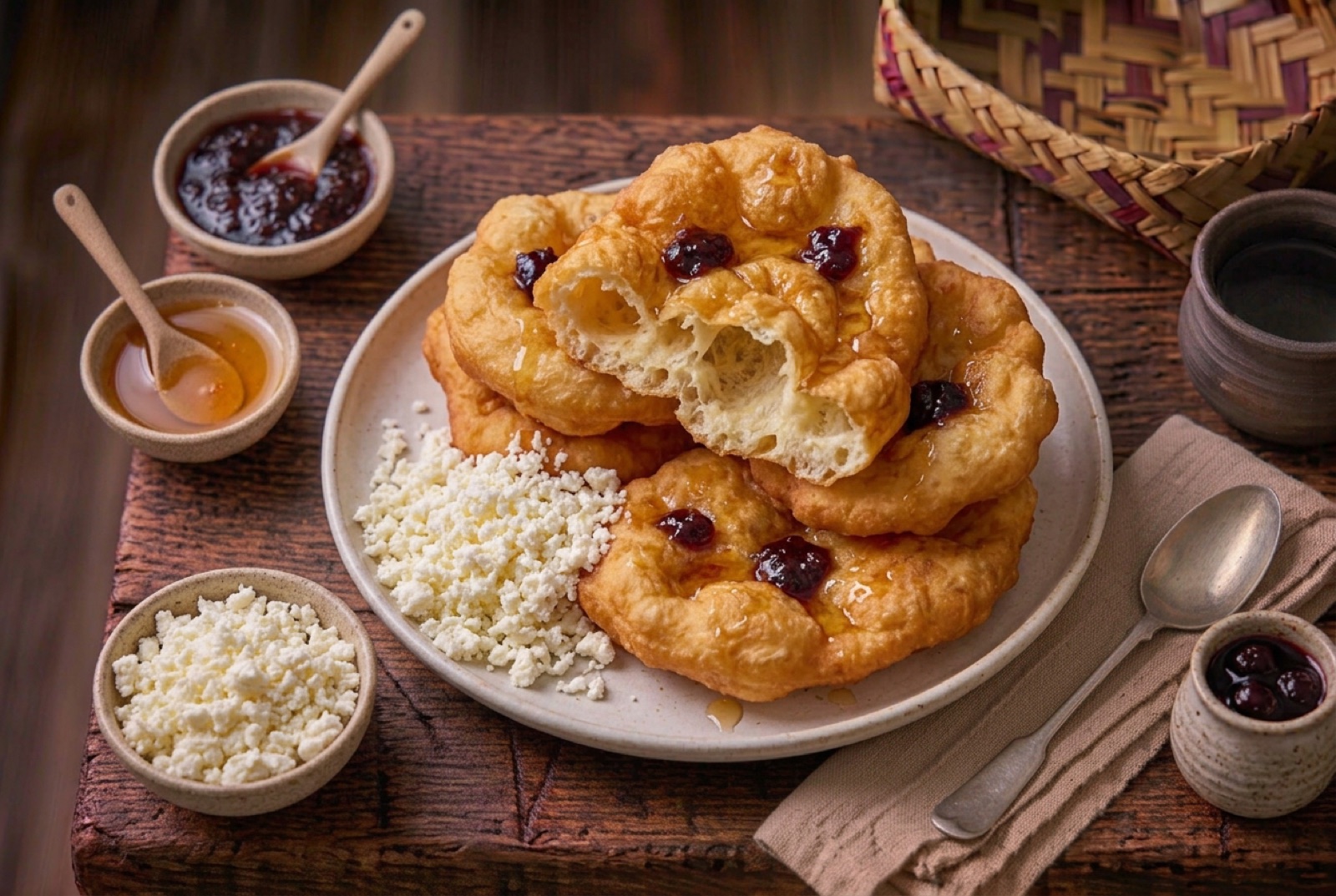
Mekici are fried breakfast breads: a slack yeasted dough loosened with yogurt, left to rise until it is full of air, then torn or stretched into irregular pieces and dropped into hot oil, where they blister, swell and turn a mottled gold in about two minutes. Inside they are hollow and stretchy rather than cakey, which is the point — the name comes from mek, meaning soft. They are never sweetened in the dough. Sweetness, if it appears at all, arrives on top as jam or honey, and just as often the topping is crumbled salty white cheese instead.

- Gate
- North MacedoniaNationwide, strongest in Skopje and the western towns
- Prep
- 15 min
- Cook
- 20 min
- Total time
- 1 hr 35 min incl. 1 hr rest
- Serves
- 4
- Status
- Easy
- Nutrition / serving · estimated
- Calories 470 kcal
- Protein 14 g
- Carbs 56 g
- Fat 21 g
- Fiber 3 g
- Sodium 830 mg
Why this recipe works.
- Uses yogurt in the dough, which is the traditional binder and gives the crumb its stretch and faint sourness.
- Keeps the dough deliberately slack, since a stiff dough fries into something closer to a doughnut than a mekica.
- Tears the pieces by hand rather than cutting them, so the ragged edges puff and crisp unevenly.
- Covers both finishes honestly — salty white cheese and sweet jam are equally standard here.
Ingredients.
11 itemsFor the dough
For frying
To serve
Equipment
- Deep heavy pan or wok for frying
- Cooking thermometer
- Slotted spoon
- Cooling rack
Instructions.
Start the yeast
Crumble the fresh yeast into the lukewarm water with the sugar, stir and leave for 10 minutes until it foams on the surface. If nothing happens, the yeast is dead or the water was too hot and you should start again.
Mix a slack dough
Combine the flour and salt in a bowl, pour in the yeast liquid, the yogurt and 2 tablespoons of oil, and beat with a wooden spoon for 3 minutes. The dough should be sticky and unmanageable by hand, closer to thick batter than to bread dough.
Tip Resist adding flour to firm it up. The looseness is what makes the fried pieces hollow rather than heavy.
Let it rise
Cover the bowl with a cloth and leave somewhere warm for about an hour, until the dough has roughly doubled and the surface is domed and full of bubbles. It should wobble when you shake the bowl.
Heat the oil
Pour the frying oil into a deep pan to a depth of at least 4 cm and bring it to 170 to 175°C. Test with a scrap of dough — it should rise and start colouring within about 20 seconds rather than sinking or browning instantly.
Tear and stretch the pieces
With oiled hands, pull off a piece of dough about the size of a plum, stretch it between your palms until the middle is thin and the edges stay thicker, and lower it into the oil. Work with three or four pieces at a time.
Tip Do not cut the dough with a knife. Torn edges catch the oil and blister; cut edges stay flat.
Fry until puffed and gold
Fry for about a minute a side, turning once, until each piece has ballooned and gone a mottled gold. Lift them out with a slotted spoon and drain on a rack, then let the oil come back up to temperature before the next batch.
Serve straight away
Pile the hot mekici onto a plate with crumbled white cheese, jam and honey alongside, and eat them within minutes. They are torn open by hand rather than cut, so the steam escapes and the cheese softens against the inside.
Tips from our kitchen.
- The dough should be too soft to knead on a board — closer to a thick batter than a bread dough. Oil your hands rather than adding flour, or the mekici will fry up heavy.
- Bring the yogurt and water to room temperature before mixing. Cold dairy slows the yeast badly and you will wait an hour for a rise that should take forty minutes.
- Hold the oil at 170 to 175°C. Hotter and the outside darkens before the middle cooks; cooler and the dough drinks oil instead of sealing and puffing.
- Fry no more than three or four at a time. Crowding drops the oil temperature by twenty degrees and every piece in the pan comes out greasy.
- Stretch each piece thin in the middle before it goes in. That thin centre is what balloons, and a piece of even thickness stays stodgy in the core.
- Drain on a rack rather than kitchen paper. Paper traps steam under the bread and softens the crust you just fried onto it.
Substitutions.
- Plain yogurt → Buttermilk, kefir, or milk soured with a teaspoon of vinegar
- Any soured dairy works; the acid tenderises the dough. Plain milk gives a blander, slightly tougher result but is perfectly usable.
- Fresh yeast → Dried instant yeast, one third of the weight
- Instant yeast can go straight into the flour without proving. If you use it, still give the dough the full rise — the flavour comes from the fermentation, not the flour.
- Sunflower oil for frying → Any neutral high-smoke-point oil
- Sunflower is what is used at home in North Macedonia. Avoid olive oil, which smokes at frying temperature and gives the dough a flavour that fights the cheese.
Variations.
- With sirenje
- The standard savoury service: hot mekici torn open and stuffed or topped with crumbled white brined sheep cheese, so the cheese softens against the steam.
- Sweet finish
- Dusted with icing sugar and served with sour cherry or plum jam, or drizzled with honey. Common in city households and in bakeries selling to schoolchildren.
- Cheese-filled
- A spoonful of white cheese sealed inside each piece before frying, so it melts into the hollow centre. Heavier, and needs slightly cooler oil to cook through.
Storage & reheating.
Mekici are a same-hour food and there is no honest way around it. Within two hours they turn dense and oily as the trapped steam condenses back into the crumb. If you must keep them, leave them uncovered at room temperature and revive them in a 200°C oven for 4 minutes, which restores some crispness but not the hollow interior. Do not refrigerate them, which accelerates staling badly, and do not freeze the fried bread. The dough itself can be made the night before and left in the fridge to rise slowly; bring it back to room temperature for 30 minutes before frying.
Serve with
Crumbled white brined cheese, sour cherry or plum jam, honey, and a glass of cold ayran or Turkish coffee.
The story behind Mekici.
Fried dough exists wherever there is flour and a pan, but the Balkan version has a particular logic behind it. Until domestic ovens became normal in the second half of the twentieth century, a household baked bread once or twice a week in a shared or communal oven, and there was no way to produce a small hot bread on demand. A frying pan, on the other hand, worked every morning. Mekici are what a family ate on the days between baking days, made from the same flour, the same yeast and whatever soured dairy was in the house — yogurt, buttermilk, or the whey left from making cheese.
The dish is shared across the whole region and nobody has an exclusive claim on it. Bulgaria calls them mekitsi, Serbia and Bosnia make close relatives as mekike, uštipci and priganice, and the Turkish pişi sits behind all of them as the Ottoman-era ancestor. In North Macedonia the local habit is the pairing rather than the recipe: mekici come to the table with sirenje, the crumbly white brined sheep cheese, alongside or instead of the sweet topping, and the salt-and-fat combination is what most Macedonians actually mean when they talk about a proper breakfast at a village house or a mountain lodge.
They remain deeply everyday. School holidays, Sunday mornings, and the breakfast served at a planinarski dom after a night in the mountains are all mekici occasions, and small bakeries in Skopje fry them to order in the morning and stop by ten. There is one firm rule that every cook repeats: they must be eaten immediately. A mekica that has cooled has gone from hollow and elastic to dense and greasy, which is why nobody makes them in advance, and why the person frying usually eats standing at the stove while the next batch goes in.
Questions, answered.
What are mekici made of?
A simple yeasted dough of flour, water, yogurt, a little oil, salt and sugar to feed the yeast. The dough is left slack and sticky rather than firm, then torn into pieces and deep-fried. There is no sweetening in the dough itself — any sweetness comes from jam, honey or icing sugar added after frying.
How are mekici different from doughnuts?
A doughnut dough is enriched with egg, butter and sugar and fries into a soft cake-like crumb. Mekici use a lean dough soured with yogurt, so they puff hollow and chewy rather than rising into a dense cake, and they are usually eaten savoury with salty white cheese rather than sweet.
Why did my mekici come out greasy?
The oil was too cool, or too many pieces went in at once and dropped the temperature. Fried dough seals almost instantly at 170 to 175°C and absorbs very little oil, but below about 160°C it soaks up fat before the crust can form. Fry three or four at a time and let the oil recover between batches.
Are mekici only Macedonian?
No. Almost the same fried dough is made across the southern Balkans — mekitsi in Bulgaria, mekike and uštipci in Serbia and Bosnia, and pişi in Turkey, which is the Ottoman-era ancestor of all of them. What is distinctly Macedonian is the pairing with sirenje, the salty white sheep cheese, as a breakfast rather than a sweet snack.
Can I make the dough the night before?
Yes. Mix the dough, cover it and let it rise slowly in the fridge overnight, which improves the flavour. Take it out and let it come back to room temperature for about 30 minutes before frying, since cold dough hits the oil and cooks unevenly, browning outside while the centre stays raw.
You might also like.
All recipes →
North Macedonia2 hr 55 min
Pastrmajlija
Macedonian Boat-Shaped Meat Flatbread
North Macedonia35 min
Tarana Čorba
Macedonian Toasted Crumb Pasta Soup
North Macedonia2 hr 5 min
Zelnik
Macedonian Leek and White Cheese Pie
North Macedonia3 hr 45 min
Macedonian Ajvar
Roasted Red Pepper Relish
Keep exploring North Macedonia.
North Macedonia has 9 more dishes in the atlas — Macedonian Ajvar and Pastrmajlija, and 7 more.
All North Macedonia recipes Flour recipes Yogurt recipes Yeast recipes breakfastsnackstreet foodvegetariannut freeRecipe by The DishRoute Kitchen · published August 21, 2026 · updated August 21, 2026